Questions

5 Marks Questions

Take a timed test

6 questions · self-marked practice — reveal the answer and mark yourself.

Question 15 Marks
Prove that $\cos \frac{2 \pi}{15} \cdot \cos \frac{4 \pi}{15} \cdot \cos \frac{8 \pi}{15} \cdot \cos \frac{16 \pi}{15}=\frac{1}{16}$
Answer

$\begin{array}{l}\text { LHS }=\cos \frac{2 \pi}{15} \cdot \cos \frac{4 \pi}{15} \cdot \cos \frac{8 \pi}{15} \cdot \cos \frac{16 \pi}{15} \\ 
=\cos \frac{2 \pi}{15} \cos 2\left(\frac{2 \pi}{15}\right) \cos 4\left(\frac{2 \pi}{15}\right) \cos 8\left(\frac{2 \pi}{15}\right)\end{array}$
Put $\frac{2 \pi}{15}=\alpha$
$\begin{array}{l}\Rightarrow \text { LHS }=\cos \alpha \cdot \cos 2 \alpha \cdot \cos 4 \alpha \cdot \cos 8 \alpha \\ \left.=\frac{2 \sin \alpha[\cos \alpha \cdot \cos 2 \alpha \cdot \cos 4 \alpha \cdot \cos 8 \alpha]}{2 \sin \alpha} \text { [multiplying numerator and denominator by } 2 \sin \alpha\right] \\ =\frac{(2 \sin \alpha \cdot \cos \alpha) \cdot \cos 2 \alpha \cdot \cos 4 \alpha \cdot \cos 8 \alpha}{2 \sin \alpha} \\ =\frac{2(\sin 2 \alpha \cdot \cos 2 \alpha \cdot \cos 4 \alpha \cdot \cos 8 \alpha)}{2(2 \sin \alpha)}[\because 2 \sin \alpha \cos \alpha=\sin 2 \alpha \text { and multiplying numerator and denominator by } 2] \\ =\frac{(2 \sin 2 \alpha \cdot \cos 2 \alpha) \cdot \cos 4 \alpha \cdot \cos 8 \alpha}{4 \sin \alpha} \\ =\frac{2(\sin 4 \alpha \cdot \cos 4 \alpha) \cos 8 \alpha}{2(4 \sin \alpha)}[\because 2 \sin \alpha \cos \alpha=\sin 2 \alpha \text { and multiplying numerator and denominator by } 2]\end{array}$
$\begin{array}{l}=\frac{2(\sin 8 \alpha \cdot \cos 8 \alpha)}{2(8 \sin \alpha)} \\ =\frac{\sin 16 \alpha}{16 \sin \alpha}=\frac{\sin (15 \alpha+\alpha)}{16 \sin \alpha}\end{array}$
Now, $15 \alpha=2 \pi$,
$=\frac{\sin (2 \pi+\alpha)}{16 \sin \alpha}=\frac{\sin \alpha}{16 \sin \alpha}=\frac{1}{16}=$ RHS
$\therefore$ LHS $=$ RHS
Hence proved.
View full question & answer
Question 25 Marks
Prove that: $\sin 6^{\circ} \sin 42^{\circ} \sin 66^{\circ} \sin 78^{\circ}=\frac{1}{16}$.
Answer
We have to prove that $\sin 6^{\circ} \sin 42^{\circ} \sin 66^{\circ} \sin 78^{\circ}=\frac{1}{16}$.
LHS $=\sin 6^{\circ} \sin 42^{\circ} \sin 66^{\circ} \sin 78^{\circ}$
By regrouping the LHS and multiplying and dividing by 4 we get, 
$=\frac{1}{4}\left(2 \sin 66^{\circ} \sin 6^{\circ}\right)\left(2 \sin 78^{\circ} \sin 42^{\circ}\right)$
But 2 sin A sin B = cos (A - B) - cos (A + B) 
Then the above equation becomes, 
$\begin{array}{l}=\frac{1}{4}\left(\cos \left(66^{\circ}-6^{\circ}\right)-\cos \left(66^{\circ}+6^{\circ}\right)\right)\left(\cos \left(78^{\circ}-42^{\circ}\right)-\cos \left(78^{\circ}+42^{\circ}\right)\right) \\ 
=\frac{1}{4}\left(\cos \left(60^{\circ}\right)-\cos \left(72^{\circ}\right)\right)\left(\cos \left(36^{\circ}\right)-\cos \left(120^{\circ}\right)\right) \\ 
=\frac{1}{4}\left(\cos \left(60^{\circ}\right)-\cos \left(90^{\circ}-18^{\circ}\right)\right)\left(\cos \left(36^{\circ}\right)-\cos \left(180^{\circ}-120^{\circ}\right)\right)\end{array}$
But $\cos \left(90^{\circ}-\theta\right)=\sin \theta$ and $\cos \left(180^{\circ}-\theta\right)=-\cos (\theta)$.
Then the above equation becomes, 
$=\frac{1}{4}\left(\cos \left(60^{\circ}\right)-\cos \left(18^{\circ}\right)\right)\left(\cos \left(36^{\circ}\right)+\cos \left(60^{\circ}\right)\right)$
$\begin{array}{l}\text { Now, } \cos \left(36^{\circ}\right)=\frac{\sqrt{5}+1}{4} \\ \sin \left(18^{\circ}\right)=\frac{\sqrt{5}-1}{4} \\ 
\cos \left(60^{\circ}\right)=\frac{1}{2}\end{array}$
Substituting the corresponding values, we get 
$\begin{array}{l}=\frac{1}{4}\left(\frac{1}{2}-\frac{\sqrt{5}-1}{4}\right)\left(\frac{\sqrt{5}+1}{4}+\frac{1}{2}\right) \\ 
=\frac{1}{4}\left(\frac{2-\sqrt{5}+1}{4}\right)\left(\frac{\sqrt{5}+1}{4}+\frac{1}{2}\right) \\ 
=\frac{1}{4}\left(\frac{3-\sqrt{5}}{4}\right)\left(\frac{3+\sqrt{5}}{4}\right) \\ 
=\frac{1}{4}\left(\frac{3^2-(\sqrt{5})^2}{4 \times 4}\right) \\ 
=\frac{1}{4}\left(\frac{9-5}{16}\right) \\ 
=\frac{1}{16}\end{array}$
LHS = RHS 
Hence proved.
View full question & answer
Question 35 Marks
In an increasing GP, the sum of the first and last terms is 66, the product of the second and the last but one is 128 and the sum of the terms is 126. How many terms are there in this GP?
Answer
Let the given GP contain n terms. Let abe the first term and r be the common ratio of this GP.
Since the given GP is increasing, we have r > 1 
Now, $T _1+ T _{ n }=66 \Rightarrow a + ar ^{( n -1)}=66 \ldots$ (i)
And, $T_2 \times T_{n-1}=128 \Rightarrow ar \times ar ^{( n -2)}=128$
$\Rightarrow a^2 r^{(n-1)}=128 \Rightarrow a r^{(n-1)}=\frac{128}{a} \ldots( ii )$
Using (ii) and (i), we get 
$a+\frac{128}{a}=66 \Rightarrow a^2-66 a+128=0$
$\begin{array}{l}\Rightarrow a^2-2 a-64 a+128=0 \\ 
\Rightarrow a(a-2)-64(a-2)=0 \\ 
\Rightarrow(a-2)(a-64)=0 \\ 
\Rightarrow a=2 \text { or } a=64\end{array}$
Putting a = 2 in (ii), we get 
$r^{(n-1)}=\frac{128}{a^2}=\frac{128}{4}=32 \ldots$
Thus, $a =2$ and $r ^{( n -1)}=32$
Now, $S _{ n }=126 \Rightarrow \frac{a\left(r^n-1\right)}{(r-1)}=126$
$\begin{array}{l}\Rightarrow 2\left(\frac{r^n-1}{r-1}\right)=126 \Rightarrow \frac{r^n-1}{r-1}=63 \\ 
\Rightarrow \frac{r^{(n-1)} \times r-1}{r-1}=63 \Rightarrow \frac{32 r-1}{r-1}=63 \\ 
\Rightarrow 32 r-1=63 r-63 \Rightarrow 31 r=62 \Rightarrow r=2 \\ 
\therefore r^{(n-1)}=32=25 \Rightarrow n-1=5 \Rightarrow n=6\end{array}$
Hence, there are 6 terms in the given GP
View full question & answer
Question 45 Marks
Evaluate: $\lim _{x \rightarrow 2} \frac{x^3+3 x^2-9 x-2}{x^3-x-6}$
Answer
We have to find the value of $\lim _{x \rightarrow 2} \frac{x^3+3 x^2-9 x-2}{x^3-x-6}$
We have,
$\lim _{x \rightarrow 2} \frac{x^3+3 x^2-9 x-2}{x^3-x-6}$
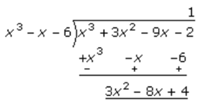
Divide $x^3+3 x^2-9 x-2$ by $x^3-x-6$\
Image

$\begin{array}{l}\Rightarrow \lim _{x \rightarrow 2} \frac{x^3+3 x^2-9 x-2}{x^3-x-6}=\lim _{x \rightarrow 2} 1+\lim _{x \rightarrow 2} \frac{3 x^2-8 x+4}{x^3-x-6} \\ =1+\lim _{x \rightarrow 2} \frac{3 x^2-2 x-6 x+4}{x^3-x-6} \\ =1+\lim _{x \rightarrow 2} \frac{3 x^2-2 x-6 x+4}{x^3-x-6} \\ \Rightarrow \lim _{x \rightarrow 2} \frac{x^3+3 x^2-9 x-2}{x^3-x-6}=1+\lim _{x \rightarrow 2} \frac{(3 x-2)(x-2)}{x^3-x-6}\end{array}$
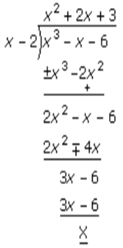
Divide $x^3-x-6$ by $x-2$
Image
$\begin{array}{l}\Rightarrow \lim _{x \rightarrow 2} \frac{x^3+3 x^2-9 x-2}{x^3-x-6}=1+\lim _{x \rightarrow 2} \frac{(3 x-2)(x-2)}{(x-2)\left(x^2+2 x+3\right)} \\ 
=1+\lim _{x \rightarrow 2} \frac{(3 x-2)}{\left(x^2+2 x+3\right)} \\
=1+\frac{3 \times 2-2}{2^2+2 \times 2+3}\end{array}$
$\begin{array}{l}=1+\frac{4}{11} \\
=\frac{15}{11}\end{array}$
View full question & answer
Question 55 Marks
Differentiate $x^2 \sin x$ from first principle.
Answer
We have to find derivative of $f(x)=x^2 \sin x$
Derivative of a function $f ( x )$ is given by $f ^{\prime}( x )=\underset{{h \rightarrow 0}}{\lim}=\frac{f(x+h)-f(x)}{h}$ where h is a very small positive number
$\therefore$ Derivative of $f ( x )= x ^2 \sin x$ is given as $f ^{\prime}( x )\underset{{h \rightarrow 0}}{\lim}=\frac{f(x+h)-f(x)}{h}$
$\begin{array}{l}\Rightarrow f ( x )\underset{{h \rightarrow 0}}{\lim} \frac{(x+h)^2 \sin (x+h)-x^2 \sin x}{h} \\ 
\text { Using }( a + b )^2= a ^2+2 ab + b ^2 \text {, we get } \\ 
\Rightarrow f ( x )\underset{{h \rightarrow 0}}{\lim} \frac{h^2 \sin (x+h)+x^2 \sin (x+h)+2 h x \sin (x+h)-x^2 \sin x}{h}\end{array}$
Using the algebra of limits, we have 
$\begin{array}{l}\Rightarrow f ( x )\underset{{h \rightarrow 0}}{\lim} \frac{h^2 \sin (x+h)}{h}+\lim _{h \rightarrow 0} \frac{x^2 \sin (x+h)-x^2 \sin x}{h}+\lim _{h \rightarrow 0} \frac{2 h x \sin (x+h)}{h} \\ 
\Rightarrow f ( x )\underset{{h \rightarrow 0}}{\lim} h \sin ( x + h )+\lim _{h \rightarrow 0} \frac{x^2(\sin (x+h)-\sin x)}{h}+\lim _{h \rightarrow 0} 2 x \sin ( x + h ) \\ 
\Rightarrow f ^{\prime}( x )=0 \times \sin ( x +0)+2 x \sin ( x +0)+ x ^2 \lim _{h \rightarrow 0} \frac{(\sin (x+h)-\sin x)}{h} \\ 
\Rightarrow f ^{\prime}( x )=2 x \sin + x ^2 \lim _{h \rightarrow 0} \frac{(\sin (x+h)-\sin x)}{h}\end{array}$
Using the algebra of limits we have 
$\therefore f^{\prime}(x)=2 x \sin x+x^2 \lim _{h \rightarrow 0} \frac{(\sin (x+h)-\sin x)}{h}$
We can't evaluate the limits at this stage only as on putting value it will take $\frac{0}{0}$ form. So, we need to do little modifications.
$\begin{array}{l}\text { Use: } \sin A-\sin B=2 \cos \left(\frac{(A-B)}{2}\right) \sin \left(\frac{(A-B)}{2}\right) \\ 
\therefore f^{\prime}(x)=2 x \sin x+x^2 \lim _{h \rightarrow 0} \frac{2 \cos \left(\frac{2 x+h}{2}\right) \sin \left(\frac{h}{2}\right)}{h} \\ 
\Rightarrow f^{\prime}(x)=2 x \sin x+x^2 \lim _{h \rightarrow 0} \frac{\cos \left(x+\frac{h}{2}\right) \sin \left(\frac{A}{2}\right)}{\frac{A}{2}}\end{array}$
Using the algebra of limits: 
$\Rightarrow f^{\prime}(x)=2 x \sin x+x^2 \lim _{h \rightarrow 0} \frac{\sin \left(\frac{h}{2}\right)}{\frac{h}{2}} \times \lim _{h \rightarrow 0} \cos \left(x+\frac{h}{2}\right)$
By using the formula we get $-\lim _{x \rightarrow 0} \frac{\sin x}{x}=1$
$\therefore f ^{\prime}( x )=2 x \sin x + x ^2 \lim _{h \rightarrow 0} \cos \left(x+\frac{h}{2}\right)$
substuite the value of h to evaluate the limit: 
Therefore, $f^{\prime}(x)=2 x \sin x+x^2 \cos (x+0)=2 x \sin x+x^2 \cos x$
Hence, 
Derivative of $f(x)=\left(x^2 \sin x\right)$ is $\left(2 x \sin x+x^2 \cos x\right)$

View full question & answer
Question 65 Marks
A bag contains 6 red, 4 white and 8 blue balls. If three balls are drawn at random, find the probability that:
i. one is red and two are white
ii. two are blue and one is red
iii. one is red.
Answer
Bag contains:
6 -Red balls
4 -White balls
8 -Blue balls 
Since three ball are drawn, 
$\therefore n(S)={ }^{18} C_3$
i. Let E be the event that one red and two white balls are drawn. 
$\begin{array}{l}\therefore n(E)={ }^6 C_1 \times{ }^4 C_2 \\ 
\therefore P(E)=\frac{{ }^6 C_1 \times{ }^4 C_2}{{ }^{18} C_3}=\frac{6 \times 4 \times 3}{2} \times \frac{3 \times 2}{18 \times 17 \times 16} \\ 
P(E)=\frac{3}{68}\end{array}$
ii. Let E be the event that two blue balls and one red ball was drawn. 
$\begin{array}{l}\therefore n(E)={ }^8 C_2 \times{ }^6 C_1 \\ 
\therefore P(E)=\frac{{ }^8 C_2 \times{ }^6 C_1}{{ }^{18} C_3}=\frac{8 \times 7}{2} \times 6 \times \frac{3 \times 2 \times 1}{18 \times 17 \times 16}=\frac{7}{34} \\ P(E)=\frac{7}{34}\end{array}$
iii. Let E be the event that one of the ball must be red. 
$\begin{array}{l}\therefore E =\{( R , W , B ) \text { or }( R , W , W ) \text { or }( R , B , B )\} \\ 
\therefore n(E)={ }^6 C_1 \times{ }^4 C_1 \times{ }^8 C_1+{ }^6 C_1 \times{ }^4 C_2+{ }^6 C_1 \times{ }^8 C_2 \\ 
\therefore P(E)=\frac{{ }^6 C_1 \times{ }^4 C_1 \times{ }^8 C_1+{ }^6 C_1 \times{ }^4 C_2+{ }^6 C_1 \times{ }^8 C_2}{{ }^{18} C_3}=\frac{6 \times 4 \times 8+\frac{6 \times 4 \times 3}{2 \times 1}+\frac{6 \times 8 \times 7}{2 \times 1}}{\frac{18 \times 17 \times 16}{3 \times 2 \times 1}} \\ 
=\frac{396}{816}=\frac{33}{68}\end{array}$
View full question & answer