Questions

5 Marks Questions

Take a timed test

6 questions · self-marked practice — reveal the answer and mark yourself.

Question 15 Marks
Prove that: $\cos ^3 x \sin 3 x+\sin ^3 x \cos 3 x=\frac{3}{4} \sin 4 x$.
Answer
We have to prove that $\cos ^3 x \sin 3 x+\sin ^3 x \cos 3 x=\frac{3}{4} \sin 4 x$.
We know that,
$\begin{array}{l}\cos 3 \theta=4 \cos ^3 \theta-3 \cos \theta \\ \Rightarrow 4 \cos ^3 \theta=\cos 3 \theta+3 \cos \theta \\ \Rightarrow \cos ^3 \theta=\frac{\cos 39+3 \cos \theta}{4} \ldots \text { (i) }\end{array}$
And similarly 
$\begin{array}{l}\Rightarrow \sin 3 \theta=3 \sin \theta-4 \sin ^3 \theta \\
\Rightarrow 4 \sin ^3 \theta=3 \sin \theta-\sin 3 \theta \\
\Rightarrow \sin ^3 \theta=\frac{3 \sin \theta-\sin 3 \theta}{4} \ldots\end{array}$
Now, 
LHS $=\cos ^3 x \sin 3 x+\sin ^3 x \cos 3 x$
Substituting the values from equation (i) and (ii), we get 
$\begin{array}{l}\Rightarrow\left(\frac{\cos 3 x+3 \cos x}{4}\right) \sin 3 x+\left(\frac{\cos 3 x-3 \cos x}{4}\right) \cos 3 x \\ 
=\frac{1}{4}(\sin 3 x \cos 3 x+3 \sin 3 x \cos x+3 \sin x \cos 3 x-\sin 3 x \cos 3 x) \\ =\frac{1}{4}[3(\sin 3 x \cos x+\sin x \cos 3 x)+0] \\ 
=\frac{1}{4}(3 \sin (3 x+x))\end{array}$
$\begin{array}{l}\text { (as } \sin (x+y)=\sin x \cos y+\cos x \sin y) \\
\Rightarrow \frac{3}{4} \sin 4 x \\
\text { LHS }=\text { RHS }\end{array}$
Henve proved

View full question & answer
Question 25 Marks
Draw the shape of the ellipse $4 x^2+9 y^2=36$ and find its major axis, minor axis, value of $c$, vertices, directrices, foci, eccentricity and length of latusrectum.
Answer
We have, equation of ellipse is $4 x^2+9 y^2=36$
$\text { or } \frac{x^2}{9}+\frac{y^2}{4}=1$
Since, the denominator of $\frac{x^2}{9}$ is greater than denominator of $\frac{y^2}{4}$ So, the major axis lies along X -axis.
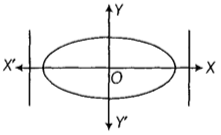
Image

i. Shape is shown above.
ii. Major axis, $2 a =2 \times 3=6$
iii. Minor axis, $2 b=2 \times 2=4$
iv. Value of $c =\sqrt{a^2-b^2}=\sqrt{9-4}=\sqrt{5}$
v. Vertices $=(-a, 0)$ and $(a, 0)$ i.e., $(-3,0)$ and $(3,0)$
vi. Directrices, $x = \pm \frac{a^2}{c}= \pm \frac{9}{\sqrt{5}}$
vii. Foci $=(- c , 0)$ and $(c, 0)$ i.e., $(-\sqrt{5}, 0)$ and $(\sqrt{5}, 0)$
viii. Eccentricity, $e =\frac{c}{a}=\frac{\sqrt{5}}{3}$
ix. Length of latusrectum, $2 l=\frac{2 b^2}{a}=\frac{2 \times 4}{3}=\frac{8}{3}$
View full question & answer
Question 35 Marks
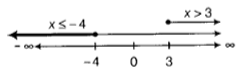
Solve the following system of linear inequalities 
$-2-\frac{x}{4} \geq \frac{1+x}{3}$ and $3-x<4(x-3)$
View full question & answer
Question 45 Marks
Find the equation of the parabola whose focus is (1, -1) and whose vertex is (2, 1). Also find its axis and latus rectum.
Answer
Here, we are given the coordinates of the focus and vertex.
So, we require the equation of the directrix.
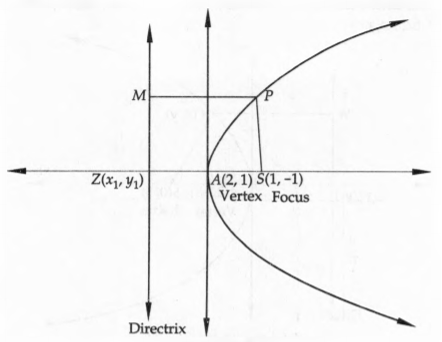
Let $Z \left( x _1, y _1\right)$ be the coordinates of the point of intersection of the axis and the directrix.
Then, the vertex $A(2,1)$ is the mid-point of the line segment joining $Z\left(x_1, y_1\right)$ and the focus $S(1,-1)$
Image
$\therefore \frac{x_1+1}{2}=2 \text { and } \frac{y_1+(-1)}{2}=1 \Rightarrow x_1=3, y_1=3$
Thus, the directrix meets the axis at Z(3, 3) 
Let $m _1$ be the slope of the axis. Then,
$m _1=($ Slope of the line joining the focus S and the vertex A $)=\frac{1+1}{2-1}=2 \ldots$. (i)
$\therefore$ Slope of the directrix $=-\frac{1}{2}[\because$ Directrix is perpendicular to the axis $]$
Thus, the directrix passes through (3, 3) and has slope - 1/2.  
So its equation is 
$\begin{array}{l}y-3=-\frac{1}{2}(x-3) \\ 
\text { or, } x+2 y-9=0\end{array}$
Let P (x, y) be a point on the parabola. 
Then,
Distance of P from the focus = Distance of P from the directrix
$\begin{array}{l}\Rightarrow \sqrt{(x-1)^2+(y+1)^2}=\left|\frac{x+2 y-9}{\sqrt{1^2+2^2}}\right| \\ 
\Rightarrow(x-1)^2+(y+1)^2=\frac{(x+2 y-9)^2}{5} \\ 
\Rightarrow 5 x^2+5 y^2-10 x+10 y+10=x^2+4 y^2+81+4 x y-18 x-36 y\end{array}$
The axis passes through the focus $(1,-1)$, and its slope is $m_1=2$
Therefore, equation of the axis is $y+1=2(x,-1)$ or, $2 x-y-3=0$
Now,
 Latus-rectum = 2 (Length of the perpendicular from the focus on the directrix)
$=2$ Length of the perpendicular from $(1,-1)$ on $x+2 y-9=0$
$=2\left|\frac{1-2-9}{\sqrt{1+4}}\right|=2 \times \frac{10}{\sqrt{5}}=4 \sqrt{5}$

View full question & answer
Question 55 Marks
Prove that: $\cos 10^{\circ} \cos 30^{\circ} \cos 50^{\circ} \cos 70^{\circ}=\frac{3}{16}$.
Answer
$\begin{array}{l}\cos 10^{\circ} \cos 30^{\circ} \cos 50^{\circ} \cos 70^{\circ}=\frac{3}{16} \\ \text { LHS }=\cos 10^{\circ} \cos 30^{\circ} \cos 50^{\circ} \cos 70^{\circ} \\ 
=\cos 30^{\circ} \cos 10^{\circ} \cos 50^{\circ} \cos 70^{\circ}\end{array}$
$\begin{array}{l}=\frac{\sqrt{3}}{2}\left(\cos 10^{\circ} \cos 50^{\circ} \cos 70^{\circ}\right) \\ =\frac{\sqrt{3}}{2}\left(\cos 10^{\circ} \cos 50^{\circ}\right) \cos 70^{\circ} \\ =\frac{\sqrt{3}}{4}\left(2 \cos 10^{\circ} \cos 50^{\circ}\right) \cos 70^{\circ}[\text { Multiplying and dividing by } 2] \\ =\frac{\sqrt{3}}{4} \cos 70^{\circ}\left(\cos \left(50^{\circ}+10^{\circ}\right)+\cos \left(10^{\circ}-50^{\circ}\right)\right\}[\text { Using } 2 \cos A \cos B=\cos (A+B)+\cos (A-B)] \\ =\frac{\sqrt{3}}{4} \cos 70^{\circ}\left\{\cos 60^{\circ}+\cos \left(-40^{\circ}\right)\right\} \\ =\frac{\sqrt{3}}{4} \cos 70^{\circ}\left[\frac{1}{2}+\cos 40^{\circ}\right]\left[\because \cos 60^{\circ}=\frac{1}{2} \text { and } \cos (-x)=\cos x \right] \\ =\frac{\sqrt{3}}{8} \cos 70^{\circ}+\frac{\sqrt{3}}{4} \cos 70^{\circ} \cos 40^{\circ} \\ =\frac{\sqrt{3}}{8} \cos 70^{\circ}+\frac{\sqrt{3}}{8}\left(2 \cos 70^{\circ} \cos 40^{\circ}\right) \\ =\frac{\sqrt{3}}{8}\left[\cos 70^{\circ}+\cos \left(70^{\circ}+40^{\circ}\right)+\cos \left(70^{\circ}-40^{\circ}\right)\right] \\ =\frac{\sqrt{3}}{8}\left[\cos 70^{\circ}+\cos 110^{\circ}+\cos 30^{\circ}\right] \\ =\frac{\sqrt{3}}{8}\left[\cos 70^{\circ}+\cos \left(180^{\circ}-70^{\circ}\right)+\frac{\sqrt{3}}{2}\right]\left[\because \cos 30^{\circ}=\frac{\sqrt{3}}{2}\right] \\ =\frac{\sqrt{3}}{8}\left[\cos 70^{\circ}-\cos 70^{\circ}+\frac{\sqrt{3}}{2}\right]\left[\because \cos \left(180^{\circ}-x\right)=-\cos x\right] \\ =\frac{\sqrt{3}}{8} \times \frac{\sqrt{3}}{2}=\frac{3}{16} \\ =\text { RHS }\end{array}$
Hence proved.
View full question & answer
Question 65 Marks
Answer
1st of all we will prepare the below table with the help of given information.
Class-interval$f_i$Mid point $x_i$$u _{ i }=\frac{x_i-53}{4}$$u_i^2$$f _{ i } u _{ i }$  $f _{ i } u_{ i }^2$
31-35233-525-1050
36-40338-3.7514.06-11.2542.18
41-45843-2.56.25-2050
46-501248-1.251.56-1518.72
51-5516530000
56-605581.251.566.257.8
61-652632.56.25512.5
66-703683.7514.0611.2542.18
 N = 51    $\sum_{i=1}^n f_i u_i^2=223.38$
$\begin{array}{l} X = a + h \left(\frac{\sum_{i=1}^n f_i u_i}{N}\right) \\ =53+4\left(\frac{-33.75}{51}\right) \\ 
=50.36\end{array}$
$\begin{array}{l}\sigma^2=h^2\left(\frac{\sum_{i-1}^n f_i u_i^2}{N}\left(\frac{\sum_{i=1}^n f_i u_i}{N}\right)^2\right) \\ 
=16\left(\frac{223.38}{51}-\frac{1139.06}{2601}\right) \\ 
=63.07 \\ 
\sigma=\sqrt{63.07} \\ 
=7.94\end{array}$
$f_i$Cumulative frequency
22
35
813
1225
1641
546
248
351
$\begin{array}{l}\sum_N f_i=51=N \\
\frac{N}{2}=25.5\end{array}$
Median class interval is 51 - 55
L = 51
F = 25
f = 16
h = 4 
$\begin{array}{l}\text { Median }= L +\frac{\frac{N}{2}-F}{f} \times h \\
=51+\frac{25.5-25}{16} \times 4 \\ 
=51+\frac{0.5}{4} \\ 
=51.125\end{array}$ 
View full question & answer