Questions

2 Marks Questions

Take a timed test

7 questions · self-marked practice — reveal the answer and mark yourself.

Question 12 Marks
Find the of derivative of the function from the first principle: $\sin x^2$.
Answer
Let $y=\sin x^2$
Then, $y+\delta y=\sin (x+\delta x)^2$
$\Rightarrow \delta y=\sin (x+\delta x)^2-\sin x^2$
Using first principle, 
$\begin{array}{l}\Rightarrow \frac{\delta y}{\delta x}=\frac{\sin (x+\delta x)^2-\sin x^2}{\delta x} \\ \Rightarrow \frac{d y}{d x}=\lim _{\delta x \rightarrow 0} \frac{\delta y}{\delta x}\end{array}$
$\begin{array}{l}=\lim _{\delta x \rightarrow 0} \frac{\sin (x+\delta x)^2-\delta \sin x^2}{\delta x} \\
=\lim _{\delta x \rightarrow 0} \frac{2 \cos \left[\frac{(x+\delta x)^2+x^2}{2}\right] \sin \left[\frac{(x+\delta x)^2-x^2}{2}\right]}{\delta x} \\
{\left[\text { using }(\sin C-\sin D)=2 \cos \left(\frac{C+D}{2}\right) \sin \left(\frac{C-D}{2}\right)\right]} \\
=\lim _{\delta x \rightarrow 0} 2 \cos \left[\frac{(x+\delta x)^2+x^2}{2}\right] \frac{\sin \left[\left(x+\frac{\delta x}{2}\right) \cdot \delta x\right]}{\left(x+\frac{\delta x}{2}\right) \cdot \delta x}\left(x+\frac{\delta x}{2}\right) \\
=2 \cdot \lim _{\delta x \rightarrow 0} \cos \left[\frac{(x+\delta x)^2+x^2}{2}\right] \cdot \lim _{\delta x \rightarrow 0} \frac{\sin \left[\left(x+\frac{\delta x}{2}\right) \cdot \delta x\right]}{\left(x+\frac{\delta x}{2}\right) \cdot \delta x} \\
\cdot \lim _{\delta x \rightarrow 0}\left(x+\frac{\delta x}{2}\right) \\
=\left[2 \times \cos x^2 \times 1 \times x\right]=2 x \cos x^2\end{array}$
Hence, $\frac{d}{d x}\left(\sin x^2\right)=2 x \cos x^2$

View full question & answer
Question 22 Marks
If $A=\{1,2,3), B=\{3,4\}$ and $C=\{4,5,6\}$, find
i. $A \times(B \cap C)$
ii. $(A \times B) \cap(A \times C)$
Answer
We have, 
$\begin{array}{l} A =\{1,2,3), B =\{3,4\} \text { and } C =\{4,5,6\} \\ i . \therefore \quad B \cap C=\{3,4\} \cap\{4,5,6\}=\{4\} \\ \quad \therefore \quad A \times(B \cap C)=\{1,2,3,\} \times\{4\} \\ \quad=\{(1,4),(2,4),(3,4)\} \\ \quad \Rightarrow \quad A \times(B \cap C)=\{(1,4),(2,4),(3,4)\}\end{array}$
ii.
$\begin{array}{l}\therefore \quad A \times B=\{1,2,3,\} \times\{3,4\} \\ =\{(1,3),(1,4),(2,3),(2,4),(3,3),(3,4)\}\end{array}$
and
$\begin{array}{l}A \times C=\{1,2,3\} \times\{4,5,6\} \\ =\{(1,4),(1,5),(1,6),(2,4),(2,5),(2,6),(3,4),(3,5),(3,6)\} \\ (A \times B) \cap(A \times C)=\{(1,4),(2,4),(3,4)\}\end{array}$
View full question & answer
Question 32 Marks
Answer
According to the question ,
we can state, A = All natural numbers i.e. {1, 2, 3…..}
B = All even natural numbers i.e. {2, 4, 6, 8…}
C = All odd natural numbers i.e. {1, 3, 5, 7……}
D = All prime natural numbers i.e. {1, 2, 3, 5, 7, 11, …} 
$A \cap B$
A contains all elements of $B$
$\begin{array}{l}\therefore B \subset A \\ \therefore A \cap B=B\end{array}$

View full question & answer
Question 42 Marks
Find the equation of the perpendicular bisector of the line joining the points (1, 3) and (3, 1).
Answer
Given points are, A(1, 3) and B(3, 1).
Let C be the mid point of AB. 
$\therefore$ Coordinates of $C=\left(\frac{1+3}{2}, \frac{3+1}{2}\right)=(2,2)$
Slope of $AB =\frac{1-3}{3-1}=-1$
$\therefore$ Slope of the perpendicular bisector of $AB =1$
Hence, the equation of the perpendicular bisector of AB is
$\begin{array}{l}y-2=1(x-2) \\
\Rightarrow x-y=0\end{array}$
or, y = x

View full question & answer
Question 52 Marks
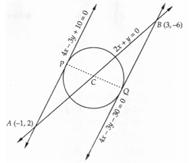
Find the equation of the circle which touches the lines $4 x-3 y+10=0$ and $4 x-3 y-30=0$ and whose centre lies on the line $2 x + y =0$.
Answer
Clearly, the lines 4x - 3y + 10 = 0 and 4x - 3y - 30 = 0 are parallel and are touching the circle.
It is given that the centre of the circle lies on the line 2x + y = 0 which intersects the lines 4x - 3y + 10 = 0 and 4x - 3y - 30 = 0 at A (-1, 2) and B (3, - 6) respectively.
Therefore, the centre of the circle is the mid-point of AB.
So, the coordinates of the centre C are (1, - 2)+
Image

Let d be the distance between parallel lines 4x -3y + 10 =0 and 4x -3y - 30 = 0 Then 
$\begin{array}{l} PQ =d=\left|\frac{10-(-30)}{\sqrt{4^2+(-3)^2}}\right|=8 \\ \Rightarrow PQ = d =8 \\ \text { Radius }=\frac{1}{2}(P Q)=\frac{1}{2} \times 8=4 \\ \Rightarrow \text { Radius }=4\end{array}$
Thus, the required circle has its centre at C (1, - 2) and radius = 4 
Hence, its equation is $(x-1)^2+(y+2)^2=4^2$
View full question & answer
Question 62 Marks
Find the equation of the parabola whose: focus is $(2,3)$ and the directrix $x-4 y+3=0$.
Answer
Let P(x, y) be any point on the parabola whose focus is S(2, 3) and the directrix is x - 4y + 3 = 0 
Draw PM perpendicular to x - 4y + 3 = 0 
Thus, we have: 
SP = PM 
$\begin{array}{l}\Rightarrow SP ^2= PM ^2 \\ \Rightarrow( x -2)^2+( y -3)^2=\left|\frac{x-4 y+3}{\sqrt{1+16}}\right|^2 \\ \Rightarrow( x -2)^2+( y -3)^2=\left(\frac{x-4 y+3}{\sqrt{17}}\right)^2 \\ \Rightarrow 17\left( x ^2+4-4 x + y ^2-6 y+9\right)= x ^2+16 y ^2+9-8 xy -24 y +6 x \\ \Rightarrow\left(17 x ^2-68 x -102 y +17 y ^2+13 \times 17\right)= x ^2+16 y ^2+9-8 xy -24 y +6 x \\ \Rightarrow 16 x ^2+ y ^2+8 xy -74 x -78 y +212=0\end{array}$
Which is the required equation of parabola.
View full question & answer
Question 72 Marks
Find the domain and range of the real valued function $f(x)=\frac{1}{\sqrt{16-x^2}}$.
Answer
We know the square of a real number is never negative. 
Clearly, $f ( x )$ takes real values only when $16- x ^2 \geq 0$
$\begin{array}{l}=16 \geq x ^2 \\ = x ^2 \leq 16 \\ = x ^2-16 \leq 0 \\ = x ^2-4^2 \leq 0 \\ =( x +4)( x -4) \leq 0 \\ = x \geq-4 \text { and } x \leq 4 \\ \therefore x \in[-4,4]\end{array}$
In addition, $f ( x )$ is also undefined when $16- x ^2=0$ because denominator will be zero and the result will be indeterminate.
$\begin{array}{l}16-x^2=0 \Rightarrow x= \pm 4 \\
\text { Hence, } x \in[-4,4]-\{-4,4\} \\
\therefore x \in(-4,4)\end{array}$
Thus, domain of $f=(-4,4)$
$\begin{array}{l}\text { Let } f ( x )= y \\ \Rightarrow \frac{1}{\sqrt{16-x^2}}=y \\ \Rightarrow\left(\frac{1}{\sqrt{16-x^2}}\right)^2=y^2 \\ \Rightarrow \frac{1}{16-x^2}=y^2 \\ =1=\left(16-x^2\right) y ^2 \\ =1=16 y^2-x^2 y^2 \\ =x^2 y^2+1-16 y^2=0 \\ =\left(y^2\right) x^2+(0) x +\left(1-16 y^2\right)=0\end{array}$
As $x \in R$, the discriminant of this quadratic equation in $x$ must be non-negative.
$\begin{array}{l}=0^2-4\left(y^2\right)\left(1-16 y^2\right) \geq 0 \\ =-4 y^2\left(1-16 y^2\right) \geq 0 \\ =4 y^2\left(1-16 y^2\right) \leq 0 \\ =1-16 y^2 \leq 0\left[\because y^2 \geq 0\right] \\ =16 y^2-1 \geq 0 \\ \Rightarrow(4 y)^2-1^2 \geq 0 \\ =(4 y+1)(4 y-1) \geq 0 \\ =4 y \leq-1 \text { and } 4 y \geq \\ \Rightarrow y \leq-\frac{1}{4} \text { and } y \geq \frac{1}{4} \\ \Rightarrow y \in\left(-\infty,-\frac{1}{4}\right] \cup\left[\frac{1}{4}, \infty\right) \\ \Rightarrow f(x) \in\left(-\infty,-\frac{1}{4}\right] \cup\left[\frac{1}{4}, \infty\right)\end{array}$
However, y is always positive because it is the reciprocal of a non-zero square root. 
$\therefore f(x) \in\left[\frac{1}{4}, \infty\right)$
Thus, range of $f =\left[\frac{1}{4}, \infty\right)$
Thus , is the required domain and range of the function
View full question & answer