Questions

2 Marks Questions

Take a timed test

7 questions · self-marked practice — reveal the answer and mark yourself.

Question 12 Marks
Find the equations of the lines which cut-off intercepts on the axes whose sum and product are 1 and -6 respectively.
Answer
Let $\frac{x}{a}+\frac{y}{b}=1$ be the equation of line.
It is given that $a+b=1$ and $a b=-6$
We know that $(a-b)^2=(a+b)^2-4 a b$
$\Rightarrow(a-b)^2=(1)^2-4 \times-6=1+24=25 \Rightarrow a-b= \pm 5$
Solving a + b = 1 and a - b = 5 we have 
a = 3 and b = -2 
Solving a +b = 1 and a - b = -5, we have 
a = -2 and b = 3 
Thus the required equations are 
$\begin{array}{l}\frac{x}{3}+\frac{y}{-2}=1 \Rightarrow-2 x+3 y=-6 \Rightarrow 2 x-3 y=6 \\ \text { and } \frac{x}{-2}+\frac{y}{3}=1 \Rightarrow 3 x-2 y=-6 \Rightarrow-3 x+2 y=6\end{array}$
View full question & answer
Question 22 Marks
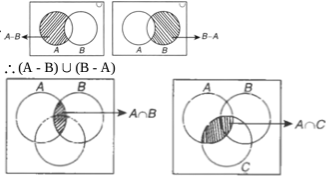
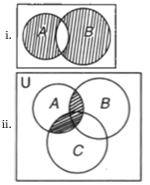
What is represented by the shaded regions in each of the following Venn-diagrams.
Image
Answer
Image
$\begin{array}{l}\therefore(A \cap B) \cup(A \cap C) \\ \text { or } A \cap(B \cup C)\end{array}$
View full question & answer
Question 32 Marks
A five digit number is formed by the digits 1, 2, 3, 4, 5 without repetition. Find the probability that the number is divisible by 4.
Answer
We have to find the probability that the number is divisible by 4.
Total number of five digit numbers formed by the digits 1, 2, 3, 4, 5 is 5!. 
$\therefore$ Total number of elementary events $=5!=120$.
We know that a number is divisible by 4 if the number formed by last two digits is divisible by 4.
Therefore last two digits can be 12,24, 32, 52 that is, last two digits can be filled in 4 ways.
But corresponding to each of these ways there are 3! = 6 ways of filling the remaining three places. 
Therefore the total number of five digit numbers formed by the digits $1,2,3,4,5$ and divisible by 4 is $4 \times 6=24$
$\therefore$ Favourable number of elementary events $=24$ 
So, required probability $=\frac{24}{120}=\frac{1}{5}$
View full question & answer
Question 42 Marks
Determine the probability p, for event. An odd number appears in a single toss of a fair die
Answer
When a fair die is thrown, the possible outcomes are
S = (1, 2, 3, 4, 5, 6)
$\therefore$ Total number of outcomes $=n(S)=6$ and
Odd numbers in a throw={1, 3, 5} 
$\therefore$ Number of favourable outcomes $=n(A)=3$
We know that, 
 Required probabiltiy $=\frac{n(A)}{n(S)}=\frac{\text { Number of favourable outcome }}{\text { Total mumber of outcomes }}=\frac{3}{6}=\frac{1}{2}$

View full question & answer
Question 52 Marks
Evaluate: $\lim _{x \rightarrow 0} \frac{1-\cos 2 x}{x^2}$.
Answer
We have to find the value of 
$\begin{array}{l}\lim _{x \rightarrow 0} \frac{1-\cos 2 x}{x^2}=\lim _{x \rightarrow 0} \frac{2 \sin ^2 x}{x^2} \\ =2 \lim _{x \rightarrow 0}\left(\frac{\sin x}{x} \times \frac{\sin x}{x}\right)=2 \lim _{x \rightarrow 0} \frac{\sin x}{x} \times \lim _{x \rightarrow 0} \frac{\sin x}{x}=2(1)(1)=2\end{array}$
View full question & answer
Question 62 Marks
Find the domain and the range of the real function: $f(x)=\frac{1}{\sqrt{x^2-1}}$
Answer
Here we have, $f(x)=\frac{1}{\sqrt{x^2-1}}$ 
we need to find where the function is defined 
The condition for the function to be defined
$\begin{array}{l}x^2-1>0 \\ \Rightarrow x^2>1 \\ \Rightarrow x>1\end{array}$
So, the domain of the function is the set of all the real numbers greater than 1 
The domain of the function, $D _{\{ f ( x )\}}=(1, \infty)$
Now put any value of x within the domain set we get the value of the function always a fraction whose denominator is not equalled to 0 
The range of the function, $R _{ f ( x )}=(0,1)$.
View full question & answer
Question 72 Marks
Write the range of the function $f(x)=\sin [x]$, where $\frac{-\pi}{4} \leq x \leq \frac{\pi}{4}$.
Answer
From the given question , we can write,
$\begin{array}{l}f(x)=\sin (x) \\ -\frac{\pi}{4} \leq x \leq \frac{\pi}{4} \\
\operatorname{Sin}\left[-\frac{\pi}{4}\right]=\sin (-1) \\ =-\sin 1 \\ \sin 0=0 \\ \sin
\frac{\pi}{4}=\sin 0 \\ =0\end{array}$
using properties of greatest integer function  
(1) = 1. (0.5) = 0. (0.5) = -1
Hence, R(f) = -( sin 1.0)
View full question & answer