Questions

Case study (4 Marks)

Take a timed test

3 questions · self-marked practice — reveal the answer and mark yourself.

Question 14 Marks
Answer
i. Total marbles $=4+5+3=12$
Required probability $=\frac{{ }^4 C_2}{{ }^{12} C_2}=\frac{\frac{4 \times 3}{2 \times 1}}{\frac{12 \times 11}{2 \times 1}}=\frac{1}{11}$
ii. Total marbles $=4+5+3=12$
Required probability $=\frac{{ }^3 C_3}{{ }^{12} C_3}=\frac{1}{\frac{12 \times 11 \times 10}{3 \times 2}}=\frac{1}{220}$
iii. Total marbles $=4+5+3=12$
Required probability $=\frac{{ }^7 C_2}{{ }^{12} C_2}=\frac{\frac{7 \times 6}{2 \times 1}}{\frac{12 \times 11}{741}}=\frac{21}{66}=\frac{7}{22}$
OR
Total marbles = 4 + 5 + 3 = 12
Required probability = 1 - P (None is blue)
$\begin{array}{l}=1-\frac{{ }^7 C_3}{{ }^{12} C_3} \\ =1-\frac{\frac{7 \times 6 \times 5}{3 \times 2}}{\frac{12 \times 11 \times 10}{3 \times 2}} \\ =1-\frac{7}{44}=\frac{37}{44}\end{array}$
View full question & answer
Question 24 Marks
Read the following text carefully and answer the questions that follow: 
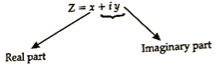
A number of the form $Z=x+i y$, where $x$ and $y$ are real and $i=\sqrt{-1}$ is called a complex number. Consider the complex number $Z_1=2+3 i$ and $Z_2=4-3 i$.
Image
i. Find the imaginary part of $Z_1 \overline{Z_1}$. (1)
ii. Find the real part of $\frac{z_1}{z_2}$. (1)
iii. Find the imaginary part of $Z_1-Z_2$. (2)
OR
Find the real part of $Z _1$. (2)
Answer
i.$\begin{array}{l}Z_1 \overline{Z_1}=(2+3 i)(2-3 i) \\
=4-9 i^2=4+9=13\end{array}$
Imaginary part $=0$
ii.$\begin{array}{l}\frac{Z_1}{Z_2}=\frac{2+3 i}{4-3 i} \times \frac{4+3 i}{4+3 i} \\
=\frac{8+6 i+12 i-9}{16+9} \\
=\frac{-1+18 i}{25}\end{array}$
Real part $=\frac{-1}{25}$
iii.$\begin{array}{l}Z_1-Z_2=(2+3 i)-(4-3 i) \\
=-2+6 i\end{array}$
Imaginary part $=6$
OR
The real part of $Z _1=2$.
View full question & answer
Question 34 Marks
Read the following text carefully and answer the questions that follow: Representation of a Relation
A relation can be represented algebraically by roster form or by set-builder form and visually it can be represented by an arrow diagram which are given below
i. Roster form In this form, we represent the relation by the set of all ordered pairs belongs to R.
ii. Set-builder form In this form, we represent the relation $R$ from set $A$ to set $B$ as $R=\{(a, b): a \in A, b \in B$ and the rule which relate the elements of A and B \}.
iii. Arrow diagram To represent a relation by an arrow diagram, we draw arrows from first element to second element of all ordered pairs belonging to relation R. 
Questions
i. If n(A) = 3 and B = {2, 3, 4, 6, 7, 8} then find the number of relations from A to B. (1)
ii. If A = {a, b} and B = {2, 3}, then find the number of relations from A to B. (1)
iii. If A = {a, b} and B = {2, 3}, write the relation in set-builder form. (2) 
OR
Express of $R =\{( a , b ): 2 a + b =5 ; a , b \in W \}$ as the set of ordered pairs (in roster form). (2)
Answer
i. Number of relations $=2^{ mn }$
$=2^{3 \times 6}=2^{18}$
ii. Number of relations $=2^{ mn }$
$=2^{2 \times 2}=2^4=16$
iii. $R=\{(x, y): x \in P, y \in Q$ and $x$ is the square of $y\}$
OR
Here, W denotes the set of whole numbers.
We have $2 a + b =5$ where $a , b \in W$
$\begin{array}{l}\therefore a=0 \Rightarrow b=5 \\ \Rightarrow a=1 \Rightarrow b=5-2=3 \\ \text { and } a=2 \Rightarrow b=1\end{array}$
For a > 3, the values of b given by the above relation are not whole numbers. 
$\therefore A=\{(0,5),(1,3),(2,1)\}$
View full question & answer