Questions

3 Marks Question

🎯

Test yourself on this topic

9 questions · timed · auto-graded

Question 13 Marks
Given that $, P (5,4,-2), Q (7,6,-4)$ and $R (11,10,-8)$ are collinear points. Find the ratio in which Q divides PR.
Answer
Let Q divides PR in the ratio $k : 1$
Thus coordinates of Q are $\left[\frac{11 k+5}{k+1}, \frac{10 k+4}{k+1}, \frac{-8 k-2}{k+1}\right]$
It is given that coordinates of Q are (7, 6, -4).$
\therefore \frac{11 k+5}{k+1}=7, \frac{10 k+4}{k+1}=6, \frac{-8 k-2}{k+1}=-4
$
Now solving these we get $k=\frac{1}{2}$
Thus Q divides PR in the ratio $\frac{1}{2}: 1$ or $1: 2$
View full question & answer
Question 23 Marks
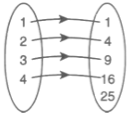
Let $A=\{1,2,3,4\}, B=\{1,4,9,16,25\}$ and $R$ be a relation defined from $A$ to $B$ as, $R=\{(x, y): x \in A, y \in B$ and $\left.y=x^2\right\}$
i. Depict this relation using arrow diagram.
ii. Find domain of R.
iii. Find range of R.
iv. Write co-domain of R.
View full question & answer
Question 33 Marks
Using binomial theorem, expand: $(\sqrt[3]{x}-\sqrt[3]{y})^6$
Answer
To find: Expension of $(\sqrt[3]{x}-\sqrt[3]{y})^6$ by means of binomial theorem..
Formula used: ${ }^n C_r=\frac{n!}{(n-r)!(r)!}$
$(a+b)^{n}={ }^n C_0 a^n+{ }^n C_1 a^{n-1} b+{ }^n C_2 a^{n-2} b^2+\ldots \ldots+{ }^n C_{n-1} a b^{n-1}+n C_n b^n$
We have, $(\sqrt[3]{x}-\sqrt[3]{y})^6$
We can write $\sqrt[3]{x}$, as $x^{\frac{1}{3}}$, and $\sqrt[3]{y}$, as $y^{\frac{1}{3}}$, 
Now, we have to solve for $\left(x^{\frac{1}{3}}-y^{\frac{1}{3}}\right)^6$
$\begin{array}{l}\Rightarrow\left[6 C _0\left( x ^{\frac{1}{3}}\right)^{6-0}\right]+\left[6 C _1\left( x ^{\frac{1}{3}}\right)^{6-1}\left(- y ^{\frac{1}{3}}\right)^1\right]+\left[6 C _2\left( x ^{\frac{1}{3}}\right)^{6-2}\left(- y ^{\frac{1}{3}}\right)^2\right] \\ +\left[6 C_3\left(x^{\frac{1}{3}}\right)^{6-3}\left(-y^{\frac{1}{3}}\right)\right]  +\left[6 C _4\left( x ^{\frac{1}{3}}\right)^{6-4}\left(- y ^{\frac{1}{3}}\right)^4\right] \\+\left[6 C _5\left( x ^{\frac{1}{3}}\right)^{6-5}\left(- y ^{\frac{1}{3}}\right)^5\right]+\left[6 C_6\left(-y^{\frac{1}{3}}\right)^6\right] \\ \Rightarrow\left[{ }^6 C _0\left(\frac{6}{x^3}\right)\right]-\left[{ }^6 C _1\left(x^{\frac{5}{3}}\right)\left(y^{\frac{1}{3}}\right)\right]+\left[6 C _2\left( x ^{\frac{4}{3}}\right)\left( y ^{\frac{2}{3}}\right)\right] \\ -\left[6 C _3\left( x ^{\frac{3}{3}}\right)\left( y ^{\frac{3}{3}}\right)\right]+\left[{ }_6 C _4\left( x ^{\frac{2}{3}}\right)\left( y ^{\frac{4}{3}}\right)\right]-\left[6 C _5\left( x ^{\frac{1}{3}}\right)\left( y ^{\frac{5}{3}}\right)\right] \\ +\left[6 C_6\left(\frac{6}{y^3}\right)\right] \\ \Rightarrow\left[\frac{6!}{0!(6-0)!}\left(x^2\right)\right]-\left[\frac{6!}{1!(6-1)!}\left(x^{\frac{5}{3}}\right)\left(y^{\frac{2}{3}}\right)\right]+\left[\frac{6!}{2!(6-2)!}\left(x^{\frac{4}{2}}\right)\left(x^{\frac{2}{3}}\right)\right] \\ -\left[\frac{6!}{3!(6-3)!}(x)(y)\right]+\left[\frac{6!}{4!(6-4)!}\left(x^{\frac{2}{3}}\right)\left(y^{\frac{4}{3}}\right)\right] \\ -\left[\frac{6!}{5!(6-5)!}\left(x^{\frac{1}{3}}\right)\left(y^{\frac{5}{3}}\right)\right]+\left[\frac{6!}{6!(6-6)!}\left(y^2\right)\right] \\ \Rightarrow\left[1\left(x^2\right)\right]-\left[6\left(x^{\frac{5}{3}}\right)\left(y^{\frac{1}{3}}\right)\right]+\left[15\left(x^{\frac{4}{3}}\right)\left(y^{\frac{2}{3}}\right)\right] \\ -[20(x)(y)]+\left[15\left(x^{\frac{2}{3}}\right)\left(\frac{4}{y^3}\right)\right] \\ -\left[6\left(x^{\frac{1}{3}}\right)\left(y^{\frac{5}{3}}\right)\right]+\left[1\left(y^2\right)\right] \\ \Rightarrow x^2-6 x^{\frac{5}{2}} y^{\frac{1}{3}}+15 x^{\frac{4}{3}} y^{\frac{2}{3}} -20 x y+15 x^{\frac{2}{3}} y^{\frac{4}{3}}-6 x^{\frac{1}{3}} y^{\frac{5}{3}}+y^2\end{array}$
Hence the result.
View full question & answer
Question 43 Marks
Solve the following system of linear inequations:
$\begin{array}{l}3 x-6 \geq 0 \\ 4 x-10 \leq 6\end{array}$
View full question & answer
Question 53 Marks
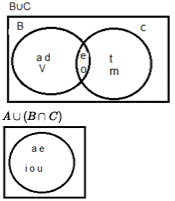
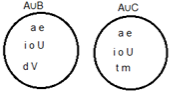
Let $A=\{a, e, i, o, u\}, B=\{a, d, e, o, v)$ and $C=\{e, o, t, m]$. Using Venn diagrams, verify that: $A \cup(B \cap C)=$ $(A \cup B) \cap(A \cup C)$
Answer
Here, it is given: $A =\{ a , e , i , o , u \}, B =\{ a , d , e , o , v \}$ and $C =\{ e , o , t , m \}$.
$B \cap C=\{e, o\}$ and $A \cup(B \cap C)=\{a, e, i, o, u\}$
LHS
Image
R.H.S: $A \cup B=\{a, d, e, I, o, u, v\}$ and $A \cup C=\{a, e, I, o, u, t, m\}$
Image

$\begin{array}{l}(A \cup B) \cap(A \cup C)=\{a, e, I, o, u\} \\ \text { L.H.S = R.H.S. }[\text { Verified }]\end{array}$
View full question & answer
Question 63 Marks
If $(x+i y)^{1 / 3}=a+i b$, where $x, y, a, b \in R$, then show that $\frac{x}{a}-\frac{y}{b}=-2\left(a^2+b^2\right)$.
Answer
We have, $(x+i y)^{1 / 3}=a+i b$
$\Rightarrow x + iy =( a + ib )^3$ [cubing on both sides]
$\Rightarrow x + iy = a ^3+ i ^3 b^3+3 iab ( a + ib )$
$\begin{array}{l}\Rightarrow x+i y=a^3-i b^3+i 3 a^2 b-3 a b^2 \\ \Rightarrow
x+i y=a^3-3 a b^2+i\left(3 a^2 b-b^3\right)\end{array}$
On equating real and imaginary parts from both sides, we get
$\begin{array}{l} x = a ^3-3 a ^2 \text { and } y =3 a ^2 b- b ^3 \\ \Rightarrow
\frac{x}{ a }= a ^2-3 b^2 \text { and } \frac{y}{b}=3 a ^2- b ^2\end{array}$
$\begin{array}{l}\text { Now, } \frac{x}{a}-\frac{y}{b}=a^2-3 b^2-3 a^2+b^2 \\ =-2
a^2-2 b^2=-2\left(a^2+b^2\right)\end{array}$
Hence proved.
View full question & answer
Question 73 Marks
Find the square roots: 7 - 24i.
Answer
Let $\sqrt{7-24 i}=x+$ iy. Then
$\sqrt{7-24 i}=x+i y$
$\begin{array}{l}\Rightarrow 7-24 i=(x+i y)^2 \\ \Rightarrow 7-24 i=\left(x^2-y^2\right)+2 i x y \\ \Rightarrow x^2-y^2=7 \ldots \text { (i) } \\ \text { and } 2 x y=-24 \ldots \text { (ii) }\end{array}$
$\begin{array}{l}\text { Now, }\left(x^2+y^2\right)^2=\left(x^2-y^2\right)^2+4 x^2 y^2 \\ \Rightarrow\left(x^2+y^2\right)^2=49+576=625\left[\because x^2+y^2>0\right] \\ \Rightarrow x^2+y^2=25 \ldots \text { (iii) }\end{array}$
add (i) and (iii), we get 
$\begin{array}{l}2 x^2=32 \\ \Rightarrow x^2=16 \\ \Rightarrow x= \pm 4\end{array}$
put value of x in (I), we get 
$y^2=9 \Rightarrow y= \pm 3$
From (ii) we observe that 2xy is negative. So, x and y are of opposite signs.
Hence, $\sqrt{7-24 i}= \pm(4-3 i)$
View full question & answer
Question 83 Marks
Find the coefficient of $x^5$ in the product $(1+2 x)^6(1-x)^7$ using binomial theorem.
Answer
Using binomial theorem 
$\begin{array}{l}(1+2 x )^6(1- x )^7=\left[{ }^6 C_0+{ }^6 C_1(2 x)+{ }^6 C_2(2 x)^2+{ }^6 C_3(2 x)^3+{ }^6 C_4(2 x)^4+{ }^6 C_5(2 x)^5+{ }^6 C_6(2 x)^6\right] \\ {\left[{ }^7 C_0-{ }^7 C_1(x)+{ }^7 C_2(x)^2-{ }^7 C_3(x)^3+{ }^7 C_4(x)^4-{ }^7 C_5(x)^5+{ }^7 C_6(x)^6-{ }^7 C_7(x)^7\right]} \\ =\left[1+12 x +60 x ^2+160 x ^3+240 x ^4+192 x ^5+64 x ^6\right]\left[1-7 x +21 x ^2-35 x ^3+35 x ^4-21 x ^5+7 x ^6- x ^7\right]\end{array}$
$\therefore$ Coefficient of $x^5$ in the product
$\begin{array}{l}=(1 \times-21)+(12 \times 35)+(60 \times-35)+(160 \times 21)+(240 \times-7)+(192 \times 1) \\ =-21+420-2100+3360-1680+192=171\end{array}$
View full question & answer
Question 93 Marks
Show that the points A(4, 6, - 3), B(0, 2, 3) and C(-4, - 4, -1) form the vertices of an isosceles triangle.
Answer
To prove: Points A, B, C form an isosceles triangle. 
Formula: The distance between two points $\left( x _1, y _1, z _1\right)$ and $\left( x _2, y _2, z _2\right)$ is given by
$D =\sqrt{\left(x_2-x_1\right)^2+\left(y_2-y_1\right)^2+\left(z_2-z_1\right)^2}$
Here, 
$\begin{array}{l}\left(x_1, y_1, z_1\right)=(4,6,-3) \\ \left(x_2, y_2, z_2\right)=(0,2,3) \\ \left(x_3, y_3, z_3\right)=(-4,-4,-1)\end{array}$
$\begin{array}{l}\text { Length } AB =\sqrt{\left(x_2-x_1\right)^2+\left(y_2-y_1\right)^2+\left(z_2-z_1\right)^2} \\ =\sqrt{(0-4)^2+(2-6)^2+(3-(-3))^2} \\ =\sqrt{(-4)^2+(-4)^2+(6)^2} \\ =\sqrt{16+16+36}\end{array}$
$\begin{array}{l}\text { Length } AB =\sqrt{68}=2 \sqrt{17} \\ \text { Length } BC =\sqrt{\left(x_3-x_2\right)^2+\left(y_3-y_2\right)^2+\left(z_3-z_2\right)^2} \\ =\sqrt{(-4-0)^2+(-4-2)^2+(-1-3)^2} \\ =\sqrt{(-4)^2+(-6)^2+(-4)^2} \\ =\sqrt{16+36+16}\end{array}$
$\begin{array}{l}\text { Length } BC =\sqrt{68}=2 \sqrt{17} \\ \text { Length } AC =\sqrt{\left(x_3-x_1\right)^2+\left(y_3-y_1\right)^2+\left(z_3-z_1\right)^2} \\ =\sqrt{(-4-4)^2+(-4-6)^2+(-1-(-5))^2} \\ =\sqrt{(-8)^2+(-10)^2+(2)^2} \\ =\sqrt{64+100+4}\end{array}$
Length $AC =\sqrt{168}$
Here, $AB = BC$
$\therefore$ vertices $A , B , C$ forms an isosceles triangle.
View full question & answer
3 Marks Question - MATHS STD 11 Science Questions - Vidyadip