Questions

5 Marks Questions

Take a timed test

6 questions · self-marked practice — reveal the answer and mark yourself.

Question 15 Marks
Find four numbers in GP, whose sum is 85 and product is 4096.
Answer
Let the four numbers in GP be 
$\frac{a}{r^3}, \frac{a}{r}, a r, a r^3 \ldots$ (i)
Product of four numbers = 4096 [given] 
$\begin{array}{l}\Rightarrow\left(\frac{a}{r^3}\right)\left(\frac{a}{r}\right)( ar )\left( ar ^3\right)=4096 \\ \Rightarrow a ^4=4096 \Rightarrow a ^4=8^4\end{array}$
On comparing the base of the power 4, we get 
$\begin{array}{l}\Rightarrow \frac{a}{r^3}+\frac{a}{r}+ ar + ar ^3=85 \\ \Rightarrow a \left[\frac{1}{r^3}+\frac{1}{r}+r+r^3\right]=85 \\ \Rightarrow 8\left[ r ^3+\frac{1}{r^3}\right]+8\left[ r +\frac{1}{r}\right]=85[\because a =8] \\ \Rightarrow 8\left[\left(r+\frac{1}{r}\right)^3-3\left(r+\frac{1}{r}\right)\right]+8\left(r+\frac{1}{r}\right)=85\left[\because a ^3+ b ^3=( a + b )^3-3( a + b )\right] \\ \Rightarrow 8\left(r+\frac{1}{r}\right)^3-16\left(r+\frac{1}{r}\right)-85=0 \ldots \text { (ii) }\end{array}$
On putiing $\left(r+\frac{1}{r}\right)= x$ in Eq. (ii), we get
$8 x^3-16 x-85=0$
$\begin{array}{l}\Rightarrow(2 x-5)\left(4 x^2+10 x+17\right)=0 \\ \Rightarrow 2 x-5=0\left[\because 4 x^2+10 x+177=0 \text { has imaginary roots }\right] \\ \Rightarrow x=\frac{5}{2} \Rightarrow r+\frac{1}{r}=\frac{5}{2}\left[p u t x=r+\frac{1}{r}\right] \\ \Rightarrow 2 r^2-5 r+2=0 \\ \Rightarrow(r-2)(2 r-1)=0 \\ \Rightarrow r=2 \text { or } r=\frac{1}{2}\end{array}$
On putting $a =8$ and $r =2$ or $r =\frac{1}{2}$ in Eq. (i), we obtain four numbers as 
$\frac{8}{2^3}, \frac{8}{2}, 8 \times 2,8 \times 2^3$
$\begin{array}{l}\text { or } \frac{8}{(1 / 2)^3}, \frac{8}{(1 / 2)}, 8 \times \frac{1}{2}, 8 \times\left(\frac{1}{2}\right)^3 \\ \Rightarrow 1,4,16,64 \text { or } 64,16,4,1\end{array}$
View full question & answer
Question 25 Marks
20 cards are numbered from 1 to 20. One card is drawn at random. What is the probability that the number on the card drawn is,
i. A prime number
ii. An odd number
iii. A multiple of 5
iv. Not divisible by 3.
Answer
Let S be the sample space
S = {1,2,3,4,5.....20} 
Let $E _1, E _2$ and $E _3, E _4$ are the event of getting prime number, an odd number, multiple of 5 and not divisible by 3 respectively.
$\begin{array}{l}P\left(E_1\right)=\frac{8}{20}=\frac{2}{5}, E _1=\{2,3,5,7,11,13,17,19\} \\ P\left(E_2\right)=\frac{10}{20}=\frac{1}{2}, E _2=\{1,3,5,7,9,11,13,15,17,19\} \\ P\left(E_3\right)=\frac{4}{20}=\frac{1}{5}, E _3=\{5,10,15,20\} \\ P\left(E_4\right)=\frac{14}{20}=\frac{7}{10}, E _4=\{1,2,4,5,7,8,10,11,13,14,16,17,19,20\}\end{array}$
View full question & answer
Question 35 Marks
If $\alpha, \beta$ are two different values of x lying between 0 and $2 \pi$ which satisfy the equation $6 \cos x +8 \sin x =9$, find the value of $\sin (\alpha+\beta)$
Answer
We have to find the value of $\sin (\alpha+\beta)$
It is given that
6 cos x + 8 sin x = 9 
$\begin{array}{l}\Rightarrow 6 \cos x=9-8 \sin x \\ \Rightarrow 36 \cos ^2 x=(9-8 \sin x)^2 \\ \Rightarrow 36\left(1-\sin ^2 x\right)=81+64 \sin ^2 x-144 \sin x \\ \Rightarrow 100 \sin ^2 x-144 \sin x+45=0\end{array}$
Now, $\alpha$ and $\beta$ are the roots of the given equation; 
therefore, $\cos \alpha$ and $\cos \beta$ are the roots of the above equation. 
$\Rightarrow \sin \alpha \sin \beta=\frac{45}{100}$
(Product of roots of a quadratic equation $a x^2+b x+c=0$ is $\frac{c}{a}$ 
Again, 6 cosx + 8 sinx = 9 
$\begin{array}{l}\Rightarrow 8 \sin x=9-6 \cos x \\ \Rightarrow 64 \sin ^2 x=(9-6 \cos x)^2 \\ \Rightarrow 64\left(1-\cos ^2 x\right)=81+36 \cos ^2 x-108 \cos x \\ \Rightarrow 100 \cos ^2 x-108 \cos x+17=0\end{array}$
Now, $\alpha$ and $\beta$ are the roots of the given equation; 
therefore, $\sin \alpha$ and $\sin \beta$ are the roots of the above equation. 
Therefore, $\cos \alpha \cos \beta=\frac{17}{100}$
Hence, $\cos (\alpha+\beta)=\cos \alpha \cos \beta-\sin \alpha \sin \beta$
$\begin{array}{l}=\frac{17}{100}-\frac{45}{100} \\ =-\frac{28}{100} \\ =-\frac{7}{25} \\ \sin (\alpha+\beta)=\sqrt{1-\cos ^2(\alpha+\beta)} \\ =\sqrt{1-\left(\frac{-7}{25}\right)^2} \\ =\sqrt{\frac{576}{625}} \\ =\frac{24}{25}\end{array}$
View full question & answer
Question 45 Marks
Differentiate log sin x from first principles.
Answer
Let f (x) = log sin x. Then, f (x + h) = log sin (x + h) 
$\therefore \frac{d}{d x}(f(x))=\underset{{h \rightarrow 0}}{\lim} \frac{f(x+h)-f(x)}{h}$
$\begin{array}{l}\Rightarrow \frac{d}{d x}( f ( x ))=\underset{{h \rightarrow 0}}{\lim} \frac{\log \sin (x+h)-\log \sin x}{h} \\ \Rightarrow \frac{d}{d x}( f ( x ))=\underset{{h \rightarrow 0}}{\lim} \frac{\log \left\{\frac{\sin (x+h)}{\sin x}\right\}}{h} \\ \Rightarrow \frac{d}{d x}( f ( x ))=\underset{{h \rightarrow 0}}{\lim} \frac{\log \left\{1+\frac{\sin (x+h)}{\sin x}-1\right\}}{h} \\ \Rightarrow \frac{d}{d x}( f ( x ))=\lim _h \frac{\log \left\{1+\frac{\sin (x+h)-\sin x}{\sin x}\right\}}{h}\end{array}$
$\begin{array}{l}\Rightarrow \frac{d}{d x}( f ( x ))=\underset{{h \rightarrow 0}}{\lim} \frac{\log \left\{1+\frac{\sin (x+h)-\sin x}{\sin x}\right\}}{h\left\{\frac{\sin (x+h)-\sin x}{\sin x}\right\}} \times\left\{\frac{\sin (x+h)-\sin x}{\sin x}\right\} \\ \Rightarrow \frac{d}{d x}( f ( x ))=\underset{{h \rightarrow 0}}{\lim} \frac{\log \left\{1+\frac{\sin (x+h)-\sin x}{h}\right\}}{\left\{\frac{\sin (x+h)-\sin x}{h}\right\}} \times \frac{\sin (x+h)-\sin x}{h} \times \frac{1}{\sin x} \\ \Rightarrow \frac{d}{d x}( f ( x ))=\underset{{h \rightarrow 0}}{\lim} \frac{\log \left\{1+\frac{\sin (x+h)-\sin x}{h}\right\}}{\left\{\frac{\sin (x+h)-\sin x}{h}\right\}} \times \underset{{h \rightarrow 0}}{\lim} \frac{2 \sin \frac{h}{2} \cos \left(x+\frac{h}{2}\right)}{h} \times \frac{1}{\sin x} \\ \Rightarrow \frac{d}{d x}( f ( x ))=\underset{{h \rightarrow 0}}{\lim} \frac{\log \left\{1+\frac{\sin (x+h)-\sin x}{h}\right\}}{\left\{\frac{\sin (x+h)-\sin x}{h}\right\}} \times \underset{{h \rightarrow 0}}{\lim} \frac{\sin \left(\frac{h}{2}\right) \cos \left(x+\frac{h}{2}\right)}{\frac{h}{2}} \times \frac{1}{\sin x} \\ \Rightarrow \frac{d}{d x}( f ( x ))=1 \times \cos x \times \frac{1}{\sin x}=\cot x .\end{array}$

View full question & answer
Question 55 Marks
Prove that $\cos \frac{2 \pi}{15} \cdot \cos \frac{4 \pi}{15} \cdot \cos \frac{8 \pi}{15} \cdot \cos \frac{16 \pi}{15}=\frac{1}{16}$
Answer

$\begin{array}{l}\text { LHS }=\cos \frac{2 \pi}{15} \cdot \cos \frac{4 \pi}{15} \cdot \cos \frac{8 \pi}{15} \cdot \cos \frac{16 \pi}{15} \\ =\cos \frac{2 \pi}{15} \cos 2\left(\frac{2 \pi}{15}\right) \cos 4\left(\frac{2 \pi}{15}\right) \cos 8\left(\frac{2 \pi}{15}\right) \\ \text { Put } \frac{2 \pi}{15}=\alpha \\ \Rightarrow \text { LHS }=\cos \alpha \cdot \cos 2 \alpha \cdot \cos 4 \alpha \cdot \cos 8 \alpha \\ \left.=\frac{2 \sin \alpha[\cos \alpha \cdot \cos 2 \alpha \cdot \cos 4 \alpha \cdot \cos 8 \alpha]}{2 \sin \alpha} \\ \text { [multiplying numerator and denominator by } 2 \sin \alpha\right] \\ =\frac{(2 \sin \alpha \cdot \cos \alpha) \cdot \cos 2 \alpha \cdot \cos 4 \alpha \cdot \cos 8 \alpha}{2 \sin \alpha} \\ =\frac{2(\sin 2 \alpha \cdot \cos 2 \alpha \cdot \cos 4 \alpha \cdot \cos 8 \alpha)}{2(2 \sin \alpha)} \\ [\because 2 \sin \alpha \cos \alpha=\sin 2 \alpha \text { and multiplying numerator and denominator by } 2] \\ =\frac{(2 \sin 2 \alpha \cdot \cos 2 \alpha) \cdot \cos 4 \alpha \cdot \cos 8 \alpha}{4 \sin \alpha} \\ =\frac{2(\sin 4 \alpha \cdot \cos 4 \alpha) \cos 8 \alpha}{2(4 \sin \alpha)} \\ [\because 2 \sin \alpha \cos \alpha=\sin 2 \alpha \text { and multiplying numerator and denominator by } 2] \\ =\frac{2(\sin 8 \alpha \cdot \cos 8 \alpha)}{2(8 \sin \alpha)} \\ =\frac{\sin 16 \alpha}{16 \sin \alpha}=\frac{\sin (15 \alpha+\alpha)}{16 \sin \alpha} \\ \text { Now, } 15 \alpha=2 \pi, \\ =\frac{\sin (2 \pi+\alpha)}{16 \sin \alpha}=\frac{\sin \alpha}{16 \sin \alpha}=\frac{1}{16}=\text { RHS } \\ \therefore \text { LHS }=\text { RHS }\end{array}$
Hence proved.
View full question & answer
Question 65 Marks
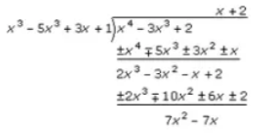
Solve: $\lim _{x \rightarrow 1} \frac{x^4-3 x^3+2}{x^3-5 x^2+3 x+1}$
Answer
Dividing $x^4-3 x^3+2$ by $x^3-5 x^2+3 x+1$
Image

$\begin{array}{l}\Rightarrow \lim _{x \rightarrow 1} \frac{x^4-3 x^3+2}{x^3-5 x^2+3 x+1}=\lim _{x \rightarrow 1}(x+2)+\lim _{x \rightarrow 1} \frac{7 x^2-7 x}{x^3-5 x^3+3 x+1} \\ =\lim _{x \rightarrow 1} x+2+\lim _{x \rightarrow 1} \frac{7 x(x-1)}{x^3-5 x^3+3 x+1} \\ =\lim _{x \rightarrow 1} x+2+\lim _{x \rightarrow 1} \frac{7 x(x-1)}{(x-1)\left(x^2-4 x-1\right)} \\ =\lim _{x \rightarrow 1} x+2+\lim _{x \rightarrow 1} \frac{7 x}{\left(x^2-4 x-1\right)}\end{array}$
$\begin{array}{l}=1+2+\frac{7}{(1-4-1)} \\ =3-\frac{7}{4} \\ =\frac{12-7}{4} \\ =\frac{5}{4}\end{array}$
View full question & answer