Question 14 Marks
Arun is running in a racecourse note that the sum of the distances from the two flag posts from him is always 10 m and the distance between the flag posts is 8 m.
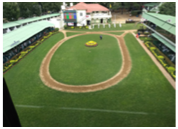
i. Path traced by Arun represents which type of curve. Find the length of major axis? (1)
ii. Find the equation of the curve traced by Arun? (1)
iii. Find the eccentricity of path traced by Arun? (2)
OR
iv. Find the length of latus rectum for the path traced by Arun. (2)
i. Path traced by Arun represents which type of curve. Find the length of major axis? (1)
ii. Find the equation of the curve traced by Arun? (1)
iii. Find the eccentricity of path traced by Arun? (2)
OR
iv. Find the length of latus rectum for the path traced by Arun. (2)
Answer
View full question & answer→i. An ellipse is the set of all points in a plane, the sum of whose distances from two fixed points in the plane is a constant. Hence path traced by Arun is ellipse.
Sum of the distances of the point moving point to the foci is equal to length of major axis =10m
ii. Given 2a = 10 & 2c = 8
$\begin{array}{l}\Rightarrow a=5 \& c=4 \\ c^2=a^2+b^2 \\ \Rightarrow 16=25+b^2 \\ \Rightarrow b^2=25-16=9\end{array}$
Equation of ellipse $\frac{x^2}{a^2}+\frac{y^2}{b^2}=1$
Required equation is $\frac{x^2}{25}+\frac{y^2}{9}=1$
iii. equation is of given curve is $\frac{x^2}{25}+\frac{y^2}{9}=1$
$a=5, b=3$ and given $2 c=8$ hence $c=4$
Eccentricity $=\frac{c}{a}=\frac{4}{5}$
OR
$\frac{x^2}{25}+\frac{y^2}{9}=1$
Hence $a=5$ and $b=3$
Length of latus rectum of ellipse is given by $\frac{2 b^2}{a}=\frac{2 \times 9}{5}=\frac{18}{5}$
Sum of the distances of the point moving point to the foci is equal to length of major axis =10m
ii. Given 2a = 10 & 2c = 8
$\begin{array}{l}\Rightarrow a=5 \& c=4 \\ c^2=a^2+b^2 \\ \Rightarrow 16=25+b^2 \\ \Rightarrow b^2=25-16=9\end{array}$
Equation of ellipse $\frac{x^2}{a^2}+\frac{y^2}{b^2}=1$
Required equation is $\frac{x^2}{25}+\frac{y^2}{9}=1$
iii. equation is of given curve is $\frac{x^2}{25}+\frac{y^2}{9}=1$
$a=5, b=3$ and given $2 c=8$ hence $c=4$
Eccentricity $=\frac{c}{a}=\frac{4}{5}$
OR
$\frac{x^2}{25}+\frac{y^2}{9}=1$
Hence $a=5$ and $b=3$
Length of latus rectum of ellipse is given by $\frac{2 b^2}{a}=\frac{2 \times 9}{5}=\frac{18}{5}$