Questions

Assertion (A) & Reason (B) MCQ

🎯

Test yourself on this topic

5 questions · timed · auto-graded

Question 11 Mark
Directions: In the following questions, the Assertions (A) and Reason(s) (R) have been put forward. Read both the statements carefully and choose the correct alternative from the following:
Assertion: The probability of drawing either an ace or a king from a pack of cards in a single draw is $\frac{2}{13}.$
Reason: For two events A and B which are not mutually exclusive,
 $\text{P}(\text{A}\cup\text{B})=\text{P}(\text{A})+\text{P}(\text{B})-\text{P}(\text{A}\cap\text{B}).$
  1. Assertion and Reason both are correct statements and Reason is the correct explanation of Assertion.
  2. Assertion and Reason both are correct statements but Reason is not the correct explanation of Assertion.
  3. Assertion is correct statement but Reason is wrong statement.
  4. Assertion is wrong statement but Reason is correct statement.
Answer
  1. Assertion and Reason both are correct statements but Reason is not the correct explanation of Assertion.

Solution:

P(Drawing either an ace or a king)$=\frac{4}{52}+\frac{4}{52}$

$=\frac{2}{13}$ ($\therefore$ Both events are mutually exclusive)

Clearly, both Assertion and Reason are correct but Reason is not the correct explanation for Assertion.
 

View full question & answer
Question 21 Mark
Directions: In the following questions, the Assertions (A) and Reason(s) (R) have been put forward. Read both the statements carefully and choose the correct alternative from the following:
Consider the experiment of rolling a die. Then, sample space is S = {1, 2, 3, 4, 5, 6}.
Assertion: The event EF : “the number appears on the die is a multiple of 7”, is an impossible event.
Reason: The event F : “the number turns up is odd or even”, is a sure event.
  1. Assertion and Reason both are correct statements and Reason is the correct explanation of Assertion.
  2. Assertion and Reason both are correct statements but Reason is not the correct explanation of Assertion.
  3. Assertion is correct statement but Reason is wrong statement.
  4. Assertion is wrong statement but Reason is correct statement.
Answer
  1. Assertion and Reason both are correct statements but Reason is not the correct explanation of Assertion.

Solution:

Given, E be the event “the number appears on the die is a multiple of 7”.

It is impossible to have a multiple of 7 on the upper face of the die.

Thus, the event $\text{E}=\phi$ is an impossible event.

The another event F is “the number turns up is odd or even”.

Clearly, F = {1, 2, 3, 4, 5, 6} = S, ie., all possible outcomes of the experiment ensure the occurrence of the event F.

Thus, the event F is a sure event.

View full question & answer
Question 31 Mark
Directions: In the following questions, the Assertions (A) and Reason(s) (R) have been put forward. Read both the statements carefully and choose the correct alternative from the following:
Assertion: A coin is tossed and then a die is rolled only in case a head is shown on the coin. The sample space for the experiment is S = (H1, H2, H3, H4, H5, H6, T}.
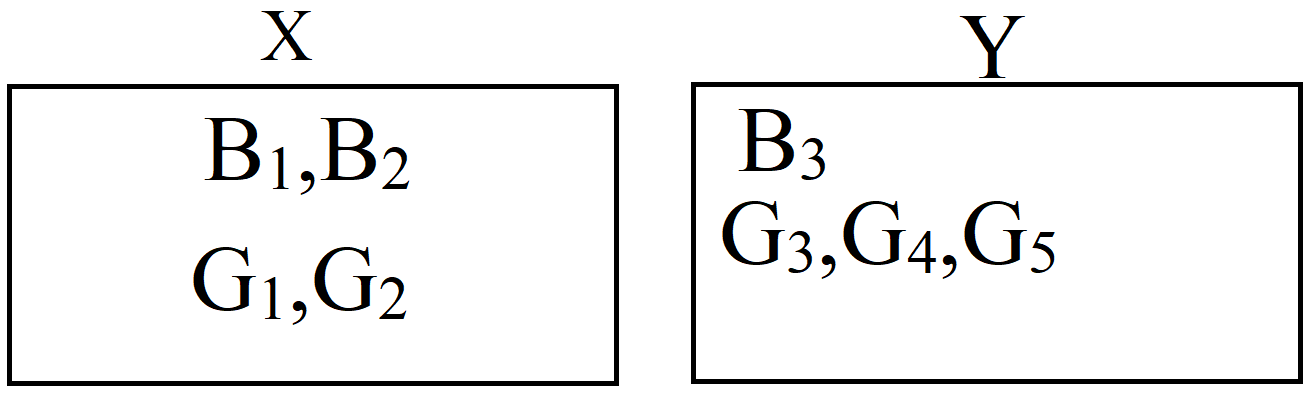
Reason: 2 boys and 2 girls are in room X, and 1 boy and 3 girls are in room Y. Then, the sample space for the experiment in which a room is selected and then a person, is S = {XB1, XB2, XG1, XG2, YB3, YG3, YG4, YG5} where Bi, denote the boys and Gj, denote the girls.
  1. Assertion and Reason both are correct statements and Reason is the correct explanation of Assertion.
  2. Assertion and Reason both are correct statements but Reason is not the correct explanation of Assertion.
  3. Assertion is correct statement but Reason is wrong statement.
  4. Assertion is wrong statement but Reason is correct statement.
Answer
  1. Assertion and Reason both are correct statements but Reason is not the correct explanation of Assertion.

Solution:

Assertion: The sample space is S = {H1, H2, H3, H4, H5, H6, T} where, H and T represents head and tail respectively of a coin.

Reason: When room X is selected, 

then there are four possibilities for selection of a person which are B1, B2, G1, G2. Similarly, there will be four possibilities for room Y.

So, the sample space is

S = {XB1, XB2, XG1, XG2, YB3, YG3, YG4, YG5}.

View full question & answer
Question 41 Mark
Directions: In the following questions, the Assertions (A) and Reason(s) (R) have been put forward. Read both the statements carefully and choose the correct alternative from the following:
Assertion: A coin is tossed. If it shows head, we draw a ball from a bag consisting of 3 brown and 4 red balls; if it shows tail we throw a die, then the sample space of this experiment is S = {HB1, HB2, HB3, HR1, HR2, HR3, HR4, T1, T2, T3, T4, T5, T6}.
Reason: Consider the experiment in which a coin is tossed repeatedly until a head comes up, then the sample space is S = {H, TH, TTH, TTTH,........ }.
  1. Assertion and Reason both are correct statements and Reason is the correct explanation of Assertion.
  2. Assertion and Reason both are correct statements but Reason is not the correct explanation of Assertion.
  3. Assertion is correct statement but Reason is wrong statement.
  4. Assertion is wrong statement but Reason is correct statement.
Answer
  1. Assertion and Reason both are correct statements but Reason is not the correct explanation of Assertion.

Solution:

Assertion: Let us denote brown balls by B1, B2, B3, and the red balls by R1, R2, R3, R4. Then, a sample space of the experiment is S = {HB1, HB2, HB3, HR1, HR2, HR3, HR4, T1, T2, T3, T4, T5, T6}.

Reason: In the experiment, head may come up on the 1st toss, or the 2nd toss, or the 3rd toss and so on till head is obtained. Hence, the desired sample space is S = {H, TH, TTH, TTTH, TTTTH......}

View full question & answer
Question 51 Mark
Directions: In the following questions, the Assertions (A) and Reason(s) (R) have been put forward. Read both the statements carefully and choose the correct alternative from the following:
Consider the experiment of rolling a die. Then, sample space is S = {1, 2, 3, 4, 5, 6}.
Assertion: If sample space of an experiment is S = {1, 2, 3, 4, 5, 6} and the events A and B are defined as
A : “a number less than or equal to 3 appears”
B :“anumber greater than or equal to 3 appears”,
then A and B are exhaustive events.
Reason: Events are exhaustive if atleast one of them necessarily occur whenever the experiment is performed.
  1. Assertion and Reason both are correct statements and Reason is the correct explanation of Assertion.
  2. Assertion and Reason both are correct statements but Reason is not the correct explanation of Assertion.
  3. Assertion is correct statement but Reason is wrong statement.
  4. Assertion is wrong statement but Reason is correct statement.
Answer
  1. Assertion and Reason both are correct statements and Reason is the correct explanation of Assertion.

Solution:

We have A = {1, 2, 3} and B = {3, 4, 5, 6}

Since $\text{A}\cup\text{B}=\text{S},$

so, A and B are exhaustive events.

View full question & answer
Assertion (A) & Reason (B) MCQ - MATHS STD 11 Science Questions - Vidyadip