Questions

M.C.Q (1 Marks)

Take a timed test

12 questions · self-marked practice — reveal the answer and mark yourself.

Question 11 Mark

In a non-leap year, the probability of having 53 tuesdays or 53 wednesdays is:

  1. $\frac{1}{7}$

  2. $\frac{2}{7}$

  3. $\frac{3}{7}$

  4. none os these.

Answer
  1. $\frac{1}{7}$

Solution:

There are 365 days in non-leap year and there are 7 days in a week

$\therefore\ 365\div7=52$ weeks + 1 days

So, this day may be Tuesday or Wednesday.

So, the required probability $=\frac{1}{7}$
View full question & answer
Question 21 Mark

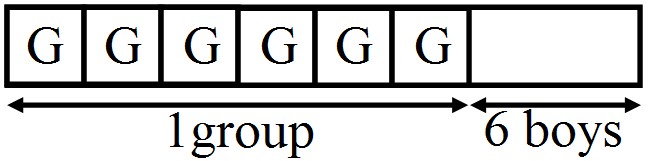
6 boys and 6 girls sit in a row at random. The probability that all the girls sit together is:

  1. $\frac{1}{432}$

  2. $\frac{12}{431}$

  3. $\frac{1}{132}$

  4. none of these.

Answer
  1. $\frac{1}{132}$

Solution:

If all the girls sit together, then we consider it as 1 group

$\therefore$ Total number of arrangement of 6 + 1 = 7 persons in a row = 7! And the girls also interchanged their places with 6! Ways.

$\therefore\ \text{Required probability}=\frac{6!7!}{12!}$

$=\frac{6\times5\times4\times3\times2\times7!}{12\times11\times10\times9\times8\times7!}=\frac{1}{132}$

View full question & answer
Question 31 Mark

The probability that at least one of the events A and B occurs is 0.6. If A and B occur simultaneously with probability 0.2, then $\text{P}(\bar{\text{A}})+\text{P}(\bar{\text{B}})$ is:

  1. 0.4
  2. 0.8
  3. 1.2
  4. 1.6
Answer
  1. $1.2$

Solution:

We have, $\text{P}(\text{A}\cup\text{B})=0.6$ and $\text{P}(\text{A}\cap\text{B})=0.2$

$\therefore\ \text{P}(\text{A}\cup\text{B})=0.6$ and $\text{P}(\text{A}\cap\text{B})=0.2$

$\Rightarrow0.6=\text{P(A)}+\text{P(B)}-0.2$

$\Rightarrow\text{P(A)}+\text{P(B)}=0.8$

$\therefore\ \text{P}(\bar{\text{A}})+\text{P}(\bar{\text{B}})=1-\text{P(A)}+1-\text{P(B)}$

$=2-\big[\text{P(A)}+\text{P(B)}\big]=2-0.8=1.2$

View full question & answer
Question 41 Mark

A single letter is selected at random from the word ‘PROBABILITY’. The probability that it is a vowel is:

  1. $\frac{1}{3}$

  2. $\frac{4}{11}$

  3. $\frac{2}{11}$

  4. $\frac{3}{11}$

Answer
  1. $\frac{4}{11}$

Solution:

Total number of alphabets in probability = 11

Number of vowels = 4

$\therefore\ \text{Required probability}=\frac{4}{11}$

View full question & answer
Question 51 Mark

While shuffling a pack of 52 playing cards, 2 are accidentally dropped. Find the probability that the missing cards to be of different colours:

  1. $\frac{29}{52}$

  2. $\frac{1}{2}$

  3. $\frac{26}{51}$

  4. $\frac{27}{51}$

Answer
  1. $\frac{26}{51}$

Solution:

We know that out of 52 playing cards 26 are of red and 26 are of black colour.

$\therefore$ P(both cards of differents colour)

$=\frac{26}{52}\times\frac{26}{51}+\frac{26}{52}\times\frac{26}{51}$

$=2\times\frac{26}{52}\times\frac{26}{51}=\frac{6}{51}$

View full question & answer
Question 61 Mark

If $\text{P}(\text{A}\cup\text{B})=\text{P}(\text{A}\cap\text{B})$ for any two events A and B, then:

  1. $\text{P(A)}=\text{P(B)}$

  2. $\text{P(A)}>\text{P(B)}$

  3. $\text{P}(\text{A})<\text{P(B)}$

  4. none of these.

Answer
  1. $\text{P(A)}=\text{P(B)}$

Solution:

Given that, $\text{P}(\text{A}\cup\text{B})=\text{P}(\text{A}\cap\text{B})$

$\Rightarrow\text{P}(\text{A})+\text{P}(\text{B})-\text{P}(\text{A}\cap\text{B})=\text{P}(\text{A}\cap\text{B})$

$\Rightarrow\big[\text{P(A)}-\text{P}(\text{A}\cap\text{B})\big]+\big[\text{P(B)}-\text{P}(\text{A}\cap\text{B})\big]=0$

But $\text{P(A)}-\text{P}(\text{A}\cap\text{B})\geq0\ ....(\text{i})$

$\big[\because\ \text{P}(\text{A}\cap\text{B})\leq\text{P(A)}\text{ or }\text{P(B)}\big]$

And $\text{P}(\text{B})-\text{P}(\text{A}\cap\text{B})\geq0\ ...(\text{ii})$

From eq. (i) and (ii) we get

$\text{P(A)}=\text{P(B)}$

View full question & answer
Question 71 Mark

Seven persons are to be seated in a row. The probability that two particular persons sit next to each other is:

  1. $\frac{1}{3}$

  2. $\frac{1}{6}$

  3. $\frac{2}{7}$

  4. $\frac{1}{2}$

Answer
  1. $\frac{1}{3}$

Solution:

If two persons sit next to each other, then consider these two person as 1 geoup.

Now, we have to arrange 6 persons.

$\therefore$ Number of arrangement = 2! × 6!

Total number of arrangement of 7 person = 7!

$\therefore\ \text{Required probability}=\frac{2!6!}{7!}=\frac{2}{7}$

View full question & answer
Question 81 Mark

Without repetition of the numbers, four digit numbers are formed with the numbers 0, 2, 3, 5. The probability of such a number divisible by 5 is:

  1. $\frac{1}{5}$

  2. $\frac{4}{5}$

  3. $\frac{1}{30}$

  4. $\frac{5}{9}$

Answer
  1. $\frac{5}{9}$

Solution:

We have digite 0, 2, 3, 5.

Number of divisible by 5 if unit place digit is '0' or '5'

If unit place is '0' then first three places can be filled in 3! ways.

If unit place is '5' then first place can be filled in two ways and second and thried place can be filled in 2! ways.

So, number of numbers ending with digit '5' is 2 × 2! = 4

$\therefore$ Total number of numbers divisible by 5 = 3! + 4 = 110 = n(E)

Also total number of numbers = 3 × 3! = 18

$\therefore\ \text{Required probability}=\frac{10}{18}=\frac{5}{9}$

View full question & answer
Question 91 Mark

Three numbers are chosen from 1 to 20. Find the probability that they are not consecutive:

  1. $\frac{186}{190}$

  2. $\frac{187}{190}$

  3. $\frac{188}{190}$

  4. $\frac{18}{^{20}\text{C}_3}$

Answer
  1. $\frac{187}{190}$

Solution:

Since, the set of three consecutive numbers from 1 to 20 are (1, 2, 3), (2, 3, 4), (3, 4, 5), ....... , (18, 19, 20), i.e., 18

P(numbers are consecutive)

$=\frac{18}{^{20}\text{C}_3}=\frac{18}{\frac{20\times19\times18}{3!}}=\frac{3}{190}$

P(three number are not consecutive)

$=1-\frac{3}{190}=\frac{187}{190}$

View full question & answer
Question 101 Mark

If the probabilities for A to fail in an examination is 0.2 and that for B is 0.3, then the probability that either A or B fails is:

  1. $>0.5$

  2. $0.5$

  3. $\leq0.5$

  4. $0$

Answer
  1. $\leq0.5$

Solution:

Given, P(A fail) = 0.2

and P(B fail) = 0.3

$\therefore\ \text{P(either A or B fail)}\leq\text{P(A fail)}+\text{P(B fail)}$

$\leq0.2+0.3$

$\leq0.5$

View full question & answer
Question 111 Mark

If A and B are mutually exclusive events, then:

  1. $\text{P(A)}\leq\text{P}(\bar{\text{B}})$

  2. $\text{P(A)}\geq\text{P}(\bar{\text{B}})$

  3. $\text{P}(\text{A})<\text{P}(\bar{\text{B}})$

  4. none of these.

Answer
  1. $\text{P(A)}\leq\text{P}(\bar{\text{B}})$

Solution:

For mutually exclusive events,

$\text{P}(\text{A}\cap\text{B})=0$

$\therefore\ \text{P}(\text{A}\cup\text{B})=\text{P(A)}+\text{P(B)}$ $\big[\because\text{ P}(\text{A}\cap\text{B})=0\big]$

$\Rightarrow\text{P}(\text{A})+\text{P(B)}\leq1$

$\Rightarrow\text{P(A)}+1-\text{P}(\bar{\text{B}})\leq1$ $\big[\text{P(B)}=1-\text{P}(\bar{\text{B}})\big]$

$\Rightarrow\text{P(A)}-\text{P}(\bar{\text{B}})\leq0$

$\Rightarrow\text{P(A)}-\text{P}(\bar{\text{B}})$

View full question & answer
Question 121 Mark

If M and N are any two events, the probability that at least one of them occurs is:

  1. $\text{P(M)}+\text{P(N)}-2\text{P(M}\cap\text{N)}$

  2. $\text{P(M)}+\text{P(N)}-\text{P(M}\cap\text{N)}$

  3. $\text{P(M)}+\text{P(N)}+\text{P(M}\cap\text{N)}$

  4. $\text{P(M)}+\text{P(N)}+2\text{P(M}\cap\text{N)}$

Answer
  1. $\text{P(M)}+\text{P(N)}-\text{P(M}\cap\text{N)}$

Solution:

If M and N are any two events.

$\text{P(M}\cup\text{N)}=\text{P(M)}+\text{P(N)}-\text{P(M}\cap\text{N)}$

View full question & answer