Question 11 Mark
Let R be a relation from N to N defined by R = {(a, b) : a, b $\in$ N and a = b2}. Check whether, (a, b) $\in$ R, (b, c) $\in$ R implies $(a, c) \in R$ ? Justify your answer.
AnswerWe have, R = {(a, b) : a, b $\in$ N and a = b2 }$$ $$ $$ $$ $$ $$
As we see, (9, 3) $\in$ R, (16, 4) $\in$ R because 3, 4, 9, 16 $\in$ N and 9 = 32 and 16 = 42
Now, 9 $\neq$ 42 = 16 ; therefore, (9, 4) does not belong to N
Hence, the statement is not true.
View full question & answer→Question 21 Mark
Let R be a relation from N to N defined by R = {(a, b) : a, b $\in$ N and a = b2}. Is the given statement true? (a, b) $\in$ R, implies $(b,a) \in R$ ? Justify your answer.
AnswerHere we have, R = {(a, b) : a, b $\in$ N and a = b2}
Also (a, b) $\in$ R, implies $(b,a) \in R$
As we can see that (4, 2) $\in$ N and 4 = 22 = 4 but $\begin{equation} 2 \neq 4^{2}=16 \end{equation}$. Hence, (2, 4) does not belong to N.
Hence, the statement is not true.
View full question & answer→Question 31 Mark
Let R be a relation from N to N defined by R = {(a, b) : a, b $\in$ N and a = b2}. Check whether $(a,a) \in R$ for all $a \in N$ ? Justify your answer.
AnswerWe have, R = {(a, b): a, b $\in$ N and a = b2}
(a, a) $\in$ R, for all a $\in$ N
As we can see that 3 $\in$ N but 3 $\neq$ 32 = 9
Hence, the statement is not true.
View full question & answer→Question 41 Mark
If A = {9, 10, 11, 12,13} and f : A $\rightarrow$ N be defined by f(n) = the highest prime factor of n, then find the range of f.
Answerf(n) = Highest prime factor of n
$\therefore$ $f(9) = 3, f(10) = 5$
$f(11 ) = 11, f(12) = 3$ and $f(13) = 13$
$\Rightarrow$ f = {$(9, 3), (10, 5), (11,11), (12, 3), (13, 13)$}
Hence, range of f = {3, 5,11,13}.
View full question & answer→Question 51 Mark
Let A = {1, 2, 3, 4}, B = {1, 5, 9, 11, 15, 16} and f = {(1, 5), (2, 9), (3, 1), (4, 5), (2,11)}. Is the given statement true? f is a function from A to B? Justify your answer.
AnswerHere it is given that: A = {1, 2, 3, 4}, B = {1, 5, 9, 11, 15, 16} and f = {(1, 5),(2, 9),(3, 1),(4, 5),(2, 11)}
Now we have, A B = {(1, 1), (1, 5), (1, 9), (1, 11), (1, 16), (2, 1), (2, 5), (2, 9), (2, 15), (2, 16), (3, 1), (3, 5), (3, 9), (3, 11), (3, 15), (3, 16), (4, 1), (4, 5),(4, 9), (4, 11), (4, 15), (4, 16)
f is a function from A to B.
f = {(1, 5),(2, 9),(3, 1),(4, 5),(2, 11)}
Since we observe that the same first element i.e. 2 corresponds to two different images that is 9 and 11. Thus f is not a function from A to B.
View full question & answer→Question 61 Mark
Let A = {1, 2, 3, 4}, B = {1, 5, 9, 11, 15, 16} and f = {(1, 5), (2, 9), (3, 1), (4, 5), (2,11)}. Is the following given statement true? f is a relation from A to B. Justify your answer.
AnswerHere it is given that: A = {1, 2, 3, 4}, B = {1, 5, 9, 11, 15, 16} and f = {(1, 5),(2, 9),(3, 1),(4, 5),(2, 11)}
Now, we have A $\times$ B = {(1, 1), (1, 5), (1, 9), (1, 11), (1, 16), (2, 1), (2, 5), (2, 9), (2, 15), (2, 16), (3, 1), (3, 5), (3, 9), (3, 11), (3, 15), (3, 16), (4, 1), (4, 5),(4, 9), (4, 11), (4, 15), (4, 16)}
Now f is a relation from A to B i.e,
f = {(1, 5), (2, 9), (3, 1), (4, 5), (2, 11)}
A relation from a non empty set A to a non empty set B is a subset of the Cartesian product A $\times$ B.
And we can see f is a subset of A $\times$ B.
Hence f is a relation from A to B statement is true.
View full question & answer→Question 71 Mark
Find the range of f(x) = x, x is a real number.
AnswerWe have, f(x) = x, where x is a real number.
It is clear that range of f(x) is set of all real numbers.
Hence, range of f(x) = R
View full question & answer→Question 81 Mark
Find the range of f(x) = x2 + 2, x is a real number.
AnswerHere we have, f(x) = x2 + 2, x is a real number.
As x2 > 0
$\Rightarrow x^{2}+2>0+2$
$\Rightarrow x^{2}+2>2$
$\Rightarrow f(x)>2$
Hence, range of f(x) = [2, $\infty$)
View full question & answer→Question 91 Mark
Find the range of f(x) = 2 - 3x, x $ \in $ R, x > 0.
AnswerLet $f(x) = y = 2 - 3x$ $\Rightarrow \quad x = \frac { 2 - y } { 3 }$
Now, x > 0 $\Rightarrow$ $2 - y$ > 0 $\Rightarrow$ y < 2
$\therefore$ Range (f) = {y: y $ \in $ R and $y \geq 2$} or $[ 2 , \infty )$
View full question & answer→Question 101 Mark
If the function t which maps temperature in degree Celcius into temperature in degree Fahrenheit is defined by t(C) = $\frac{9C}{5}$+ 32, then find t(0).
AnswerHere it is given that, $t(C) =$ $\frac{9 C}{5}$$+ 32$
Put C = 0, we get
$t(0) =$ $\frac{9 \times 0}{5}$ + 32 = 0 + 32 = 32
View full question & answer→Question 111 Mark
A function f is defined by f(x) = 2x –5. What is the value of f(-3)?
AnswerWe have, f(x) = 2x - 5
Putting x = -3
$\therefore f( - 3) = 2 \times - 3 - 5 = - 11$
View full question & answer→Question 121 Mark
A function f is defined by f(x) = 2x –5. What is the value of f(7)?
AnswerWe have, f(x) = 2x - 5
Putting x = 7
$\therefore f(7) = 2 \times 7 - 5 = 9$
View full question & answer→Question 131 Mark
A function f is defined by f(x) = 2x –5. What is the value of f(0)?
AnswerWe have, f(x) = 2x - 5
Putting x = 0
$\therefore $ f (0) = 2 $\times$ 0 - 5 = - 5
View full question & answer→Question 141 Mark
Find the domain and range of the real function: $\begin{equation} f(x)=\sqrt{9-x^{2}} \end{equation}$
AnswerHere the given function is: $\begin{equation} f(x)=\sqrt{9-x^{2}} \end{equation}$
Domain: These are the values of x for which f(x) is defined. From the given f(x) we can say that, f(x) should be real and for that, 9 - x2 $\geq$ 0 [since a value less than 0 will give an imaginary value] (3 + x)(3 - x) $\geq$ 0. Now there are two critical points, x = +3 and x = -3. Taking a value less than -3 and putting in the expression we get, (3 - 5)(3 + 5) = -ve value and thus plotting these on number line we have
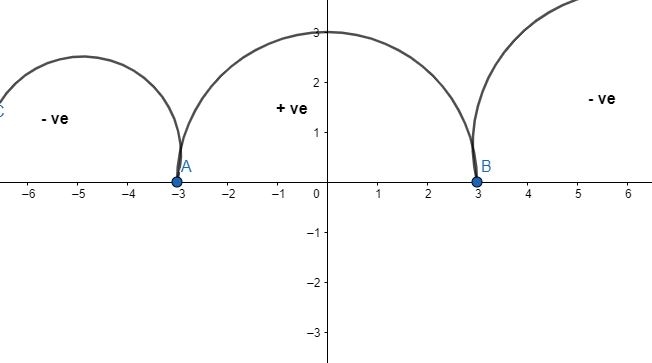
Since, f(x) is defined for all real numbers that are greater than or equal to -3 and less than or equal to 3, the domain of f(x) is [-3, 3].
Range: The values of f(x) obtained by putting possible values of x. From the f(x) we can see that, the values obtained will only be positive and can be any positive number less than 3. Hence the range of f(x) = [0, 3).
View full question & answer→Question 151 Mark
Find the domain and range of the real function: f(x) = - |x|
AnswerHere the given function is: f(x) = -|x|
As we know that,
$\begin{equation} |\mathrm{X}|=\left\{\begin{array}{l} {\mathrm{x}, \text { if } \mathrm{x} \geq 0} \\ {-\mathrm{x}, \text { if } \mathrm{x}<0} \end{array}\right. \end{equation}$
$\begin{equation} f(x)=-|x|=\left\{\begin{array}{l} {-x, \text { if } x \geq 0} \\ {x, \text { if } x<0} \end{array}\right. \end{equation}$
Domain: The values that can be put in the function to obtain real value. For example f(x) = x, now we can put any value in place of x and we will get a real value. Hence, the domain of this function will be Real Numbers.
Range: The values that we obtain of the function after putting the value from the domain. For Example: f(x) = x + 1, now if we put x = 0, f(x) = 1 . This 1 is a value of Range that we obtained. Since, f(x) is defined for x $\in$ R, the domain of f is R.
It can be observed that the range of f(x) = -|x| is all real numbers except positive real numbers. Because we will always get a negative number when we put a value from a domain.
Thus, the range of function is f(x) is (-$\infty$, 0]
View full question & answer→Question 161 Mark
State that the given relation is a function? Give reason. If it is a function, determine its domain and range:R= {(1, 3), (1, 5), (2, 5)}
AnswerWe have, R= {(1, 3), (1, 5), (2, 5)}
This relation is not a function because there is an element 1 which is associated to two elements 3 and 5.
View full question & answer→Question 171 Mark
State that the given relation is a function? Give reason. If it is a function, determine its domain and range. R={(2, 1), (4, 2), (6, 3), (8, 4), (10,5), (12, 6), (14, 7)}
AnswerThe given relation is,
{(2, 1), (4, 2), (6, 3), (8, 4), (10, 5), (12, 6), (14, 7)}
All values of x are distinct. Each value of x has a unique value of y.
Therefore, the relation is a function.
$\therefore $ Domain of function = {2, 4, 6, 8, 10, 12, 14}
Range of function = {1, 2, 3, 4, 5, 6, 7}
View full question & answer→Question 181 Mark
State that the given relation is a function? Give reason. If it is a function, determine its domain and range. {(2, 1), (5, 1), (8, 1), (11, 1), (14, 1), (17, 1)}
AnswerHere the given relation is:
{(2, 1), (5, 1), (8, 1), (11, 1), (14, 1), (17, 1)}
All values of x are distinct. Each value of x has a unique value of y.
So the relation is a function.
Therefore, the domain of function = {2,5, 8, 11, 14, 17}
Range of function = {1}
View full question & answer→Question 191 Mark
Let R be the relation on Z defined by R = {(a, b): $a,b \in {Z}$, a - b is an even integer. Find the domain and range of R.
AnswerHere R = {(a, b): a, b, $ \in Z$, a - b is an integer}
= {(a, b) : a, b $ \in Z$, both a and b are even or both a and b are odd}
= {(a, b): a, b $ \in Z$, (a and b are even) $ \cup $ (a and b are odd)}
$\therefore $ Domain of R = Z
Range of R = Z
View full question & answer→Question 201 Mark
Let A = {x, y, z} and B = {1, 2}. Find the number of relations from A to B.
AnswerHere A ={x, y, z} and B = {1, 2}
Number of elements in set A = 3
Number of elements in set B = 2
Number of subsets of $A \times B = 3 \times 2 = 6$
Number of relations from A to B = 26
View full question & answer→Question 211 Mark
Write the relation R= {(x, x3) : x is a prime number less than 10} in roster form.
AnswerR = {(x, x3) : x is a prime number less than 10}
Putting x = 2, 3, 5 , 7
R = {(2, 8), (3, 27), (5, 125), (7, 343)}
View full question & answer→Question 221 Mark
Determine the domain and range of the relation R defined by R = {(x, x + 5): x $ \in $ (0, 1, 2, 3, 4, 5)}
AnswerHere R = {(x, x + 5): $x \in $(0, 1, 2, 3, 4, 5)}
= {(a, b): a = 0, 1, 2,3, 4, 5}
Now a = x and b = x + 5
Putting a = 0, 1, 2, 3, 4, 5 we get b = 5, 6, 7, 8, 9, 10
$\therefore $ Domain of R = {0, 1, 2, 3, 4, 5}
Range of R = {5, 6, 7, 8, 9, 10}
View full question & answer→Question 231 Mark
The figure shows a relationship between the sets P and Q. Write this relation roster form. What is its domain and range?
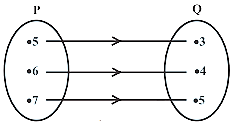
AnswerFrom the figure, the relation in roaster form is, R = {(5, 3), (6, 4), (7, 5)}
As Domain of R = set of all first elements of the order pairs in the relation.
$\Rightarrow$ Domain of R = {5, 6, 7}
Range of R = set of all second elements of the order pairs in the relation.
$\Rightarrow$ range of R = {3, 4, 5}.
View full question & answer→Question 241 Mark
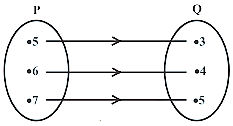
The figure shows a relationship between the sets P and Q. Write this relation in the set-builder form. What is its domain and range?
Answer
The relation in set builder form is, R = {(x, y): y = x - 2; x $\in$ P}
or R = {(x, y): y = x - 2; for x = 5, 6, 7}
View full question & answer→Question 251 Mark
A = {1, 2, 3, 5} and B = {4, 6, 9}. Define a relation R from A to B by
R = {(x, y): the difference between x and y is odd, ${ x } \in A , y \in B \}$. Write R in roster form.
AnswerGiven, A = {1, 2, 3, 5} and B = {4, 6, 9}
R = {(x, y): the difference between x and y is odd, $x \in A , y \in B \}$
In roster form, R = {(1, 4), (1, 6), (2, 9), (3, 4), (3, 6), (5, 4), (5, 6)}.
View full question & answer→Question 261 Mark
Define a relation R on the set N of natural numbers by R = {(x, y): y = x + 5, x is a natural number less than 4; x, y $ \in N$]. Depict this relationship using roster from. Write down the domain and the range.
AnswerHere R = {(x, y) : y = x + 5, x is a natural number less than 4; $x,y \in N$}
Putting x = 1, 2, 3 in y = x + 5 we get y = 6, 7, 8
$\therefore $ R = {(1, 6), (2, 7), (3, 8)}
Domain = {1, 2, 3}
Range = {6, 7, 8}
View full question & answer→Question 271 Mark
Let A = {1, 2, 3, . . . 14}. Define a relation R from A to A by R = {(x, y): 3x - y = 0, where $x,y \in A$}. Write down its domain, codomain and range.
AnswerHere A = {1, 2, 3, . . . , 14}
We shall consider the ordered pairs which satisfy 3x - y = 0
They are (1, 3), (2, 6), (3, 9) and (4, 12)
Thus R = {(1, 3), (2, 6), (3, 9), (4, 12)}
$\therefore $ Domain = {1, 2, 3, 4}
Range = {3, 6, 9, 12}
Codomain = {1, 2,3, . . . , 14}
View full question & answer→Question 281 Mark
Let A and B be two sets such that n(A) = 3 and n(B) = 2. If (x, 1), (y, 2), (z, 1) are in A $\times$ B., find A and B, where x, y and z are distinct elements.
AnswerHere (x, 1) $\in$ A $\times$ B $\Rightarrow$ x $\in$ A and 1 $\in$ B
(y, 2) $\in$ A $\times$ B $\Rightarrow$ y $\in$ A and 2 $\in$ B
(z, 1) $\in$ A $\times$ B $\Rightarrow$ z $\in$ A and 1
It is given that n(A) = 3 and n(B) = 2
$\therefore $ A = {x, y, z}
and B = {1, 2}
View full question & answer→Question 291 Mark
Let A = {1, 2} and B = {3, 4}. Write $A \times B$. How many sub sets will $A \times B$ have? List them.
AnswerHere A = {1, 2} and B = {3, 4}
$\therefore A \times B = (1,2) \times (3,4\} $
= {(1, 3}, (1, 4), (2, 3), (2, 4)}
Number of elements in $A \times B = 4$
Number of subsets of $A \times B = {2^4} = 16$
The subset are:
$\phi ,${(1, 3)}, {(1, 4)}, {(2, 3)}, {(2, 4)}, {(1, 3), (1, 4)}, {(1, 3), (2, 3)}, {(1, 3), (2, 4)}, {(1,4), (2, 3)}, {(1, 4), (2, 4)}, {(2, 3), (2, 4)}, {(1, 3), (1, 4), (2, 3)}, {(1, 3), (1, 4), (2, 4)}, {(1, 3), (2, 3), (2, 4)} {(1, 4), (2, 3), (2, 4)}, {(1, 3), (1, 4), (2, 3), (2, 4)}
View full question & answer→Question 301 Mark
Let A = {1, 2}, B = {1, 2, 3, 4}, C = {5, 6} and D = {5, 6, 7, 8}. Verify that: A $\times$ C is a subset of B $\times$ D.
AnswerHere it is given that: $A=\{1,2\}, B=\{1,2,3,4\}, C=\{5,6\}\ and \ D=\{5,6,7,8\}$
To verify: A $\times$ C is a subset of B $\times$ D
(A $\times$ C) = {(1, 5),(1, 6),(2, 5),(2, 6)}
B $\times$ D = {(1, 5),(1, 6),(1, 7),(1, 8),(2, 5),(2, 5),(2, 7),(2, 8),(3, 5),(3, 6),(3, 8),(4, 5),(4, 7),(4, 8)}
As we see all the elements of set A $\times$ B are there in set B $\times$ D
Hence, A $\times$ C is a subset of B $\times$ D.
View full question & answer→Question 311 Mark
Let A = {1, 2}, B = {1, 2, 3, 4}, C = {5, 6} and D = {5, 6, 7, 8}. Verify that: A $\times$ (B $\cap$ C) = (A $\times$ B) $\cap$ (A $\times$ C)
AnswerGiven: $A=\{1,2\}, B=\{1,2,3,4\}, C=\{5,6\} \ and \ D=\{5,6,7,8\}$
To verify: $A \times(B \cap C)=(A \times B) \cap(A \times C)$
As we see, $\mathrm{B} \cap \mathrm{C}=\{1,2,3,4\} \cap\{5,6\}=\phi$
By definition if either of the two set P and Q is null set then $P \times Q$ will also be a null set. i.e. $P \times Q=\phi$
$\Rightarrow \mathrm{A} \times(\mathrm{B} \cap \mathrm{C})=\phi$ ......(i)
Now, $(A \times B)$ = {(1, 1),(1, 2),(1, 3),(1, 4),(2, 1),(2, 2),(2, 3),(2, 4)}
And $(A \times C)$ = {(1, 5),(1, 6),(2, 5),(2, 6)}
$\Rightarrow(A \times B) \cap(A \times C)=\phi$ ........(ii)
From (i) and (ii), we have
$\mathrm{A} \times(\mathrm{B} \cap \mathrm{C})=(\mathrm{A} \times \mathrm{B}) \cap(\mathrm{A} \times \mathrm{C})$
Hence proved.
View full question & answer→Question 321 Mark
If $A \times B$= {(a, x), (a, y), (b, x), (b, y)}, find A and B.
AnswerHere $A \times B$ = {(a, x), (a, y), (b, x), (b, y)}
A = set of first elements = {a, b}
B = set of second elements = {x, y}
View full question & answer→Question 331 Mark
If A = {-1, 1} find $A \times A \times A$
AnswerHere A= {-1, 1}
$A \times A$ = {(-1, -1), (-1, 1), (1, -1),(1,1)}
$\therefore A \times A \times A$= {(-1, -1, -1), (-1, -1, 1), (-1, 1, -1), (-1, 1, 1), (1, -1, -1)
(1, -1, 1), (1, 1, -1), (1, 1, 1)}
View full question & answer→Question 341 Mark
If G ={7, 8) and H = {5, 4, 2}, find $G \times H$and $H \times G$.
AnswerHere G = {7, 8} and H = {5, 4, 2}
$\therefore G \times H$= { (7, 5), (7, 4), (7, 2), (8, 5), (8, 4), (8, 2)}
and $H \times G$= {(5, 7), (5, 8), (4, 7), (4, 8), (2, 7), (2, 8)}
View full question & answer→Question 351 Mark
If the set A has 3 elements and set B = {3, 4, 5}, then find the number of elements in A $\times$ B.
AnswerSet A has 3 elements and set $B$ also has $3$ elements, $\therefore$ the number of elements in $A\times B = 3\times 3 = 9$
View full question & answer→Question 361 Mark
The Cartesian product $A \times A$ has 9 elements among which are found to be (-1, 0) and (0, 1). Find the set A and the remaining element of $A \times A$.
AnswerHere $( - 1,0) \in A \times A \Rightarrow - 1 \in A$ and $0 \in A$
(0, 1) $ \in A \times A \Rightarrow 0 \in A$ and $1 \in A$
$\therefore - 1,0,1, \in A$
It is given that $n(A \times A) = 9$ which implies that n (A) = 3
$\therefore $ A = (-1, 0, 1)
$\therefore $ $A \times A$ = {(-1, -1), (-1, 0), (-1, 1) (0, -1), (0, 0), (0, 1), (1, -1), (1, 0), (1, 1)}
So the remaining elements of $A \times A$ are
(-1, 1), (-1, 1), (0, -1), (0, 0), (1, -1), (1, 0) and (1, 1)
View full question & answer→Question 371 Mark
If $\left( \frac { x } { 3 } + 1 , y - \frac { 2 } { 3 } \right) = \left( \frac { 5 } { 3 } , \frac { 1 } { 3 } \right),$ find the values of x and y.
AnswerGiven, $\left( \frac { x } { 3 } + 1 , y - \frac { 2 } { 3 } \right) = \left( \frac { 5 } { 3 } , \frac { 1 } { 3 } \right)$
Comparing corresponding elements,
$\Rightarrow \frac { x } { 3 } + 1 = \frac { 5 } { 3 }$and $y - \frac { 2 } { 3 } = \frac { 1 } { 3 }$
$\Rightarrow \quad \frac { x } { 3 } = \frac { 5 } { 3 } - 1$and $y = \frac { 1 } { 3 } + \frac { 2 } { 3 }$
$\Rightarrow \quad \frac { x } { 3 } = \frac { 5 - 3 } { 3 }$and $y = \frac { 3 } { 3 }$
$\Rightarrow \quad \frac { x } { 3 } = \frac { 2 } { 3 }$ and $y = 1$
$\therefore$ $x = 2$ and $y = 1$
View full question & answer→Question 381 Mark
Let A = {1, 2} and B = {3, 4}. Find the number of relations from A to B.
AnswerGiven that, A = {1, 2} and B = {3, 4}
We have, A $\times$ B = {(1, 3), (1, 4), (2, 3), (2, 4)}.
Since n (A $\times$ B ) = 4, the number of subsets of A $\times$ B is 24.
Therefore, the number of relations from A into B will be 24
View full question & answer→Question 391 Mark
The fig.shows a relation between the sets P and Q. Write this relation in roster form. What is its domain and range?
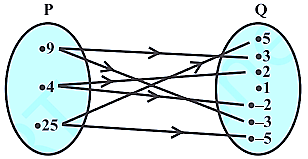
AnswerFrom the fig,we can write,
R = {(9, 3), (9, –3), (4, 2), (4, –2), (25, 5), (25, –5)}
The domain of this relation is {4, 9, 25}.
The range of this relation is {– 2, 2, –3, 3, –5, 5}
View full question & answer→Question 401 Mark
The fig.shows a relation between the sets P and Q. Write this relation in set-builder form
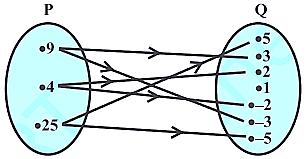
AnswerFrom the fig,we observe that the relation R is “x is the square of y”.
In set-builder form, R = {(x, y): x is the square of y, x $∈$ P, y $∈$ Q}
View full question & answer→Question 411 Mark
Let A = {1, 2, 3, 4, 5, 6}. Define a relation R from A to A by R = {(x, y) : y = x + 1 }. Write down the domain, codomain and range of R
AnswerWe have, R={(x,y):y=x+1}
Since A={1,2,3,4,5,6}
Therefore, R={(1,2),(2,3),(3,4),(4,5),(5,6)}
Therefore, domain ={1, 2, 3, 4, 5,}
Similarly, the range = {2, 3, 4, 5, 6} and the co-domain = {1, 2, 3, 4, 5, 6}
View full question & answer→Question 421 Mark
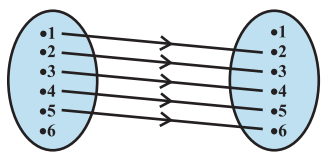
Let A = {1, 2, 3, 4, 5, 6}. Define a relation R from A to A by R = {(x, y) : y = x + 1 }. Depict this relation using an arrow diagram.
AnswerWe have,
R = {(1,2), (2,3), (3,4), (4,5), (5,6)}
The corresponding arrow diagram is shown in Fig.
View full question & answer→Question 431 Mark
If R is the set of all real numbers, what do the cartesian products R $\times$ R and R $\times$ R $\times$ R represent?
AnswerWe have, $$ R $\times$ R = {(x, y) : x, y $\in$ R}.
This represents the coordinates of all the points in two dimensional space and the cartesian product R $\times$ R $\times$ R represents the set R $\times$ R $\times$ R = {(x, y, z) : x, y, z $\in$ R} which represents the coordinates of all the points in three-dimensional space.
View full question & answer→Question 441 Mark
If P = {1, 2}, form the set P $\times$ P $\times$ P
Answer P $\times$ P $\times$ P = {(1, 1, 1), (1, 1, 2), (1, 2, 1), (1, 2, 2), (2, 1, 1), (2, 1, 2), (2, 2, 1), (2, 2, 2)}
View full question & answer→Question 451 Mark
If P = {a, b, c} and Q = {r}, form the sets P $\times$ Q and Q $\times$ P. Are these two products equal?
AnswerBy the definition of the cartesian product, P $\times$ Q = {(a, r), (b, r), (c, r)} and Q $\times$ P = {(r, a), (r, b), (r, c)}
By the definition of equality of ordered pairs, the pair (a, r) is not equal to the pair (r, a).
Therefore, we conclude that P $\times$ Q $\ne$ Q $\times$ P
However, the number of elements in each set will be the same.
View full question & answer→Question 461 Mark
Let R be a relation from Q to Q defined by R = {(a, b): a,b $∈$ Q and a – b $∈$ Z}. Show that (a, b) $∈$ R and (b, c) $∈$ R implies that (a, c) $∈$ R
Answer(a, b) and (b, c) $∈$ R implies that a – b $∈$ Z. b – c $∈$ Z.
Therefore, a – c = (a – b) + (b – c) $∈$ Z.
Hence, (a, c) $∈$ R
View full question & answer→Question 471 Mark
Let R be a relation from Q to Q defined by R = {(a, b): a,b $∈$ Q and a – b $∈$ Z}. Show that (a, b) $∈$ R implies that (b, a) $∈$ R
Answer(a, b) $∈$ R implies that a – b $∈$ Z.
So, b – a $∈$ Z. [$\because\ m\in Z \Rightarrow-m\in Z$]
Hence, (b, a) $∈$ R
View full question & answer→Question 481 Mark
Let R be a relation from Q to Q defined by R = {(a, b): a,b $∈$ Q and a – b $∈$ Z}. Show that (a, a) $∈$ R for all a $∈$ Q
AnswerWe have, a – a = 0 $∈$ Z, if follows that (a, a) $∈$ R
View full question & answer→Question 491 Mark
Let f(x) = $\sqrt x$ and g(x) = x be two functions defined over the set of non-negative real numbers. Find (f + g) (x), (f – g) (x), (fg) (x) and $\begin{equation} \left(\frac{f}{g}\right)(x) \end{equation}$.
AnswerWe have,
$(f + g) (x)=f(x)+g(x) = $$\sqrt x$ + x,
$(f – g) (x) =f(x)-g(x)= \sqrt x– x,$
$(fg) x = f(x).g(x)=$$ \sqrt{x}(x)=x^{\frac{3}{2}} $
$\left(\frac{f}{g}\right)(x)=\frac{f(x)}{g(x)}=\frac{\sqrt{x}}{x}=x^{-\frac{1}{2}}, x \neq 0 $
View full question & answer→Question 501 Mark
Let f(x) = x2 and g(x) = 2x + 1 be two real functions. Find (f + g) (x), (f –g) (x), (fg) (x), $\begin{equation} \left(\frac{f}{g}\right)(x) \end{equation}$
AnswerWe have,
$(f + g) (x) =f(x)+g(x)= x^2 + 2x + 1,$
$(f – g) (x)=f(x)-g(x) = x^2 – 2x – 1,$
$(fg) (x)=f(x)g(x) = x^2 (2x + 1) = 2x^3 + x^2,$
$\begin{equation} \left(\frac{f}{g}\right)(x)=\frac{f(x)}{g(x)}=\frac{x^{2}}{2 x+1}, x \neq-\frac{1}{2} \end{equation}$
View full question & answer→Question 511 Mark
Tell whether the given relat is a function or not? Justify : R = {(1, 2),(2, 3),(3, 4), (4, 5), (5, 6), (6, 7)}
AnswerSince every element has one and only one image, therefore this relation is a function.
View full question & answer→Question 521 Mark
Tell whether the given relation is a function or not? Justify : R = {(2, 2),(2, 4),(3, 3), (4, 4)}
AnswerSince the same first element 2 corresponds to two different images 2 and 4, therefore, this relation is not a function.
View full question & answer→Question 531 Mark
Tell whether the given state is a function or not? Justify your answer.
R = {(2,1),(3,1), (4,2)}
AnswerR = {(2,1),(3,1), (4,2)}
Here we have, Since 2, 3, 4 are the elements of domain of R having their unique images, this relation R is a function.
View full question & answer→Question 541 Mark
If (x + 1, y – 2) = (3, 1), find the values of x and y
AnswerSince the ordered pairs are equal, the corresponding elements are equal.Then,we have,
x + 1 = 3 and y – 2 = 1
Solving we get x = 2 and y = 3
View full question & answer→