Sample QuestionsRelations questions
One sample from each question group in this chapter. Select any group above to see the full set with answer keys.
If R is a relation on a finite set having n elements, then the number of relations on A is:
- $2^{\text{n}}$
- $2^{\text{n}^2}$
- $\text{n}^2$
- $\text{n}^\text{n}$
View full solution →If R is a relation from a finite set A having m elements of a finite set B having n elements, then the number of relations from A to B is:
- 2mn
- 2mn - 1
- 2mn
- mn
If the set A has p elements, B has q elements, then the number of elements in A × B is:
- p + q
- p + q + 1
- pq
- p2
Let R be a relation from a set A to a set B, then:
- $\text{R}=\text{A}\cup\text{B}$
- $\text{R}=\text{A}\cap\text{B}$
- $\text{R}\subseteq\text{A}\times\text{B}$
- $\text{R}\subseteq\text{B}\times\text{A}$
View full solution →If $\text{R}=\{(\text{x, y}):\text{x, y}\in\text{Z},\text{ x}^2+\text{y}^2\leq4\}$ is a relation on Z, then the domain of R is:
- {0, 1, 2}
- {0, -1, -2}
- {-2, -1, 0, 1, 2}
- none of these.
View full solution →State whether the following statements are true or false. If the statements is false, re-write the given statements correctly:
If A and B are non-empty sets, then A × B is a non-empty set of ordered pairs (x, y) such that $\text{x}\in\text{B}$ and $\text{y}\in\text{A}$
View full solution →State whether the following statements are true or false. If the statements is false, re-write the given statements correctly:
If P = {m, n} and Q = {n, m}, then P × Q = {(m, n), (n, m)}
State whether the following statements are true or false. If the statements is false, re-write the given statements correctly:
If A = {1, 2}, B = {3, 4}, then $\text{A}\times(\text{B}\cap\phi)=\phi$
View full solution →If A = {1, 2, 3}, B = {4, 5, 6}, the given following are relations from A to B? Give reason in support of your answer.
{(1, 6), (3,4), (5, 2)}
If $\text{R}=\{(\text{x, y}):\text{x},\text{ y}\in\text{Z},\text{ x}^2+\text{y}^2\leq4\}$ is a relation defined on the set Z of integers, then write domain of R.
View full solution →If A = {1, 3, 5} and B = {2, 4}, list of elements of R, if $\text{R}=\{(\text{x, y}):\text{x, y}\in\text{A}\times\text{B and x}>\text{y}\}.$
View full solution →Let A = {1, 2, 3} and $\text{R}=\{(\text{a, b}):|\text{a}^2-\text{b}^2|\leq5,\text{a, b}\in\text{A}\}.$ Then write R as set of ordered pairs.
View full solution →If n(A) = 3, n(B) = 4, then write n(A × A × B).
Let R be a relation on N × N defined by:
$(\text{a, b})\text{ R }(\text{c, d})\Leftrightarrow\text{a}+\text{d}=\text{b}+\text{c}$ for all $(\text{a, b}),(\text{c, d})\in\text{N}\times\text{N}$
Show that:
$(\text{a},\text{b})\text{ R }(\text{c, d})\Rightarrow(\text{c},\text{d})\text{ R (a, b)}$ for all $\text{(a, b)(c, d)}\in\text{N}\times\text{N}$
View full solution →Let R be a relation on N × N defined by:
$(\text{a, b})\text{ R }(\text{c, d})\Leftrightarrow\text{a}+\text{d}=\text{b}+\text{c}$ for all $(\text{a, b}),(\text{c, d})\in\text{N}\times\text{N}$
Show that:
$(\text{a},\text{b})\text{ R }(\text{a, b})\text{ for all }(\text{a, b})\in\text{N}\times\text{N}$
View full solution →If $\text{a}\in\{2,4,6,9\}$ and $\text{b}\in\{4,6,18,27\},$ then form the set of all ordered pairs (a, b) such that a divides b and a < b.
View full solution →If A = {1, 2, 3}, B = {4, 5, 6}, the given following are relations from A to B? Give reason in support of your answer.
A × B.
Let R be a relation from N to N defined by $\text{R}=\{(\text{a, b}):\text{a, b}\in\text{N and a}=\text{b}^2\}.$ Are the following statement true?
$(\text{a, b}):\text{R }\text{for all a}\in\text{N}$
View full solution → - If $\Big(\frac{\text{a}}{3}+1,\text{b}-\frac{2}{3}\Big)=\Big(\frac{5}{3},\frac{1}{3}\Big),$ find the values of a and b.
- f(x + 1, 1) = (3, y - 2), find the values of x and y.
Let A and B be two sets. Show that the sets A × B and B × A have elements in common iff the sets A and B have an elements in common.
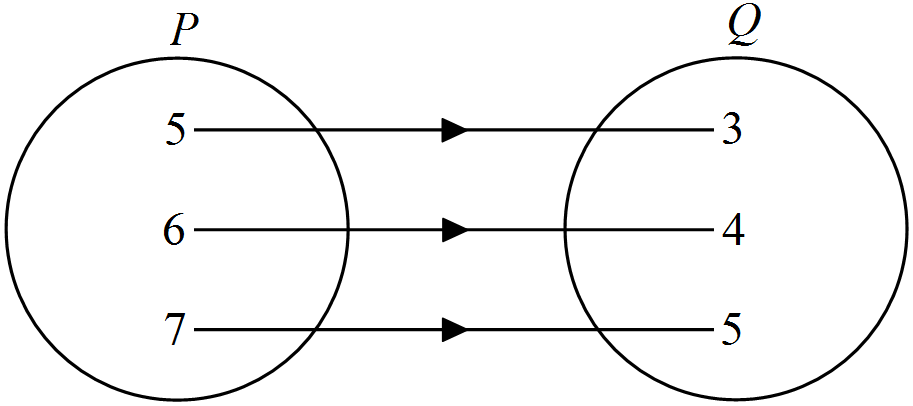
The adjacent figure shows a relationship between the sets P and Q. Write this relation in:
- Set builder form.
- Roster form. What is its domain and range?
If A = {1, 2, 4} and B = {1, 2, 3}, represent following sets graphically:
B × A
Determine the domain and range of the relation R defined by:
R = {(x, x3): x is a prime number less than 10}
Prove that:
$(\text{A}\cap\text{B})\times\text{C}=(\text{A}\times\text{C})\cap(\text{B}\times\text{C})$
View full solution →If A = {2, 3}, B = {4, 5}, C = {5, 6}, find $\text{A}\times(\text{B}\cap\text{C}),\text{ A}\times(\text{B}\cap\text{C}),(\text{A}\times\text{B})\cup(\text{A}\times\text{C}).$
View full solution →Prove that:
$(\text{A}\cup\text{B})\times\text{C}=(\text{A}\times\text{C})\cup(\text{B}\times\text{C})$
View full solution →If A = {1, 2, 3}, B = {3, 4} and C = {4, 5, 6}, find
$(\text{A}\times\text{B})\cap(\text{A}\times\text{C})$
View full solution →If $\text{A}\times\text{b}\subseteq\text{C}\times\text{D and A}\times\text{B}=\phi,$ prove that $\text{A}\subseteq\text{C and B}\subseteq\text{D}$
View full solution →