Questions

M.C.Q (1 Marks)

Take a timed test

15 questions · self-marked practice — reveal the answer and mark yourself.

Question 11 Mark

Suppose A1, A2, ..., A30 are thirty sets each having 5 elements and B1, B2, ..., Bn are n sets each with 3 elements, let $\bigcup\limits_{\text{i}=1}^{30}\text{A}_\text{i}=\bigcup\limits_{\text{j}=1}^\text{n}\text{B}_\text{j}=\text{S}$ and each element of S belongs to exactly 10 of the Ai ’s and exactly 9 of the B, 'S. then n is equal to.

  1. 15
  2. 3
  3. 45
  4. 35
Answer
  1. 45

Solution:

Number of elements in $\text{A}_1\cup\text{A}_2\cup\text{A}_3\ ..... \cup \text{A}_{30}=30\times5=150$ (When repetition is not allowed)

But each element is repeated 10 times

$\therefore \text{n(S)}=\frac{30\times5}{10}=\frac{150}{10}=15\ .....\text{(i)}$

Number of elements in $\text{B}_1\cup\text{B}_2\cup\text{B}_3\ ...... \text{B}_\text{n}=3\text{n}$ (when repetitiom is not allowed)

But each element is repeated 09 times

$\therefore \text{n(S)}=\frac{3\text{n}}{9}=\frac{\text{n}}{3}\ .....\text{(ii)}$

From (i) and (ii) we get

$\frac{\text{n}}{3}=15\Rightarrow \text{n}=15\times3=45$

Hence, the corrrect option is (c).
View full question & answer
Question 21 Mark

Let F1 be the set of parallelograms, F2 the set of rectangles, F3 the set of rhombuses, F4 the set of squares and F5 the set of trapeziums in a plane. Then F1 may be equal to,

  1. $\text{F}_2\cap\text{F}_3$

  2. $\text{F}_3\cap\text{F}_4$

  3. $\text{F}_2\cup\text{F}_5$

  4. $\text{F}_2\cup\text{F}_3\cup\text{F}_4\cup\text{F}_1$

Answer
  1. $\text{F}_2\cup\text{F}_3\cup\text{F}_4\cup\text{F}_1$

Solution:

Every rectangel, rhombus, square in a plane is a parallelogram but every trapezium is not a parallelogram.

$\text{F}_1=\text{F}_2\cup\text{F}_3\cup\text{F}_4\cup\text{F}_1$

View full question & answer
Question 31 Mark

The set $(\text{A} \cap \text{B}')' \cup (\text{B} \cap \text{C})$ is equal to.

  1. $\text{A}'\cup\text{B}\cup\text{C}$

  2. $\text{A}'\cup\text{B}$

  3. $\text{A}'\cup\text{C}'$

  4. $\text{A}'\cap\text{B}$

Answer
  1. $\text{A}'\cup\text{B}$

Solution:

We konw that: $(\text{A}\cap\text{B})'=\text{A}'\cup\text{B}'$ [De Morgan's law]

$\therefore (\text{A}\cap\text{B}')'\cup(\text{B}\cap\text{C})=\big[\text{A}'\cup(\text{B}')\big]\cup(\text{B}\cap\text{C})$

$=(\text{A}'\cap\text{B})\cup(\text{B}\cap\text{C})\big[\because (\text{B}')'=\text{B}\big]$

$=\text{A}'\cup\text{B}$

Hence, the correct optiom is (b).

View full question & answer
Question 41 Mark

If X = {8n - 7n - 1 | n $\in$ N} and Y = {49n - 49 | n $\in$ N}. Then

  1. $\text{X} \subset \text{Y}$

  2. $\text{Y} \subset \text{X}$

  3. $\text{X} = \text{Y}$

  4. $\text{X} \cap \text{Y} = \phi$

Answer
  1. $\text{X} \subset \text{Y}$

Solution:

X = {8n - 7n - 1| n $\in$ N} = {0, 49, 490, .....}

Y = {49n - 49 | n $\in$ N} = {0, 49, 147, ....., 490, .....}

Clearlut, every element of X is in Y but every element of Y is not in X.

$\therefore \text{X}\subset\text{Y}$

View full question & answer
Question 51 Mark

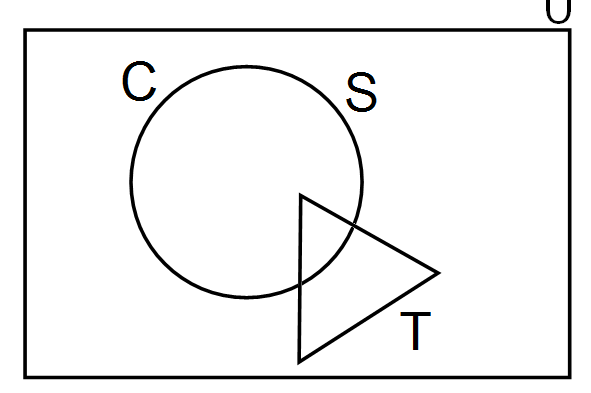
Let S = set of points inside the square, T = the set of points inside the triangle and C = the set of points inside the circle. If the triangle and circle intersect each other and are contained in a square. Then

  1. $\text{S}\cap\text{T}\cap\text{C}=\phi$

  2. $\text{S}\cup\text{T}\cup\text{C}=\text{C}$

  3. $\text{S}\cup\text{T}\cup\text{C}=\text{S}$

  4. $\text{S}\cup\text{T} = \text{S}\cap\text{C}$

Answer
  1. $\text{S}\cup\text{T}\cup\text{C}=\text{S}$

Solution:

The given conditions of the question may be represented by the following Venn diagram. From the given Venn diagram, we conclude thta

$\text{S}\cup\text{T}\cup\text{C}=\text{S}$

Hence, the correct option is (c).

View full question & answer
Question 61 Mark
Answer
  1. $39 \leq \text{x} \leq 63$

Solution:

Let p% of the people watch a channel and q% of the people watch another channel

$\because \text{n}(\text{p}\cap\text{q})=\text{x}\% \text{ and n}(\text{p}\cup\text{q})\leq100$

So, $\text{n}(\text{p}\cap\text{q})\geq\text{n(p)}+\text{n(q)}-\text{n}(\text{p}\cap\text{q})$

$100\geq63+76-\text{x}$

$100\geq139-\text{x}\Rightarrow\text{x}\geq139-100\Rightarrow \text{x}\geq39$

Now n(p) = 63

$\therefore \text{n}(\text{p}\cap\text{q})\leq\text{n(p)}\Rightarrow \text{x}\geq63$

So $39\leq\text{x}\geq63.$ Hence, the correcr option is (c).

View full question & answer
Question 71 Mark

Let S = {x | x is a positive multiple of 3 less than 100} P = {x | x is a prime number less than 20}. Then n(S) + n(P) is.

  1. 34
  2. 31
  3. 33
  4. 30
Answer
  1. 31

Solution:

Given that: S = {x | x is a positive multiple of 3 < 100}

$\therefore$ S = {3, 6, 9, 12, 15 18, ....., 99}

n(S) = 33

T = (x | x is a prime number < 20)

$\therefore$ T = {2, 3, 5, 7, 11, 13, 17, 19}

n(T) = 8

So, n(S) + n(T) = 33 + 8 = 41

Hence, the correct option is (b).

View full question & answer
Question 81 Mark

Let R be set of points inside a rectangle of sides a and b (a, b > 1) with two sides along the positive direction of x-axis and y-axis. Then

  1. R = {(x, y) : 0 ≤ x ≤ a, 0 ≤ y ≤ b}.
  2. R = {(x, y) : 0 ≤ x < a, 0 ≤ y ≤ b}.
  3. R = {(x, y) : 0 ≤ x ≤ a, 0 < y < b}.
  4. R = {(x, y) : 0 < x < a, 0 < y < b}.
Answer
  1. R = {(x, y) : 0 < x < a, 0 < y < b}.

Solution:

Since, R be the set of points inside the rectangle.

$\therefore$ R = {(x, y) : 0 < x < a, 0 < y < b}.

View full question & answer
Question 91 Mark

Two finite sets have m and n elements. The number of subsets of the first set is 112 more than that of the second set. The values of m and n are, respectively,

  1. 4, 7
  2. 7, 4
  3. 4, 4
  4. 7, 7
Answer
  1. 7, 4

Solution:

According to the question,

⇒ 2m - 2n = 12

⇒ 2n(2m-n - 1) 24. 7

⇒ 2n = 24 and 2m-n - 1 = 7

⇒ n = 2 and 2m-n = 8

⇒ 2m-n = 23 ⇒ m - n = 3 ⇒ m - 4 = 3 ⇒ m = 7

View full question & answer
Question 101 Mark

In a town of 840 persons, 450 persons read Hindi, 300 read English and 200 read both. Then the number of persons who read neither is,

  1. 210
  2. 290
  3. 180
  4. 260
Answer
  1. 290

Solution:

Let H be the set of persons who read Hindi and E be the ser of persons who read English.

Then, n(U) = 840, n(H) = 450, n(E) 300, $\text{n}(\text{H}\cap\text{E})=200$

Number of persons who read neither $=\text{n}(\text{H}'\cap\text{F}')$

$=\text{n}(\text{H}\cup\text{E})'=\text{n(U)}-\text{n}(\text{H}\cup\text{E})$

$=840-\big[\text{n(H)}+\text{n(E)}-\text{n}(\text{H}\cap\text{E})\big]$

$=840-(450+300-200)=290$

View full question & answer
Question 111 Mark

If A = {1, 3, 5, 7, 9, 11, 13, 15, 17} B = {2, 4, ....., 18} and N the set of natural numbers is the universal set, then $\text{A}' \cup (\text{A} \cup \text{B}) \cup \text{B}')$ is

  1. $\phi$
  2. N
  3. A
  4. B
Answer
  1. N

Solution:

Given that:

A = {1, 3, 5, 7, 9, 11, 13, 15, 17}

B = {2, 4, ...., 18}

U = N = {1, 2, 3, 4, 5, .....}

$\text{A}'\cup(\text{A}\cup\text{B})\cap\text{B}'=\text{A}'\big[(\text{A}\cap\text{B}')\cup(\text{B}\cap\text{B}')\big]$

$=\text{A}'\cup(\text{A}\cap\text{B}')\cup\phi \ \big[\because \text{A}\cap\text{A}'=\phi\big]$

$=\text{A}'\cup(\text{A}\cap\text{B}')$

$=(\text{ A}'\cup\text{A})\cap(\text{A}'\cup\text{B}')$

$=\text{N}\cup(\text{A}'\cup\text{B}')\ \big[\because \text{A}'\cup\text{A}=\text{N}\big]$

$=\text{A}'\cup\text{B}'$

$=(\text{A}\cup\text{B}')=(\phi)'=\text{N} \ \big[\because \text{A}\cap\text{B}=\phi\big]$

Hence, the correct option is (b).

View full question & answer
Question 121 Mark

If A and B are two sets, then $\text{A} \cap (\text{A} \cup \text{B})$ equals.

  1. $\text{A}$

  2. $\text{B}$

  3. $\phi$

  4. $\text{A}\cap\text{B}$

Answer
  1. $\text{A}$

Solution:

Given that: $\text{A}\cap(\text{A}\cup\text{B})$

Let $\text{x}\in\text{A}\cap(\text{A}\cup\text{B})$

$\Rightarrow \text{x}\in\text{A}$ and $\text{x}\in(\text{A}\cup\text{B})$

$\Rightarrow \text{x}\in\text{A}$ and $(\text{x}\in\text{A}\text{ or x}\in\text{B})$

$\Rightarrow (\text{x}\in\text{A and x}\in\text{A})$ or $(\text{x}\in\text{A and x}\in\text{B})$

$\Rightarrow \text{x}\in\text{A}$ or $\text{x}\in(\text{A}\cap\text{B})$

$\Rightarrow \text{x}\in\text{A}$

Hence, the correct option is (a).

View full question & answer
Question 131 Mark

If X and Y are two sets and X′ denotes the complement of X, then $\text{X}\cap(\text{X}\cup\text{Y})'$ is equal to.

  1. $\text{X}.$

  2. $\text{Y}.$

  3. $\phi.$

  4. $\text{X}\cap\text{Y}.$

Answer
  1. $\phi.$

Solution:

Let $\text{x}\in\text{X}\cap(\text{X}\cup\text{Y})'$

$\Rightarrow \text{x}\in\text{X}\cap(\text{X}'\cup\text{Y})'$

$\Rightarrow \text{x}\in(\text{X}\cap\text{X})\cap(\text{X}\cap\text{Y}')$

$\Rightarrow \text{x}\in\phi\cap(\text{x}\cap\text{Y}')\ \big[\because \text{A}\cap\text{A}'=\phi\big]$

$\Rightarrow \text{x}\in\phi$

Hence, the correct option is (c).

View full question & answer
Question 141 Mark

If sets A and B are defined as $\text{A}=\Big\{(\text{x},\text{y})|\text{y}=\frac{1}{\text{x}},0\neq\text{x}\in\text{R}\Big\}\ \text{B}=\{(\text{x},\text{y})|\text{y}=-\text{x},\text{x}\in\text{R}\},$ then

  1. $\text{A}\cap\text{B}=\text{A}$

  2. $\text{A}\cap\text{B}=\text{B}$

  3. $\text{A}\cap\text{B}=\phi$

  4. $\text{A}\cup\text{B}=\text{A}$

Answer
  1. $\text{A}\cap\text{B}=\phi$

Solution:

Given that: $\text{A}=\Big\{(\text{x},\text{y}|\text{y}=\frac{1}{\text{x}},0\neq\text{x}\in\text{R}\Big\},$

and $\text{B}=\big\{(\text{x},\text{y}|\text{y}=\text{x},\text{x}\in\text{R}\big\}$

It is very clear that $\text{y}=\frac{1}{\text{x}}$ and y = -x

$\because \frac{1}{\text{x}}\neq -\text{x}$

$\therefore \text{A}\cap\text{B}=\phi$

Hence, the correct option is (c).

View full question & answer
Question 151 Mark

In a class of 60 students, 25 students play cricket and 20 students play tennis, and 10 students play both the games. Then, the number of students who play neither is.

  1. 0
  2. 25
  3. 35
  4. 45
Answer
  1. 25

Solution:

Total number of students = 60

Number of students who play cricket = 25

Number of students who play tennis = 20

Number of students who play cricket and tennis both = 10

$\Rightarrow \text{n}(\text{C}\cap\text{T})=10$

$\therefore \text{n}(\text{C}\cap\text{T}) =\text{n(C)}+\text{n(T)}-\text{n}(\text{C}\cap\text{T})$

$=25+20-10=45-10=35$

$\therefore \text{n}(\text{C}'\cap\text{T}') = \text{n(U)}-\text{n}(\text{C}\cap\text{T})$

$=60-35=25$

Hence, the correct option is (b).

View full question & answer