Questions

Assertion (A) & Reason (B) MCQ

🎯

Test yourself on this topic

13 questions · timed · auto-graded

Question 11 Mark
Directions: In the following questions, the Assertions (A) and Reason(s) (R) have been put forward. Read both the statements carefully and choose the correct alternative from the following:
Assertion (A) slope of line 3x - 4y + 10 = 0 is $\frac{3}{4}.$
Reason (R) x - intercept and y- intercept of 3x - 4y + 10 = 0 respectively are $\frac{-10}{3}$ and $\frac{5}{2}.$
  1. Both assertion and reason are true and reason is the correct explanation of assertion.
  2. Both assertion and reason are true but reason is not the correct explanation of assertion.

  3. Assertion is true but reason is false.
  4. Assertion is false but reason is true
Answer
  1. Both assertion and reason are true but reason is not the correct explanation of assertion.
View full question & answer
Question 21 Mark
Directions: In the following questions, the Assertions (A) and Reason(s) (R) have been put forward. Read both the statements carefully and choose the correct alternative from the following:
Assertion (A)  Area of the triangle whose vertices are (4, 4), (3, -2) and (- 3, 16), is
Reason (R)  Area of triangle whose vertices are (x1, y1), (x2, y2) and (x3, y3), is $\frac{1}{2}\text{x}_1(\text{y}_2-\text{y}_3)+\text{x}_2(\text{y}_3-\text{y}_1)+\text{x}_3(\text{y}_1-\text{y}_2)$
  1. A is true, R is true; R is acorrect explanation of A.
  2. A is true, R is true; R is not a correct explanation of A.
  3. A is true; R is false
  4. A is false; R is true.
Answer
  1. A is true, R is true; R is acorrect explanation of A.

Solution:

Assertion Area of the triangle, whose vertices are (4, 4), (3, -2) and (-3, 16)

$=\frac{1}{2}4(-2-16)+3(16-4)+(-3)(4+2)$

$=\frac{|72+36-18|}{2}=\frac{|-54|}{2}=\frac{54}{2}=27$

View full question & answer
Question 31 Mark
Directions: In the following questions, the Assertions (A) and Reason(s) (R) have been put forward. Read both the statements carefully and choose the correct alternative from the following:
Assertion (A) The distance between the lines 4x + 3y = 11 and 8x + 6y = 15 is $\frac{7}{10}$
Reason (R) The distance between lines the ax + by = c1 and ax + by = c2 is given by $\frac{\text{c}_1-\text{c}_2}{\sqrt{\text{a}^2+\text{b}^2}}$
  1. A is true, R is true; R is acorrect explanation of A.
  2. A is true, R is true; R is not a correct explanation of A.
  3. A is true; R is false
  4. A is false; R is true.
Answer
  1. A is true, R is true; R is acorrect explanation of A.

Solution:

Assertion Given lines are 4x + 3y = 11 and 4x + 3y = $\frac{15}{2}$

Distance between them

$=\Bigg|\frac{11-\frac{15}{2}}{\sqrt{16}+9}\Bigg|$

$=\Big|\frac{7}{2\times5}\Big|=\frac{7}{10}$

View full question & answer
Question 41 Mark
Directions: In the following questions, the Assertions (A) and Reason(s) (R) have been put forward. Read both the statements carefully and choose the correct alternative from the following:
Assertion (A) Slope of line 3x - 4y +10 = 0 is $\frac{3}{4}$
Reason (R) x - intercept and y-intercept of 3x - 4y + 10 = 0 respectively are $\frac{-10}{3} $ and $\frac{5}{2}.$
  1. A is true, R is true; R is acorrect explanation of A.
  2. A is true, R is true; R is not a correct explanation of A.
  3. A is true; R is false
  4. A is false; R is true.
Answer
  1. A is true, R is true; R is not a correct explanation of A.

Solution:

Assertion Given equation 3x - 4y + 10 = 0 can be written as

$\text{y}=\frac{3}{4}\text{x}+\frac{5}{2}\ ...(\text{i}) $

Comparing Eq. (i) with y = mx + c, we have slope of the given line as $\text{m}=\frac{3}{4}.$

Reason Equation 3x - 4y + 10 = 0 can be written as

$3\text{x}-4\text{y}=-10\text{ or}\frac{\text{x}}{-\frac{10}{3}}+\frac{\text{y}}{\frac{5}{2}}=1\ ...(\text{ii}) $

Comparing Eq. (ii) with $\frac{\text{x}}{\text{a}}+\frac{\text{y}}{\text{b}}=1,$ we have

x - intercept as $\text{a}=-\frac{10}{3}$ and y-intercept as $\text{b}=\frac{5}{2}.$

View full question & answer
Question 51 Mark
Directions: In the following questions, the Assertions (A) and Reason(s) (R) have been put forward. Read both the statements carefully and choose the correct alternative from the following:
Assertion (A) The point (3, 0) is at 3 units distance from the Y-axis measured along the positive X - axis and has zero distance from the X - axis.
Reason (R) The point (3, 0) is at 3 units distance from the X - axis measured along the positive Y - axis and has zero distance from the Y - axis
  1. A is true, R is true; R is acorrect explanation of A.
  2. A is true, R is true; R is not a correct explanation of A.
  3. A is true; R is false
  4. A is false; R is true.
Answer
  1. A is true; R is false

Solution:

Assertion The point (3, 0) is at 3 units distance from the Y-axis measured along the positive X-axis and has zero distance from the X-axis.

View full question & answer
Question 61 Mark
Directions: In the following questions, the Assertions (A) and Reason(s) (R) have been put forward. Read both the statements carefully and choose the correct alternative from the following:
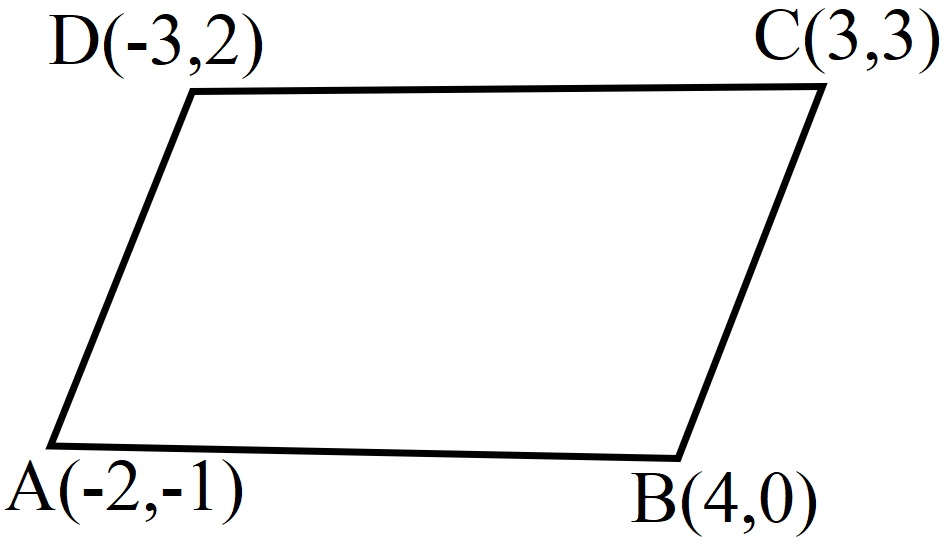
if A (- 2, - 1), B (4, 0), C (3, 3) and D (- 3, 2) are the vertices of a parallelogram, then
Assertion (A) Slope of AB = Slope of BC and Slope of CD = Slope of A D.
Reason (R) Mid - point of AC = Mid - point of BD.
  1. A is true, R is true; R is acorrect explanation of A.
  2. A is true, R is true; R is not a correct explanation of A.
  3. A is true; R is false
  4. A is false; R is true.
Answer
  1. A is false; R is true.

Solution:

$\because $ ABCD is a parallelogram.

$\therefore$ AB|| CD = Slope of AB = Slope of CD

and BC || AD = Slope of BC = Slope of AD

Reason mid - point of

$\text{Ac}\Big(\frac{-2+3}{2},\frac{-1+3}{2}\Big)$

$=\Big(\frac{1}{2},\frac{2}{2}\Big)=\Big(\frac{1}{2},1\Big)$

and mid-point of $\text{BD}=\Big(\frac{4-3}{2},\frac{0+2}{2}\Big)$

$=\Big(\frac{1}{2},1\Big)$

= Mid - point of AC = Mid-point of BD

View full question & answer
Question 71 Mark
Directions: In the following questions, the Assertions (A) and Reason(s) (R) have been put forward. Read both the statements carefully and choose the correct alternative from the following:
Assertion (A) The centroied cannot lie on the Y - axis.
Reason (R) The condition that the centroid may lie on the x - axis is a + b = 3.
  1. Both assertion and reason are true and reason is the correct explanation of assertion.
  2. Both assertion and reason are true but reason is not the correct explanation of assertion.
  3. Assertion is true but reason is false.
  4. Assertion is false but reason is true
Answer
  1. Both assertion and reason are true but reason is not the correct explanation of assertion.
View full question & answer
Question 81 Mark
Directions: In the following questions, the Assertions (A) and Reason(s) (R) have been put forward. Read both the statements carefully and choose the correct alternative from the following:
Assertion (A) Slope of X - axis is zero and slope of Y - axis is not defined
Reason (R) Slope of X - axis is not defined and slope of Y - axis is zero.
  1. A is true, R is true; R is acorrect explanation of A.
  2. A is true, R is true; R is not a correct explanation of A.
  3. A is true; R is false
  4. A is false; R is true.
Answer
  1. A is true; R is false

Solution:

Assertion Slope of X - axis is zero and slope of Y - axis is not defined.

View full question & answer
Question 91 Mark
Directions: In the following questions, the Assertions (A) and Reason(s) (R) have been put forward. Read both the statements carefully and choose the correct alternative from the following:
if the vertices of a triangle are (1, a), (2, b) and (c2, - 3). Then,
Assertion (A) The centroid cannot lie on the Y-axis.
Reason (R) The condition that the centroid may lie on the X - axis is a + b = 3.
  1. A is true, R is true; R is acorrect explanation of A.
  2. A is true, R is true; R is not a correct explanation of A.
  3. A is true; R is false
  4. A is false; R is true.
Answer
  1. A is true, R is true; R is not a correct explanation of A.

Solution:

Assertion Centroid of the triaigle is

$\text{G} \equiv\Big(\frac{1+2+\text{c}^2}{3},\frac{\text{a}+\text{b}-3}{2}\Big)$

$\text{i.e.}\Big(\frac{3+\text{c}^2}{3},\frac{\text{a}+\text{b}-3}{3}\Big)$

$\because$ G will lie on Y-axis, then

$\frac{3+\text{c}^2}{3}=0\Rightarrow\text{c}^2=-3\text{ or}\text{ c}\equiv\pm\text{ i}\sqrt{3}$

$\because$ Both values of c are imaginary.

Hence, G cannot lie on Y-axis.

Reason $\because$ G will lies on X-axis, then

$\frac{\text{a}+\text{b}-3}{3}=0$

$\Rightarrow\text{a}+\text{b}-3=0\text{ or}\text{ a}+\text{b}=3$

View full question & answer
Question 101 Mark
Directions: In the following questions, the Assertions (A) and Reason(s) (R) have been put forward. Read both the statements carefully and choose the correct alternative from the following:
Assertion (A) The angle between the lines x + 2y - 3 = 0 and 3x + y + 1 = 0 is $\tan^{-1}$ (1).
Reason (R) Angle between two lines is given by $\tan^{-1}\Big[\pm\big(\frac{\text{m}_2-\text{m}_1}{1+\text{m}_1\text{m}_2}\Big)\Big]$
  1. A is true, R is true; R is acorrect explanation of A.
  2. A is true, R is true; R is not a correct explanation of A.
  3. A is true; R is false
  4. A is false; R is true.
Answer
  1. A is true, R is true; R is acorrect explanation of A.

Solution:

Assertion Let m, and m, be the slopes of the straight lines x + 2y - 3 = 0 and 3x + y + 1 = 0.

Then, $\text{m}_1=-\frac{1}{2}$ and m2 = -3

Let $\theta$ be the angle between the given lines.

Then, $\tan\theta=\pm\Big(\frac{\text{m}_2-\text{m}_1}{1+\text{m}_1\text{m}_2}\Big)$

$=\pm\Bigg(\frac{-3+\frac{1}{2}}{1+\frac{3}{2}}\Bigg)=\pm1$

$\Rightarrow\theta=\tan^1(1)\text{ or }\pi-\tan^{-1}(1)$

View full question & answer
Question 111 Mark
Directions: In the following questions, the Assertions (A) and Reason(s) (R) have been put forward. Read both the statements carefully and choose the correct alternative from the following:
If the equation of line is x - y = 4, then
Assertion (A) The normal form of same equation is $\text{x}\cos\alpha+\text{y}\sin\alpha=\rho$ where $\alpha=315^\circ$ and $\rho=2\sqrt{2}.$
Reason (R) The perpendicular distance of line from the origin is $3\sqrt{2}.$
  1. A is true, R is true; R is acorrect explanation of A.
  2. A is true, R is true; R is not a correct explanation of A.
  3. A is true; R is false
  4. A is false; R is true.
Answer
  1. A is true; R is false

Solution:

Assertion Given equation of line is x - y = 4

On dividing above equation by

$\sqrt{\text{(coefficient of x)}^2+\text{(conffcient of y})^2}$

$\text{i.e.} \sqrt{(1)^2+(-1)^2}=\sqrt{2},$ we get

$\frac{1}{\sqrt{2}}\text{x}-\frac{1}{\sqrt{2}}\text{y}=\frac{4}{\sqrt{2}}$

$\Rightarrow\cos45^\circ\text{x}-\sin45^\circ\text{ y}=2\sqrt{2}$

[ $\because \cos \text{x}$ is positive and $\sin \text{x}$ is negative, it is possible only in fourth quadrant]

$\Rightarrow\text{x}\cos(360^\circ-45^\circ)+\text{y}\sin(360^\circ-45^\circ)=2\sqrt{2}$

$\Big[\because\cos(360^\circ-\theta)=\cos\theta\text{ and }\sin(360^\circ-\theta)=-\sin\theta\Big]$

$\Rightarrow\text{x}=\cos315^\circ+\text{y }315^\circ=2\sqrt{2}$

On comparing with $\text{x}\cos\alpha+\text{y}\sin\alpha=\rho,$ we get

$\alpha=315^\circ$

and $\rho=2\sqrt{2}$

View full question & answer
Question 121 Mark
Directions: In the following questions, the Assertions (A) and Reason(s) (R) have been put forward. Read both the statements carefully and choose the correct alternative from the following:
Assertion (A) The slope of the line x +7y = 0 is $\frac{1}{7}$ and y - intercept is 0.
Reason (R) The slope of the line ; 6x + 3y - 5 = 0 is - 2and y - intercept is $\frac{5}{3}.$
  1. A is true, R is true; R is acorrect explanation of A.
  2. A is true, R is true; R is not a correct explanation of A.
  3. A is true; R is false
  4. A is false; R is true.
Answer
  1. A is false; R is true.

Solution:

Assertion Given equation is x + 7y = 0

$\Rightarrow\text{y}=\frac{-\text{x}}{7}+0$

On comparing with y = mx + c, we get

Slope $\text{(m)}=\frac{-1}{7},$ y - intercept = 0

Reason Given equation is 6x + 3y - 5 = 0

$\Rightarrow\text{y}=-2\text{x}+\frac{5}{3}$

On comparing with y = mx + c, we get

Slope (m) = - 2, y - intercept $\frac{5}{3}$

View full question & answer
Question 131 Mark
Directions: In the following questions, the Assertions (A) and Reason(s) (R) have been put forward. Read both the statements carefully and choose the correct alternative from the following:
Assertion (A) A point P (h, k) lies on the straight line x + y + 1 = 0 and is at a distance 5 units from the origin. If k is negative, then h is equal to - 3.
Reason (R) The distance formula is $\sqrt{\text{x}_2-\text{x}_1)^2+(\text{x}_2-\text{y}_1)^2}$
  1. A is true, R is true; R is acorrect explanation of A.
  2. A is true, R is true; R is not a correct explanation of A.
  3. A is true; R is false
  4. A is false; R is true.
Answer
  1. A is false; R is true.

Solution:

Assertion Since, the point (A, k) lies on x + y + 1 = 0.

 ⇒ h + k + 1 = 0

and  h2 + k2  = 25

⇒ (-1 - k)2 + k2 = 25

= 2k2 + 2k - 24 = 0

k+ k - 12 = 0 ⇒ k = -4 or k =3

[k = 3 rejected as k < 0]

$\therefore$ h = -1 - (-4) = 3

View full question & answer
Assertion (A) & Reason (B) MCQ - MATHS STD 11 Science Questions - Vidyadip