Questions

M.C.Q (1 Marks)

Take a timed test

20 questions · self-marked practice — reveal the answer and mark yourself.

Question 11 Mark

The distance between the lines y = mx + c1 and y = mx + c2 is:

  1. $\frac{\text{c}_1-\text{c}_2}{\sqrt{\text{m}^2+1}}$

  2. $\frac{|\text{c}_1-\text{c}_2|}{\sqrt{1+\text{m}^2}}$

  3. $\frac{\text{c}_2-\text{c}_1}{\sqrt{1+\text{m}^2}}$

  4. $0$

Answer
  1. $\frac{|\text{c}_1-\text{c}_2|}{\sqrt{1+\text{m}^2}}$

Solution:

Let any point on the line y = mx + c1 be P(x1, y1).

The equation of the other line is: y = mx + c2

⇒ mx - y + c2 = 0

Distance of point P from this line, $\text{d}=\frac{|\text{mx}_1-\text{y}_1+\text{c}_2|}{\sqrt{\text{m}^2+1}}$

Since P line on the first line, we get

⇒ y1 = mx1 + c1

⇒ mx1 - y1 = -c1

$\therefore \text{d}=\frac{|\text{c}_1-\text{c}_2|}{\sqrt{\text{m}^2+1}}$​​​​​​​

View full question & answer
Question 21 Mark

The equation of the straight line passing through the point (3, 2) and perpendicular to the line y = x is:

  1. x - y = 5
  2. x + y = 5
  3. x + y = 1
  4. x - y = 1
Answer
  1. x + y = 5

Solution:

Slope of the given line y = x is 1.

Thus, slope of line perpendicular to y = x is -1.

Line passes through the point (3, 2).

So, equation of the required line is:

y - 2 = -1(x - 3)

⇒ x + y = 5

View full question & answer
Question 31 Mark

For specifying a straight line, how many geometrical parameters should be known?

  1. 1
  2. 2
  3. 4
  4. 3
Answer
  1. 2

Solution:

Different form of equation of straight line are slope intercept form, y = mx + c, Paramerer = 2

Intercept form, $\frac{\text{x}}{\text{a}}+\frac{\text{y}}{\text{b}}=1,$ parameter = 2

One-point from, y - y1 = m(x - x1), parameter = 2

Normal form, $\text{x}\cos \text{w}+\text{y}\sin\text{w}=\text{P},$ Parameter = 2

Hence, the correct option is (b).

View full question & answer
Question 41 Mark

The equations of the lines passing through the point (1, 0) and at a distance $\frac{\sqrt{3}}{2}$ from the origin, are

  1. $\sqrt{3}\text{x}+\text{y}-\sqrt{3}=0,\sqrt{3}\text{x}-\text{y}-\sqrt{3}=0$

  2. $\sqrt{3}\text{x}+\text{y}+\sqrt{3}=0,\sqrt{3}\text{x}-\text{y}+\sqrt{3}=0$

  3. $\text{x}+\sqrt{3}\text{y}-\sqrt{3}=0,\text{x}-\sqrt{3}\text{y}-\sqrt{3}=0$

  4. None of these.

Answer


  1. None of these.

Solution:

Equation of any line passing through (1, 0) is

⇒ y - 0 = m(x - 1)

⇒ mx - y - m = 0

Distance of the line from origin is $\frac{\sqrt{3}}{2}$

$\therefore \frac{\sqrt{3}}{2} =\Big|\frac{\text{m}\times0-0-\text{m}}{\sqrt{1+\text{m}^2}}\Big|$

$\Rightarrow \frac{\sqrt{3}}{2}=\Big|\frac{-\text{m}}{\sqrt{1+\text{m}^2}}\Big|$

Squaring both sides, we get

$\frac{3}{4}=\frac{\text{m}^2}{1+\text{m}^2}$

$\Rightarrow 4\text{m}^2=3+3\text{m}^2$

$\Rightarrow 4\text{m}^2-3\text{m}^2=3$

$\Rightarrow \text{m}^2=3$

$\therefore \text{m}=\pm\sqrt{3}$

$\therefore$ Required equations are

$\pm\sqrt{3}\text{x}-\text{y}\mp\sqrt{3}=0$

i.e., $\sqrt{3}\text{x}-\text{y}-\sqrt{3}=0=0$ and $-\sqrt{3}\text{x}-\text{y}+\sqrt{3}=0=0$

$\Rightarrow \sqrt{3}\text{x}+\text{y}-\sqrt{3}=0$

Hence, the correct option is (a).

View full question & answer
Question 51 Mark

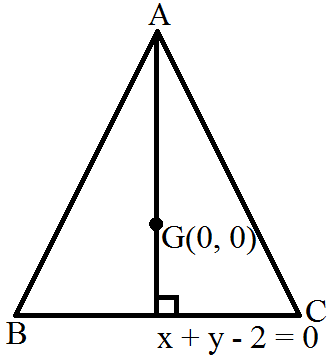
One vertex of the equilateral triangle with centroid at the origin and one side as x + y - 2 = 0 is:

  1. (-1, -1)
  2. (2, 2)
  3. (-2, -2)
  4. (2, -2)

[Hint: Let ABC be the equilateral triangle with vertex A (h, k) and let $\text{D}(\alpha,\beta)$ be the point on BC. Then $\frac{2\alpha+\text{h}}{3}=0=\frac{2\beta+\text{k}}{3}.$ Also $\alpha+\beta-2=0$ and $\frac{\text{k}-0}{\text{h}-0}\times(-1)=-1\Big].$

Answer
  1. (-2, -2).

Solution:

Let ABC be the equilateral triangle with vertex A(h, k).

Also, centroid is G(0, 0).

Now, $\text{AG}\bot\text{BC}$

Slope of line BC or x + y - 2 = 0 is -1.

$\therefore$ Slope of $\text{AG},\frac{\text{k}}{\text{h}}=1$ or h = k.

Now distance of origin from $\text{BC}=\frac{|0+0-2}{\sqrt{1^2+1^2}|}=\sqrt{2}$

$\therefore$ Distance of A form $\text{BC}=3\sqrt{2}=\frac{|\text{h}+\text{k}-2|}{\sqrt{1^2+1^2}}$

$\therefore$ |h + k - 2| = 6

⇒ h + k - 8 = 0 or h + k + 4 = 0

⇒ h + k - 8 = 0 or h + k + 4 = 0

⇒ h = 4 or h = -2

$\therefore$ Vertex is (-2, -2).

View full question & answer
Question 61 Mark

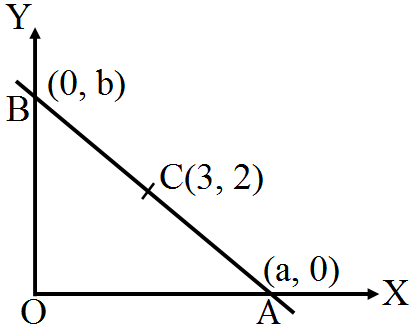
If the coordinates of the middle point of the portion of a line intercepted between the coordinate axes is (3, 2), then the equation of the line will be:

  1. 2x + 3y = 12
  2. 3x + 2y = 12
  3. 4x - 3y = 6
  4. 5x - 2y = 10
Answer
  1. 2x + 3y = 12

Solution:

Let the given the line meets the axes at A(a, 0) and B(0, b).

Given that C(3, 2) is the mid-point of AB

$\therefore 3=\frac{\text{a}+0}{2}\Rightarrow \text{a}=6$

and $2=\frac{0+\text{b}}{2}\Rightarrow \text{b}=4$

Intercept form of the line AB

$\Rightarrow \frac{\text{x}}{6}+\frac{\text{y}}{4}=1$

$\Rightarrow 2\text{x}+3\text{y}=12$

Hence, the correct option is  (a).


View full question & answer
Question 71 Mark

The point (4, 1) undergoes the following two successive transformations:

  1. Reflection about the line y = x.
  2. Translation through a distance 2 units along the positive x-axis.

Then the final coordinates of the point are:

  1. (4, 3)
  2. (3, 4)
  3. (1, 4)
  4. $\frac{7}{2},\frac{7}{2}$
Answer
  1. (3, 4)

Solution:

Reflection of A(4, 1) in y = x is 5(1, 4).

Now translation of point B through a distance '2' units along the positive x-axis shifts B to C(1 + 2, 4) or C(3, 4).

View full question & answer
Question 81 Mark

The distance of the point of intersection of the lines 2x - 3y + 5 = 0 and 3x + 4y = 0 from the line 5x - 2y = 0 is:

  1. $\frac{130}{17\sqrt{29}}$

  2. $\frac{13}{7\sqrt{29}}$

  3. $\frac{130}{7}$

  4. None of these.
Answer
  1. $\frac{130}{17\sqrt{29}}$

Solution:

Given lines are:

2x - 3y + 5 = 0 .....(i)

and 3x + 4y = 0 .....(ii)

Solving these lines, we get point of intersection as $\Big(\frac{-20}{17},\frac{15}{17}\Big).$

$\therefore$ Distance of this point from the line '5x - 2y = 0'

$=\frac{\Big|5\times\Big(-\frac{20}{17}\Big)-2\Big(\frac{15}{17}\Big)\Big|}{\sqrt{25+4}}=\frac{\Big|\frac{-100}{17}-\frac{30}{17}\Big|}{\sqrt{25}}$

$=\frac{130}{17\sqrt{29}}$

View full question & answer
Question 91 Mark

Equation of the line passing through (1, 2) and parallel to the line y = 3x - 1 is:

  1. y + 2 = x + 1
  2. y + 2 = 3 (x + 1)
  3. y - 2 = 3 (x - 1)
  4. y - 2 = x - 1
Answer
  1. y - 2 = 3 (x - 1)

Solution:

Given equation is y = 3x - 1

Slope = 3

Slope of the line passing through the given point (1, 2) and parallel to the given line = 3

So, the equation of the required line is

y - 2 = 3(x - 1)

Hence, the correct option is (c).

View full question & answer
Question 101 Mark

Slope of a line which cuts off intercepts of equal lengths on the axes is:

  1. -1
  2. -0
  3. 2
  4. $\sqrt{3}$
Answer
  1. -1

Solution:

Intercept form of a line is

$\frac{\text{x}}{\text{a}}+\frac{\text{y}}{\text{b}}=1$

$\Rightarrow \frac{\text{x}}{\text{a}}+\frac{\text{y}}{\text{a}}=1(\because \text{a}=\text{b})$

⇒ x + y = a

⇒ y =- -x + a

$\therefore$ Slope is -1

Hence, the correct option is (a).

View full question & answer
Question 111 Mark

A line cutting off intercept -3 from the y-axis and the tengent at angle to the xaxis is $\frac{3}{5}$, its equation is:

  1. 5y - 3x + 15 = 0
  2. 3y - 5x + 15 = 0
  3. 5y - 3x - 15 = 0
  4. None of these.
Answer
  1. 5y - 3x + 15 = 0

Solution:

Since the lines cut off intercepts -3 on y-axis then the line is passing through the point (0, -3).

Given that: $\tan\theta=\frac{3}{5}$

⇒ Slope of the line $\text{m}=\frac{3}{5}$

So, the equation of the line is

y - y1 = m(x - x1)

$\Rightarrow \text{y}+ 3 = \frac{3}{5}(\text{x} -0)$

⇒ 5y + 15 = 3x

⇒ 3x - 5y - 15 = 0

⇒ 5y - 3x + 15 = 0

Hence, the correct option is (a).

View full question & answer
Question 121 Mark

The ratio in which the line 3x + 4y + 2 = 0 divides the distance between the lines 3x + 4y + 5 = 0 and 3x + 4y - 5 = 0 is:

  1. 1 : 2
  2. 3 : 7
  3. 2 : 3
  4. 2 : 5
Answer
  1. 3 : 7

Solution:

Given lines are:

3x + 4y + 5 = 0 .....(i)

3x + 4y - 5 = 0 .....(ii)

The third line is: 3x + 4y + 2 = 0

Distance between the line (i) and (iii) $=\frac{|5-2|}{\sqrt{9+16}}=\frac{3}{5}$

Distance between the lines (ii) and (iii) $=\frac{|-5-2|}{\sqrt{9+16}}=\frac{7}{5}$

Hence, the required ratio is $\frac{3}{5}:\frac{7}{5}$ or 3 : 7.

View full question & answer
Question 131 Mark

The equations of the lines which pass through the point (3, -2) and are inclined at 60° to the line $\sqrt{3} \text{x} + \text{y} = 1$ is:

  1. $\sqrt{3}\text{x}+\text{y}-\sqrt{3}=0,\sqrt{3}\text{x}-\text{y}-\sqrt{3}=0$

  2. $\sqrt{3}\text{x}+\text{y}+\sqrt{3}=0,\sqrt{3}\text{x}-\text{y}+\sqrt{3}=0$

  3. $\text{x}+\sqrt{3}\text{y}-\sqrt{3}=0,\text{x}-\sqrt{3}\text{y}-\sqrt{3}=0$

  4. None of these.
Answer
  1. $\sqrt{3}\text{x}+\text{y}-\sqrt{3}=0,\sqrt{3}\text{x}-\text{y}-\sqrt{3}=0$

Solution:

Slope of the given line $\sqrt{3}\text{x}+\text{y}=1$ is, $\text{m}=-\sqrt{3}.$

Let the slope of the required line which makes an angle of 60° with the above line is m.

$\therefore \tan 60^\circ=\bigg|\frac{-\sqrt{3}-\text{m}}{1-\sqrt{3}\text{m}}\bigg|$

$\Rightarrow \bigg|\frac{-\sqrt{3}-\text{m}}{1-\sqrt{3}\text{m}}\bigg|=\sqrt{3}$

$\Rightarrow -\sqrt{3}-\text{m}=\sqrt{3}-3\text{m}$ or $-\sqrt{3}-\text{m}=-\sqrt{3}+3\text{m}$

$\Rightarrow \text{m}=\sqrt{3}$ or m = 0

Line is passing throught the point (3, -2).

Thus, the equation of the required line is: $\text{y}+2=\sqrt{3}(\text{x}-3)$ or y + 2 = 0

$\Rightarrow \sqrt{3}\text{x}-\text{y}-2-3\sqrt{3}=0$ and y + 2 = 0

View full question & answer
Question 141 Mark

A line passes through (2, 2) and is perpendicular to the line 3x + y = 3. Its yintercept is:

  1. $\frac{1}{3}$

  2. $\frac{2}{3}$

  3. $1$

  4. $\frac{4}{3}$

Answer
  1. $\frac{4}{3}.$

Solution:

Any line perpendicular to 3x + y = 3

$\text{x}-3\text{y}=\lambda \ (\lambda=\text{constant})$

If is passes through the point (2, 2) then

$2-3(2)=\lambda\Rightarrow \lambda=-4$

$\therefore$ Required equation is x - 3y = -4

$\Rightarrow 3\text{y}=-\text{x}-4$

$\Rightarrow \text{y}=\frac{1}{3}\text{x}+\frac{4}{3}\big[\because \text{y}=\text{mx}+\text{c}\big]$

So, the y-intercept is $\frac{4}{3}.$

Hence, the correct option is (d).

View full question & answer
Question 151 Mark

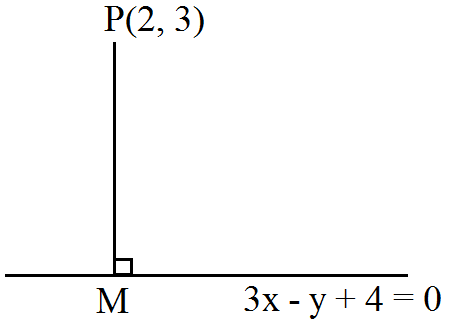
The coordinates of the foot of perpendiculars from the point (2, 3) on the line y = 3x + 4 is given by

  1. $\frac{37}{10},\frac{-1}{10}$

  2. $\frac{-1}{10},\frac{37}{10}$

  3. $\frac{10}{37},-10$

  4. $\frac{2}{3},-\frac{1}{3}$

Answer
  1. $\frac{-1}{10},\frac{37}{10}$

Solution:

Let the foot of perpendicular from the point P(2, 3) on the line 3x - y + 4 = 0 be M(h, k).

M(h, k) lies on the given line,

$\therefore$ 3h - k + 4 = 0 .....(i)

Also, slopw of the given line is 3.

$\therefore$ Slope of $\text{PM}=-\frac{1}{3}=\frac{\text{k}-3}{\text{h}-2}$ or h + 3k - 11 = 0 .....(ii)

Solving (1) and (ii), we get $(\text{h},\text{k})\equiv\Big(-\frac{1}{10},\frac{37}{10}\Big)$

View full question & answer
Question 161 Mark

A point equidistant from the lines 4x + 3y + 10 = 0, 5x – 12y + 26 = 0 and 7x + 24y – 50 = 0 is:

  1. (1, -1)
  2. (1, 1)
  3. (0, 0)
  4. (0, 1)
Answer
  1. (0, 0)

Solution:

Given equation are

4x + 3y + 10 = 0 .....(i)

5x - 12y + 26 = 0 .....(ii)

and 7x + 27y - 50 = 0 .....(iii)

Let (x1, y1) be any point equidistant from eq. (i), eq. (ii) and eq. (iii).

Distance of (x1, y1) from eq. (i)

$=\Big|\frac{4\text{x}_1+3\text{y}_1+10}{\sqrt{16+9}}\Big|=\Big|\frac{4\text{x}_1+3\text{y}_1+10}{5}\Big|$

Distance of (x1, y1) from eq. (iii)

$=\Big|\frac{5\text{x}_1-12\text{y}_1+26}{\sqrt{25+144}}\Big|=\Big|\frac{5\text{x}_1-12\text{y}_1+26}{13}\Big|$

Distance of (x1, y1) from eq. (iii)

$=\Big|\frac{7\text{x}_1+24\text{y}_1-50}{\sqrt{49+576}}\Big|=\Big|\frac{7\text{x}_1+24\text{y}_1-50}{25}\Big|$

If the point (x1, y1) is equidistant from the given lines, then

$\Big|\frac{4\text{x}_1+3\text{y}_1+10}{5}\Big|=\Big|\frac{5\text{x}_1-12\text{y}_!+26}{13}\Big|=\Big|\frac{7\text{x}_1+24\text{y}_1-50}{25}\Big|$

We see that putting x1 = 0 and y1 = 0, the above relation is satisfied i.e.,

$=\frac{10}{5}=\frac{26}{13}=\frac{50}{25}=2$

Hence, the correct option is (c).

View full question & answer
Question 171 Mark

The tangent of angle between the lines whose intercepts on the axes are a, -b and b, -a, respectively, is

  1. $\frac{\text{a}^2-\text{b}^2}{\text{ab}}$

  2. $\frac{\text{b}^2-\text{a}^2}{2}$

  3. $\frac{\text{b}^2-\text{a}^2}{2\text{ab}}$

  4. None of these.
Answer
  1. $\frac{\text{b}^2-\text{a}^2}{2\text{ab}}$

Solution:

Intercepts of line are a and -b; i.e., line passes through the points (a, 0), (0, -b).

$\therefore$ Slope of line, $\text{m}_1=\frac{-\text{b}-0}{0-\text{a}}=\frac{\text{b}}{\text{a}}$

Intercepts of line are b, -a; i.e., line passes through the points (b, 0), (0, -a).

$\therefore$ Slope of line, $\text{m}_2=\frac{-\text{a}-0}{0-\text{b}}=\frac{\text{a}}{\text{b}}$

If $\theta$ is the angle between the lines, then

$\tan=\theta=\frac{\frac{\text{b}}{\text{a}}-\frac{\text{a}}{\text{b}}}{1+\frac{\text{a}}{\text{b}}\times\frac{\text{b}}{\text{a}}}=\frac{\frac{\text{b}^2-\text{a}^2}{\text{ab}}}{2}=\frac{\text{b}^2-\text{a}^2}{2\text{ab}}$

View full question & answer
Question 181 Mark

The equation of the line passing through the point (1, 2) and perpendicular to the line x + y + 1 = 0 is:

  1. y - x + 1 = 0
  2. y - x - 1 = 0
  3. y - x + 2 = 0
  4. y - x - 2 = 0
Answer
  1. y - x - 1 = 0

Solution:

Slope of the given line +1 = 0 is -1.

So, slope of line perpendicular to above line is 1.

Line passes through the point (1, 2).

Therefore, equation of the required linens:

⇒ y - 2 = 1(x - 1)

⇒ y - x - 1 = 0.

View full question & answer
Question 191 Mark

If the line $\frac{\text{x}}{\text{a}} + \frac{\text{y}}{\text{b}} =1$ passes through the points (2, -3) and (4, -5), then (a, b) is:

  1. (1, 1)
  2. (-1, 1)
  3. (1, -1)
  4. (-1, -1)
Answer
  1. (-1, -1)

Solution:

Equation of line passing through the points (2, -3) and (4, -5) is

$\text{y}+3=\frac{-5+3}{4-2}(\text{x}-2)$

$\Rightarrow \text{y}+3=\frac{-2}{2}(\text{x}-2)$

$\Rightarrow \text{y}+3=-(\text{x}-2)$

$\Rightarrow \text{y}+3=-\text{x}+2$

$\Rightarrow \text{x}+\text{y}=-1$

$\Rightarrow \frac{\text{x}}{-1}+\frac{\text{y}}{-1}=1$ (intercept from)

$\therefore \text{a}=-1,\text{b}=-1$

Hence, the correct option is (d).

View full question & answer
Question 201 Mark

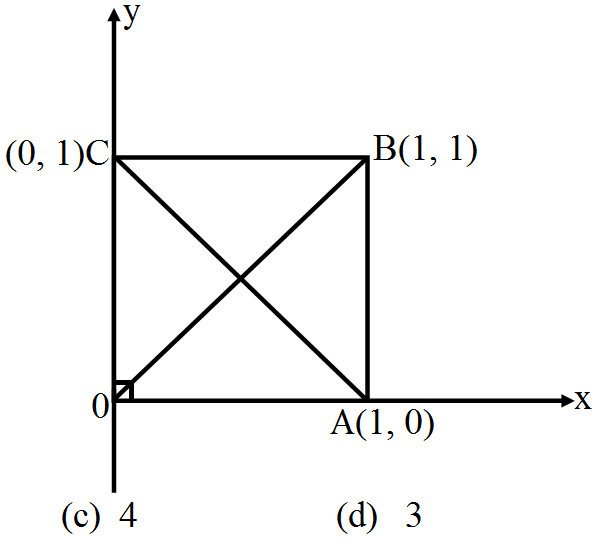
Equations of diagonals of the square formed by the lines x = 0, y = 0, x = 1 and y = 1 are:

  1. y = x, y + x = 1
  2. y = x, x + y = 2
  3. $2\text{y} = \text{x}, \text{y} + \text{x} = \frac{1}{3}$

  4. y = 2x, y + 2x = 1
Answer
  1. y = x, y + x = 1

Solution:

Given lines are plotted on coordinate plane as shown in the adjacent figure.

From the figure, equation of diagonal OB is y = x.

Equation of the diagonal AC is x + y = 1 (using intercept form).

View full question & answer
M.C.Q (1 Marks) - MATHS STD 11 Science Questions - Vidyadip