Question 13 Marks
Find the equation of a line drawn perpendicular to the line $\frac{x}{4}+\frac{y}{6}=1$ through the point where it meets the Y-axis.
AnswerGiven equation of line is
$\frac{x}{4}+\frac{y}{6}=1 \Rightarrow \frac{3 x+2y}{12}=1$
$\Rightarrow 3x + 2y = 12 ...(i)$
If line (i) meet the Y-axis, then put $x = 0$ in Eq. (i), we get
$0 + 2y = 12 \Rightarrow y = 6$
$\therefore$ Point is $(0, 6).$
Slope of line (i) is, $m_{1}=\frac{-3}{2}$
$\therefore$ Slope of line perpendicular to line (i) is,
$m_{2}=-\frac{1}{m_{1}}=\frac{-1}{(-3 / 2)}=\frac{2}{3}$
Now, equation of line having slope $\frac{2}{3}$ and passing through $(0, 6)$ is given by
$y - y_1= m(x - x_1)$
$\Rightarrow \quad y-6=\frac{2}{3}(x-0)$
$\Rightarrow 3y - 18 = 2x$
$\Rightarrow 2x - 3y + 18 = 0$
which is required equation of line.
View full question & answer→Question 23 Marks
Find the perpendicular distance from the origin of the line joining the points $(\cos \theta ,\sin \theta )$ and $(\cos \phi ,\sin \phi )$.
AnswerEquation of the line joining points $(\cos \theta ,\sin \theta )$ and $(\cos \phi ,\sin \phi )$.
$y - \sin \theta = \frac{{\sin \phi - \sin \theta }}{{\cos \phi - \cos \theta }}(x - \cos \theta )$
$ \Rightarrow (\cos \phi - \cos \theta )y - \sin \theta \cos \phi $$ + \sin \theta \cos \theta $
$ = (\sin \phi - \sin \theta )x - \sin \phi \cos \theta $$ + \sin \theta \cos \theta $
$ \Rightarrow (\sin \phi - \sin \phi )x - (\cos \phi - \cos \theta )$$y - \sin \phi \cos \theta + \sin \theta \cos \phi = 0$
$ \Rightarrow (\sin \phi - \sin \phi )x - (\cos \phi - \cos \theta )y$$ + \sin (\theta - \phi ) = 0$
Now perpendicular distance from (0, 0) to the given line is
$ = \left| {\frac{\begin{gathered} (\sin \phi - \sin \theta ) \times 0 - (\cos \phi - \cos \theta \times 0 \hfill \\ + \sin (\theta - \phi ) \hfill \\ \end{gathered} }{{\sqrt {{{(\sin \phi - \sin \theta )}^2} + {{(\cos \phi - \cos \theta )}^2}} }}} \right|$
$ = \left| {\frac{{\sin (\theta - \phi )}}{{\sqrt {{{\sin }^2}\phi + {{\sin }^2}\theta - 2\sin \phi \sin \theta + {{\cos }^2}\phi + {{\cos }^2}\theta - 2\cos \phi \cos \theta } }}} \right|$
$ = \left| {\frac{{\sin (\theta - \phi )}}{{\sqrt {2 - 2(\cos \theta \cos \phi + \sin \theta \sin \theta )} }}} \right|$
$ = \left| {\frac{{\sin (\theta - \phi )}}{{\sqrt {2[1 - \cos (\theta - \phi )]} }}} \right| = \left| {\frac{{\sin (\theta - \phi )}}{{\sqrt {2\left[ {2{{\sin }^2}\left( {\frac{{\theta - \phi }}{2}} \right)} \right]} }}} \right|$
$=\frac{{|\sin (\theta - \phi )|}}{{\left| {2\sin \left( {\frac{{\theta - \phi }}{2}} \right)} \right|}}$.
View full question & answer→Question 33 Marks
Find the equations of the lines which cut-off intercepts on the axes whose sum and product are $1$ and $-6$ respectively.
AnswerLet $\frac{x}{a} + \frac{y}{b} = 1$ be the equation of line.
It is given that $a + b = 1$ and $ab = -6$
We know that $(a - b)^2 = (a + b)^2 - 4ab$
$ \Rightarrow {(a - b)^2} = {(1)^2} - 4 \times - 6 = 1 + 24 = 25 \Rightarrow a - b = \pm 5$
Solving $a + b = 1$ and $a - b = 5$ we have
$a = 3$ and $b = -2$
Solving $a +b = 1$ and $a - b = -5,$ we have
$a = -2$ and $b = 3$
Thus the required equations are
$\frac{x}{3} + \frac{y}{{ - 2}} = 1 \Rightarrow - 2x + 3y = - 6 \Rightarrow 2x - 3y = 6$
and $\frac{x}{{ - 2}} + \frac{y}{3} = 1 \Rightarrow 3x - 2y = - 6 \Rightarrow - 3x + 2y = 6$
View full question & answer→Question 43 Marks
A person standing at the junction (crossing) of two straight paths represented by the equations 2x - 3y + 4 = 0 and 3x + 4y - 5 = 0 wants to reach the path whose equation is 6x - 7y + 8 = 0 in the least time. Find equation of the path that he should follow.
Answer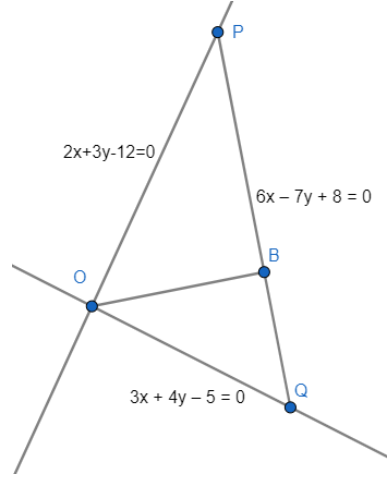
Now let us say that O is the intersection of lines 2x - 3y + 4 = 0 and 3x + 4y - 5 = 0
Now consider the line 2x - 3y + 4 = 0
Multiplying the whole equation by 4 we get,
8x - 12y + 16 = 0 ...(1)
Now consider the line 3x + 4y - 5 = 0
Multiplying the whole equation by 3 we get 9x + 12y - 15 = 0 ...(2)
Now adding equation (1) and equation (2) we have 9x + 8x + 16 - 15 = 0
Hence we get x = $ \frac{-1}{17}.$
Now substituting the value of x in equation 2x - 3y + 4 = 0 we get,
$2\left(\frac{-1}{17}\right)-3 y+4=0$
$\Rightarrow \frac{-2}{17}+4=3 y$
$\Rightarrow \frac{-2+4 \times 17}{17}=3 y$
$\Rightarrow \frac{-2+68}{17 \times 3}=y$
$\Rightarrow y=\frac{66}{51}$
$\Rightarrow y=\frac{22}{17}$
Hence we get $O(x, y)=\left(\frac{-1}{17}, \frac{22}{17}\right)$
Now consider the equation of line PQ, 6x - 7y + 8 = 0
Rearranging the terms we get y = $\frac{6 x}{7}+\frac{8}{7}$.
Now comparing the line with the equation y = mx + c we get the slope of line m = $\frac{6}{7}$
Now we know that OB is perpendicular to PQ since the shortest path connecting the point and a line is
perpendicular drawn from the line. And the product of slope of perpendicular lines is -1. Hence slope of line OB is $\frac{-7}{6}$.
Now we have the slope of line is $\frac{-7}{6}$ and the line passes through point $\left(\frac{-1}{17}, \frac{22}{17}\right)$
Hence the equation of line in slope point form $y-y_{1}=m\left(x-x_{1}\right)$ is
Hence we get the equation of the line OB is
$y-\frac{22}{17}=\frac{-7}{6}\left(x-\frac{(-1)}{17}\right)$
$\Rightarrow \frac{17 y-22}{17}=\frac{-7(17 x+1)}{17 \times 6}$
$\Rightarrow$ 6(17y - 22) = -7(17x + 1)
$\Rightarrow$ 102y - 132 = -119x - 7
$\Rightarrow$ 119x + 102y = 125
Hence the required equation of line is 119x + 102y = 125.
Note: Now we can also solve this question by first finding the foot of the perpendicular from the point O to the line 6x - 7y + 8 = 0. Now, this foot of perpendicular is nothing but point B hence we can easily find the equation of OB by using the equation of a line in two-point form.
View full question & answer→Question 53 Marks
Prove that the product of the lengths of the perpendiculars drawn from the points $\left( {\sqrt {{a^2} - {b^2}} ,0} \right)$ and $\left( { - \sqrt {{a^2} - {b^2}} ,0} \right)$ to the line $\frac{x}{a}\cos \theta + \frac{y}{b}\sin \theta = 1$ is $b^2.$
AnswerLet $P_1$ and $P_2$ be the length of perpendiculars from $\left( {\sqrt {{a^2} - {b^2}} ,0} \right)$ and $\left( { - \sqrt {{a^2} - {b^2}} ,0} \right)$to the line $\frac{x}{a}\cos \theta + \frac{y}{b}\sin \theta = 1$.
$\therefore {P_1} = \left| {\frac{{\frac{{\sqrt {{a^2} - {b^2}} \cos \theta }}{a} + \frac{{0 \times \sin \theta }}{b} - 1}}{{\sqrt {{{\left( {\frac{{\cos \theta }}{a}} \right)}^2} + {{\left( {\frac{{\sin \theta }}{b}} \right)}^2}} }}} \right|$
$= \left| {\frac{{\frac{{\sqrt {{a^2} - {b^2}} \cos \theta - 1}}{a}}}{{\sqrt {\frac{{{{\cos }^2}\theta }}{{{a^2}}} + \frac{{{{\sin }^2}\theta }}{{{b^2}}}} }}} \right|$
${P_2} = \left| {\frac{{\frac{{ - \sqrt {{a^2} - {b^2}} \cos \theta }}{a} + \frac{{0 \times \sin \theta }}{b} - 1}}{{\sqrt {{{\left( {\frac{{\cos \theta }}{a}} \right)}^2} + {{\left( {\frac{{\sin \theta }}{b}} \right)}^2}} }}} \right|$
$= \left| {\frac{{\frac{{ - \sqrt {{a^2} - {b^2}} \cos \theta }}{a} - 1}}{{\sqrt {\frac{{{{\cos }^2}\theta }}{{{a^2}}} + \frac{{{{\sin }^2}\theta }}{{{b^2}}}} }}} \right|$
Now ${P_1}{P_2} = \left| {\frac{{\frac{{\sqrt {{a^2} - {b^2}} \cos \theta }}{a} - 1}}{{\sqrt {\frac{{{{\cos }^2}\theta }}{{{a^2}}} + \frac{{{{\sin }^2}\theta }}{{{b^2}}}} }}} \right|$$\left| {\frac{{\frac{{ - \sqrt {{a^2} - {b^2}} \cos \theta }}{a} - 1}}{{\sqrt {\frac{{{{\cos }^2}\theta }}{{{a^2}}} + \frac{{{{\sin }^2}\theta }}{{{b^2}}}} }}} \right|$
$= \frac{{\left| {\left[ {\frac{{\sqrt {{a^2} - {b^2}} \cos }}{a} - 1} \right]\left[ {\frac{{\sqrt {{a^2} - {b^2}} \cos \theta }}{a} + 1} \right]} \right|}}{{\frac{{{{\cos }^2}\theta }}{{{a^2}}} + \frac{{{{\sin }^2}\theta }}{{{b^2}}}}}$
$= \frac{{\left| {\left[ {\frac{{({a^2} - {b^2}){{\cos }^2}\theta }}{{{a^2}}} - 1} \right]} \right|}}{{\frac{{{{\cos }^2}\theta }}{{{a^2}}} + \frac{{1 - {{\cos }^2}\theta }}{{{b^2}}}}}$$= \frac{{\left| {\left[ {\frac{{({a^2} - {b^2}){{\cos }^2}\theta }}{{{a^2}}} - 1} \right]} \right|}}{{\frac{{{b^2}{{\cos }^2}\theta + {a^2} - {a^2}{{\cos }^2}\theta }}{{{a^2}{b^2}}}}}$
$= \frac{{\left| {{a^2} - ({a^2} - {b^2}){{\cos }^2}\theta } \right|}}{{\frac{{{a^2} - ({a^2} - {b^2}){{\cos }^2}\theta }}{{{b^2}}}}}$
$= {a^2} - ({a^2} - {b^2}){\cos ^2}\theta \times \frac{{{b^2}}}{{{a^2} - ({a^2} - {b^2}){{\cos }^2}\theta }}$
$= b^2.$
View full question & answer→Question 63 Marks
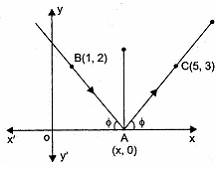
A ray of light passing through the point (1, 2) reflects on the x-axis at point A and the reflected ray passes through the point (5, 3). Find the coordinates of A.
AnswerLet BA be the incident ray and AC be the reflected ray.
Now for line AC
$\tan \phi = \frac{{3 - 0}}{{5 - x}}$
$\Rightarrow \tan \phi = \frac{3}{{5 - x}}$....... (i)
Now for line BA
$\tan \left( {180 - \phi } \right) = \frac{{2 - 0}}{{1 - x}}$
$\Rightarrow - \tan \phi = \frac{2}{{1 - x}}$. . . (ii)
From (i) and (ii), we have
$\frac{3}{{5 - x}} = \frac{{ - 2}}{{1 - x}} \Rightarrow$ 3 - 3x = - 10 + 2x $\Rightarrow$ -5x = -13
$\Rightarrow x = \frac{{13}}{5}$
Thus coordinates of point A are $\left( {\frac{{13}}{5},0} \right)$
View full question & answer→Question 73 Marks
Find equation of the line which is equidistant from parallel lines $9x + 6y - 7 = 0$ and $3x + 2y + 6 = 0$
AnswerThe equations of parallel lines are
$9x + 6y- 7 = 0$ and $3x + 2y + 6 = 0$
Let $A(x_1, y_1)$ be any point which is equidistant from the parallel lines.
$\therefore \left| {\frac{{9{x_1} + 6{y_1} - 7}}{{\sqrt {{{(9)}^2} + {{(6)}^2}} }}} \right| = \left| {\frac{{3{x_1} + 2{y_1} + 6}}{{\sqrt {{{(3)}^2} + {{(2)}^2}} }}} \right|$
$\Rightarrow \frac{{9{x_1} + 6{y_1} - 7}}{{3\sqrt {13} }} = \pm \frac{{3{x_1} + 2{y_1} + 6}}{{\sqrt {13} }}$
Taking $\frac{{9{x_1} + 6{y_1} - 7}}{{3\sqrt {13} }} = - \frac{{3{x_1} + 2{y_1} + 6}}{{\sqrt {13} }}$
$\Rightarrow 9x_1 + 6y_1 - 7 = -9x_1 - 6y_1 - 18$
$\Rightarrow18x_1+12y_1+11=0$
Thus equation of required line is $18 x + 12 y + 11 = 0$
View full question & answer→Question 83 Marks
If sum of the perpendicular distances of a variable point P(x, y) from the lines x + y - 5 = 0 and 3x - 2y + 7 = 0 is always 10. Show that P must move on a line.
AnswerThe equations of given lines are
x + y - 5 = 0. . . (i) and 3x - 2y + 7 = 0. . . (ii)
Perpendicular distance of point P(x, y) from line x + y - 5 = 0
$\left| {\frac{{x + y - 5}}{{\sqrt {{{(1)}^2} + {{(1)}^2}} }}} \right| = \left| {\frac{{x + y - 5}}{{\sqrt 2 }}} \right|$
Perpendicular distance of point P(x, y) from line 3x - 2y + 7 = 0
$= \left| {\frac{{3x - 2y + 7}}{\sqrt{{{(3)}^2} + {{( - 2)}^2}}}} \right| = \left| {\frac{{3x - 2y + 7}}{{\sqrt {13} }}} \right|$
It is given that
$= \left| {\frac{{x + y - 5}}{{\sqrt 2 }}} \right| + \left| {\frac{{3x - 2y + 7}}{{\sqrt {13} }}} \right| = 10$
$\Rightarrow \left| {\sqrt {13} (x + y - 5)} \right| + \left| {\sqrt 2 (3x - 2y + 7)} \right|$$= 10\sqrt {26}$
When x + y - 5$ \geqslant$0 and 3x - 2y + 7$\geqslant$0
Then $\sqrt {13} (x + y - 5) + \sqrt 2 (3x - 2y + 7) = 10\sqrt {26}$
$\Rightarrow (\sqrt {13} + 3\sqrt 2 )x + (\sqrt {13} - 2\sqrt 2 )y$$- 5\sqrt {13} + 7\sqrt 2 - 10\sqrt {26} = 0$
Which represents a line
Similarly
When x + y - 5$ \geqslant$0 and 3x - 2y + 7<0
x + y - 5 < 0 and 3x - 2y + 7$ \geqslant$0
and x + y - 5 < 0 and 3x - 2y + 7 < 0
In all the above cases it represents a line, thus point P(x, y) must move on a line.
View full question & answer→Question 93 Marks
If the lines $y = 3x + 1$ and $2y = x + 3$ are equally inclined to the line $y = mx + 4,$ find the value of $m.$
AnswerLet $\theta$ be the angle which the line $y = mx + 4$ makes with the lines $y = 3x + 1$ and $2y = x + 3.$
Then
$\therefore \tan \alpha = \left| {\frac{{m - 3}}{{1 + 3m}}} \right|$ and $\tan \theta = \left| {\frac{{m - \frac{1}{2}}}{{1 + \frac{m}{2}}}} \right| = \left| {\frac{{2m - 1}}{{2 + m}}} \right|$
$\Rightarrow \left| {\frac{{m - 3}}{{1 + 3m}}} \right| = \left| {\frac{{2m - 1}}{{2 + m}}} \right|$
$\Rightarrow \left| {\frac{{m - 3}}{{1 + 3m}}} \right| = \pm \frac{{2m - 1}}{{m + 2}}$
$ \Rightarrow m^2 - m - 6 = \pm(6m^2 - m - 1)$
$\Rightarrow 5m^2 + 5 = 0$ or $7m^2 - 2m - 7 = 0$
$\Rightarrow m = \frac{{1 \pm 5\sqrt 2 }}{7}$
View full question & answer→Question 103 Marks
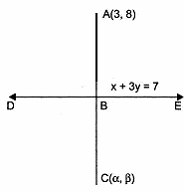
Find the image of the point (3, 8) with respect to the line x + 3y = 7 assuming the line to be a plane mirror.
AnswerLet the image of the point A(3, 8) in the line mirror DE be $C(\alpha ,\beta )$. Then AC is perpendicular bisector of DE.
The coordinates of point B are $\left( {\frac{{\alpha + 3}}{2},\frac{{\beta + 8}}{2}} \right)$.
Since point B lies on the line x + 3y = 7.
$\therefore \frac{{\alpha + 3}}{2} + \frac{{3(\beta + 8)}}{2} = 7 \Rightarrow$$\alpha + 3 + 3\beta + 24 = 14$
$\therefore \alpha + 3\beta + 13 = 0$....... (i)
Since AC is perpendicular on DE,
$\therefore$ Slope of AC $ \times$ Slope of DE = -1
$\Rightarrow \frac{{\beta - 8}}{{\alpha - 3}} \times \frac{{ - 1}}{3} = - 1 \Rightarrow \beta - 8 = 3\alpha - 9$
$\Rightarrow 3\alpha - \beta - 1 = 0$. . . (ii)
Solving (i) and (ii) we get
$\alpha = - 1 ,\beta=-4$
Thus image of point (3, 8) is (-1, -4)
View full question & answer→Question 113 Marks
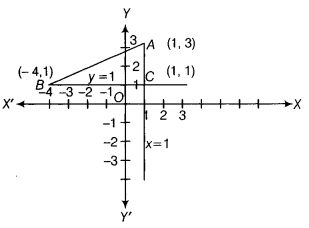
The hypotenuse of a right-angled triangle has its ends at the points (1, 3) and (- 4, 1). Find the equation of the legs (perpendicular sides) of the triangle.
AnswerFirst we plot the points A(1, 3) and B (-4, 1) in the XY-plane. From the point A(1, 3), we draw a line parallel to Y-axis. And the point B(-4, 1), we draw a line parallel to X-axis. The point of intersection of two lines is on C, which is right angled at C.
$\therefore$ The coordinate of C will be (1, 1)
$\therefore$ Equation of line AC passing through A(1, 3) and C(1, 1) is
$y-y_{1}=\frac{y_{2}-y_{1}}{x_{2}-x_{1}}\left(x-x_{1}\right)$
$\therefore \quad y-3=\frac{1-3}{1-1}(x-1)$
$\Rightarrow \quad y-3=\frac{-2}{0}(x-1) \Rightarrow x=1$
Equation of line BC is
$y-1=\frac{1-1}{1+4}(x-1)$
$\Rightarrow \quad y-1=\frac{0}{1+4}(x-1)$
$\Rightarrow$ y - 1 = 0 $\Rightarrow$ y = 1
Hence, the legs of a triangle are x = 1 and y = 1.
View full question & answer→Question 123 Marks
Find the distance of the line 4x + 7y + 5 = 0 from the point (1, 2) along the line 2x - y = 0
AnswerWe have to find the distance between point (1, 2) and point of intersection of lines 4x + 7 y + 5 = 0 and 2x - y = 0
Now the point of intersection of lines 4x + 7 y + 5 = 0 and 2x - y = 0 is obtained by solving these equations.
$\therefore x = \frac{{ - 5}}{{18}}$ and $y = \frac{{ - 5}}{9}$
$\therefore$ Distance between point (1, 2) and $\left( {\frac{{ - 5}}{{18}},\frac{{ - 5}}{9}} \right)$ is
$\sqrt {{{\left( {1 + \frac{5}{{18}}} \right)}^2} + {{\left( {2 + \frac{5}{9}} \right)}^2}} = \sqrt {{{\left( {\frac{{23}}{{18}}} \right)}^2} + {{\left( {\frac{{23}}{9}} \right)}^2}}$
$= \frac{{23}}{{18}}\sqrt {{{(1)}^2} + {{(2)}^2}} = \frac{{23}}{{18}}\sqrt 5$ units.
View full question & answer→Question 133 Marks
In what ratio is the line joining A (-1, 1) and B(5, 7) divided by the line x + y = 4?
AnswerLet the given line divide AB in the ratio m : 1.
Then, we have hehe point of division is C $\left(\frac{5 m-1}{m+1}, \frac{7 m+1}{m+1}\right)$
This point C must lie on the line x + y = 4
$\therefore \quad \frac{5 m-1}{m+1}+\frac{7 m+1}{m+1}=4 \Leftrightarrow$ (5m -1 ) + (7m + 1) = 4(m + 1)
$\Leftrightarrow 8 m=4 \Leftrightarrow m=\frac{1}{2}$
Therefore, the required ratio is $\frac{1}{2}$ : 1, i.e., 1: 2.
View full question & answer→Question 143 Marks
Find the equation of the lines through the point (3, 2) which make an angle of 45°with the line x - 2y = 3.
AnswerLet m be the slope of required line which passes through point (3, 2). Then equation of required line is
y - 2 = m (x - 3). . . (i)
The equation of given line is x - 2y = 3
$\Rightarrow y = \frac{x}{2} - \frac{3}{2}$. . . (ii)
$\therefore$ Slope of given line is $\frac{1}{2}$.
It is given that lines (i) and (ii) make an angle of 45°
$\therefore \tan 45^\circ = \left| {\frac{{m - \frac{1}{2}}}{{1 + \frac{m}{2}}}} \right| \Rightarrow 1 = \left| {\frac{{2m - 1}}{{2 + m}}} \right|$
$\Rightarrow \frac{{2m - 1}}{{2 + m}} = \pm 1$
When $\frac{{2m - 1}}{{2 + m}} = 1 \Rightarrow$ 2m - 1 = 2 + m $\Rightarrow$ m = 3
Then equation of required line is y - 2 = 3(x - 3).
$\Rightarrow$ y - 2 = 3x - 9 $\Rightarrow$ 3x - y - 7 = 0
When $\frac{{2m - 1}}{{2 + m}} = - 1 \Rightarrow$ 2m - 1 = - 2 - m $\Rightarrow$ 3m = -1
$\Rightarrow m = \frac{{ - 1}}{3}$
Then equation of required line is $y - 2 = \frac{{ - 1}}{3}(x - 3)$
$\Rightarrow$ 3y - 6 = -x + 3 $\Rightarrow$ x + 3y - 9 = 0
View full question & answer→Question 153 Marks
If three lines whose equations are $y = m_1x + c_1y = m_2x + c_2 $ and $y = m_3x + c_3$ are concurrent, then show that $m_1(c_2 - c_3) + m_2(c_3 - c_1) + m_3 (c_1 - c_2) = 0.$
Answeri.e. $-m_1x + y - c_1 = 0 - m_2x + y - c_2 = 0$ and $-m_3x + y - c_3= 0$
We know that three lines are concurrent if
$\left| {\begin{array}{*{20}{c}} { - {m_1}}&1&{ - {c_1}} \\ { - {m_2}}&1&{ - {c_2}} \\ { - {m_3}}&1&{ - {c_3}} \end{array}} \right| = 0$
$ \Rightarrow - {m_1}[ - {c_3} + {c_2}] + {m_2}[{c_3} - {c_1}]$$ - {m_3}[ - {c_2} + {c_1}] = 0$
$ \Rightarrow {m_1}({c_2} - {c_3}) + {m_2}({c_3} - {c_1})$$ + {m_3}({c_1} - {c_2}) = 0$
View full question & answer→Question 163 Marks
Find the points on the x-axis, where distances from the line $\frac{x}{3} + \frac{y}{4} = 1$are 4 units.
AnswerLet the coordinates of the point on x-axis be $(\alpha ,0)$.
$\therefore$ Perpendicular distance of the point $(\alpha ,0)$ from the line 4x + 3y - 12 = 0 is
$\left| {\frac{{4\alpha + 3(0) - 12}}{{\sqrt {{{(4)}^2} + {{(3)}^2}} }}} \right| = \left| {\frac{{4\alpha - 12}}{5}} \right|$
It is given that $\left| {\frac{{4\alpha - 12}}{5}} \right| = 4$
$ \Rightarrow \frac{{4\alpha - 12}}{5} = \pm 4$
Now $\frac{{4\alpha - 12}}{5} = 4$ or $\frac{{4\alpha - 12}}{5} = - 4$
$\Rightarrow 4\alpha - 12 = 20{\text{ or }}4\alpha - 12 = - 20$
$\Rightarrow 4\alpha = 32{\text{ or }}4\alpha = - 8$
$\Rightarrow \alpha = 8{\text{ or }}\alpha = - 2$
Thus the points on x-axis are (8, 0) and (-2, 0)
View full question & answer→Question 173 Marks
If p is the length of perpendicular from the origin to the line whose intercepts on the axes are a and b, then show that $\frac{1}{{{p^2}}} = \frac{1}{{{a^2}}} + \frac{1}{{{b^2}}}$.
AnswerThe given line is $\frac{x}{a} + \frac{y}{b} = 1$.
$ \Rightarrow $ bx + ay = ab $ \Rightarrow $ bx + ay - ab = 0
Now p is the length of perpendicular from origin to bx + ay - ab = 0
$\therefore P = \left| {\frac{{b \times 0 + a \times 0 - ab}}{{\sqrt {{b^2} + {a^2}} }}} \right| = \frac{{ab}}{{\sqrt {{b^2} + {a^2}} }}$
$ = {P^2} = \frac{{{a^2}{b^2}}}{{{b^2} + {a^2}}} \rightarrow\frac{1}{{{p^2}}} = \frac{{{b^2} + {a^2}}}{{{a^2}{b^2}}}$ $ = \frac{1}{{{p^2}}} = \frac{{{b^2}}}{{{a^2}{b^2}}} + \frac{{{a^2}}}{{{a^2}{b^2}}}$
$=\frac{1}{{{p^2}}} = \frac{1}{{{a^2}}} + \frac{1}{{{b^2}}}$
View full question & answer→Question 183 Marks
If $p$ and $q$ are the length of perpendiculars from the origin to the lines $x\cos \theta - y\sin \theta = k\cos 2\theta$ and $x\sec \theta + y\operatorname{co} \sec \theta = k$ respectively, prove that $p^2 + 4q^2 = k^2.$
AnswerLength of perpendicular from origin to line $x\cos \theta - y\sin \theta - k\cos 2\theta = 0$ is
$p = \left| {\frac{{0 \times \cos \theta - 0 \times \sin \theta - kcos2\theta }}{{\sqrt {{{\cos }^2}\theta + {{\sin }^2}\theta } }}} \right|$$= \left| {\frac{{ - k\cos 2\theta }}{1}} \right| = k\cos 2\theta$
Length of perpendicular from origin to line $x\sec \theta + y\cos ec\theta - k = 0$ is
$q = \left| {\frac{{0 \times \sec \theta + 0 \times \cos ec\,\theta - k}}{{\sqrt {{{\sec }^2}\theta + \cos e{c^2}\theta } }}} \right|$$= \left| {\frac{{ - k}}{{\sqrt {\frac{{{{\sin }^2}\theta + {{\cos }^2}\theta }}{{{{\sin }^2}\theta {{\cos }^2}\theta }}} }}} \right|$
$=\left| { - k\sin \theta \cos \theta } \right| = \frac{k}{2}\sin 2\theta$
Now ${p^2} +4 {q^2} = {(k\cos 2\theta )^2} + 4{\left( {\frac{k}{2}\sin 2\theta } \right)^2}$
$= {k^2}({\cos ^2}2\theta + {\sin ^2}2\theta ) = {k^2}$.
View full question & answer→Question 193 Marks
The perpendicular from the origin to the line y = mx + c meets it at the point (-1, 2). Find the value of m and c.
AnswerEquation of the line PQ
$y - 0 = \left( {\frac{{2 - 0}}{{ - 1 - 0}}} \right)(x - 0)$
$\Rightarrow$ y = -2x $\Rightarrow$ 2x + y = 0 ....... (i)
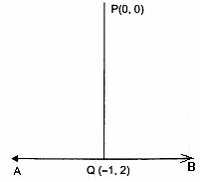
Slope of the required line which is perpendicular to line (i) is $\frac{1}{2}$
$\therefore$ Equation of the line AB is
$y - 2 = \frac{1}{2}(x + 1) \Rightarrow$ 2y - 4 = x + 1
$\Rightarrow$ 2y = x + 5 $ \Rightarrow y = \frac{x}{2} + \frac{5}{2}$
Comparing it with y = mx + c, we have
$m = \frac{1}{2}$ and $c = \frac{5}{2}$.
View full question & answer→Question 203 Marks
Find the coordinates of the foot of perpendicular from the point (-1, 3) to the line 3x - 4y - 16 = 0
AnswerLet Q be the foot of perpendicular drawn from P(-1, 3) on the line 3x - 4y - 16 = 0
$\therefore$ Equation of a line $\bot$ to 3x - 4y - 16 = 0 is 4x + 3y + k = 0
Since this line passes through point (-1, 3)
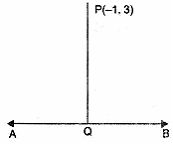
$\therefore 4 \times - 1 + 3 \times 3 + k = 0$$\Rightarrow - 4 + 9 + k = 0 \Rightarrow k = - 5$
Thus Q is a point of intersection of the lines
3x - 4y - 16 = 0 and 4x + 3y - 5 = 0
Solving these equations by cross multiplication we have
$\frac{x}{{ - 68}} = \frac{y}{{49}} = - \frac{1}{{25}}$
$\therefore \frac{x}{{ - 68}} = \frac{{ - 1}}{{25}} \Rightarrow x = \frac{{68}}{{25}}$
$\frac{y}{{49}} = \frac{{ - 1}}{{25}} \Rightarrow y = \frac{{ - 49}}{{25}}$
Thus coordinates of foot of perpendicular are $\left( {\frac{{68}}{{25}},\frac{{ - 49}}{{25}}} \right)$.
View full question & answer→Question 213 Marks
Two lines passing through the point $(2, 3)$ intersects each other at an angle of $60^\circ .$ If slope of one line is $2$ Find equation of the other line.
AnswerHere $m_1 = 2$ and $\theta = 60^\circ$
We know that $\tan \theta = \left| {\frac{{{m_1} - {m_2}}}{{1 + {m_1}{m_2}}}} \right|$
$\therefore \tan 60^\circ = \left| {\frac{{2 - {m_2}}}{{1 + 2{m_2}}}} \right| \Rightarrow \sqrt 3 = \left| {\frac{{2 - {m_2}}}{{1 + 2{m_2}}}} \right|$$\Rightarrow \frac{{2 - {m_2}}}{{1 + 2{m_2}}} = \pm \sqrt 3$
If $\frac{{2 - {m_2}}}{{1 + 2{m_2}}} = \sqrt 3 \Rightarrow 2 - {m_2} = \sqrt 3 + 2\sqrt 3 {m_2}$$\Rightarrow (2\sqrt 3 + 1){m_2} = 2 - \sqrt 3$
$\Rightarrow {m_2} = \frac{{2 - \sqrt 3 }}{{2\sqrt 3 + 1}}$
$\therefore$ Equation of required line is
$y - 3 = \frac{{2 - \sqrt 3 }}{{2\sqrt 3 + 1}}(x - 2)$
$\Rightarrow (2\sqrt 3 + 1)y - 6\sqrt 3 - 3$$= (2 - \sqrt 3 )x - 4 + 2\sqrt 3$
$\Rightarrow (\sqrt 3 - 2)x + (2\sqrt 3 + 1)y$$= - 4 + 2\sqrt 3 + 6\sqrt 3 + 3$
$\Rightarrow (\sqrt 3 - 2)x + (2\sqrt 3 + 1)y = 8\sqrt 3 - 1$
If $\frac{{2 - {m_2}}}{{1 + 2{m_2}}} = - \sqrt 3 \Rightarrow 2 - {m_2} = - \sqrt 3 - 2\sqrt 3 {m_2}$$\Rightarrow (2\sqrt 3 - 1){m_2} = - (2 + \sqrt 3 )$
$\Rightarrow {m_2} = \frac{{ - (2 + \sqrt 3 )}}{{(2\sqrt 3 - 1)}}$
$\therefore$ Equation of required line is
$y - 3 = \frac{{ - (2 + \sqrt 3 )}}{{(2\sqrt 3 - 1)}}(x - 2)$
$\Rightarrow (2\sqrt 3 - 1)y - 6\sqrt 3 + 3$$\Rightarrow - (2 + \sqrt 3 )x + 4x2\sqrt 3$
$\Rightarrow (2 + \sqrt 3 )x + (2\sqrt 3 - 1)y$$\Rightarrow 4 + 2\sqrt 3 + 6\sqrt 3 - 3$
$\Rightarrow (2 + \sqrt 3 )x + (2\sqrt 3 - 1)y \Rightarrow 8\sqrt 3 + 1$.
View full question & answer→Question 223 Marks
The vertices of $\Delta PQR$, are P(2, 1), Q(-2, 3) and R (4, 5). Find equation of the median through the vertex R.
AnswerHere P (2, 1), Q(-2, 3) and R(4, 5) are the vertices of $\Delta PQR$.
RS is the median through vertex R.
Then S is midpoint of PQ.
$\therefore$ Coordinates of S are $\left( {\frac{{2 - 2}}{2},\frac{{1 + 3}}{2}} \right)$ i.e. (0, 2)
So equation of required median RS is
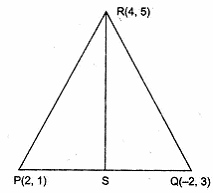
$y - 2 = \left( {\frac{{5 - 2}}{{4 - 0}}} \right)(x - 0)$
$\Rightarrow y - 2 = \frac{3}{4}x \Rightarrow$ 4y - 8 = 3x $\Rightarrow$ 3x - 4y + 8 = 0.
View full question & answer→Question 233 Marks
By using the concept of equation of a line, prove that the three points $(3, 0), (-2, -2)$ and $(8, 2)$ are collinear.
AnswerHere $(x_1, y_1) = (3, 0)$ and $(x_2, y_2) = (-2, -2).$
Putting these values in $y - y_1 = \left( {\frac{{{y_2} - {y_1}}}{{{x_2} - {x_1}}}} \right) (x - x_1),$ we have,
$\therefore y - 0 = \left( {\frac{{ - 2 - 0}}{{ - 2 - 3}}} \right) (x - 3)$
$ \Rightarrow y = \left( {\frac{{ - 2}}{{ - 5}}} \right)(x - 3)$
$\Rightarrow 5y = 2x - 6$
$\Rightarrow 2x - 5y = 6$
Put the coordinates of third point $(8, 2)$ in above equation, we have
$2\times8 - 5\times2 = 6$
$\Rightarrow 16 - 10 = 6 \Rightarrow 6 = 6$ which is true.
Thus the third point lies on the line of the first two points. So given three points are collinear.
View full question & answer→Question 243 Marks
Point R(h, k) divides a line segment between the axis in the ratio 1 : 2. Find equation of the line.
AnswerLet A(x, 0) and B (0, y) be two points where the line intersect x and y axis respectively and R(h, k) is a point divides AB in the ratio 1: 2.
Then $\frac{{2x + 0}}{{2 + 1}} = h$ and $\frac{{0 + y}}{{2 + 1}} = k$
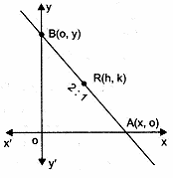
$\Rightarrow x = \frac{3}{2}h$ and y = 3 k
Now equation of required line is
$\frac{x}{{\frac{3}{2}h}} + \frac{y}{{3k}} = 1 \Rightarrow \frac{{2x}}{{3h}} + \frac{y}{{3k}} = 1$
$\Rightarrow$ 2kx + hy = 3 kh
View full question & answer→Question 253 Marks
P (a, b) is the mid point of a line segment between x axis. Show that equation of the line is $\frac{x}{a} + \frac{y}{b} = 2$.
AnswerLet A(x, 0) and B (0, y) be two points where the line intersect x and y-axis respectively and P(a, b) is midpoint of AB.
Then $\frac{{0 + x}}{2} = a \Rightarrow$ x = 2 a
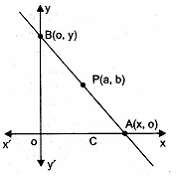
and $\frac{{0 + y}}{2} = b \Rightarrow$ y = 2 b
Now equation of required line is
$\frac{x}{{2a}} + \frac{y}{{2b}} = 1 \Rightarrow \frac{x}{a} + \frac{y}{b} = 2$
View full question & answer→Question 263 Marks
The owner of a milk store finds that he can sell 980 litres of milk each week at Rs. $14$/ litre and $1220$ litres of milk each week at Rs. $16$/litre. Assuming a linear relationship between selling price and demand, how many litres could he sell weekly at Rs. $17$/litres?
AnswerHere $(x_1, y_1) = (980, 14)$ and $(x_2, y_2) = (1220, 16).$
Putting these values in $y - y_1 = \left( {\frac{{{y_2} - {y_1}}}{{{x_2} - {x_1}}}} \right) (x - x_1),$ we have
$y - 14 = {\left[ {\frac{{16 - 14}}{{1220 - 980}}} \right]} (x - 980)$
$\Rightarrow y - 14 = \frac{2}{{240}} (x - 980)$
$\Rightarrow y - 14 = \frac{1}{{120}} (x - 980)$
$\Rightarrow 120(y - 14) = x - 980$
Putting $y = 17$, we have
$120 (17 - 14) = x - 980$
$\Rightarrow 120 \times 3 = x - 980$
$\Rightarrow x = 1340$ litres
View full question & answer→Question 273 Marks
The length $L ($in centimeter$)$ of a copper rod is a linear function of its Celsius temperature $C.$ In an experiment if $L = 124.942$ when $C = 20$ and $L = 125.134$ when $C = 110,$ express $L$ in terms of $C$.
AnswerLet the length be represented by $y$ and the temperature by $x.$
Then $(x_1, y_1) = (20, 124.942)$ and $(x_2, y_2) = ( 110, 125.134)$
Putting these values in $y - {y_1} = \left( {\frac{{{y_2} - {y_1}}}{{{x_2} - {x_1}}}} \right)(x - {x_1}).$
$\therefore y - 124.942 = \frac{{(125.134 - 124.942)}}{{(110 - 20)}} (x - 20)$
$ \Rightarrow y - 124.942 = \frac{{0.192}}{{90}}(x - 20)$
$\Rightarrow y - 124.942 = \frac{{0.032}}{{15}}(x - 20)$
$\Rightarrow 15y - 1874.13 = 0.03x - 0.64$
$\Rightarrow 1y\ y = 0.032 x + 1873.49$
$\Rightarrow y = 0.0021x + 124.8993$
$\Rightarrow L = 0.0021 C + 124.8993$
View full question & answer→Question 283 Marks
Find equation of the line passing through the point $(2, 2)$ and cutting off intercepts on the axis whose sum is $9.$
AnswerSince the line passes through point $(2, 2).$
$\therefore \frac{2}{a} + \frac{2}{b} = 1 . . . . (i)$
It is given that $a + b = 9 \Rightarrow a = 9 - b. . . (ii)$
Putting value of a in $(i)$
$\frac{2}{{9 - b}} + \frac{2}{b} = 1 \Rightarrow 2b + 18 - 2b = 9b - b^2$
$\Rightarrow b^2 - 9b + 18 = 0 \Rightarrow (b - 3)(b - 6) = 0$
$\Rightarrow b = 3, 6$
Putting these values of $b$ in $(ii)$
For $b = 3, a = 9 - 3 = 6$
For $b = 6, a = 9 - 6 = 3$
Thus equation of lines are
$\frac{x}{6} + \frac{y}{3} = 1 \Rightarrow x + 2 y = 6$
$\frac{x}{3} + \frac{y}{6} = 1 \Rightarrow 2x + y = 6$
View full question & answer→Question 293 Marks
A line perpendicular to the line segment joining the points (1, 0) and (2, 3) divides it in the ratio 1 : n. Find the equation of the line.
AnswerLet point C divides the join of A(1, 0) and B(2, 3) in the ratio 1 : n.
$\therefore$ Coordinates of C are $\left( {\frac{{2 + n}}{{1 + n}},\frac{3}{{1 + n}}} \right)$
Slope of AB $= \frac{{3 - 0}}{{2 - 1}} = 3$
Since the required line is perpendicular to AB,
$\therefore$ ;Slope of required line $m = - \frac{1}{3}$
Now the required line passing through point $\left( {\frac{{2 + n}}{{1 + n}},\frac{3}{{1 + n}}} \right)$ having slope $-\frac{1}{3}$.
$\therefore$ Equation of required line is
$y - \frac{3}{{1 + n}} = \frac{{ - 1}}{3}\left( {x - \frac{{2 + n}}{{1 + n}}} \right)$
$\Rightarrow \frac{{(1 + n)y - 3}}{{1 + n}} = - \frac{1}{3}\left[ {\frac{{(1 + n)x - 2 - n}}{{1 + n}}} \right]$
$\Rightarrow$ 3(1 + n)y - 9 = -(1 + n)x + 2 + n
$\Rightarrow$ (1+ n)x + 3 ( 1+ n) y = n + 11.
View full question & answer→Question 303 Marks
Find the distance between $P(x_1, y_1)$ and $Q(x_2, y_2)$ when $: PQ$ is parallel to the $x-$axis.
AnswerHere $P(x_1, y_1)$ and $Q(x_2, y_2)$ are two points.
$PQ$ is parallel to the x-axis then $y_2 - y_1 = 0$
Then, distance $PQ = \sqrt {({x_2} - {x_1})} = |{x_2} - {x_1}|$
View full question & answer→Question 313 Marks
Find the distance between $P(x_1, y_1) $ and $Q(x_2, y_2)$ when $PQ$ is parallel to the y-axis
AnswerHere $P(x_1, y_1)$ and $Q(x_2, y_2)$ are two points.
Then, distance $PQ = \sqrt {{{({x_2} - {x_1})}^2} + {{({y_2} - {y_1})}^2}} $
$PQ$ is parallel to the y-axis then $x_2 - x_1 = 0$
View full question & answer→Question 323 Marks
The base of an equilateral triangle with side $2$a lies along the $Y-$axis such that the mid-point of the base is at the origin. Find vertices of the triangle.
AnswerLet $BC$ be the base of a triangle which lies on $Y-$axis and third vertex may be $A (h, 0)$ or $A'(-h, 0).$
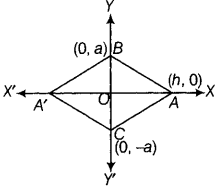
Since, $\Delta A B C$ is an equilateral, then $AB = BC.$
$\therefore AB^2 = BC^2$
$\Rightarrow (h - 0)^2 + (0 - a)^2 = (2a)^{2}[\because$ distance between two points $(x_1, y_1)$ and $(x_2, y_2)$ $=\sqrt{\left(x_{2}-x_{1}\right)^{2}+\left(y_{2}-y_{1}\right)^{2}} ]$
$\Rightarrow h^2 + a^2 = 4a^2 \Rightarrow h^2 = 3a^2$
$\Rightarrow \quad h=\pm \sqrt{3} a [$taking square root$]$
Hence, the vertices of triangle are $(\sqrt{3} a, 0),(0, a),(0,-a)$ or $(-\sqrt{3}a, 0),(0, a),(0,-a).$ View full question & answer→Question 333 Marks
Find the angle between the x-axis and the line joining the points (3, -1) and (4, -2).
AnswerLet A(3, -1) and B(4, -2) be two points. Let Q be the angle which AB makes with positive direction of x-axis.
$\therefore$ Slope of AB = $\tan \theta$
Also Slope of AB $= \frac{{ - 2( - 1)}}{{4 - 3}} = \frac{{ - 1}}{1} = - 1$
Now $\tan \theta = - 1 = - \tan 45^\circ = \tan (180 - 45)^\circ$
$\Rightarrow \theta = 135^\circ$
View full question & answer→Question 343 Marks
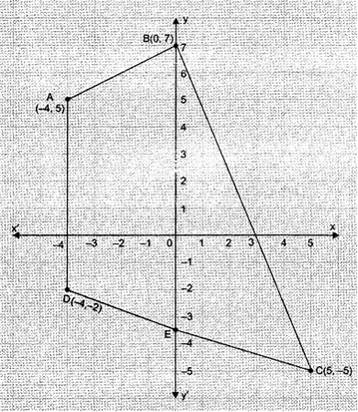
Draw a quadrilateral in the Cartesian plane, whose vertices are (-4, 5), (0, 7), (5, -5) and (-4, -2) also find its area.
AnswerArea of quadrilateral ABCD = area of $\Delta BCE$ + area of trap. ABED
$ = \frac{1}{2} \times 10.4 \times 5 + \frac{1}{2}(10.4 + 7) \times 4$
$ = 5.2 \times 5 + 2 \times 17.4$
= 26 + 34.8 = 60.8 sq. units.
View full question & answer→Question 353 Marks
In Fig., time and distance graph of a linear motion is given. Two positions of time and distance are recorded as, when T = 0, D = 2 and when T = 3, D = 8. Using the concept of slope, find law of motion, i.e., how distance depends upon time.
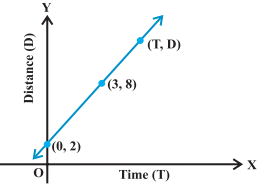
AnswerSuppose (T, D) be any point on the line, where D denotes the distance at time T.
Thus points (0, 2), (3, 8) and (T, D) are collinear so that
$\frac{8-2}{3-0}=\frac{D-8}{T-3}$ or 6 (T- 3) 3 (D- 8)
or D = 2(T + 1)
which is the required relation.
View full question & answer→Question 363 Marks
Three points $P (h, k), Q (x_1 , y_1 )$ and $R (x_2 , y_2 )$ lie on a line. Show that $(h – x_1 ) (y_2 – y_1 ) = (k – y_1 ) (x_2 – x_1 ).$
AnswerSince points $P, Q$ and $R$ are collinear, therefore,
Slope of $PQ =$ Slope of QR i.e.,$\frac{y_{1}-k}{x_{1}-h}=\frac{y_{2}-y_{1}}{x_{2}-x_{1}}$
or $\frac{k-y_{1}}{h-x_{1}}=\frac{y_{2}-y_{1}}{x_{2}-x_{1}}$
or $(h - x_1) (y_2 - y_1) = (k - y_1) (x_2 - x_1)$
View full question & answer→Question 373 Marks
Show that the path of a moving point such that its distances from two lines 3x – 2y = 5 and 3x + 2y = 5 are equal is a straight line.
AnswerHere,it is the given lines are
3x – 2y = 5 … (1)
and 3x + 2y = 5 … (2)
Let (h, k) is any point, whose distances from the lines (1) and (2) are equal. Thus
$\frac{|3 h-2 k-5|}{\sqrt{9+4}}=\frac{|3 h+2 k-5|}{\sqrt{9+4}}$ or $|3 h-2 k-5|=|3 h+2 k-5|$
which gives 3h – 2k – 5 = 3h + 2k – 5 or – (3h – 2k – 5) = 3h + 2k – 5.
Solving these two relations we get k = 0 or $h=\frac{5}{3}$ Therefore, the point (h, k) satisfies the equations y = 0 or $x=\frac{5}{3}$ which represent straight lines. Therefore, path of the point equidistant from the lines (1) and (2) is a straight line.
View full question & answer→Question 383 Marks
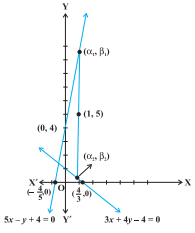
A line is such that its segment between the lines $5x – y + 4 = 0$ and $3x + 4y – 4 = 0$ is bisected at the point $(1, 5).$ Obtain its equation.
AnswerEquations of given lines are;
$5x – y + 4 = 0 ... (1)$
$3x + 4y – 4 = 0 ... (2)$
Let the required line intersects the lines $(1)$ and $(2)$ at points $(\alpha _1 , \beta_1 )$ and $(\alpha _2 , \beta_2 )$ respectively.
Hence, we have,
$5\alpha _1 – \beta_1 + 4 = 0$ and
$3 \alpha _2 + 4 \beta_2 – 4 = 0$
or $\beta_{1}=5 \alpha_{1}+4 \text { and } \beta_{2}=\frac{4-3 \alpha_{2}}{4}$
We are given that the midpoint of the segment of the required line between $(\alpha _1 , \beta_1 )$ and $(\alpha _2 , \beta_2 )$ is $(1, 5).$ Therefore
$\frac{\alpha_{1}+\alpha_{2}}{2}=1 \text { and } \frac{\beta_{1}+\beta_{2}}{2}=5$
or $\alpha_{1}+\alpha_{2}=2 \text { and } \frac{5 \alpha_{1}+4+\frac{4-3 \alpha_{2}}{4}}{2}=5$
or $\alpha _1 + \alpha _2 = 2$ and $20\alpha _1 – 3\alpha _2= 20 ... (3)$
Solving equations in (3) for $\alpha _1$_ and $\alpha _2 ,$ we get
$\alpha_{1}=\frac{26}{23} \text { and } \alpha_{z}=\frac{20}{23}$ and hence, $\beta_{1}=5 \cdot \frac{26}{23}+4=\frac{222}{23}$
Equation of the required line passing through $(1, 5)$ and $(\alpha _1, \beta_1 )$ is
$y-5=\frac{\beta_{1}-5}{\alpha_{1}-1}(x-1)$
or $y-5=\frac{\frac{222}{23}-5}{\frac{26}{23}-1}(x-1)$
or $107x – 3y – 92 = 0$
which is the equation of required line. View full question & answer→Question 393 Marks
Show that the area of the triangle formed by the lines $y = m_1 x + c_1 , y = m_2x + c_2 $ and $x = 0$ is $\frac{\left(c_{1}-c_{2}\right)^{2}}{2\left|m_{1}-m_{2}\right|}$
AnswerGiven lines are
$y = m_1x + c_1 ... (1)$
$y = m_2x + c_2 ... (2)$
$x = 0 ... (3)$
We know that line $y = mx + c$ meets the line $x = 0 (y-$axis$)$ at the point $(0, c).$ Thus, two vertices of the triangle formed by lines (1) to $(3)$ are $P (0, c_1)$ and $Q (0, c_2 ).$ Third vertex can be obtained by solving equations $(1)$ and $(2).$ Solving (1) and (2), we obtain
$x=\frac{\left(c_{2}-c_{1}\right)}{\left(m_{1}-m_{2}\right)} \text { and } y=\frac{\left(m_{1} c_{2}-m_{2} c_{1}\right)}{\left(m_{1}-m_{2}\right)}$
Thus, third vertex of the triangle is $R \left(\frac{\left(c_{2}-c_{1}\right)}{\left(m_{1}-m_{2}\right)}, \frac{\left(m_{1} c_{2}-m_{2} c_{1}\right)}{\left(m_{1}-m_{2}\right)}\right)$
Now, the area of the triangle is given
$=\frac{1}{2} | 0\left(\frac{m_{1} c_{2}-m_{2} c_{1}}{m_{1}-m_{2}}-c_{2}\right)+\frac{c_{2}-c_{1}}{m_{1}-m_{2}}\left(c_{2}-c_{1}\right)+0\left(c_{1}-\frac{m_{1} c_{2}-m_{2} c_{1}}{m_{1}-m_{2}}\right)|=\frac{\left(c_{2}-c_{1}\right)^{2}}{2\left|m_{1}-m_{2}\right|}$
View full question & answer→Question 403 Marks
Assuming that straight lines work as the plane mirror for a point, find the image of the point (1, 2) in the line x – 3y + 4 = 0
AnswerSuppose Q (h, k) is the image of the point P (1, 2) in the line
x – 3y + 4 = 0 ... (1) 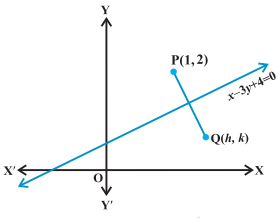
Thus,the line (1) is the perpendicular bisector of line segment PQ
Therefore,Slope of line PQ=$\frac{-1}{\text { Slope of line } x-3 y+4=0}$
so that $\frac{k-2}{h-1}=\frac{-1}{\frac{1}{3}}$ or 3h+k=5
and the mid-point of PQ, i.e., point $\left(\frac{h+1}{2}, \frac{k+2}{2}\right)$ will satisfy the equation (1) so that
$\frac{h+1}{2}-3\left(\frac{k+2}{2}\right)+4=0 \text { or } h-3 k=-3$ .........(3)
Solving (2) and (3), we obtain h=$\frac{6}{5}$ and k=$\frac{7}{5}$
Therefore, the image of the point (1, 2) in the line (1) is $\left(\frac{6}{5}, \frac{7}{5}\right)$
View full question & answer→Question 413 Marks
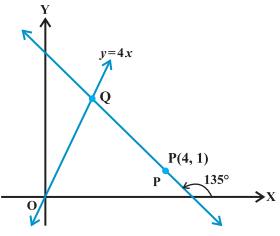
Find the distance of the line 4x – y = 0 from the point P (4, 1) measured along the line making an angle of 135° with the positive x-axis.
AnswerGiven that the line is 4x – y = 0 ... (1)
In order to find the distance of the line (1) from the point P (4, 1) along another line, we have to find the point of intersection of both the lines.
For this purpose, we will first find the equation of the second line.
Slope of second line is tan 135° = –1.
Equation of the line with slope -1 through the point P (4, 1) is
y – 1 = – 1 (x – 4) or x + y – 5 = 0 ... (2)
Solving (1) and (2), we get x = 1 and y = 4 so that point of intersection of the two lines Q (1, 4).
Now, distance of line (1) from the point P (4, 1) along the line (2)
= the distance between the points P (4, 1) and Q (1, 4).
$=\sqrt{(1-4)^{2}+(4-1)^{2}}=3 \sqrt{2} \text { units. }$
Therefore, the required distance is $3 \sqrt{2}$ units.
View full question & answer→