Questions

M.C.Q (1 Marks)

Take a timed test

25 questions · self-marked practice — reveal the answer and mark yourself.

Question 11 Mark
If (x, 3) and (3, 5) are the extremities of a diameter of a circle with centre at (2, y), then the values of x and y are:
  1. (3, 1)
  2. x = 4, y = 1
  3. x = 8, y = 2
  4. None of these
Answer
  1.  None of these

Solution:

The end points of the diameter of a circle are (x, 3) and (3, 5).

According to the question, we have:

$\frac{\text{x}+3}{2}=2,\ \text{y}=\frac{5+3}{2}$

$\Rightarrow\text{x}=1,\ \text{y}=4$ 

View full question & answer
Question 21 Mark
The equation of the incircle formed by the coordinate axes and the line 4x + 3y = 6 is:
  1. x2 + y2 - 6x - 6y + 9 = 0 
  2. 4 (x2 + y2 - x - y) + 1 = 0
  3. 4 (x2 + y2 + x + y) + 1 = 0
  4. None of these
Answer
  1. 4 (x2 + y2 - x - y) + 1 = 0

Solution:

The line 4x + 3y = 6 cuts the coordinate axes at $\Big(\frac{3}{2},\ 0\Big)$ and (0, 2)

The coordinates of the incentre is $\Big(\frac{\text{ax}_1+\text{bx}_2+\text{cx}_3}{\text{a+b+c}},\ \frac{\text{ay}_1+\text{by}_2+\text{cy}}{\text{a+b+c}}\Big)$

Here, $\text{a}=\frac{5}{2},\ \text{b}=\frac{3}{2},\ \text{c}=2,\ \text{x}_1=0,\ \text{y}_1\\=0,\ \text{x}_2=0,\ \text{y}_2=2,\ \text{x}_3=\frac{3}{2},\ \text{y}_3=0$

Thus, the coordinates of the incentre:

$\Big(\frac{0+0+3}{6},\ \frac{0+3+0}{6}\Big)$

$=\big(\frac{1}{2},\ \frac{1}{2}\Big)$

The equation of the incircle:

$\Big(\text{x}-\frac{1}{2}\Big)^2+\Big(\text{y}-\frac{1}{2}\Big)^2=\text{a}^2$

Also, radius of the incircle $=\frac{\sqrt{\text{s}(\text{s}-\text{a})(\text{s}-\text{b})(\text{s}-\text{c})}}{\text{s}}$

Here, $\text{s}=\frac{\text{a+b+c}}{2}=\frac{\frac{5}{2}+\frac{3}{2}+2}{2}=3$

$\therefore$ Radius of the incircle $=\sqrt{\frac{3(3-\text{a})(3-\text{b}(3-\text{c}))}{3}}$

$=\frac{\sqrt{3\Big(3-\frac{5}{2}\Big)\Big(3-\frac{3}{2}\Big)(3-\text{c})}}{3}$

$=\frac{\sqrt{3\Big(3-\frac{1}{2}\Big)\Big(\frac{3}{2}\Big)}}{3}$

$=\frac{1}{2}$

The equation of circle:

$\Big(\text{x}-\frac{1}{2}\Big)^2+\Big(\text{y}-\frac{1}{2}\Big)^2=\frac{1}{4}$

$\Rightarrow4(\text{x}^2+\text{y}^2)-\text{x}-\text{y}+1=0$

View full question & answer
Question 31 Mark
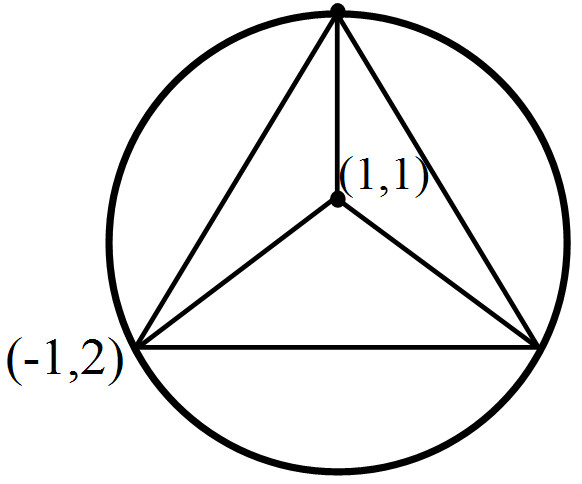
If the centroid of an equilateral triangle is (1, 1) and its one vertex is (-1, 2), then the equation of its circumcircle is:
  1. x2 + y2 - 2x - 2y - 3 = 0
  2. x2 + y2 + 2x - 2y - 3 = 0
  3. x2 + y2 + 2x + 2y - 3 = 0
  4. None of these
Answer
  1. x2 + y2 - 2x - 2y - 3 = 0

Solution:

The centre of the circumcircle is (1, 1).

Radius of the circumcircle

$\therefore$ Equation of the circle: $=\sqrt{(1+1)^2+(1-2)^2}=\sqrt{5}$

(x - 1)2 + (y - 1)2 = 5

⇒ x2 + y2 - 2x - 2y - 3 = 0

View full question & answer
Question 41 Mark
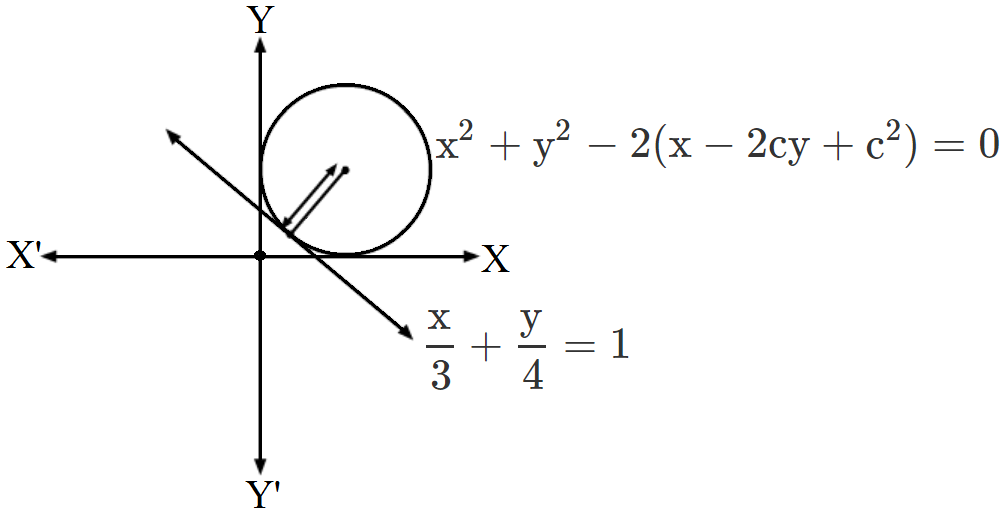
The equation of the circle which touches the axes of coordinates and the line $\frac{\text{x}}{3}+\frac{\text{y}}{4}=1$ and whose centres lie in the first quadrant is x2 + y2 − 2cx − 2cy + c2 = 0, where c is equal to:
  1. 4
  2. 2
  3. 3
  4. 6
Answer
  1. 6

Solution:

The equation of the circle that touches the axes of coordinates is x2 + y2 - 2cx − 2cy + c2 = 0.

Also, x2 + y2 − 2cx − 2cy + c2 = 0 touches the line $\frac{\text{x}}{3}+\frac{\text{y}}{4}=1$ or 4x +3y -12 = 0.

Since the circle lies in the first quadrant, it centre is is (c, c).

From the figure, we have:

$\Bigg|\frac{4\text{c}+3\text{c}-12}{\sqrt{4^2+3^3}}\Bigg|=\text{c}$

$\Rightarrow\frac{7\text{c}-12}{5}=\text{c}$

$\Rightarrow\text{c}=6$

View full question & answer
Question 51 Mark
The equation of the circle passing through the point (1, 1) and having two diameters along the pair of lines x2 - y2 - 2x + 4y - 3 = 0, is:
  1. x2 + y2 - 2x - 4y + 4 = 0
  2. x2 + y2 + 2x + 4y - 4 = 0
  3. x2 + y2 - 2x + 4y + 4 = 0
  4. None of these
Answer
  1. x2 + y2 - 2x - 4y + 4 = 0

Solution:

Let the required equation of the circle be (x - h)2 + (y - k)2 = a2.

Comparing the given equation x2 - y2 - 2x + 4y - 3 = 0 with

ax2 + by2 + 2hxy + 2gx + 2fy + c = 0, we get:

a = 1, b = -1, h = 0, g = -1, f = 2, c = -3

Intersection point $\Big(\frac{\text{hf}-\text{bg}}{\text{ab}-\text{h}^2},\ \frac{\text{gh}-\text{af}}{\text{ab}-\text{h}^2}\Big)=\Big(\frac{-1}{-1},\ \frac{-2}{-1}\Big)=(1,\ 2)$

Thus, the centre of the circle is (1, 2)

The equation of the required circle is (x - 1)2 + (y - 2)2 = a2

Since circle passes through (1, 1), we have:

1 = a2

$\therefore$ Equation of the required circle:

(x - 1)2 + (y - 2)2 = 1

⇒ x2 + y2 - 2x - 4y + 4 = 0

View full question & answer
Question 61 Mark
If the point (2, k) lies outside the circles x2 + y2 + x - 2y - 14 = 0 and x2 + y2 = 13 then klies in the interval:
  1. $(-3,\ -2)\cup(3,\ 4)$
  2. $-3,\ 4$
  3. $(-\infty,\ -3)\cup(4,\ \infty)$
  4. $(-\infty,\ -2)\cup(3,\ \infty)$
Answer
  1. $(-\infty,\ -3)\cup(4,\ \infty)$

Solution:

The given equations of the circles are x2 + y2 + x - 2y − 14 = 0 and x2 + y2 = 13.

Since (2, k) lies outside the given circles, we have:

4 + k2 + 2 - 2k - 14 > 0 and 4 + k2 > 13

⇒ k2 - 2k - 8 > 0 and k2 > 9

⇒ (k - 4)(k + 2) > 0 and k2 > 9

⇒ k > 4 or k < -2 and k > 3 or k < -3

⇒ k > 4 and k < -3

$\Rightarrow\text{k}\in(-\infty,\ -3)\cup(4,\ \infty)$

View full question & answer
Question 71 Mark
The equation x2 + y2 + 2x - 4y + 5 = 0 represents:
  1. A point.
  2. A pair of straight lines.
  3. A circle of non-zero radius..
  4. None of these.
Answer
  1. A point

Solution:

The radius of the given circle $=\sqrt{1^1+(-2)^2-5}=0$

Hence, the radius of the given circle is zero, which represents a point.

View full question & answer
Question 81 Mark
If the circles x2 + y2 = 9 and x2 + y2 + 8y + c = 0 touch each other, then c is equal to:
  1. 15
  2. -15
  3. 16
  4. -16
Answer
  1. 15

Solution:

The centre of the circle x2 + y2 = 9 is (0, 0).

Let us denote it by C1.

The centre of the circle x2 + y2+ 8y + c = 0 is (0, -4).

Let us denote it by C2.

The radius of x2 + y2 = 9 is 3 units.

x2 + y2+ 8y + c = 0

$\Rightarrow(\text{x}-0)^2+(\text{y}+4)^2=16-\text{c}=(\sqrt{16-\text{c}})^2$

Therefore, the radius of the above circle is $\sqrt{16-\text{c}}$

Let the circles touch each other at P.

$\therefore\text{C}_1\text{C}_2=\text{PC}_2+\text{PC}_1$

$\Rightarrow\text{PC}_2=4-3=1$

$\Rightarrow\text{PC}_2-1=\sqrt{16-\text{c}}$

$\Rightarrow\text{c}=15$

View full question & answer
Question 91 Mark
Equation of the circle through origin which cuts intercepts of length a and b on axes is:
  1. x2 + y2 + ax + by = 0
  2. x2 + y2 - ax - by = 0
  3. x2 + y2 + bx + ay = 0
  4. None of these
Answer
  1. x2 + y2 - ax - by = 0

Solution:


Centre of the circle is $\Big(\frac{\text{a}}{2},\ \frac{\text{b}}{2}\Big)$ and its radius is $\sqrt{\Big(\frac{\text{a}}{2}\Big)^2+\Big(\frac{\text{b}}{2}\Big)^2}=\frac{1}{2}\sqrt{\text{a}^2+\text{b}^2}$

Equation of circle:

$\Big(\text{x}-\frac{\text{a}}{2}\Big)^2+\Big(\text{y}-\frac{\text{b}}{2}\Big)^2=\frac{1}{4}(\text{a}^2+\text{b}^2)$

$\Rightarrow(2\text{x}-\text{a}^2)+(2\text{y}-\text{b})^2=(\text{a}^2+\text{b}^2)$

$\Rightarrow4\text{x}^2+\text{a}^2-4\text{ax}+4\text{y}^2+\text{b}^2-4\text{by}=\text{a}^2+\text{b}^2$

$\Rightarrow\text{x}^2-\text{ax}+\text{y}^2-\text{by}=0$

View full question & answer
Question 101 Mark
If the equation of a circle is $\lambda\text{x}^2+(2\lambda-3)\text{y}^2-4\text{x}+6\text{y}-1=0,$ then the coordinates of centre are:
  1. $\Big(\frac{4}{3},\ -1\Big)$
  2. $\Big(\frac{2}{3},\ -1\Big)$
  3. $\Big(\frac{-2}{3},\ 1\Big)$
  4. $\Big(\frac{2}{3},\ 1\Big)$
Answer
  1.  $\Big(\frac{2}{3},\ -1\Big)$

Solution:

To find the centre:

Coefficient of x2 = Coefficient of y2

$\therefore\lambda=2\lambda-3\Rightarrow\lambda=3$

Therefore, the given equation can be rewritten as $3\text{x}^2+3\text{y}^2-4\text{x}+6\text{y}-1=0.$

$\therefore\text{x}^2+\text{y}^2-\frac{4}{3}\text{x}+2\text{y}-\frac{1}{3}=0$

Thus, the coordinates of the centre is $\Big(\frac{2}{3},\ -1\Big).$

View full question & answer
Question 111 Mark
If the circles x2 + y2 = a and x2 + y2 - 6x - 8y + 9 = 0, touch externally, then a =
  1. 1
  2. -1
  3. 21
  4. 16
Answer
  1. 1

Solution:

x2 + y2 = a ........ (1)

And, x2 + y2 − 6x − 8y + 9 = 0 ........ (2)

Let circles (1) and (2) touch each other at point P.

The centre of the circle x2 + y2 = a, 0, is (0, 0).

The centre of the circle x2 + y2 − 6x − 8y + 9 = 0, C1, is (3, 4).

Also, radius of circle (1) $=\sqrt{\text{a}}=\text{OP}$

Radius of circle (2) $\sqrt{9+16-9}=4=\text{C}_1\text{P}$

From figure, we have:

$\Rightarrow\sqrt{3^2+4^2}=4+\sqrt{\text{a}}$

$\Rightarrow5=4+\sqrt{\text{a}}$

$\Rightarrow\text{a}=1$

View full question & answer
Question 121 Mark
The equation of the circle passing through the origin which cuts off intercept of length 6 and 8 from the axes is:
  1. x2 + y2 - 12x - 16y = 0
  2. x2 + y2 + 12x + 16y = 0
  3. x2 + y2 + 6x + 8y = 0
  4. x2 + y2 - 6x - 8y = 0
Answer
  1. x2 + y2 - 6x - 8y = 0

Solution:

The centre of the required circle is$\Big(\frac{6}{2},\ \frac{8}{2}\Big)=(3,\ 4).$

The radius of the required circle is $\sqrt{3^2+4^2}=\sqrt{25}=5$

Hence, the equation of the circle is as follows:

(x - 3)2 + (y - 4)2 = 52

⇒ x2 + y2 - 6x - 8y = 0

View full question & answer
Question 131 Mark
If the circles x2 + y2 + 2ax + c = 0 and x2 + y2 + 2by + c = 0 touch each other, then:
  1. $\frac{1}{\text{a}^2}+\frac{1}{\text{b}^2}=\frac{1}{\text{c}}$
  2. $\frac{1}{\text{a}^2}+\frac{1}{\text{b}^2}=\frac{1}{\text{c}}$
  3. $\text{a}+\text{b}=2\text{c}$
  4. $\frac{1}{\text{a}}+\frac{1}{\text{b}}=\frac{2}{\text{c}}$
Answer
  1. $\frac{1}{\text{a}^2}+\frac{1}{\text{b}^2}=\frac{1}{\text{c}}$

Solution:

Given:

x2 + y2 + 2ax + c = 0 ....... (1)

And, x2 + y2 + 2by + c = 0 ........ (2)

For circle (1), we have:

Centre = (-a, 0) = C1

For circle (2), we have:

Centre = (0,-b) = C2

Let the circles intersect at point P.

$\therefore$ Coordinates of P = Mid point of C1C2

$\Rightarrow$ Coordinates of P $=\Big(\frac{-\text{a}+0}{2},\ \frac{0-\text{b}}{2}\Big)=\Big(\frac{-\text{a}}{2},\ \frac{-\text{b}}{2}\Big)$

Now, we have:

PC1 = radius of (1)

$\Rightarrow\sqrt{(-\text{a}+\frac{\text{a}}{2})^2}+\Big(0-\frac{\text{b}}{2}\Big)^2=\sqrt{\text{a}^2-\text{c}}$

$\Rightarrow\frac{\text{a}^2}{4}+\frac{\text{b}}{4}^2=\text{a}^2-\text{c}\ .....(3)$

Also, radius of circle (1) = radius of circle (2)

$\Rightarrow\sqrt{\text{a}^2-\text{c}}=\sqrt{\text{b}^2-\text{c}}$

$\Rightarrow\text{a}^2=\text{b}^2\ .....(4)$

From (3) and (4), we have:

$\frac{\text{a}^2}{2}=\text{a}^2-\text{c}$

$\Rightarrow\frac{\text{a}^2}{2}=\text{c}$

$\Rightarrow\frac{2}{\text{a}^2}=\frac{1}{\text{c}}$

$\Rightarrow\frac{1}{\text{a}^2}+\frac{1}{\text{a}^2}=\frac{1}{\text{c}}$

$\Rightarrow\frac{1}{\text{a}^2}+\frac{1}{\text{b}^2}=\frac{1}{\text{c}}$

View full question & answer
Question 141 Mark
If the equation (4a - 3) x2 + ay2 + 6x - 2y + 2 = 0 represents a circle, then its centre is:
  1. (3, -1)
  2. (3, 1)
  3. (-3, 1)
  4. None of these
Answer
  1. (-3, 1)

Solution:

If the equation (4a - 3) x2 + ay2 + 6x - 2y + 2 = 0 represents a circle, then we have:

Coefficient of x2 = Coefficient of y2

⇒ 4a - 3 = a

⇒ a = 1

$\therefore$ Equation of the circle = x2 + y2 + 6x - 2y + 2 = 0

Thus, the coordinates of the centre is (-3, 1).

View full question & answer
Question 151 Mark
The number of integral values of $\lambda$ for which the equation $\text{x}^2+\text{y}^2+\lambda+(1-\lambda)\text{y}+5=0$ is the equation of a circle whose radius cannot exceed 5, is:
  1. 14
  2. 18
  3. 16
  4. None of these
Answer
  1. 16

Solution:

$\sqrt{\Big(\frac{-\lambda}{2}^2\Big)+\Big(\frac{\lambda-1}{2}\Big)^2-5}\leq5$

$\Rightarrow\Big(\frac{-\lambda}{2}^2\Big)+\Big(\frac{\lambda-1}{2}\Big)\leq30$

$\lambda^2+(\lambda-1)^2\leq120$

$\Rightarrow2\lambda^2-2\lambda-199\leq0$

Using quadratic formula:

$\Rightarrow\lambda=\frac{2\pm\sqrt{2^2-4(2)(-119)}}{2(2)}$

$\Rightarrow\lambda=\frac{2\pm\sqrt{956}}{4}$

$\Rightarrow\lambda=\frac{1\pm\sqrt{239}}{2}$

$\Rightarrow\lambda=-7.23,\ 8.23$

$\Rightarrow-7.23\leq\lambda\leq8.23$

$\Rightarrow\lambda=-7,\ -6,\ -5,\ -4,\ -3,\ -2,\ -1\\0,\ 1,\ 2,\ 3,\ 4,\ 5,\ 6,\ 7,\ 8,\ $ $(\text{if}\ \lambda\in\text{Z})$

Thus, the number of integral values of $\lambda$ is 16.

View full question & answer
Question 161 Mark
The circle x2 + y2 + 2gx + 2fy + c = 0 does not intersect x-axis, if:
  1. g2 < c
  2. g2 > c
  3. g2 > 2c
  4. None of these
Answer
  1. g2 < c

Solution:

Given:

x2 + y2 + 2gx + 2fy + c = 0 ......... (1)

The given circle intersects the x-axis.

The equation of circle becomes x2 + 2gx + c = 0 ......... (2)

Solving equation (2):

$\therefore$ Discriminant, $\text{D}=\sqrt{4\text{g}^2-4\text{c}}\geq0$

$\Rightarrow4\text{g}^2-4\text{c}\geq0$

$\Rightarrow\text{g}^2-\text{c}\geq0$

$\Rightarrow\text{g}^2\geq\text{c}$

Hence, if g2 < c, then the given circle will not intersect the x-axis.

View full question & answer
Question 171 Mark
Equation of the diameter of the circle x2 + y2 − 2x + 4y = 0 which passes through the origin is:
  1. x + 2y = 0
  2. x − 2y = 0
  3. 2x + y = 0
  4. 2x − y = 0
Answer
  1. 2x + y = 0

Solution:

Let the diameter of the circle be y = mx.

Since the diameter of the circle passes through its centre, (1, -2) satisfies the equation of the diameter.

$\therefore$ m = -2

Substituting the value of m in the equation of diameter:

y = -2x

⇒ 2x + y = 0

Hence, the required equation of the diameter is 2x + y = 0.

View full question & answer
Question 181 Mark
If $2\text{x}^2+\lambda\text{xy}+2\text{y}^2(\lambda-4)\text{x}+6\text{y}-5=0$ is the equation of a circle, then its radius is:
  1. $3\sqrt{2}$
  2. $2\sqrt{3}$
  3. $2\sqrt{2}$
  4. None of these
Answer
  1. None of these

Solution:

The given equation is $2\text{x}^2+\lambda\text{xy}+2\text{y}^2+(\lambda-4)\text{x}+6\text{y}-5=0$ which can be rewritten as

$\text{x}^2+\frac{\lambda\text{xy}}{2}+\text{y}^2+\frac{(\lambda-4)}{2}\text{x}+3\text{y}-\frac{5}{2}=0.$

Comparing the given equation $\text{x}^2+\text{y}62+2\text{gx}+2\text{fy}+\text{c}=0$ with we get: $\lambda=0$

$\therefore\text{x}^2+\text{y}^2-2\text{x}+3\text{y}-\frac{5}{2}=0$

$\therefore$ Radius $=\sqrt{(-1)^2+\Big(\frac{3}{2}\Big)^2+\frac{5}{2}}=\sqrt{1+\frac{9}{4}+\frac{5}{2}}=\sqrt{\frac{23}{4}}=\frac{\sqrt{23}}{2}$

View full question & answer
Question 191 Mark
If the circle x2 + y2 + 2ax + 8y + 16 = 0 touches x-axis, then the value of a is:
  1. $\pm16$
  2. $\pm4$
  3. $\pm8$
  4. $\pm1$
Answer
  1. $\pm4$

Solution:

The equation of the circle is x2 + y2 + 2ax + 8y + 16 = 0.

Its centre is (-a, -4) and its radius is a units.

Since the circle touches the x-axis, we have:

$\sqrt{(-\text{a}+\text{a})^2+(4-0)^2}=\text{a}$

$\Rightarrow\text{a}=\pm4$

View full question & answer
Question 201 Mark
The radius of the circle represented by the equation $3\text{x}^2+3\text{y}^2+(\lambda-6)\text{y}+3=0$ is:
  1. $\frac{3}{2}$
  2. $\frac{\sqrt{17}}{2}$
  3. $\frac{2}{3}$
  4. None of these
Answer
  1. $\frac{3}{2}$

Solution:

The equation of the circle is $3\text{x}^2+3\text{y}^2+(\lambda-6)\text{y}+3=0$

$\therefore$ Coefficient of $\text{xy}=0$

$\Rightarrow\lambda=0$

$\therefore3\text{x}^2+3\text{y}^2+9\text{x}-6\text{y}+3=0$

$\Rightarrow\text{x}^2+\text{y}^2+3\text{x}-2\text{y}+1=0$

Therefore, the radius of the circle is $\sqrt{\Big(\frac{3}{2}\Big)^2+(-1)^2-1}=\frac{3}{2}.$

View full question & answer
Question 211 Mark
The equation of a circle with radius 5 and touching both the coordinate axes is:
  1. x2 + y2 ± 10x ± 10y + 5 = 0
  2. x2 + y2 ± 10x ± 10y = 0
  3. x2 + y2 ± 10x ± 10y + 25 = 0
  4. x2 + y2 ± 10x ± 10y + 51 = 0
Answer
  1. x2 + y2 ± 10x ± 10y + 25 = 0

Solution:

Case I: If the circle lies in the first quadrant:

The equation of a circle that touches both the coordinate axes and hasradius a is x2 + y2 - 2ax - 2ay + a2 = 0.

The given radius of the circle is 5 units, i.e. a = 5.

Thus, the equation of the circle is x2 + y2 - 10x - 10y + 25 = 0.

Case II: If the circle lies in the second quadrant:

The equation of a circle that touches both the coordinate axes and has radius a is x2 + y2 + 2ax - 2ay + a2 = 0.

The given radius of the circle is 5 units, i.e. a = 5.

Thus, the equation of the circle is x2 + y2 + 10x - 10y + 25 = 0.

Case III: If the circle lies in the third quadrant:

The equation of a circle that touches both the coordinate axes and has radius a is x2 + y2 + 2ax + 2ay + a2 = 0

The given radius of the circle is 5 units, i.e. a = 5.

Thus, the equation of the circle is x2 + y2 + 10x + 10y + 25 = 0.

Case IV: If the circle lies in the fourth quadrant:

The equation of a circle that touches both the coordinate axes and has radius a is x2 + y2 - 2ax + 2ay + a2 = 0.

The given radius of the circle is 5 units, i.e. a = 5.

Thus, the equation of the circle is x2 + y2 - 10x + 10y + 25 = 0.

Hence, the required equation of the circle is x2 + y2 ± 10x ± 10y + 25 = 0.
View full question & answer
Question 221 Mark
If the point $(\lambda,\ \lambda+1)$ lies inside the region bounded by the curve $\text{x}=\sqrt{25-\text{y}^2}$ and y-axis, then $\lambda$ belongs to the interval:
  1. $(-1,\ 3)$
  2. $(-4,\ 3)$
  3. $(-\infty,\ -4)\cup(3,\ \infty)$
  4. None of these
Answer
  1. $(-1,\ 3)$

Solution:

The given equation of the curve is x2 + y2 = 25

Since $(\lambda,\ \lambda+1)$ lies inside the region bounded by the curve x2 + y2 = 25 and the y-axis, we have:

$\lambda^2+(\lambda+1)^2<25,$ provided $\lambda+1>0$

$\Rightarrow\lambda^2+\lambda^2+12\lambda<25,\ \lambda>-1$

$\Rightarrow2\lambda^2+2\lambda-24<0,\ \lambda>-1$

$\Rightarrow\lambda^2+\lambda-12<0,\ \lambda>-1$

$\Rightarrow(\lambda-3)(\lambda+4)<0,\ \lambda>-1$

$\Rightarrow-4<\lambda<3,\ \lambda>-1$

$\Rightarrow\lambda\in(-1,\ 3)$

View full question & answer
Question 231 Mark
The area of an equilateral triangle inscribed in the circle x2 + y2 - 6x - 8y - 25 = 0 is:
  1. $\frac{225\sqrt{3}}{6}$
  2. $25\pi$
  3. $50\pi-100$
  4. None of these
Answer
  1. $\frac{225\sqrt{3}}{6}$

Solution:

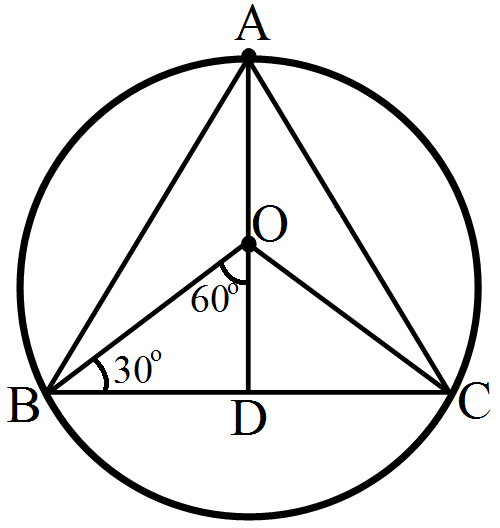
Let ABC be the required equilateral triangle.

The equation of the circle is x2 + y2 - 6x - 8y - 25 = 0.

Therefore, coordinates of the centre O is (3, 4).

Radius of the circle $=\text{OA}=\text{OB}=\text{OC}=\sqrt{9+16+25}=5\sqrt{2}$

In $\Delta\text{BOD},$ we have:

$\sin60^\circ=\frac{\text{DB}}{\text{BO}}$

$\Rightarrow\text{DB}=\frac{\sqrt{3}}{2}(5\sqrt{2})$

$\Rightarrow\text{BC}=2\text{BD}-\sqrt{3}\big(5\sqrt{2}\big)=5\sqrt{6}$

Now, area of $\triangle\text{ABC}=\frac{\sqrt{3}}{4}\text{BC}^2=\big(5\sqrt{6}\big)^2\\=\frac{\sqrt{3}(150)}{4}=\frac{\sqrt{3}(75)}{2}=\frac{\sqrt{3}(225)}{6}$ square units

View full question & answer
Question 241 Mark
The equation of the circle concentric with x2 + y2 - 3x + 4y - c = 0 and passing through (-1, -2) is:
  1. x2 + y2 - 3x + 4y - 1 = 0
  2. x2 + y2 - 3x + 4y = 0
  3. x2 + y2 - 3x + 4y + 2 = 0
  4. None of these
Answer
  1. x2 + y2 - 3x + 4y = 0

Solution:

The centre of the circle x2 + y2 - 3x + 4y - c = 0 is $\Big(\frac{3}{2},\ -2\Big).$

Therefore, the centre of the required circle is $\Big(\frac{3}{2},\ -2\Big).$

The equation of the circle is $\Big(\text{x}-\frac{3}{2}\Big)^2+(\text{y}+2)^2=\text{a}^2. \ ......(1)$

Also, circle (1) passes through (-1, -2).

$\therefore\Big(-1-\frac{3}{2}\Big)^2+\Big(-2+2\Big)^2=\text{a}^2$

$\Rightarrow\text{a}=\frac{5}{2}$

Substituting the value of a in equation (1):

$\Big(\text{x}-\frac{3}{2}\Big)^2+(\text{y}+2)^2=\Big(\frac{5}{2}\Big)^2$

$\Rightarrow\frac{(2\text{x}-3)^2}{4}+(\text{y}+2)^2=\frac{25}{4}$

$\Rightarrow(2\text{x}-3)^2+4(\text{y}+2)^2=25$

$\Rightarrow\text{x}^2+\text{y}^2-3\text{x}+4\text{y}=0$

Hence, the required equation of the circle is x2 + y2 - 3x + 4y = 0.

View full question & answer
Question 251 Mark
If (-3, 2) lies on the circle x2 + y2 + 2gx + 2fy + c = 0 which is concentric with the circle x2 + y2 + 6x + 8y - 5 = 0, then c =
  1. 11
  2. -11
  3. 24
  4. None of these
Answer
  1. -11

Solution:

The centre of the circle x2 + y2 + 6x + 8y - 5 = 0 is (-3, -4).

The circle x2 + y2 + 2gx + 2fy + c = 0 is concentric with the circle x2 + y2 + 6x + 8y - 5 = 0.

Thus, the centre of x2 + y2 + 2gx + 2fy + c = 0 is (-3, -4).

$\therefore$ g = 3, f = 4

Also, it is given that (-3, 2) lies on the circle x2 + y2 + 2gx + 2fy + c = 0.

$\therefore$ (-3)2 + 22 + 2(3)(-3) + 2(4)(2) + c = 0

⇒ 9 + 4 - 18 + 16 + c = 0

⇒ c = -11

View full question & answer