Intercept in negative direction of y-axis is (0, -4)
Hence, required equation of line is
y = mx + c
⇒ y = 3x - 4
58 questions · self-marked practice — reveal the answer and mark yourself.
with slope -2 and intersecting the x-axis at a distance of 3 units to the left of origin.
Slope of the line parallel to x-axis $=\frac{-1}{0}$
The required equation line perpendicular to x-axis is $\text{y}-\text{y}_1=\text{m}(\text{x}-\text{x}_1)$$\text{y}-3=\frac{-1}{0}(\text{x}-4)$
$\text{x}-4=0$$\text{x}=4$
$\frac{\text{x}}{2\alpha}+\frac{\text{y}}{2\beta}=1$


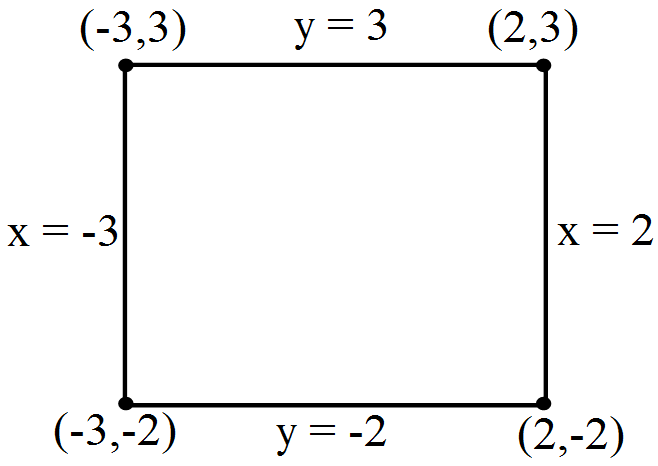
From the figure, the coordinates of the vertices of the square are
$(2,3),(-3,3),(-3,-2),(2,-2).$Slope of perpendicular line (M) which is perpendicularn to line L is
$-\sqrt3$So equation of line M is
$\text{y}=-\sqrt{3\text{x}}+\text{c}$Given perpendicular distance from origin to line M is 4
$4=\frac{\text{c}}{2}\Rightarrow\text{c}=8$
So, equation of line M is
$\text{y}=-\sqrt{3\text{x}}+8$$\text{x}\cos\alpha+\text{y}\sin\alpha=\text{P}$
$\Rightarrow\text{x}\cos300^\circ+\text{y}\sin300^\circ=8$
$\Rightarrow\text{x}\times\frac{1}{2}-\text{y}\times\frac{\sqrt3}{2}=8$
$\Rightarrow\text{x}-\sqrt{3\text{x}}=16$
$\text{x}\cos\alpha+\text{y}\sin\alpha=\text{p}$
$\Rightarrow\text{x}\cos60^\circ+\text{y}\sin60^\circ=5$
$\Rightarrow\text{x}\times\frac{1}{2}+\text{y}\times\frac{\sqrt3}{2}=5$
$\Rightarrow\text{x}+\sqrt{3\text{y}}=10$
$\frac{\text{x}}{\text{a}}+\frac{\text{y}}{\text{b}}=1$
It cuts the axes at A(a, 0) and B(0, b)
THe portion of AB intercepted between the axis is 5 : 3.
$\therefore\text{h}=\frac{3\times\text{a}+5\times0}{8}$ and $\text{k}=\frac{3\times0+5\times\text{b}}{8}$
$\Rightarrow\text{p}=\Big(\frac{3\text{a}}{8},\frac{5\text{b}}{8}\Big)$
The line is passing through the point (-4, 3)
$\Rightarrow\frac{3\text{a}}{8}=-4\ \frac{5\text{b}}{8}=3$
$\Rightarrow\text{a}=\frac{-32}{3}\ \text{b}=\frac{24}{5}$
$\therefore$ The equation of the given line is,
$\frac{\text{x}}{\frac{-32}{3}}+\frac{\text{y}}{\frac{24}{5}}=1$
$\frac{-3\text{x}}{32}+\frac{\text{5y}}{24}=1$
$\text{9x}-\text{20y}+96=0$
$\frac{\text{x}-2}{\cos\alpha}=\frac{\text{y}-1}{\sin\alpha}=\text{r}$
$\Rightarrow\frac{\text{x}-2}{\frac{1}{\sqrt2}}=\frac{\text{y}-1}{\frac{1}{\sqrt2}}=\text{r}$
or
$\text{x}=\frac{1}{\sqrt2}\text{r}+2,\ \text{y}=\frac{1}{\sqrt2}\text{r}+1$$\text{B}\Big(\frac{\text{r}}{\sqrt2}+2,\ \frac{\text{r}}{\sqrt2}+1\Big)$ lie on x + 2y + 1 = 0
$\therefore\frac{\text{r}}{\sqrt2}+2+\frac{2\text{r}}{\sqrt2}+2+1=0$
$\frac{3\text{r}}{\sqrt2}=\pm5$
$\text{r}=\frac{5\sqrt2}{3}$
The lenght of AB is
$\frac{5\sqrt2}{3}$ units.$\frac{\text{x}-3}{\cos\frac{\pi}{6}}=\frac{\text{y}-4}{\sin\frac{\pi}{6}}=\pm\text{r}$
or
$\text{x}=\pm\frac{\sqrt3}{2}\text{r}+3$ and $\text{y}=\pm\frac{1}{2}\text{r}+4$$\text{Q}\Big(\pm\frac{\sqrt3\text{r}}{2}+3,\ \pm\frac{\text{r}}{2}+4\Big)$ lie in
$\text{12x}+\text{5y}+10=0$$\therefore12\Bigg(\pm\frac{\sqrt3\text{r}}{2}+3\Bigg)+5\Big(\pm\frac{\text{r}}{2}+4 \Big)+10=0$
$\pm\frac{12\sqrt3\text{r}}{2}+36\pm\frac{5\text{r}}{2}+20+10=0$
$\text{r}=\frac{\pm132}{5+12\sqrt3}$
Hence, lenght PQ is
$\frac{132}{12\sqrt3+5}$Divide the equation by 2, we get
$\frac{1}{2}\text{x}+\frac{\sqrt3}{2}\text{y}=2$
$\text{x}\cos60^\circ+\text{y}\sin60^\circ=2$
So,
$\text{p}=2$ and $\omega=60^\circ$⇒ Angle between line and positive direction of x axis $=\frac{90^\circ}{2}$
= 45°
Slope of line $(\text{m})=\tan\theta$
$\text{m}=\tan45^\circ$
$\text{m}=1$
= Angle between line and positive side of axis = 90° + 30°
$\theta^\circ=120^\circ$
$\text{m}=\tan120^\circ$
$\text{m}=-\sqrt3$
When the slope of line is zero then the line is parallel to x axis.
Thus the line makes an acute angle $\Big(0<\theta<\frac{\pi}{2}\Big)$ with the positive $\text{x}$ axis.
Thus the line makes an abtuse angle $\Big(\theta<\frac{\pi}{2}\Big)$with the positive x axis.
$\text{ax}+\text{by}+8=0$
$\Rightarrow-\frac{\text{x}}{\frac{8}{\text{a}}}-\frac{\text{y}}{\frac{8}{\text{b}}}=1$
It cuts the axes at
$\text{A}\Big(\frac{-8}{\text{a}},0\Big)$ and $\text{B}\Big(0,\frac{-8}{\text{b}}\Big).$The equation of given line is.
$\text{2x}-\text{3y}+6=0$
$\Rightarrow\frac{-\text{x}}{3}+\frac{\text{y}}{2}=1$
It cuts the axes at C(-3, 0) and D(0, 2).
The intercepts of both the lines are opposite in sign
$\Rightarrow\Big(\frac{-8}{\text{a}},0\Big)=-(-3,0)$and $\Big(0,\frac{-8}{\text{b}}\Big)=-(0,2)$
$\Rightarrow\frac{-8}{\text{a}}=3$ and $\frac{-8}{\text{b}}=-2$
$\Rightarrow\text{a}=\frac{-8}{3}$ and $\text{b}=4$
$\text{x}\cos\alpha+\text{y}\sin\alpha=\text{P}$
$\Rightarrow\text{x}\cos150^\circ+\text{y}\sin150^\circ=4$
$\Rightarrow-\text{x}\times\frac{\sqrt3}{2}+\text{y}\times\frac{1}{2}=4$
$\Rightarrow-\sqrt{3\text{x}}+\text{y}=8$
Any line parallel to x axis will also have the same slope.
therefore m = 0
Also line has y intercept, ie (a, b)
⇒ (0, -2) ⇒ (x1y1)
The required equation of line is
$\text{y}-\text{y}_1=\text{m}(\text{x}-\text{x}_1)$$\text{y}-(-2)=0(\text{x}-0)$
$\text{y}+2=0$
$\text{y}=-2$
Then,
$3=\frac{2(0)+3(\text{a})}{2+3}\Rightarrow3=\frac{3\text{a}}{5}\Rightarrow\text{a}=5$
$4=\frac{2(\text{b})+3(0)}{2+3}\Rightarrow4=\frac{2\text{b}}{5}\Rightarrow\text{b}=10$
$\therefore$ A is (5, 0), B is (0, 10)
Equation of AB is
$\frac{\text{x}}{5}+\frac{\text{y}}{10}=1$
$\text{2x}=\text{y}=10$
Then,
$\text{a}\times\text{a}=25$
$\text{a}^2=25$
$\text{a}=25$
(Ignoring negative sign because it is given that the intercepts are positive)
⇒
a = b = 5 (given the intercepts are equal)$\therefore$ Putting in equation of straight line
$\frac{\text{x}}{\text{a}}+\frac{\text{y}}{\text{b}}=1$
$\frac{\text{x}}{5}+\frac{\text{y}}{5}=1$
$\text{x}+\text{y}=5$
$\sqrt3\text{x}+\text{y}+2=0$
$\Rightarrow\sqrt3\text{x}+\text{y}=-2$
$\Rightarrow\frac{\sqrt3\text{x}}{-2}+\frac{\text{y}}{-2}=1$
$\Rightarrow\frac{\text{x}}{\frac{-2}{\sqrt3}}+\frac{\text{y}}{-2}=1$
⇒ x intercept
$=\frac{-2}{\sqrt3},$ y intercept = -2$\text{x}\cos\alpha+\text{y}\sin\alpha=\text{P}$
$\Rightarrow\text{x}\cos225^\circ+\text{y}\sin225^\circ=8$
$\Rightarrow-\text{x}\times\frac{1}{\sqrt2}-\text{y}\times\frac{1}{\sqrt2}=8$
$\Rightarrow\text{x}+\text{y}+8\sqrt2=0$
$\sqrt3\text{x}+\text{y}+2=0$
$\Rightarrow\text{y}=-\sqrt3\text{x}-2$
$\Rightarrow\text{m}=-\sqrt3,\ \text{c}=-\sqrt2$
y-intercept = -2, slope =
$-\sqrt3$$\frac{\text{x}-\text{x}_1}{\cos\theta}=\frac{\text{y}-\text{y}_1}{\sin\theta}=\pm\text{r}$
or
$\text{x}=\text{x}_1\pm\text{r}\cos\theta$ and
$\text{y}-\text{y}_1=\pm\text{r}\sin\theta$$\text{Q}(\text{x}_1\pm\text{r}\cos\theta,\ \text{y}_1\pm\text{r}\sin\theta)$ lie in $\text{ax}+\text{by}+\text{c}=0$
$\Rightarrow\ \text{a}(\text{x}_1+\text{r}\cos\theta)+\text{b}(\text{y}_1\pm\text{r}\sin\theta)+\text{c}=0$
$\Rightarrow\ \pm\text{r}(\text{a}\cos\theta+\text{b}\sin\theta)=-\text{c}-\text{ax}_1-\text{by}_1$
$ \Rightarrow\ -\text{r}=\Big|\frac{\text{ax}_1+\text{by}_1+\text{c}}{\text{a}\cos\theta+\text{b}\sin\theta}\Big|$
$\frac{\text{x}-2}{\cos45^\circ}=\frac{\text{y}-3}{\sin45^\circ}=\text{r}$
$\text{x}=\frac{\text{r}}{\sqrt2}+2$
and $\text{y}=\frac{\text{r}}{\sqrt2}+3$$\text{P}\Big(\frac{\text{r}}{\sqrt2}+2,\ \frac{\text{r}}{\sqrt2}+3\Big)$ lie on $2\text{x}-3\text{y}+9=0$
$\therefore2\Bigg(\frac{\text{r}+2\sqrt2}{\sqrt2}\Bigg)-3\Bigg(\frac{\text{r}+3\sqrt2}{\sqrt2}\Bigg)+9=0$
$\Rightarrow\ 2\text{r}+4\sqrt2-\text{3r}-9\sqrt2+9\sqrt2=0$
$\Rightarrow\ \text{r}=4\sqrt2$
$\therefore$ The point (2, 3) is at a distance of
$4\sqrt2$ from $2\text{x}-3\text{y}+9=0$$\sqrt3\text{x}+\text{y}+2=0$
$\Rightarrow-\sqrt3\text{x}-\text{y}=2$
$\Rightarrow\Big(\frac{-\sqrt3}{2}\Big)\text{x}+\Big(\frac{-1}{2}\Big)\text{y}=1 $
$\Rightarrow\cos\alpha=\frac{-\sqrt3}{2}=\cos210^\circ$ and $\sin\alpha=\frac{-1}{2}=\sin210^\circ$
$\Rightarrow\text{p}=1,\ \alpha=210^\circ$
$\text{y}+2=\frac{2+2}{8+2}(\text{x}+2)$
$2\text{x}-5\text{y}-6=0$
Clearly, (3, 0) satisfies the equation which means that the line passing through (-2, -2) and (8, 2)also passes through (3, 0)
Hence three points are collinear.