Questions · Page 1 of 3

5 Marks Questions

🎯

Test yourself on this topic

50 questions · timed · auto-graded

Question 15 Marks
Find the equations of the two straight lines through (1, 2) forming two sides of a square of which 4x + 7y = 12 is one diagonal.
Answer
Let ABCD be a square whose diagnal BD is 4x + 7y = 12
Then, slope of $\text{BD}=\frac{-4}{7}$
Let slope of AB = m
Then, $\tan45^\circ=\frac{\text{m}+\frac{4}{7}}{1-\frac{4}{7}\text{m}}$
$7-4\text{m}=7\text{m}+4$
$11\text{m}=3$
$\therefore \text{m}=\frac{3}{11}$
$\therefore $ slope of $\text{BC}=\frac{-1}{\text{slope of AB}}$
$=\frac{-11}{3}$
$\therefore$ Equation of AB is
$(\text{y}-2)=\frac{3}{11}(\text{x}-1)$
$11\text{y}-22=3\text{x}-3$
$3\text{x}-11\text{y}+19=0$
and
Equation of BC is
$(\text{y}-2)=\frac{-11}{3}(\text{x}-1)$
$11\text{x}+3\text{y}-17=0$
View full question & answer
Question 25 Marks
Find the equation of the straight line passing through the point of intersection of the lines 5x - 6y - 1 = 0 and 3x + 2y + 5 = 0 and perpendicular to the line 3x - 5y + 11 = 0
Answer
Solving equations 5x - 6y - 1 = 0 and 3x + 2y + 5 = 0, we get
x = -1 and y = 1
SO, the given intersect at the point whose coordinate are (-1, -1),
We know that, the equation of the required line is perpendicular to the line 3x - 5y + 11 = 0
Slope of the required line $=-\frac{5}{3}$
Equation of the required line is given by,
$(\text{y+1})=-\frac{5}{3}(\text{x+1})$
3y + 5x + 8 = 0
View full question & answer
Question 35 Marks
Find the equations of the straight lines which pass through the origin and trisect the portion of the straight line 2x + 3y = 6 which is intercepted between the axes.
Answer
The line 2x + 3y = 6 cuts coordinates axis at A(3, 0) and B(0, 2).
The portion AB intercepted between the axis is trisected by points P and Q.
$\therefore\frac{\text{AP}}{\text{PB}}=\frac{1}{2}$ and $\frac{\text{AQ}}{\text{QB}}=\frac{2}{1}$
⇒ Coordinate of P $=\Big(\frac{1\times0+3\times2}{3},\frac{1\times2+0}{3}\Big)=\Big(\frac{1}{3},\frac{2}{3}\Big)$
⇒ Coordinate of Q $=\Big(\frac{2\times0+3\times1}{3},\frac{4+0}{3}\Big)=\Big(\frac{3}{3},\frac{4}{3}\Big)$
Equation of OQ $=\text{y}-0=\frac{\frac{4}{3}-0}{\frac{3}{3}-0}(\text{x}-0)$
3y = 4x
Equation of OP $=\text{y}-0=\frac{\frac{2}{3}-0}{\frac{1}{3}-0}(\text{x}-0)$
x - 3y = 0
View full question & answer
Question 45 Marks
Find the equation of a straight line passing through the point of intersection of 2x - 7y + 11 = 0 and x + 3y - 8 = 0 and is parallel to (i) x-axis (ii) y-axis.
Answer
The required line is
$2\text{x}-7\text{y}+11+\lambda(\text{x}+3\text{y}-8)=0$
or, $\text{x}(2+\lambda)+\text{y}(-7+3\lambda)+11-8\lambda=0$
When the line is parallel to x-axis. It slope is 0
$\therefore-\frac{(2+\lambda)}{3\lambda-7}=0$
$\lambda=-2$
$\therefore$ Equation of line is
$2\text{x}-7\text{y}+11-2(\text{x}+3\text{y}-8)=0$
$-13\text{y}+27=0$
When the line is parallel to y-axis then,
$\frac{-1}{\text{slope}}=0$
i.e., $\frac{3\lambda-7}{2+\lambda}=0$
$\therefore$ Equation of line is
$2\text{x}-7\text{y}+11+\frac{7}{3}(\text{x}+3\text{y}-8)=0$
$\Rightarrow\frac{6\text{x}-21\text{y}+33+7\text{x}+21\text{y}-56}{3}=0$
$\Rightarrow6\text{x}-21\text{y}+33+7\text{x}+21\text{y}-56=0$
$\Rightarrow13\text{x}-23=0$
$\Rightarrow13\text{x}=23$
View full question & answer
Question 55 Marks
Find the area of the triangle formed by the lines:
$x + y - 6 = 0, x - 3y - 2 = 0$ and $5x - 3y + 2 = 0$
Answer
$x + y - 6 = 0 ...(1)$
$x - 3y - 2 =0 ...(2)$
$5x - 3y + 2 = 3 ...(3)$
Solving $1$ and $2$ gives us $(x_1, y_1) = (5, 1)$
Solving $2$ and $3$ gives us $(x_2, y_2) = (-1, -1)$
Solving $3$ and $1$ gives us $(x_3, y_3) = (2, 4)$
So Area of triangle when three vertices are given is
$\frac{1}{2}(\text{x}_1(\text{y}_2 - \text{y}_3)+ \text{x}_2(\text{y}_3 - \text{y}_1)+ \text{x}_3(\text{y}_1 - \text{y}_2))$
$=\frac{1}{2}[|-25 - 3 +4|]$
$=12 \ \text{squnits}$
View full question & answer
Question 65 Marks
Find the distance of the point of intersection of the lines $2x + 3y = 21$ and $3x - 4y + 11 = 0$ from the line $8x + 6y + 5 = 0$.
Answer
The point of intersection of two lines can be calculated by solving the equations
Solving $2x + 3y = 21$ and $3x - 4y + 11 = 0$, we get the point of intersection as $p(3, -5)$
Distance of p from $8x + 6y + 5 = 0$ is
Here, $a = 8, b = -6, c = 5, x_1 = 3, y_1 = 5$
$\frac{|\text{ax}_1+\text{by}_1+\text{c}|}{\sqrt{\text{a}^2+\text{b}^2}}$
$\Rightarrow\frac{|8(3)-6(-5)+5|}{\sqrt{64+36}}$
$\Rightarrow\frac{|24+30+5|}{\sqrt{100}}=\frac{|59|}{10}$
$\Rightarrow\frac{59}{10}$
View full question & answer
Question 75 Marks
Find the equations to the straight lines which pass through the origin and are inclined at an angle of 75° to the straight line $\text{x}+\text{y}+\sqrt{3}(\text{y}-\text{x})=\text{a}.$
Answer
Let the required equation be y = mx + c
But, c = 0 as it passes through origin (0, 0)
$\therefore$ equation of the lines is y = mx.
Slope of $\text{x}+\text{y}+\sqrt3\text{y}=\sqrt{3}\text{x}=\text{a}$
or $(\sqrt{3}+1)\text{x}+(1-\sqrt3)\text{y}=\text{ a }$ is
$\frac{\sqrt3+1}{\sqrt{3-1}}=\frac{4-2\sqrt{3}}{2}=2-\sqrt{3}$
The angle between $\text{x}+\text{y}+\sqrt3\text{y}-\sqrt3=\text{a}$ and $\text{y}=\text{ mx }$ is 75°
$\tan(75^\circ)=\frac{\text{m}_1\pm\text{m}_2}{1\mp\text{m}_1\text{m}_2}$
$\tan(30^\circ+45^\circ)=\frac{\text{m}\pm(2-\sqrt3)}{1-\text{m}(2-\sqrt3)}$
$\frac{\frac{1}{\sqrt{3}}+1}{1-\frac{1}{\sqrt{3}}\times1}=\frac{\text{m}\pm(2-\sqrt{3})}{1-\text{m}(2-\sqrt{3})}$
$2+\sqrt{3}=\frac{\text{m+2}-\sqrt{3}}{1+\text{m}(\sqrt3-2)}$ and $2+\sqrt3=\frac{\text{m}+\sqrt3-2}{1+\text{m}(2-\sqrt3)}$
$\therefore\frac{1}{\text{m}}=0$ or $\text{m}=-\sqrt3$
$\therefore \text{y}=\text{mx}$ $\text{y}=-\sqrt3\text{x}$ and x = 0 are the required equations.
View full question & answer
Question 85 Marks
Find the equations of the straight lines each of which passes through the point (3, 2) and cuts off intercepts a and b respectively on X and Y-axes such that a - b = 2.
Answer
The equation of line is
$\frac{\text{x}}{\text{a}}+\frac{\text{y}}{\text{b}}=1$
Here,
a - b = 2
or a = 2 + b
$\therefore\frac{\text{x}}{\text{b}+2}+\frac{\text{y}}{\text{b}}=1 \ ...(\text{i})$
It passes through (3, 2)
$\therefore \frac{3}{\text{b}+2}+\frac{2}{\text{b}}=1$
$\text{3b}+\text{2b}+4=\text{b}^2+\text{2b}$
$\Rightarrow\text{b}^2-\text{3b}-4=0$
⇒ b = 4 or -1
⇒ a = 6 or 1.
$\therefore$ Equation of lines are
$\frac{\text{x}}{\text{6}}+\frac{\text{y}}{\text{4}}=1$
$\Rightarrow\text{2x}+\text{3y}=12$
or
$\frac{\text{x}}{1}-\frac{\text{y}}{1}=1$
$\therefore\text{x}-\text{y}=1$
View full question & answer
Question 95 Marks
Prove that the lines 2x - 3y + 1 = 0, x + y = 3, 2x - 3y = 2 and x + y = 4 form a parallelogram.
Answer
In a paralleogram opposite sides are parallel and parallel sides have equal slope.
Slopes of line 2x - 3y + 1 = 0
$\text{m}_1=\frac{2}{3} \ ...(1)$
Slopes of line x + y = 3
$\text{m}_2=1 \ ...(2)$
Slopes of line 2x - 3y - 2 = 0
$\text{m}_3=\frac{2}{3} \ ...(3)$
Slopes of line x + y = 4
$\text{m}_4=-1 \ ...(4)$
From (1), (2), (3) and (4)
We observe that opposite sides of ABCD have same slope and hence are parallel.
Hence proved, the given quadrilateral is a parallelogram.
View full question & answer
Question 105 Marks
Find the equation of a line which is perpendicular to the line $\sqrt{3}\text{x}-\text{y}+5=0$ and which cuts off an intercept of $4$ units with the negative direction of $y-$axis.
Answer
Required equation of line is
$y - y_1 = m'(x - x_1) ...(1)$
point is $(x_1y_1) = (0, -4)$
It is perpendicular to line $\sqrt{3}\text{x}-\text{y}+5=0$
$\Rightarrow $ Slope is $y = mx + c$
$\text{y}=\sqrt{3}\text{x}+5$
$\text{m}=\sqrt{3}$
$\text{m}'=\frac{-1}{\text{m}}=\frac{-1}{\sqrt{3}}$
Putting $m$' and $(x_1y_1)$ in $(1)$
$\text{y}-(-4)=\frac{-1}{\sqrt{3}}(\text{x}-0)$
$\text{y}+4=\frac{-\text{x}}{\sqrt{3}}$
$\text{x}+\sqrt{3}\text{y}+4\sqrt{3}=0$
View full question & answer
Question 115 Marks
The perpendicular distance of a line from the origin is 5 units and its slope is -1. Find the equation of the line.
Answer
The perpendicular distance from the origin to the line is 5, so
$\text{x}\cos\alpha+\text{y}\sin\alpha=5$
$\text{y}\sin\alpha=-\text{x}\cos\alpha+5$
$\text{y}=-\frac{\cos\alpha}{\sin\alpha}\text{x}+5$
$\text{y}=-\cot\alpha\text{x}+5$
Comparing with y = mx + c
$\text{m}=-\cot\alpha$
$-1=-\cot\alpha$
$\cot\alpha=1$
$\alpha=\frac{\pi}{4}$
So, the equation of line is
$\text{x}\cos\frac{\pi}{4}+\text{y}\sin\frac{\pi}{4}=5$
$\frac{\text{x}}{\sqrt{2}}+\frac{\text{y}}{\sqrt{2}}=5$
$\text{x}+\text{y}+5\sqrt{2}$
View full question & answer
Question 125 Marks
If the length of the perpendicular from the point (1, 1) to the line ax - by + c = 0 be unity, show that $\frac{1}{\text{c}}+\frac{1}{\text{a}}-\frac{1}{\text{b}}=\frac{\text{c}}{2\text{ab}}.$
Answer
Length of perpendicular from (1, 1) to ax - by + c = 0
$\Rightarrow\Bigg|\frac{\text{a}(1)-\text{b}(1)+\text{c}}{\sqrt{\text{a}^2+\text{b}^2}}\Bigg|=1$
$\text{a}-\text{b}+\text{c}=\sqrt{\text{a}^2+\text{b}^2}$
$(\text{a}-\text{b}+\text{c})^2=\text{a}^2+\text{b}^2$
$\text{a}^2+\text{b}^2+\text{c}^2+2\text{ac}-2\text{bc}-2\text{ab}=\text{a}^2+\text{b}^2$
$\text{c}^2+2\text{ac}-2\text{bc}=2\text{ab}$
$\text{c}+2\text{a}-2\text{b}=\frac{2\text{ab}}{\text{c}}$
$\frac{\text{c}}{2\text{ab}}+\frac{2\text{a}}{2\text{ab}}-\frac{2\text{b}}{2\text{ab}}=\frac{1}{\text{c}}$
$\frac{\text{c}}{2\text{ab}}=\frac{1}{\text{c}}+\frac{1}{\text{a}}-\frac{1}{\text{b}}$
Hence, prove
View full question & answer
Question 135 Marks
Find the area of the triangle formed by the lines:
y = 0, x = 2 and x + 2y = 3.
Answer
y = 0 ...(1)
x = 2 ...(2)
x + 2y = 3 ...(3)
In triangle ABC, let equations (1), (2) and (3) represent the sides AB, BC and CA, respectively.
Solving (1) and (2)
x = 2, y = 0
Thus AB and BC intersect at B(2, 0)
Solving (1) and (3)
x = 3, y = 0
Thus, AB and CA intersect at A(3, 0)
Similary, solving (2) and (3)
$\text{x}=2,\text{y}=\frac{1}{2}$
Thus, BC and CA interset at $\text{C}(2,\frac{1}{2})$
$ \therefore$ Area of triangle ABC $=\frac{1}{2}\begin{bmatrix}2&0&1\\3&0&1\\2&\frac{1}{2}&1\end{bmatrix}=\frac{1}{4}$
View full question & answer
Question 145 Marks
The perpendicular from the origin to the line y = mx + c meets it at the point (-1, 2). Find the values of m and c.
Answer
OP is perpendicular to the given line y = mx + c
$\therefore$ (Slope of OP) × (Slope of line) = -1
$\frac{2-0}{-1-0}\times\text{m}=-1$
$\text{m}=\frac{-1\times-1}{2}=\frac{1}{2}$
and (-1, 2) lies on the line $\text{y}=\frac{1}{2}+\text{c}$
$\therefore2=\frac{1}{2}(-1)+\text{c}$
$\text{c}=2+\frac{1}{2}=\frac{5}{2}$
$\therefore\text{c}=\frac{5}{2}$ and $\text{m}=\frac{1}{2}$
View full question & answer
Question 155 Marks
Prove that the perpendicular drawn from the point (4, 1) on the join of (2, -1) and (6, 5) divides it in the ratio 5:8.
Answer
Let the perpendicular drawn from P(4, 1) on the line joining A(2, -1) and B(6, 5) divides in the ratio k : 1 at the point R.
Using section formula, coordinates of R are:
$\text{x}=\frac{6\text{k}+2}{\text{k}+1}$ and $\text{y}=\frac{5\text{k}-1}{\text{k}+1} \ ...(\text{i})$
PR prependicular to AB
$\therefore$(slope of PR) × (slope of AB)= -1
$\Rightarrow\Big(\frac{\text{y}-1}{\text{x}-4}\Big)\times\Big(\frac{5-(-1)}{6-2}\Big)=-1$
$\Rightarrow\frac{\frac{\text{5k}-1}{\text{k}+1}-1}{\frac{\text{6k}+2}{\text{k}+1}-4}\times\frac{6}{4}=-1$
$\Rightarrow\frac{\text{5k}-1-\text{k}-1}{\text{6k}+2-\text{4k}-4}=\frac{-4}{6}$
$\frac{\text{4k}-2}{\text{2k}-2}=\frac{-2}{3}$
$3(\text{2x}-1)=-2(\text{k}-1)$
$\Rightarrow\text{6k}-3=-2\text{k}+2$
$\text{8k}=5$
$\Rightarrow\text{k}=\frac{5}{8}$
ratio is 5 : 8
$\therefore$ R divides ABin the ratio 5 : 8
View full question & answer
Question 165 Marks
The owner of a milk store finds that he can sell 980 litres milk each week at Rs 14 per liter and 1220 liters of milk each week at Rs 16 per liter. Assuming a linear relationship between selling price and demand, how many liters could he sell weekly at Rs 17 per liter.
Answer
Assuming x be the price per liter and y be the quantity of the milk sold at this price.So,the line representing the relationship passes through (14,980) and (16,1220).
So its equation is
$\text{y}-980=\frac{1220-980}{16-14}(\text{x}-14)$
$\text{y}-980=120(\text{x}-14)$
$\text{120x}-\text{y}-7000=00$
When $\text{x}=17,120\times17-\text{y}-700=0$
$\text{y}=1340$
View full question & answer
Question 175 Marks
Find the equations of the sides of the triangles the coordinates of whose angular points are respectively:
(0, 1), (2, 0) and (-1, -2).
Answer
Let A(0, 1), B(2, 0) and C(-1, -2)then equation of side AB is
$\text{y}-\text{y}_1=\frac{\text{y}_2-\text{y}_1}{\text{x}_2-\text{x}_1}(\text{x}-\text{x}_1)$
$\text{y}-1=\frac{0-1}{2-0}(\text{x}-0)$
$\text{y}-1=-\frac{1}{2}(\text{x})$
$\text{x}+\text{2y}=2$
Equation of side BC is
$\text{y}-\text{y}_2=\frac{\text{y}_3-\text{y}_2}{\text{x}_3-\text{x}_2}(\text{x}-\text{x}_2)$
$\text{y}-0=\frac{-2-0}{-1-2}(\text{x}-2)$
$\text{y}=\frac{2}{3}(\text{x}-2)$
$\text{2x}-\text{3y}=4$
Equation of side AC is
$\text{y}-\text{y}_1=\frac{\text{y}_3-\text{y}_1}{\text{x}_3-\text{x}_1}(\text{x}-\text{x}_ 1)$
$\text{y}-1=\frac{-2-1}{-1-0}(\text{x}-0)$
$\text{y}-1=3(\text{x}-0)$
$\text{y}-\text{3x}=1$
View full question & answer
Question 185 Marks
Prove that the straight lines (a + b)x + (a - b )y = 2ab, (a - b)x + (a + b)y = 2ab and x + y = 0 form an isosceles triangle whose vertical angle is $2\tan^{-1}\Big(\frac{\text{a}}{\text{b}}\Big).$
Answer
(a + b)x + (a - b )y = 2ab ...(i)
(a - b)x + (a + b)y = 2ab ...(ii)
x + y = 0 ...(iii)
Converting all the equation in the form
$\text{y}=\text{mx}+\text{c}$
$\text{y}=\frac{-(\text{a}+\text{b})\text{x}}{\text{a}-\text{b}}+\frac{2\text{ab}}{\text{a}+\text{b}}$
$\Rightarrow\text{m}_2=\frac{-(\text{a}-\text{b})}{\text{a}-\text{b}}$
$\text{y}=-\text{x}$
$\Rightarrow\text{m}_3=-1$
Thus angle between (i) and (ii)
$\tan\theta_1=\Big|\frac{\text{m}_1-\text{m}_2}{1+\text{m}_1\text{m}_2}\Big|$
$=\begin{vmatrix}\frac{-\Big(\frac{\text{a}+\text{b}}{\text{a}-\text{b}}\Big)+\Big(\frac{\text{a}-\text{b}}{\text{a}+\text{b}}\Big)}{1+\Big(\frac{\text{a}+\text{b}}{\text{a}-\text{b}}\times\frac{\text{a}-\text{b}}{\text{a}+\text{b}}\Big)}\end{vmatrix}$
$=\frac{2\text{ab}}{\text{b}^2-\text{a}^2}$
$=\frac{2\frac{\text{a}}{\text{b}}}{1-\Big(\frac{\text{a}}{\text{b}}\Big)^2}$
$\tan\theta_1=\tan\Big(2\tan^{-1}\Big(\frac{\text{a}}{\text{b}}\Big)\Big)$
$\theta_1=2\tan^{-1}\Big(\frac{\text{a}}{\text{b}}\Big)$
$\tan\theta_2=\Big|\frac{\text{m}_2-\text{m}_3}{1+\text{m}_2\text{m}_3}\Big|$
$=\begin{vmatrix}\frac{-\Big(\frac{\text{a}-\text{b}}{\text{a}+\text{b}}\Big)+1}{1+\frac{\text{a}-\text{b}}{\text{a}+\text{b}}}\end{vmatrix}$
$=\Big|\frac{-\text{a}+\text{b}+\text{a}+\text{b}}{\text{a}+\text{b}+\text{a}-\text{b}}\Big|=\Big|\frac{2\text{b}}{2\text{a}}\Big|=\frac{\text{b}}{\text{a}}$
$\tan\theta_3=\Big|\frac{\text{m}_1-\text{m}_3}{1+\text{m}_1\text{m}_3}\Big|$
$=\begin{vmatrix}\frac{-\Big(\frac{\text{a}+\text{b}}{\text{a}-\text{b}}\Big)+1}{1+\frac{\text{a}+\text{b}}{\text{a}-\text{b}}}\end{vmatrix}$
$=\Big|\frac{-\text{a}-\text{b}+\text{a}-\text{b}}{\text{a}-\text{b}+\text{a}+\text{b}}\Big|=\Big|\frac{-2\text{b}}{2\text{a}}\Big|=\frac{\text{b}}{\text{a}}$
Thus, the vertical angle is $2\tan^{-1}\Big(\frac{\text{b}}{\text{a}}\Big).$
View full question & answer
Question 195 Marks
Find the equation of the line, which passes through P (1, -7) and meets the axes at Aand B respectively so that 4 AP - 3 BP = 0.
Answer
Let the equation of line be $\frac{\text{x}}{\text{a}}+\frac{\text{y}}{\text{b}}=1$and a + b = 9
$\therefore$ b = 9 - a
$\therefore$ Equation is
$\frac{\text{x}}{\text{a}}+\frac{\text{y}}{9-\text{a}}=1$
and it passes through (2, 2)
$\therefore$ $\frac{2}{\text{a}}+\frac{2}{(\text{a}-\text{a})}=1$
$18-2\text{a}+2\text{a}=\text{9a}-\text{a}^2$
$\text{a}^2-\text{9a}+18=0$
a = 6, 3
$\therefore$ b = 3, 6
The equation of line are
$\frac{\text{x}}{6}+\frac{\text{y}}{3}=1$ or $\frac{\text{x}}{3}+\frac{\text{y}}{6}=1$
2x + y - 6 = 0 or x + 2y - 6 = 0
View full question & answer
Question 205 Marks
Find the equation of a straight line passing through the point of intersection of 2x + 3y + 1 = 0 and 3x - 5y - 5 = 0 and equally inclined to the axes.
Answer
The required line is
$(2\text{x}+3\text{y}-1)+\lambda(3\text{x}-5\text{y}-5)=0$
or, $\text{x}(2+3\lambda)+\text{y}(3-5\lambda)-1-5\lambda=0$
Since this lines is equally inclined to both the axes, it slope should be 1 or -1
$\therefore\frac{-2-3\lambda}{3-5\lambda}=1$ or, $\frac{-2-3\lambda}{3-5\lambda}=-1$
$\Rightarrow3-5\lambda=-2-3\lambda$ or, $\Rightarrow-2-3\lambda=-3+5\lambda$
$\Rightarrow5=2\lambda$ or, $\Rightarrow1=8\lambda$
$\Rightarrow\lambda=\frac{5}{2}$ or, $\Rightarrow\lambda=\frac{1}{8}$
$\therefore$ The required line is
$2\text{x}+3\text{y}+1+\frac{5}{2}(3\text{x}-5\text{y}-5)=0$
$4\text{x}+6\text{y}+2+15\text{x}-25\text{y}-25=0$
$19\text{x}-19\text{y}-23=0$
or
$(2\text{x}+3\text{y}+1)+\frac{1}{8}(3\text{x}-5\text{y}-5)=0$
$16\text{x}+24\text{y}+8+3\text{x}-5\text{y}-5=0$
$19\text{x}+19\text{y}+3=0$
$\therefore$ The two possible equation are
$19\text{x}-19\text{y}-23=0$ or $19\text{x}+19\text{y}+3=0$
View full question & answer
Question 215 Marks
Find the angles between the following pairs of straight lines:
3x + y + 12 = 0 and x + 2y - 1 = 0
Answer
Writing the equation in the form
$\text{y}=\text{mx}+\text{c}$
$3\text{x}+\text{y}+12=0$
$\text{y}=-3\text{x}-12$
$\Rightarrow\text{m}_1=-3$
Also
$\text{x}+2\text{y}-1=0$
$2\text{y}=1-\text{x}$
$\text{y}=\frac{1}{2}-\frac{\text{x}}{2}$
$\Rightarrow\text{m}_2=\frac{-1}{2}$
Angle between the lines
$\tan\theta=\Big|\frac{\text{m}_1-\text{m}_2}{1+\text{m}_1\text{m}_2}\Big|$
$=\Bigg|\frac{-3-\big(\frac{-1}{2}\big)}{1+(-3)\big(\frac{-1}{2}\big)}\Bigg|$
$=\Bigg|\frac{-3+\frac{1}{2}}{1+\frac{3}{2}}\Bigg|=\Bigg|\frac{\frac{-6+12}{2}}{\frac{2+3}{2}}\Bigg|$
$=\Big|\frac{-5}{5}\Big|=1$
⇒ angle $=\frac{\pi}{4}$
View full question & answer
Question 225 Marks
Find the equation of the straight line passing through the origin and bisecting the portion of the line ax + by + c = 0 intercepted between the coordinate axes.
Answer
The equation of the given line is,$\text{ax}+\text{by}+\text{c}=0$
$\text{ax}+\text{by}=-\text{c}$
$\frac{\text{x}}{\frac{\text{-c}}{\text{a}}}+\frac{\text{y}}{\frac{-\text{c}}{\text{b}}}=1$
$\text{c}=\Bigg(\frac{\frac{\text{-c}}{\text{a}}+0}{2},\frac{0-\frac{\text{c}}{\text{a}}}{2}\Bigg)$
$\text{c}=\Big(\frac{-c}{2\text{a}},\frac{-\text{c}}{2\text{b}}\Big)$
The equation of line passing through the point (0, 0) and $\text{c}=\Big(\frac{-\text{c}}{\text{2a}},\frac{-\text{c}}{\text{2b}}\Big),$
$\Big(\text{y}+\frac{\text{c}}{\text{2b}}\Big)=\Bigg(\frac{\frac{-\text{c}}{\text{2b}}}{\frac{-\text{c}}{\text{2a}}}\Bigg)\Big(\text{x}+\frac{\text{c}}{\text{2a}}\Big)$
$\Rightarrow\frac{-\text{c}}{\text{2a}}\Big(\text{y}+\frac{\text{c}}{\text{2b}}\Big)=\Big(\frac{-\text{c}}{\text{2b}}\Big)\Big(\text{x}+\frac{\text{c}}{\text{2b}}\Big)$
$\Rightarrow\frac{-\text{y}}{\text{a}}+\frac{\text{x}}{\text{b}}=0$
$\Rightarrow\text{ax}-\text{by}=0$
View full question & answer
Question 235 Marks
Find the equations of the straight lines passing through $(2, -1)$ and making an angle of $45^\circ$ with the line $6x + 5y - 8 = 0.$
Answer
We know that the equations of two lines passing through a point $(x_1,y_1)$ and making an angle $\alpha$ with the given line $y = mx + c$ are
$\text{y}-\text{y}_1=\frac{\text{m}\pm\tan\alpha}{1\mp\text{m}\tan\alpha}(\text{x}-\text{x}_1)$
Here,
Equation of the given line is,
$6\text{x}+5\text{y}-8=0$
$\Rightarrow5\text{y}=-6\text{x}+8$
$\Rightarrow\text{y}=-\frac{6}{5}\text{x}+\frac{8}{5}$
Comparing this equation with $y = mx + c$ we get,
$\text{m}=-\frac{6}{5}$
$\text{x}_1=2,\text{ y}_1=-1,\alpha=45^\circ,\text{ m}=-\frac{6}{5}$
So, the equation of the required lines are
$\text{y}+1=\frac{-\frac{6}{5}+\tan45^\circ}{1+\frac{6}{5}\tan45^\circ}(\text{x}-2)$ and $\text{y}+1=\frac{-\frac{6}{5}-\tan45^\circ}{1-\frac{6}{5}\tan45^\circ}(\text{x}-2)$
$\Rightarrow\text{y+1=}\frac{-\frac{6}{5}+1}{1+\frac{6}{5}}(\text{x}-2)$ and $\text{y+1}=\frac{-\frac{6}{5}-1}{1-\frac{6}{5}}(\text{x}-2)$
$\Rightarrow\text{y+1}=\frac{-1}{11}(\text{x}-2)$ and $\text{y+1}=\frac{-11}{-1}(\text{x}-2)$
$\Rightarrow\text{x}+11\text{y}+9=0$ and $11\text{x}-\text{y}-23=0$
View full question & answer
Question 245 Marks
Find the perpendicular distance from the origin of the perpendicular from the point (1, 2) upon the straight line $\text{x}-\sqrt{3}\text{y}+4=0.$
Answer
The perpendicular of (1, 2) on the straight line $\text{x}-\sqrt{3}\text{y}-4$ Then, the equation is
$\text{y}-\text{y}_1=\text{m}'(\text{x}-\text{x}_1)$
$\text{x}_1=1, \ \text{y}_1=2, \ \text{m}=\frac{1}{\sqrt{3}}, \ \text{m}'=-\sqrt{3}$
$\text{y}-2=-\sqrt{3}(\text{x}-1)$
$\text{y}+\sqrt{3}\text{x}-(2+\sqrt{3})=0 \ ...(\text{i})$
The perpendicular distance from (0, 0) to (i) is
$\frac{|\text{ax}_1+\text{by}_1+\text{c}|}{\sqrt{\text{a}^2+\text{b}^2}}$
$\text{a}=\sqrt{3}, \ \text{b}=1, \ \text{c}=-(2+\sqrt{3})$
$\text{x}_1=0, \ \text{y}_1=0$
$=\frac{\big|\sqrt{3}(0)+1(0)+(-2-\sqrt{3})\big|}{\sqrt{(3)^2+(1)^2}}=\frac{2+\sqrt{3}}{2}$
View full question & answer
Question 255 Marks
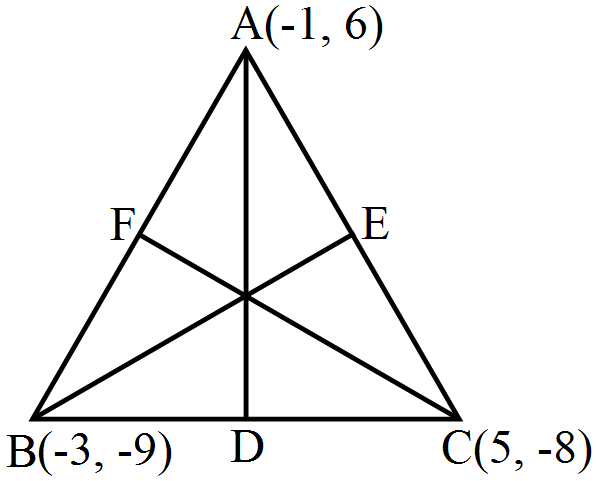
Find the equations of the medians of a triangle, the coordinates of whose vertices are (-1, 6), (-3, -9) and (5, -8).
Answer
Let A(-1, 6), B(-3, -9) and C(5, -8) be the coordinates of the given triangle.Let D,E and F be midpoints of BC,CA and AB, respectively.
So, the coordinates od D,E and F are

$\text{D}\equiv\Big(\frac{-3+5}{2},\frac{-9-8}{2}\Big)=\Big(1,\frac{-17}{2}\Big)$
$\text{E}\equiv \Big(\frac{-1+5}{2},\frac{6-8}{2}\Big)=(2,-1)$
$\text{F}\equiv \Big(\frac{-1-3}{2},\frac{6-9}{2}\Big)=\Big(-2,-\frac{3}{2}\Big)$
Median Ad passes through A(-1,6) and $\text{D}\Big(1,-\frac{17}{2}\Big)$
So, its equation is
$\text{y}-6=\frac{-\frac{17}{2}-6}{1+1}(\text{x}+1)$
$\Rightarrow4\text{y}-24=-29\text{x}-29$
$29\text{x}+4\text{y}+5=0$
Median BE passes through B(-3, -9) and E(2, -1).
So, its equation is
$\text{y}+9=\frac{-1+9}{2+3}(\text{x}+3)$
$\Rightarrow5\text{y}+45=8\text{x}+24$
$8\text{x}-5\text{y}-21=0$
Median CF passes through C(5, -8) and $\text{F}\Big(-2,\ -\frac{3}{2}\Big).$
So, its equation is
$\text{y}+8=\frac{-\frac{3}{2}+8}{-2-5}(\text{x}-5)$
$\Rightarrow-14\text{y}-112=3\text{x}-65$
$\Rightarrow13\text{x}+14\text{y}+47=0$
View full question & answer
Question 265 Marks
Reduce the equation 3x - 2y + 6 = 0 to the intercept form and find the x and y intercepts.
Answer
$\frac{\text{x}}{\text{a}}+\frac{\text{y}}{\text{b}}=1$
3x - 2y + 6 = 0
3x - 2y = -6
$\frac{-3\text{x}}{-6}-\frac{2\text{y}}{-6}=1$
$\frac{\text{x}}{\frac{-6}{3}}+\frac{\text{y}}{\frac{-6}{-2}}=1$
$\frac{\text{x}}{-2}+\frac{\text{y}}{3}=1$
⇒ x-intercept = a = -2
y-intercept = b = 3
View full question & answer
Question 275 Marks
Find the equation of the line passing through the point of intersection of the lines 4x - 7y - 3 = 0 and 2x - 3y + 1 = 0 that has equal intercepts on the axes.
Answer
Given lines are,
4x - 7y = 3
2x - 3y = -1
Solving these two, we get the
point of intersection,
x = -8, y = -5
Point of intersection of given lines is (-8, -5) equation of line makeing equal
intercepts (a) on the coordinate axes is,
$\frac{\text{x}}{\text{a}}+\frac{\text{y}}{\text{a}}=1$
x + y = a
-8 - 5 = a
a = -13
So,
Equation of required line is
x + y = -13
View full question & answer
Question 285 Marks
Find the equation of the straight line passing through the point of intersection of $2x + y - 1 = 0$ and $x + 3y - 2 = 0$ and making with the coordinate axes a triangle of area $\frac{3}{8}$ sq.units.
Answer
$\text{L}_1+\lambda\text{L}_2=0$ is the equation of line passing through two lines $L_1 $ and $L_2.$
$\therefore(2\text{x}+\text{y}-1)+\lambda(\text{x}+3\text{y}-2)=0$ is the required equation ...(i)
or, $\text{x}(2+\lambda)+\text{y}(1+3\lambda)-1-2\lambda=0$
$\frac{\text{x}}{\frac{1+2\lambda}{2+\lambda}}+\frac{4}{\frac{1+2\lambda}{1+3\lambda}}=1$
$\text{Area of} \ \triangle=\frac{1}{2}\times\text{OB}\times\text{OA}$
$\frac{8}{3}=\frac{1}{2}$ \times (y intercept) \times (x intercept)
$\frac{8}{3}=\frac{1}{2}\times\Big(\frac{1+2\lambda}{1+3\lambda}\Big)\times\Big(\frac{1+2\lambda}{2+\lambda}\Big)$
$\frac{16}{3}=\frac{1+4\lambda^2+4\lambda}{2+3\lambda^2+7\lambda}$
$32+48\lambda^2+112\lambda=-3-12\lambda^2-12\lambda$
$60\lambda^2+124\lambda+35=0$
$\lambda=\frac{-124\pm\sqrt{(124)^2-4\times60\times35}}{2\times60}$
Approximately $= 1$
$\therefore$ Subtituting in $(i) \Rightarrow 3x + 4y - 3 = 0, 12x + y - 3 = 0$
View full question & answer
Question 295 Marks
Find the equation of the right bisector of the line segment joining the points (3, 4) and (-1, 2).
Answer
The slope of line joining (3, 4) and (-1, 2) is
$\frac{2-4}{-1-3}=\frac{-2}{-4}=\frac{1}{2}$
The required line is $\perp$ to the given line
$\therefore$ (Slope of required line) $\times\frac{1}{2}=-1 \big[\because\text{m}_1\times\text{m}_2$ for perpendicular lines$\big]$
$\text{m}_1=-2$
And the line passes through the mid point of line joining (3, 4) and (1, 2)
i.e; $\Big(\frac{3-1}{2},\frac{4+2}{2}\Big)$ or $(1,3)$
$\therefore$ equation of the required line is
y - 3 = (-2)(x - 1)
or y - 3 = -2x + 2
or 2x + y - 5 = 0
View full question & answer
Question 305 Marks
Find the equation of the side BC of the triangle ABC whose vertices are (-1, -2), (0, 1) and (2, 0) respectively. Also, find the equation of the median through (-1, -2).
Answer
Equation of BC$\text{y}-\text{y}_1=\frac{\text{y}_2-\text{y}_1}{\text{x}_2-\text{x}_1}(\text{x}-\text{x}_1)$
$\text{y}-1=\frac{0-1}{2-0}(\text{x}-0)$ $\Big[$$\because$ B(0, 1), C(2, 0)$\Big]$
$2\text{y}-2=-\text{x}$
$\text{x}+\text{2y}=2$
D is midpoint of BC
So,
$\text{D}=\Big(\frac{\text{x}_1+\text{x}_2}{2},\frac{\text{y}_1+\text{y}_2}{2}\Big)=\Big(\frac{0+2}{2},\frac{1+0}{2}\Big)=\Big(1,\frac{1}{2}\Big)$
$\therefore$ Equation of the median AD:
$\text{y}-\text{y}_1=\frac{\text{y}_2-\text{y}_1}{\text{x}_2-\text{x}_1}(\text{x}-\text{x}_1)$
$\text{y}-(-2)=\frac{\frac{1}{2}-(-2)}{1-(-1)}(\text{x}-(-1))=\frac{\frac{5}{2}}{2}(\text{x}+1)\ \Big[\because\text{A}(-1, -2),\text{D}\Big(1,\frac{1}{2}\Big)\Big]$
$\text{4y}+8=\text{5x}+5$
$5\text{x}-\text{4y}-3=0$
View full question & answer
Question 315 Marks
If the image of the point (2, 1) with respect to a line mirror is (5, 2), find the equation of the mirror.
Answer
Here,
Let l be line mirror and B is image of A
Let m be slope of line l
So,
m(slope of AB) = -1
$\text{m}\Big(\frac{2-1}{5-2}\Big)=-1$
$\text{m}\Big(\frac{1}{3}\Big)=-1$
$\text{m}=-3$
M is mid point of AB
$\text{m}\Big(\frac{2+5}{2},\frac{2+1}{2}\Big)$
$\text{m}\Big(\frac{7}{2},\frac{3}{2}\Big)$
Equation line l is,
$\text{y}-\text{y}_1=\text{m}(\text{x}-\text{x}_1)$
$\text{y}-\frac{3}{2}=(-3)\Big(\text{x}-\frac{7}{2}\Big)$
$\frac{2\text{y}-3}{2}=-3\text{x}+\frac{21}{2}$
$2\text{y}-3=-6\text{x}+21$
$6\text{x}+2\text{y}=24$
$3\text{x}+\text{y}=12$
View full question & answer
Question 325 Marks
Find the equation of the right bisector of the line segment joining the points $(a, b)$ and $(a_1, b_1).$
Answer
Any line which is right bisector to another line segment passes through the mid-point of end-points and is perpendicular to it.
$\Rightarrow $ mid point of $(a, b)$ and $(a_1,b_1)$ is
$(\text{x}_1,\text{y}_1)=\Big(\frac{\text{a}+\text{a}_1}{2},\frac{\text{b}+\text{b}_1}{2}\Big)$
Slope of line $(\text{m})=\frac{\text{b}_1-\text{b}}{\text{a}_1-\text{a}}$
Slope of required line is $\text{m}'=\frac{\text{a}-\text{a}_1}{\text{b}-\text{b}_1}$
Equation of required line is
$\text{y}-\text{y}_1=\text{m}'(\text{x}-\text{x}_1)$
$\text{y}-\Big(\frac{\text{b}+\text{b}_1}{2}\Big)=\frac{\text{a}-\text{a}_1}{\text{b}-\text{b}_1}\Big(\text{x}-\frac{\text{a}+\text{a}_1}{2}\Big)$
$2\text{x}(\text{a}_1-\text{a})+2\text{y}(\text{b}_1-\text{b})+\text{a}_2+\text{b}_2=\text{a}_1^2+\text{b}_1^2$
View full question & answer
Question 335 Marks
Find the equation of the line, which passes through P (1, -7) and meets the axes at Aand B respectively so that 4 AP - 3 BP = 0.
Answer
The equation of straight line is$\text{y}-\text{y}_1=\text{m}(\text{x}-\text{x}_1) \ ...(\text{i})$
The line passes through (x, y) ie, (1, 7) and meets the axes at A and B
⇒ A point is (a, 0) and B is (0, b)
$\frac{\text{AP}}{\text{BP}}=\frac{3}{4}$
Using section formula $\frac{\text{lx}_2+\text{mx}_1}{\text{l}+\text{m}},\frac{\text{ly}_2+\text{my}_1}{\text{l}+\text{m}}$
$\text{l}:\text{m}=3:4, (\text{a},0)\Leftrightarrow(\text{x}_1,\text{y}_1),(0,\text{b})\Leftrightarrow(\text{x}_2,\text{y}_2)$
$\Rightarrow1=\frac{3(0)+4(\text{a})}{3+4}$
$\Rightarrow1=\frac{4\text{a}}{7}$
$\Rightarrow\text{a}=\frac{4}{7}$
$-7=\frac{3(\text{b})+4(0)}{3+4}$
$\Rightarrow-7=\frac{3b}{7}$
$\Rightarrow\text{b}=\frac{-49}{3}$
then $\text{A}\Big(\frac{7}{4},0\Big),\ \text{B}\Big(0,\frac{-49}{3}\Big)$ Putting in (1)
$\text{y}-\text{y}_1=\frac{\text{y}_2-\text{y}_1}{\text{x}_2-\text{x}_1}(\text{x}-\text{x}_1)$
$\text{y}-0=\frac{\frac{-49}{3}-0}{0-\frac{7}{4}}\Big(\text{x}-\frac{7}{4}\Big)$
$\text{y}-0=\frac{49}{3}\times\frac{4}{7}\Big(\text{x}-\frac{7}{4}\Big)$
$\text{y}=\frac{28}{3}\Big(\text{x}-\frac{7}{4}\Big)$
$\text{3y}-\text{28x}+49=0$
View full question & answer
Question 345 Marks
Find the coordinates of the incentre and centroid of the triangle whose sides have the equations 3x - 4y = 0, 12y + 5x = 0 and y - 15 = 0.
Answer
Let ABC be the triangle whose side BC, CA and AB have the equations
y - 15 = 0, BC
3x - 4y = 0, AC
5x + 12y = 0, AB
Solving these equation pair wise we can obtain the
coordinates of the vertices A, B, C as
A(0, 0), B(-36, 15), C(20, 15) respectively
Centroid $\Big(\frac{-36+20+0}{3},\frac{15+15+0}{3}\Big)=\Big(\frac{-16}{3},10\Big)$
For incentre, We have
$\text{a}=\text{BC}=\sqrt{56^2+0}=56$
$\text{b}=\text{CA}=\sqrt{20^2+15^2}=25$
$\text{c}=\text{AB}=\sqrt{36^2+16^2}=39$
Coordinates of incenter are
$\Big(\frac{56\times0+25\times-36+39\times20}{36+25+39},\frac{56\times0+25\times15+39\times15}{36+25+39}\Big)$
$=(-1.8)$
View full question & answer
Question 355 Marks
Find the equation of the line passing through the point (-3, 5) and perpendicular to the line joining (2, 5) and (-3, 6).
Answer
The line passes through the point (-3, 5)So $(\text{x}_1\text{y}_1)=(3,5)$
The line is perpendicular to the line joining (2, 5) and (-3, 6)
$\Rightarrow\text{m}=\frac{-1}{\text{slope of line joining (2,5) and (-3,6)}}=\frac{-1}{\frac{\text{y}_2-\text{y}_1}{\text{x}_2-\text{x}_1}}=\frac{-1}{\frac{6-5}{-3-2}}\frac{-1}{\frac{-1}{5}}$
$\therefore \text{m}=5$
Hence the equation of straight line is
$\text{y}-\text{y}_1=\text{m}(\text{x}-\text{x}_1)$
$\text{y}-5=5\big(\text{x}(-3)\big)$
$\text{y}-5=\text{5x}+15$
$\text{5x}-\text{y}+20=0$
View full question & answer
Question 365 Marks
Find the equation of the straight line which divides the join of the points (2, 3) and (−5, 8) in the ratio 3 : 4 and is also perpendicular to it.
Answer
The coordinates of the point which divides the join of the points (2, 3) and (-5, 8) in the ratio 3 : 4 is given by (x, y) where,$\text{x}=\frac{\text{lx}_2+\text{mx}_1}{\text{l}+\text{m}}=\frac{3(-5)+4(2)}{3+4}=\frac{-15+6}{7}=\frac{-9}{7}$
$\text{y}=\frac{\text{ly}_2+\text{my}_1}{\text{l}+\text{m}}=\frac{3(8)+4(3)}{3+4}=\frac{24+12}{7}=\frac{36}{7}$
Slope of the line joining the points (2, 3) and (5, 8) $=\frac{8-3}{-5-2}=\frac{5}{-7}=\frac{-5}{7}$
$\therefore$ Slope of line perpendicular to line $=\text{m}=\frac{7}{5}$
The required equation is:
$\text{y} - \text{y}_1 = \text{m}(\text{x} - \text{x}_1)$
$\text{y}-\frac{36}{7}=\frac{7}{5}\Big(\text{x}-\Big(\frac{-9}{7}\Big)\Big)$
$49\text{x}-35\text{y}+229=0$
View full question & answer
Question 375 Marks
Find the angles between the following pairs of straight lines:
3x - y + 5 = 0 and x - 3y + 1 = 0
Answer
Finding slopes of the lines by converting the equation in the form$\text{y}=\text{mx}+\text{c}$
$3\text{x}-\text{y}+5=0$
$\Rightarrow\text{y}=3\text{x}+5$
$\Rightarrow\text{m}_1=3$
Also
$\text{x}-3\text{y}+1=0$
$3\text{y}=\text{x}+1$
$\text{y}=\frac{\text{x}}{3}+\frac{1}{3}$
$\Rightarrow\text{m}_2=\frac{1}{3}$
Thus angle between the lines is
$\tan\theta=\Big|\frac{\text{m}_1-\text{m}_2}{1+\text{m}_1\text{m}_2}\Big|$
$=\Bigg|\frac{3-\frac{1}{3}}{1+3\times\frac{1}{3}}\Bigg|=\Bigg|\frac{\frac{9-1}{3}}{1+1}\Bigg|$
$=\Bigg|\frac{\frac{8}{3}}{2}\Bigg|=\Big|\frac{8}{6}\Big|=\frac{4}{3}$
$\Rightarrow\theta=\tan^{-1}\Big(\frac{4}{3}\Big)$
View full question & answer
Question 385 Marks
Find the equation of the straight lines passing through the following pair of points:
$(\text{a}\cos\alpha, \ \text{a} \ \sin\alpha)$ and $(\text{a}\cos\beta, \ \text{a} \ \sin\beta)$
Answer
Let $\text{A}(\text{x}_1\text{y}_1)$ be $(\text{a}\cos\alpha,\text{a}\sin\alpha)$$\text{B}(\text{x}_2\text{y}_2)$ be $(\text{a}\cos\beta,\text{a}\sin\beta)$
$\Rightarrow\text{y}-\text{y}_1=\frac{\text{y}_2-\text{y}_1}{\text{x}_2-\text{x}_1}(\text{x}-\text{x}_1)$
$\Rightarrow\text{y}-\text{a}\sin\alpha=\frac{\text{a}\sin\beta-\text{a}\sin\alpha}{\text{a}\cos\beta-\text{A}\cos\alpha}(\text{x}-\text{a}\cos\alpha)$
$\Rightarrow\text{y}-\text{a}\sin\alpha=\frac{a\Big(-2\sin\big(\frac{\beta-\alpha}{2}\big)\Big)\cos\beta\Big(\frac{\beta+\alpha}{2}\Big)}{\text{a}\Big(-2\sin\frac{\beta-\alpha}{2}\Big)\sin\Big(\frac{\beta+\alpha}{2}\Big)}(\text{x}-\text{a}\cos\alpha)$
$\Rightarrow \text{y}-\text{a}\sin\alpha=\frac{\cos\Big(\frac{\alpha+\beta}{2}\Big)}{\sin\Big(\frac{\alpha+\beta}{2}\Big)}(\text{x}-\text{a}\cos\alpha)$
$\Rightarrow \text{x}\cos\Big(\frac{\alpha+\beta}{2}\Big)+\text{y}\sin\frac{\alpha+\beta}{2}=\text{a}\cos\frac{\alpha-\beta}{2}$
$\therefore$ The equation of line joining the points $(\text{a}\cos\alpha,\text{a}\sin\alpha)$and $(\text{a}\cos\beta,\text{a}\sin\beta)$ is $\text{x}\cos\Big(\frac{\alpha+\beta}{2}\Big)+\text{y}\sin\frac{\alpha+\beta}{2}=\text{a}\cos\frac{\alpha-\beta}{2}$
View full question & answer
Question 395 Marks
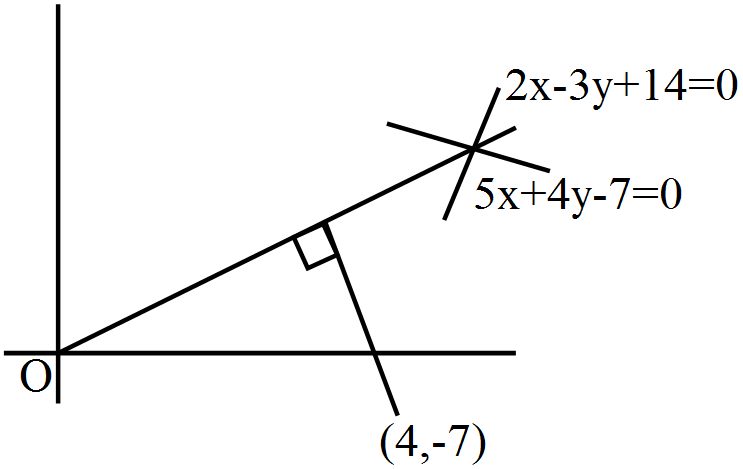
Find the length of the perpendicular from the point (4, -7) to the line joining the origin and the point of intersection of the lines 2x - 3y + 14 = 0 and 5x + 4y - 7 = 0.
Answer

The point of intersection of the lines 2x - 3y + 14 = 0 and 5x + 4y - 7 = 0 can be found out by solving these equations.
Solving these equations we get, $\text{x}=-\frac{35}{23}$ and $\text{y}=\frac{252}{69}$
Equation of line joining origin and the point $\Big(-\frac{35}{23},\frac{252}{69}\Big)$ is y = mx, where $\text{m}=\frac{\frac{252}{69}}{-\frac{35}{23}}=-\frac{12}{5}$
Therefore the equation of required line is $\text{y}=-\frac{12\text{x}}{5}$
$12\text{x}+5\text{y}=0$
Perpendicular distance from (4, -7) to 12x + 5y = 0 is
$\text{p}=\Bigg|\frac{12(4)+5(-7)}{\sqrt{12^2+(-5)^2}}\Bigg|=\frac{13}{13}=1$
View full question & answer
Question 405 Marks
Show that the origin is equidistant from the lines $4x + 3y + 10 = 0; 5x - 12y + 26 = 0$ and $7x + 24y = 50.$
Answer
Reduce $4x + 3y + 10 = 0$ to perpendicular form
$4x + 3y = -10$
$-4x - 3y = 10$
Dividing each term by $\sqrt{(-4)^2+(-3)^2}=\sqrt{16+9}=\sqrt{25}=5$
$\frac{-4}{5}\text{x}-\frac{3}{5}\text{y}=\frac{10}{5}=2$
$\Rightarrow p_1 = 2 ...(1)$
$5x - 12y + 26 = 0$
$5x - 12y = -26$
Dividing each term by $\sqrt{(-5)^2+(12)^2}=\sqrt{25+144}=\sqrt{169}=13$
$\frac{-5}{13}\text{x}+\frac{12}{13}\text{y}=\frac{26}{13}=2$
$\Rightarrow p_1 = 2 ...(2)$
$7x + 24y = 50$
Dividing each term by $\sqrt{(7)^2+(24)^2}=\sqrt{49+576}=\sqrt{625}=25$
$\frac{7}{25}\text{x}+\frac{24}{25}\text{y}=\frac{50}{25}=2$
$\Rightarrow p_1 = 2 ...(3)$
Hence, origin is equidistant from all three lines.
View full question & answer
Question 415 Marks
Find the equation of the straight lines passing through the following pair of points:
$\Big(\text{at}_1,\frac{\text{a}}{\text{t}_1}\Big)$ and $\Big(\text{at}_2,\frac{\text{a}}{\text{t}_2}\Big)$
Answer
Let $\text{A}(\text{x}_1\text{y}_1)$ be $\Big(\text{at}_1,\frac{\text{a}}{\text{t}_1}\Big)$$\text{B}(\text{x}_2\text{y}_2)$ be $\Big(\text{at}_2,\frac{\text{a}}{\text{t}_2}\Big)$
Then equation of line AB is
$\Rightarrow\text{y}-\text{y}_1=\frac{\text{y}_2-\text{y}_1}{\text{x}_2-\text{x}_1}(\text{x}-\text{x}_1)$
$\Rightarrow\text{y}-\frac{\text{a}}{\text{t}_1}=\frac{\frac{\text{a}}{\text{t}_2}-\frac{\text{a}}{\text{t}_1}}{\text{at}_2-\text{at}_1}(\text{x}-\text{at}_1)$
$\Rightarrow \text{y}-\frac{\text{a}}{\text{t}_1}=\frac{a(\text{t}_1-\text{t}_2)}{\text{at}_1\text{t}_2(\text{t}_2-\text{t}_1)}(\text{x}-\text{at}_1)$
$\Rightarrow\text{y}-\frac{\text{a}}{\text{t}_1}=\frac{-1}{\text{t}_1\text{t}_2}(\text{x}-\text{at}_1)$
$\Rightarrow\text{t}_1\text{t}_2\text{y}+\text{x}=\text{a}(\text{t}_1+\text{t}_2)$
$\therefore$ The equation of the line joining the points $\Big(\text{at}_1,\frac{\text{a}}{\text{t}_1}\Big)$ and $\Big(\text{at}_2,\frac{\text{a}}{\text{t}_2}\Big)$ is $\text{t}_1\text{t}_2\text{y}+\text{x}=\text{a}(\text{t}_1+\text{t}_2)$
View full question & answer
Question 425 Marks
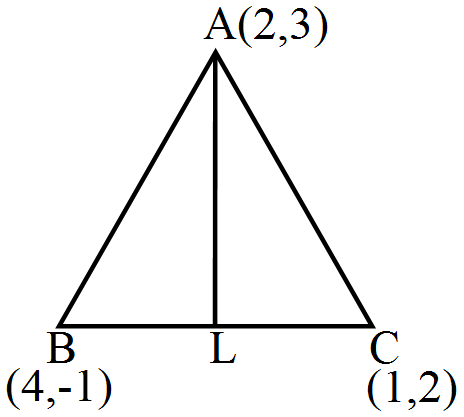
In the triangle ABC with vertices A (2, 3), B (4, -1) and C (1, 2), find the equation and the length of the altitude from the vertex A.
Answer
The equation of BC is $\text{y}+1=\frac{2+1}{1-4}(\text{x}-4)$ $\text{y}+1=-\text{x}+4$ $\text{x}+\text{y}-3=0$ $\text{AL}=\big|\frac{2+3-3}{\sqrt{1+1}}\big|$ $=\sqrt{2}$
Clearly, slope of BC having equation x + y - 3 = 0 is -1. So, slope of AL is 1. As it passes through A(2, 3) so, its equation is y - 3 = 1(x - 2) or x - y + 1 = 0
View full question & answer
Question 435 Marks
Find the angles between the following pairs of straight lines:x - 4y = 3 and 6x - y = 11
Answer
To find angle convert the equation in the form$\text{y}=\text{mx}+\text{c}$
$\text{x}-4\text{y}=3$
$\Rightarrow4\text{y}=\text{x}-3$
$\text{y}=\frac{\text{x}}{4}-\frac{3}{4}$
$\Rightarrow\text{m}_1=\frac{1}{4}$
Also, $6\text{x}-\text{y}=11$
$\text{y}=6\text{x}-11$
$\Rightarrow\text{m}_2=6$
Thus, angle between the lines is
$\tan\theta=\Big|\frac{\text{m}_1-\text{m}_2}{1+\text{m}_1\text{m}_2}\Big|$
$=\Bigg|\frac{\frac{1}{4}-6}{1+\frac{1}{4}\times6}\Bigg|$
$=\Bigg|\frac{\frac{-23}{4}}{1+\frac{3}{2}}\Bigg|=\Bigg|\frac{\frac{-23}{4}}{\frac{5}{2}}\Bigg|$
$\Rightarrow\theta=\tan^{-1}\Big(\frac{23}{10}\Big)$
View full question & answer
Question 445 Marks
Find the distance of the line 2x + y = 3 from the point (-1, -3) in the direction of the line whose slope is 1.
Answer
The slope of the line = 1$\tan\theta=1 $
or $\theta =\frac{\pi}{4}$
$\therefore$ Equation of line is
$\frac{\text{x}+1}{\cos\frac{\pi}{4}}=\frac{\text{y}+3}{\sin\frac{\pi}{4}}=\text{r}$
or
$\text{x}=\frac{\text{r}}{\sqrt2}-1$ and $\text{y}=\frac{\text{r}}{\sqrt2}-3$
$\text{p}\Big(\frac{\text{r}}{\sqrt2}-1,\ \frac{\text{r}}{\sqrt2}-3\Big)$ lie in $2\text{x}+\text{y}=3$
$\therefore2\Big(\frac{\text{r}}{\sqrt2}-1\Big)+\Big(\frac{\text{r}}{\sqrt2}-3\Big)=3$
$\Rightarrow\frac{\text{3r}}{\sqrt2}=8$
$\text{r}=\frac{8\sqrt2}{3}$
The equation of 2x + y = 3 from (-1, -3) is $\frac{8\sqrt2}{3}$ units.
View full question & answer
Question 455 Marks
The equation of one side of an equilateral triangle is $x - y = 0$ and one vertex is $(2+\sqrt3,5).$ Prove that a second side is $\text{y}+(2-\sqrt{3})\text{x}=6$ and find the equation of the third side.$f$
Answer
Let $\text{C}(2+\sqrt3,5)$ be vertex and $x = y$ be the opposite side of equilateral triangle $ABC.$
The other two sides makes an angle of $60^\circ$ with other two sides.
slope of $x - y = 0$ is $1 $.
$\therefore\text{y}-5=\frac{1\pm\tan60^\circ}{1\mp\tan60^\circ}(\text{x}-2-\sqrt3)$
$\text{y}-5=\frac{1+\sqrt{3}}{1-\sqrt{3}}(\text{x}-2-\sqrt{3})$ and $\text{y}-5=\frac{1-\sqrt{3}}{1+\sqrt{3}}(\text{x}-2-\sqrt{3})$
$\text{y}-5=(\sqrt{3}-2)(\text{x}-2-\sqrt{3})$ and $\text{y}-5=(\sqrt{3}-2)(\text{x}-2-\sqrt{3})$
$\text{y}+(2+\sqrt{3})\text{x}=12+4\sqrt3$ and $\text{y}+(2-\sqrt{3})\text{x}=6$
Hence proved the $2^{nd}$ side of $\Delta\text{ABC}$ is $\text{y}+(2-\sqrt3)\text{x}=6$
and the $3^{rd}$ side is $\text{y}+(2+\sqrt{3})\text{x}=12+4\sqrt3.$
View full question & answer
Question 465 Marks
Find the equation of the line joining the point (3, 5) to the point of intersection of the lines 4x + y - 1 = 0 and 7x - 3y - 35 = 0.
Answer
The point of intersection of the lines
4x + y - 1 = 0 and 7x - 3y - 35 = 0
is y = 1 - 4x
7x - 3(1 - 4x) - 35 = 0
7x - 3 + 12x - 35 = 0
19x = 38
x = 2
⇒ y = 1 - 4x = 1 - 8 = -7
$\therefore$ Let P(2, -7) and Q(3, 5)
The equation of line PQ is
$\text{y} - \text{y}_1 = \text{m}(\text{x} - \text{x}_1)$
$\text{y-y}_1=\frac{\text{y}_2-\text{y}_1}{\text{x}_2-\text{x}_1}(\text{x-x}_1)$
$\text{y}-(-7)=\frac{5-(-7)}{3-2}(\text{x}-2)$
$\text{y} + 7 = 12(\text{x} - 2)$
$\text{y} - 12\text{x} = -31$
$12\text{x} - \text{y} - 31 = 0$
View full question & answer
Question 475 Marks
Find the equation to the straight line parallel to 3x - 4y + 6 = 0 and passing through the middle point of the join of points (2, 3) and (4, -1).
Answer
The slope of the given line is equal to the slope of line 3x -4y + 6 = 0 as the two lines are parallel to each other
$\therefore \ \text{m}_1=\text{m}_2=\frac{3}{4}$
And the line passes through mid point of points (2, 3) and (4, -1)
i.e; $\Big(\frac{2+4}{2},\frac{3-1}{2}\Big)$ [using mid point formula]
$\Rightarrow(3,1)$
$\therefore$ Using one point-slope equation of line
$(\text{y}-1)=\frac{3}{4}(\text{x}-3)$
$4\text{y}-4=3\text{x}-9$
$3\text{x}-4\text{y}=5$
Is the required line.
View full question & answer
Question 485 Marks
Find the angles between the following pairs of straight lines:
$(m^2 - mn)y = (mn + n^2)x + n^3 $ and $(mn + m^2)y = (mn - n^2)x + m^3.$
Answer
Converting the equation in the form
$\text{y}=\text{mx}+\text{c}$
$\text{y}=\frac{(\text{mn}+\text{n}^2)}{\text{m}^2-\text{mn}}\text{x}+\frac{\text{n}^3}{(\text{m}^2-\text{mn})}$
$\Rightarrow\text{m}_1=\frac{\text{mn}+\text{n}^2}{\text{m}^2-\text{mn}}$
Also, $\text{y}=\frac{(\text{mn}-\text{n}^2)}{\text{mn}+\text{m}^2}\text{x}+\frac{\text{m}^3}{\text{mn}+\text{m}^2}$
$\Rightarrow\text{m}_2=\frac{\text{mn}-\text{n}^2}{\text{mn}+\text{m}^2}$
Thus, angle between 2 lines is $\tan\theta$
$\tan\theta=\Big|\frac{\text{m}_1-\text{m}_2}{1+\text{m}_1\text{m}_2}\Big|$
$=\begin{vmatrix}\frac{\Big(\frac{\text{mn}+\text{n}^2}{\text{m}^2-\text{mn}}\Big)-\Big(\frac{\text{mn}-\text{n}^2}{\text{mn}+\text{m}^2}\Big)}{1+\Big(\frac{\text{mn}+\text{n}^2}{\text{m}^2-\text{mn}}\Big)\Big(\frac{\text{mn}-\text{n}^2}{\text{mn}+\text{m}^2}\Big)}\end{vmatrix}$
$=\Bigg|\frac{\text{m}^2\text{n}^2+\text{m}^3\text{n}+\text{n}^3\text{m}+\text{n}^2\text{m}^2-\text{m}^3\text{n}+\text{m}^2\text{n}^2+\text{n}^2\text{m}^2-\text{m}\text{n}^3}{\text{m}^3\text{n}+\text{m}^4-\text{m}^2\text{n}^2-\text{m}^3\text{n}+\text{m}^2\text{n}^2-\text{m}\text{n}^3+\text{m}\text{n}^3-\text{n}^4}\Bigg|$
$=\Bigg|\frac{4\text{m}^2\text{n}^2}{\text{m}^4-\text{n}^4}\Bigg|$
$\Rightarrow\theta=\tan^{-1}\Big|\frac{4\text{m}^2\text{n}^2}{\text{m}^4-\text{n}^4}\Big|$
View full question & answer
Question 495 Marks
Find the equation of the bisector of angle A of the triangle whose vertices are A (4, 3), B(0, 0) and C (2, 3).
Answer
Let AD be the bisector of $\angle\text{A}$Then, BD : DC=AB : AC
Now,
$|\text{AB}|=\sqrt{(4-0)^2+(3-0)^2}=5$
$|\text{AC|}=\sqrt{(4-2)^2+(3-3)^2}=2$
$\Rightarrow\frac{\text{AB}}{\text{AC}{}}=\frac{\text{BD}}{\text{DC}}=\frac{5}{2}$
⇒ D divides BC in the ratio 5 : 2
So the coordinates of D are $\Big(\frac{5\times2+0}{5+2},\frac{5\times3+0}{5+2}\Big)=\Big(\frac{10}{7},\frac{15}{7}\Big)$
$\therefore$ The equation of AD is
$\text{y}-3=\Bigg(\frac{\frac{15}{7}-3}{\frac{10}{7}-4}\Bigg)(\text{x}-4)$
$\text{y}-3=\Big(\frac{15-21}{10-28}\Big)(\text{x}-4)$
$\Rightarrow\text{y}-3=\frac{1}{3}(\text{x}-4)$
$\Rightarrow3(\text{y}-3)=\text{x}-4$
$\Rightarrow\text{x}-\text{3y}+9-4=0$
$\Rightarrow\text{x}-\text{3y}+5=0$
View full question & answer
Question 505 Marks
The line through (h, 3) and (4, 1) intersects the line 7x - 9y - 19 = 0 at right angle. Find the value of h.
Answer
If two lines intersect at right angles, then product of their slope is -1.
Slope of 7x - 9y -19 = 0 is $\text{m}_1=\frac{7}{9} \ ...(1)$
Slope of line joining (h, 3) and $(4,1)=\frac{1-3}{4-\text{h}}$
or, $\text{m}_2=\frac{2}{\text{h}-4} \ ...(2)$
$\text{m}_1\times\text{m}_2=-1$
$\frac{7}{9}\times\frac{2}{\text{h}-4}=-1$
$14=-9\text{h}+36$
$9\text{h}=36-14$
$\text{h}=\frac{22}{9}$
View full question & answer