Question types

Alternating Current question types

49 questions across 6 question groups — pick any mix to generate a Physics paper with step-by-step answer keys.

49
Questions
6
Question groups
5
Question types
Sample Questions

Alternating Current questions

One sample from each question group in this chapter. Select any group above to see the full set with answer keys.

In an AC series circuit, the instantaneous current is zero when the instantaneous voltage is maximum. Connected to the source may be a:
  1. Pure inductor.
  2. Pure capacitor.
  3. Pure resistor.
  4. Combination of an inductor and a capacitor.
View full solution
The magnetic field energy in an inductor changes from maximum value to minimum value in 5.0ms when connected to an AC source. The frequency of the source:
  1. 20Hz.
  2. 50Hz.
  3. 200Hz.
  4. 500Hz.
View full solution
The AC voltage across a resistance can be measured using:
  1. A potentiometer.
  2. A hot-wire voltmeter.
  3. A moving-coil galvanometer.
  4. A moving-magnet galvanometer.
View full solution
A current $\text{i}_1=\text{i}_0\sin\omega\text{t}$ passes through a resistor of resistance R. How much thermal energy is produced in one time period? A current $\text{i}_2=-\text{i}_0\sin\omega\text{t}$ passes through the resistor. How much thermal energy is produced in one time period? If i1, and i2 both pass through the resistor simultaneously, how much thermal energy is produced? Is the principle of superposition obeyed in this case?
View full solution
An AC source is connected to a capacitor. Will the rms current increase, decrease or remain constant if a dielectric slab is inserted into the capacitor?
View full solution
In a circuit containing a capacitor and an AC source the current is zero at the. stant the source voltage is maximum. Is it consistent with Ohm's law?
View full solution
A transformer is designed to convert an AC voltage of 220V to an AC voltage of 12V. If the input terminals are connected to a DC voltage of 220V, the transformer usually burns. Explain.
View full solution
The peak power consumed by a resistive coil, when connected to an AC source, is 80W. Find the energy consumed by the coil in 100 seconds, which is many times larger than the time period of the source.
View full solution
The current in a discharging LR circuit is given by $\text{i}=\text{i}_0\text{e}^{\frac{-\text{t}}{\tau}}$ where $\tau$ is the time constant of the circuit. Calculate the rms current for the period $\text{t}=0$ to $\text{t}=\tau.$
View full solution
A resistance is connected to an AC source. If a capacitor is included in the series circuit, will the average power absorbed by the resistance increase or decrease? If an inductor of small inductance is also included in the series circuit, will the average power absorbed increase or decrease further?
View full solution
The dielectric strength of air is 3.0 × 10⁶V/m. A parallel-plate air-capacitor has area 20cm2 and plate separation 0.10mm. Find the maximum rms voltage of an AC source that can be safely connected to this capacitor.
View full solution
Q 163 Marks Question3 Marks
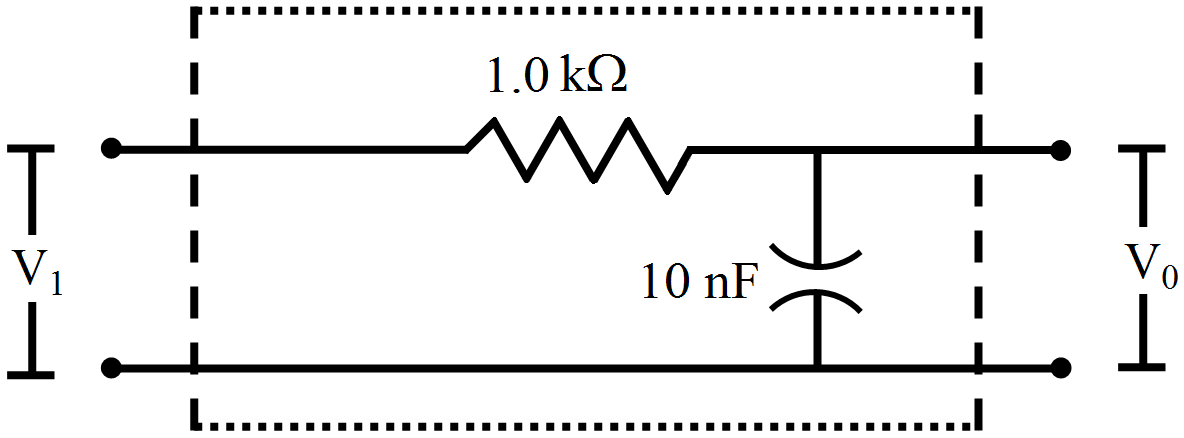
Figure shows a typical circuit for a low-pass filter. An AC input Vi = 10mV is applied at the left end and the output V0 is received at the right end. Find the output voltage for ν = 10kHz, 1.0MHz and 10.0MHz. Note that as the frequency is increased the output decreases and, hence, the name low-pass filter.

View full solution
Q 173 Marks Question3 Marks
An inductor-coil, a capacitor and an AC source of rms voltage 24V are connected in series. When the frequency of the source is varied, a maximum rms current of 6.0A is observed. If this inductor coil is connected to a battery of emf 12V and internal resistance $4.0\Omega,$ what will be the current?
View full solution
Q 183 Marks Question3 Marks
The voltage and current in a series AC circuit are given by, $\text{V}=\text{V}_0\cos\omega\text{t}$ and $\text{i}=\text{i}_0\sin\omega\text{t}.$ What is the power dissipated in the circuit?
View full solution
Q 193 Marks Question3 Marks
A coil of inductance 5.0mH and negligible resistance is connected to the oscillator of the previous problem. Find the peak currents in the circuit for $\omega=100\text{s}^{-1},500\text{s}^{-1},1000\text{s}^{-1}.$
View full solution
Q 203 Marks Question3 Marks
A transformer has 50 turns in the primary and 100 in the secondary. If the primary is connected to a 220V DC supply, what will be the voltage across the secondary?
View full solution
Q 214 Marks Question4 Marks
The household supply of electricity is at 220V (rms value) and 50Hz. Find the peak voltage and the least possible time in which the voltage can change from the rms value to zero.
View full solution
A coil has a resistance of $10\Omega$ and an inductance of 0.4 henry. It is connected to an AC source of $6.5\text{V},\frac{30}{\pi}\ \text{Hz}$ Find the average power consumed in the circuit.
View full solution
An inductance of 2.0H, a capacitance of $18\mu\text{F}$ and a resistance of $10\text{K}\Omega$ are connected to an AC source of 20V with adjustable frequency.
  1. What frequency should be chosen to maximise the current in the circuit?
  2. What is the value of this maximum current?
View full solution
A resistor of resistance $100\Omega$ is connected to an AC source $\in=(12\text{V})\sin(250\pi\text{s}^{-1})\text{t}.$ Find the energy dissipated as heat during $\text{t}=0$ to $\text{t}=1.0\text{ms}.$
View full solution
A capacitor of capacitance $10\mu\text{F}$ is connected to an oscillator with output voltage $\in=(10\text{V})\sin\omega\text{t}.$ Find the peak currents in the circuit for $\omega=10\text{s}^{-1},100\text{s}^{-1},500\text{s}^{-1},1000\text{s}^{-1}.$
View full solution
In a series RC circuit with an AC source, $\text{R}=300\Omega,\text{C}=25\mu\text{F},\in_0=50\text{V}$ and $\nu=\frac{50}{\pi}\text{Hz}.$ Find the peak current and the average power dissipated in the circuit.
View full solution

Generate a Alternating Current paper free

Pick question groups from the list above, set marks and difficulty, and export a branded PDF with step-by-step answer keys. First 3 chapters free — no signup.

Download App