Questions

5 Marks Questions

Take a timed test

10 questions · self-marked practice — reveal the answer and mark yourself.

Question 15 Marks
A person stands on a spring balance at the equator.
  1. By what fraction is the balance reading less than his true weight?
  2. If the speed of earth's rotation is increased by such an amount that the balance reading is half the true weight, what will be the length of the day in this case?
Answer
When the balance reading is half, we have:$=\frac{\text{mg}-\text{m}\omega^3\text{r}}{\text{mg}}-=\frac{1}{2}$
True weight =$\Rightarrow\omega^2\text{r}=\frac{\text{g}}{2}$
$\Rightarrow\omega=\sqrt{\frac{\text{g}}{2\text{r}}}$
$=\sqrt{\frac{12}{2\times6400\times10}}\text{rad}/\text{ s}$
$\therefore\text{Duration of the day}=2\pi\times\sqrt{\frac{2\times6400\times10^2}{9.8}}\text{s}$
$=2\pi\sqrt\frac{{6.4\times10^7}}{49}\text{s}$
$=\frac{2\pi\times8000}{7\times3600}\text{h}=2\text{h}$
View full question & answer
Question 25 Marks
A hemispherical bowl of radius $R$ is rotated about its axis of symmetry which is kept vertical. A small block is kept in the bowl at a position where the radius makes an angle $\theta$ with the vertical. The block rotates with the bowl without any slipping. The friction coefficient between the block and the bowl surface is $\mu.$ Find the range of the angular speed for which the block will not slip.
Answer
If the bowl rotates at maximum angular speed, the block tends to slip upwards. So, the frictional force acts downward. Here, $\text{r}=\text{R}\sin\theta$ From FBD –1

$\text{R}_1-\text{mg}\cos\theta-\text{m}\omega_1^2(\text{R}\sin\theta)\sin\theta=0\ \dots(1)$ $[\text{because r}= \text{R}\sin\theta]$
and $\mu\text{R}_1\text{mg}\sin\theta-\text{m}\omega_1^2(\text{R}\sin\theta)\cos\theta=0\ \dots(2)$ Substituting the value of $R_1$ from Eq (1) in Eq(2), it can be found out that,$\omega_1=\Big[\frac{\text{g}(\sin\theta+\mu\cos\theta)}{\text{R}\sin\theta(\cos\theta-\mu\sin\theta)}\Big]^\frac{1}{2}$

Again, for minimum speed, the frictional force $\mu\text{R}_2$ acts upward. From FBD–2, it can be proved that,$\omega_2=\Big[\frac{\text{g}(\sin\theta-\mu\cos\theta)}{\text{R}\sin\theta(\cos\theta+\mu\sin\theta)}\Big]^\frac{1}{2}$
$\therefore$ the range of speed is between $\omega_1$ and $\omega_2.$
View full question & answer
Question 35 Marks
A block of mass m moves on a horizontal circle against the wall of a cylindrical room of radius R. The floor of the room on which the block moves is smooth but the friction coefficient between the wall and the block is $\mu.$ The block is given an initial speed $\nu_0.$ As a function of the speed $\nu$ write,
  1. The normal force by the wall on the block.
  2. The frictional force by the wall.
  3. The tangential acceleration of the block.
  4. Integrate the tangential acceleration $\Big(\frac{\text{d}\nu}{\text{dt}}=\nu\frac{\text{d}\nu}{\text{ds}}\Big)$ to obtain the speed dt ds of the block after one revolution.
Answer
A block of mass ‘m’ moves on a horizontal circle against the wall of a cylindrical room of radius ‘R’ Friction coefficient between wall & the block is $\mu.$
  1. Normal reaction by the wall on the block is $=\frac{\text{mv}^2}{\text{R}}$
  2. $\therefore$ Frictional force by wall $=\frac{\mu\text{mv}^2}{\text{R}}$
  3. $=\frac{\mu\text{mv}^2}{\text{R}}=\text{ma}$
$\Rightarrow\text{a}=-\frac{\mu\text{v}^2}{\text{R}}$ (Deceleration)
  1. Now, $\frac{\text{dv}}{\text{dt}}=\text{v}\frac{\text{dv}}{\text{ds}}=-\frac{\mu\text{v}^2}{\text{R}}$
$\Rightarrow\text{ds}=-\frac{\text{R}}{\mu}\frac{\text{dv}}{\text{v}}$
$\Rightarrow\text{s}=-\frac{\text{R}}{\mu}\text{lnV}+\text{c}$
At $s = 0, v = v_0$
Therefore, $\text{c}=\frac{\text{R}}{\mu}\text{ln}\text{V}_0$
so, $\text{s}=-\frac{\text{R}}{\mu}\text{ln}\frac{\text{v}}{\text{v}_0}$
$\Rightarrow\frac{\text{v}}{\text{v}_0}=\text{e}^{\frac{-\mu\text{s}}{\text{R}}}$
For, one rotation $\text{s}=2\pi\text{R,}$ so $\text{v}=\text{v}_0\text{e}^{-2\pi\mu}$
View full question & answer
Question 45 Marks
A car goes on a horizontal circular road of radius R, the speed increasing at a constant rate $\frac{\text{d}\nu}{\text{dt}}=\text{a}.$ The friction dt coefficient between the road and the tyre is $\mu.$ Find the speed at which the car will skid.
Answer


Since the motion is nonuniform, the acceleration has both radial & tangential component.
$\text{a}_\text{r}=\frac{\text{V}^2}{\text{r}}$
$\text{a}_\text{t}=\frac{\text{dv}}{\text{dt}}=\text{a}$
Resultant magnitude $=\sqrt{\Big(\frac{\text{V}^2}{\text{r}}\Big)^2+\text{a}^2}$
Now $\mu\text{N}=\text{m}\sqrt{\Big(\frac{\text{v}^2}{\text{r}}\Big)^2+\text{a}^2}$
$\Rightarrow\mu\text{ mg}=\text{m}\sqrt{\Big(\frac{\text{v}^2}{\text{r}}\Big)^2+\text{a}^2}$
$\Rightarrow\mu^2\text{g}^2=\Big(\frac{\text{v}^4}{\text{r}^2}\Big)+\text{a}^2$
$\Rightarrow\text{v}^4=(\mu^2\text{g}^2-\text{a}^2)$
$\Rightarrow\text{v}=[(\mu^2\text{g}^2-\text{a}^2)\text{r}^2]^\frac{1}{4}$
View full question & answer
Question 55 Marks
A table with smooth horizontal surface is fixed in a cabin that rotates with a uniform angular velocity $\omega$ in a circular path of radius R (In figure). A smooth groove AB of length L(<$\theta$ with the radius OA of the circle in which the cabin rotates. A small particle is kept at the point A in the groove and is released to move along AB. Find the time taken by the particle to reach the point B.
Answer

The cabin rotates with angular velocity $\omega$ & radius R
$\therefore$ The particle experiences a force $\text{mR}\omega^2$
The component of $\text{mR}\omega^2$ along the groove provides the required force to the particle to move along AB.
$\therefore$ $\text{mR}\omega^2\cos\theta=\text{ma}$
$\Rightarrow\text{a}=\text{R}\omega^2\cos\theta$
length of groove = L
$\text{L}=\text{ut}+\frac{1}{2}\text{at}^2$
$\Rightarrow\text{L}=\frac{1}{2}\text{R}\omega^2\cos\theta\text{ t}^2$
$\Rightarrow\text{t}^2=\frac{2\text{L}}{\text{R}\omega^2\cos\theta}$
$\Rightarrow\text{t}=\sqrt{\frac{2\text{L}}{\text{R}\omega^2\cos\theta}}$
View full question & answer
Question 65 Marks
A block of mass m is kept on a horizontal ruler. The friction coefficient between the ruler and the block is g. The ruler is fixed at one end and the block is at a distance L from the fixed end. The ruler is rotated about the fixed end in the horizontal plane through the fixed end.
  1. What can the maximum angular speed be for which the block does not slip?
  2. If the angular speed of the ruler is uniformly increased from zero at an angular acceleration $\alpha,$ at what angular speed will the block slip?
Answer
  1.  


When the ruler makes uniform circular motion in the horizontal plane.

$\mu\text{ mg}=\text{m}\omega_1^2\text{L}$

$\omega_1=\sqrt{\frac{\mu\text{g}}{\text{L}}}$
  1.  


When the ruler makes uniformly accelerated circular motion.

$\mu\text{ mg}=\sqrt{(\text{m}\omega_2^2\text{L})^2+(\text{mL}\alpha)^2}$

$\Rightarrow\omega_2^4+\alpha^2=\frac{\mu^2\text{g}^2}{\text{L}}$

$\Rightarrow\omega_2=\bigg[\Big(\frac{\mu^2\text{g}^2}{\text{L}}\Big)^2-\alpha^2\bigg]^\frac{1}{4}$
View full question & answer
Question 75 Marks
A car moving at a speed of 36 km/hr is taking a turn on a circular road of radius 50m. A small wooden plate is kept on the seat with its plane perpendicular to the radius of the circular road (figure In). A small block of mass 100g is kept on the seat which rests against the plate. The friction coefficient between the block and the plate is $\mu=0.58.$
  1. Find the normal contact force exerted by the plate on the block.
  2. The plate is slowly turned so that the angle between the normal to the plate and the radius of the road slowly increases. Find the angle at which the block will just start sliding on the plate.
Answer
v = Velocity of car = 36km/hr = 10m/s r = Radius of circular path = 50m m = mass of small body = 100g = 0.1kg.$\mu$ = Friction coefficient between plate & body = 0.58
  1. The normal contact force exerted by the plate on the block,
$\text{N}=\frac{\text{mv}^2}{\text{r}}=\frac{0.1\times100}{50}=0.2\text{N}$
  1. The plate is turned so the angle between the normal to the plate & the radius of the road slowly increases,
$\text{N}=\frac{\text{mv}^2}{\text{r}}\cos\theta\ \dots(1)$
$\mu\text{ N}=\frac{\text{mv}^2}{\text{r}}\cos\theta\ \dots(2)$
Putting value of N from (1),
$\mu\frac{\text{mv}^2}{\text{r}}\cos\theta=\frac{\text{mv}^2}{\text{r}}\sin\theta$
$\Rightarrow\mu=\tan\theta$
$\Rightarrow\theta=\tan^{-1}\mu$
$\Rightarrow\theta=\tan^{-1}(0.58)=30^\circ$
View full question & answer
Question 85 Marks
A turn of radius 20m is banked for the vehicles going at a speed of 36 km/h. If the coefficient of static friction between the road and the tyre is 0.4, what are the possible speeds of a vehicle so that it neither slips down nor skids up?
Answer
In the question it is given radius of turn r = 20m and banked with angle $\theta$ for speed$\upsilon=\frac{36\text{km}}{\text{h}}=\frac{36{\times}5}{18}=10\text{m}/\text{ sec}$
And coefficient of friction $\mu=0.4$ From here we can find the value of $\tan\theta$ We know $\tan\theta=\frac{\upsilon^2}{\text{rg}}$$\Rightarrow\tan\theta=\frac{10^2}{20\times10}=\frac12\dots(1)$
We assume two conditions one when a vehicle moves with maximum speed in this condition the vehicle may skid up if speed will increase. In this situation friction between road and tyre is opposite to skidding direction as shown in figure We mark all forces on vehicle as shown in figure and dividing them in their component From figure clearly see that if vehicle is in equilibrium so the force acting on vehicle are equal along the road and perpendicular to the road Force along the road $\Rightarrow{\text{mg}\sin\theta}+\mu\text{N}=\frac{\text{m}\upsilon^2}{\text{r}}\cos\theta$
Rearranging this equation$\Rightarrow\mu\text{N}=\frac{\text{m}\upsilon^2}{\text{r}}\cos\theta-\text{mg}\sin\theta\dots(2)$
Now take forces perpendicular to road$\Rightarrow\text{N}=\text{mg}\cos\theta+\frac{\text{m}\upsilon^2}{\text{r}}\sin\theta\dots(3)$
Divide (2) by (3)$\Rightarrow\mu=\frac{\frac{\text{m}\upsilon^2}{\text{r}}\cos\theta-\text{mg}\sin\theta}{\text{mg}\cos\theta+\frac{\text{m}\upsilon^2}{\text{r}}\sin\theta}$
Solving this equation we get$\Rightarrow\mu=\frac{\upsilon^2\cos\theta-\text{r}\sin\theta}{\text{rg}\cos\theta+\upsilon^2\sin\theta}$
Right hand side divided by $\cos\theta$$\Rightarrow\mu(\text{rg}+\text{v}^2\tan\theta)=\text{v}^2-\text{rg}\tan\theta$
Solving this we can find value of vv maximum velocity of vehicle where it will not skid$\Rightarrow\upsilon=\sqrt{\frac{\text{rg}\tan\theta+\mu\text{rg}}{1-\mu\tan\theta}}$
Put the given values in this equation$\Rightarrow\upsilon=\sqrt{\frac{20\times10\times\frac12+0.4\times20\times10}{1-0.4\times\frac12}}$
$\Rightarrow\upsilon=\sqrt{225}$
$\upsilon=15\text{m}/\text{ sec}$
Convert into $\text{km/ h}$ Maximum speed $\text{v = 54km/ h}$ Now we take the minimum speed case in this case friction applied in upward direction along the road as shown in figure. Equate Forces along road$\Rightarrow\mu\text{N}=\frac{\text{m}\upsilon^2}{\text{r}}\cos\theta=\text{mg}\sin\theta $
$\Rightarrow\mu\text{N}=\text{mg}\sin\theta-\frac{\text{m}\upsilon^2}{\text{r}}\cos\theta\dots(4)$
Forces perpendicular to road$\Rightarrow\text{N}=\text{mg}\cos\theta-\frac{\text{m}\upsilon^2}{\text{r}}\sin\theta\dots(5)$
Divide (4) by (5)$\Rightarrow\mu=\frac{\text{mg}\sin\theta-\frac{\text{m}\upsilon^2}{\text{r}}\cos\theta}{\text{mg}\cos\theta+\frac{\text{m}\upsilon^2}{\text{r}}\sin\theta}$
Solving this we get$\Rightarrow\mu=\frac{\text{rg}\sin\theta-\upsilon^2\cos\theta}{\text{rg}\cos\theta-\upsilon^2\sin\theta}$
Divide right hand side by $\cos\theta$$\Rightarrow\mu=\frac{\text{rg}\tan\theta-\upsilon^2}{\text{rg}-\upsilon^2\tan\theta}$
Further solving it we get$\Rightarrow\mu=\sqrt{\frac{\text{rg}\tan\theta-\mu\text{rg}}{\mu\tan\theta+1}}$
Putting given values in above equation$\Rightarrow\upsilon=\sqrt{\frac{20\times10\times\frac12+0.4\times20\times10}{0.4\times\frac12+1}}$
By solving this$\Rightarrow\upsilon=\sqrt{16.66}$
Minimum speed$\therefore\text{v}=4.08\text{m/ sec}$
Convert into $\text{km/ h}$$\upsilon=4.08\times\frac{18}5=14.68\text{km/ h}$
Hence the minimum speed is $14.7\text{km/ h}$
View full question & answer
Question 95 Marks
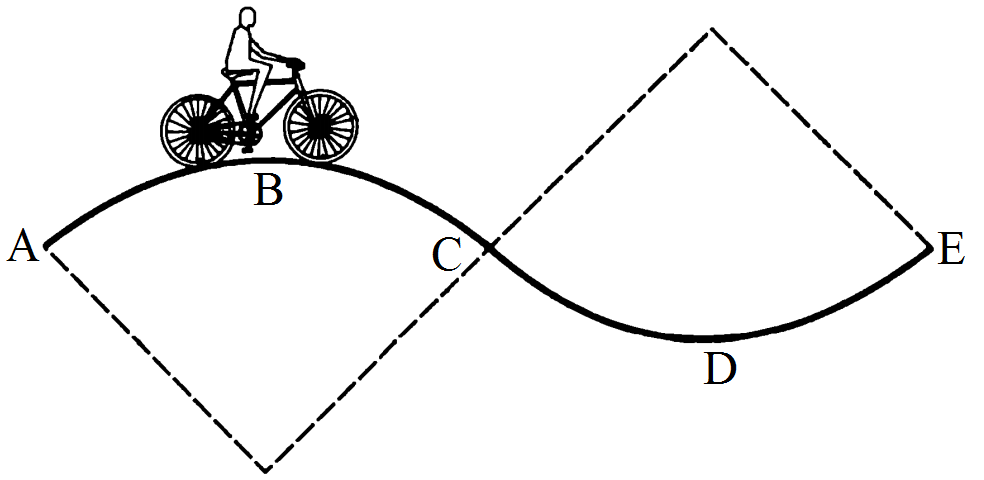
A track consists of two circular parts ABC and CDE of equal radius 100m and joined smoothly as shown in figure. Each part subtends a right angle at its centre. A cycle weighing 100 kg together with the rider travels at a constant speed of 18km/h on the track.
  1. Find the normal contact force by the road on the cycle when it is at B and at D.
  2. Find the force of friction exerted by the track on the tyres when the cycle is at B, C and D.
  3. Find the normal force between the road and the cycle just before and just after the cycle crosses C.
  4. What should be the minimum friction coefficient between the road and the tyre, which will ensure that the cyclist can move with constant speed? Take g= 10m/s$^2$.
Answer
Radius of the curves = 100m Weight = 100kg Velocity = 18km/hr = 5m/sec
  1. $\text{AT B}=\text{mg}-\frac{\text{mv}^2}{\text{R}}=\text{N}\Rightarrow\text{N}=(100\times10)-\frac{100\times25}{100}=1000-25=975\text{N}$
$\text{AT D, N}=\text{mg}-\frac{\text{mv}^2}{\text{R}}=1000+25=1025\text{N}$
  1. At B and D the cycle has no tendency to slide. So at B & D, frictional force is zero.
$\text{At C, mg}\sin\theta=\text{F}\Rightarrow\text{F}=1000\times\frac1{\sqrt{2}}=707\text{N}$
  1.  
  1. Before C $\text{mg}\cos\theta-\text{N}=\frac{\text{mv}^2}{\text{R}}\Rightarrow\text{N}=\text{mg}\cos\theta-\frac{\text{mv}^2}{\text{R}}=707-25=683\text{N}$
  2. $\text{N}-\text{mg}\cos\theta=\frac{\text{mv}^2}{\text{R}}\Rightarrow\text{N}=\frac{\text{mv}^2}{\text{R}}+\text{mg}\cos\theta=25+707=732\text{N}$
To find out the minimum desired coefficient of friction, we have to consider a point just before C. (where N is minimum) Now, $\mu\text{N}=\text{mg}\sin\theta\Rightarrow\mu\times682=707\Rightarrow\mu=1.037$
View full question & answer
Question 105 Marks
A motorcycle has to move with a constant speed on an overbridge which is in the form of a circular arc of radius R and has a total length L. Suppose the motorcycle starts from the highest point.
  1. What can its maximum velocity be for which the contact with the road is not broken at the highest point?
  2. If the motorcycle goes at speed $\frac{1}{\sqrt2}$ times the maximum found in part (a), where will it lose the contact with the road?
  3. What maximum uniform speed can it maintain on the bridge if it does not lose contact anywhere on the bridge?
Answer
R = radius of the bridge.
L = total length of the over bridge.
  1.  


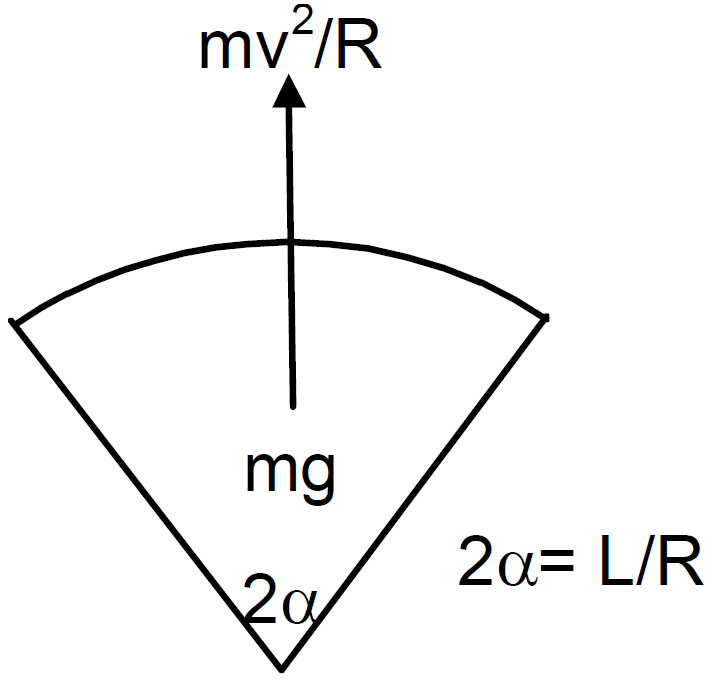
At the highest pt.

$\text{mg}=\frac{\text{mv}^2}{\text{R}}$

$\Rightarrow\text{v}^2=\text{Rg}$

$\Rightarrow\text{v}=\sqrt{\text{Rg}}$
  1.  


Given, $\text{v}=\frac{1}{\sqrt2}\sqrt{\text{Rg}}$

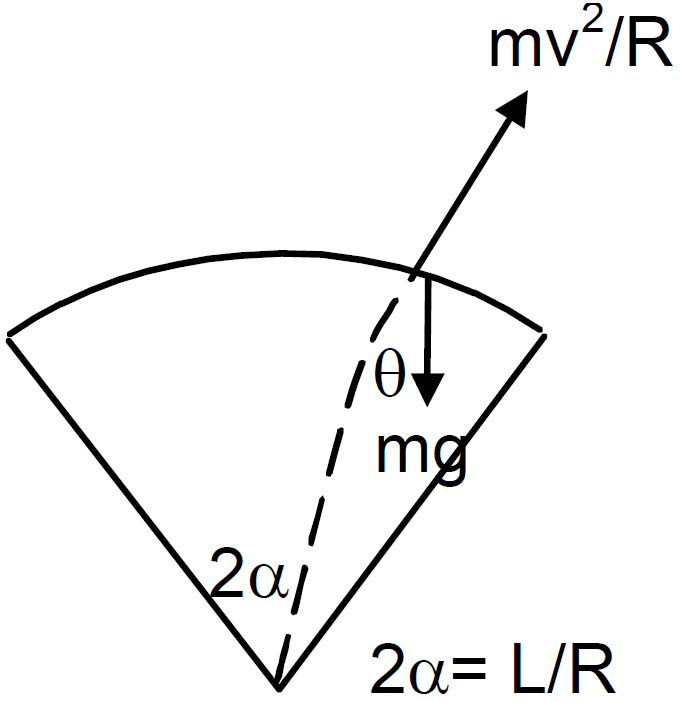
suppose it loses contact at B. So, at B, $\text{mg}\cos\theta=\frac{\text{mv}^2}{\text{R}}$

$\Rightarrow\text{v}^2=\text{Rg}\cos\theta$

$\Rightarrow\Big(\sqrt{\frac{\text{Rv}}{2}}\Big)^2=\text{Rg}\cos\theta$

$\Rightarrow\frac{\text{Rg}}{2}=\text{Rg}\cos\theta$

$\Rightarrow\cos\theta=\frac{1}{2}$

$\Rightarrow\theta=60^\circ=\frac{\pi}{3}$

$\theta = \frac{\ell}{\text{r}}\rightarrow \ell = \text{r} \theta= \frac{\pi\text{R}}{3}$

So, it will lose contact at distance $ \frac{\pi\text{R}}{3}$ from highest point.
  1.  


Let the uniform speed on the bridge be v.

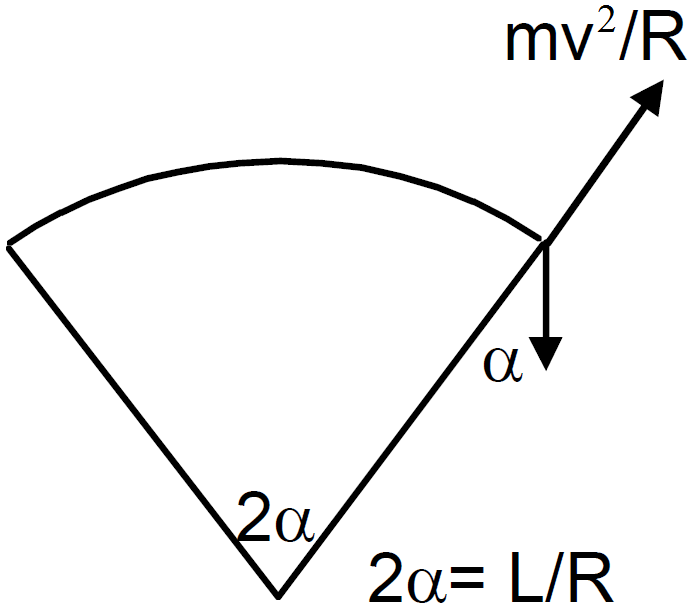
The chances of losing contact is maximum at the end of the bridge for which $\alpha=\frac{\text{L}}{2\text{R}}.$

So, $\frac{\text{mv}^2}{\text{R}}=\text{mg}\cos\alpha$

$\Rightarrow\text{v}=\sqrt{\text{gR}\cos\Big(\frac{\text{L}}{2\text{R}}\Big)}$
View full question & answer
5 Marks Questions - Physics STD 11 Science Questions - Vidyadip