$\Rightarrow0.07=\frac{1.65-1.61}{\mu_\text{y}-1}$
$\Rightarrow\mu_\text{y}-1=\frac{0.04}{0.07}=\frac{4}{7}$
Again,$\delta=(\mu-1)\text{A}$$\Rightarrow\text{A}=\frac{\delta_\text{y}}{\mu_\text{y}-1}=\frac{4}{\Big(\frac{4}{7}\Big)}=7^\circ$
7 questions · self-marked practice — reveal the answer and mark yourself.
$\Rightarrow0.07=\frac{1.65-1.61}{\mu_\text{y}-1}$
$\Rightarrow\mu_\text{y}-1=\frac{0.04}{0.07}=\frac{4}{7}$
Again,$\delta=(\mu-1)\text{A}$$\Rightarrow\text{A}=\frac{\delta_\text{y}}{\mu_\text{y}-1}=\frac{4}{\Big(\frac{4}{7}\Big)}=7^\circ$

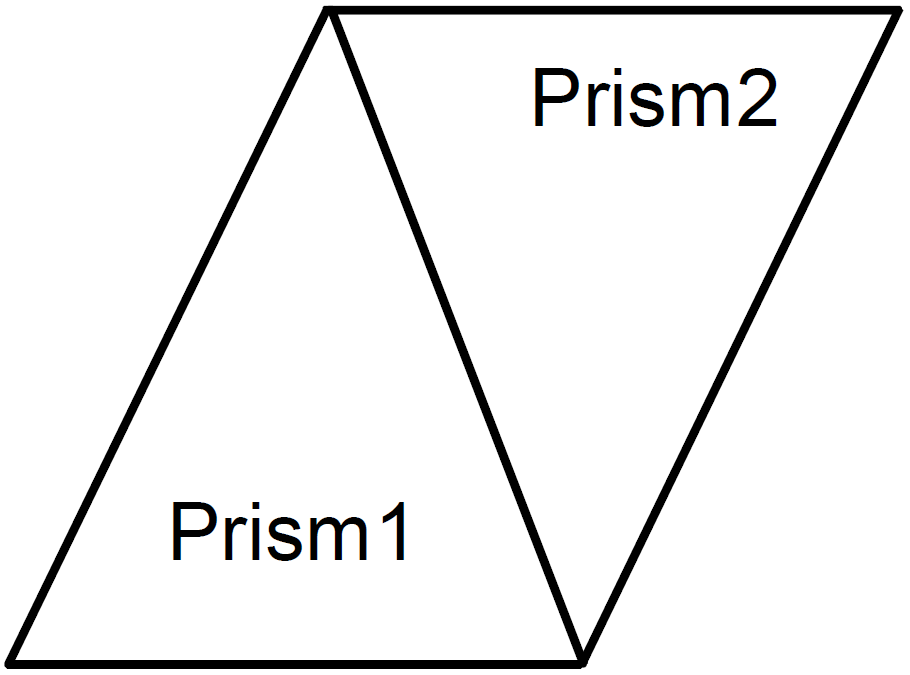
$\mu_\text{cr}=1.515,\mu_\text{cv}=1.525$ and $\mu_\text{fr}=1.612,\mu_\text{fv}=1.632$ and A = 5°
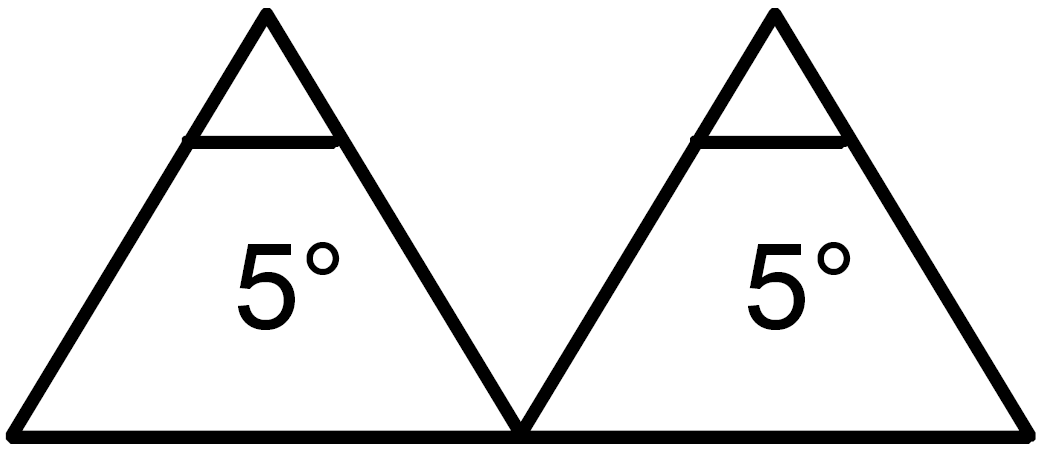
Since, they are similarly directed, the total deviation produced is given by,$\delta=\delta_\text{c}+\delta_\text{r}=(\mu_\text{c}-1)\text{A}+(\mu_\text{r}-1)\text{A}$ $=(\mu_\text{c}+\mu_\text{r}-2)\text{A}$
So, angular dispersion of the combination is given by,$\delta_\text{v}-\delta_\text{y}=(\mu_\text{cv}+\mu_\text{fv}-2)\text{A}-(\mu_\text{cr}+\mu_\text{fr}-2)\text{A}$
$=(\mu_\text{cv}+\mu_\text{fv}-\mu_\text{cr}-\mu_\text{fr})\text{A}$ $=(1.525+1.632-1.515-1.612)5=0.15^\circ$
$\frac{1}{\text{f}}=(\mu-1)\Big(\frac{1}{\text{R}_1}-\frac{1}{\text{R}_2}\Big)$
Here, f is the focal length, $\mu$ is the refractive index, R is the radius of curvature of lens. The refractive index $(\mu)$ depends on the inverse of square of wavelength. The focal length of a mirror is independent of the colour of light.
$\mu'_\text{v}=1.52$ and $\mu_\text{v}=1.62,\delta_\text{v}=1^\circ$
$\delta_\text{v}=(\mu_\text{v}-1)\text{A}-(\mu'_\text{v}-1)\text{A}$ [Since A = A']
$\Rightarrow\delta_\text{v}=(\mu_\text{v}-\mu'_\text{v})\text{A}$
$\Rightarrow\text{A}=\frac{\delta_\text{v}}{\mu_\text{v}-\mu'_\text{v}}=\frac{1}{1.62-1.52}=10^\circ$
$\mu_\text{r}=1.56,\mu_\text{y}=1.60,\ \text{and}\ \mu_\text{v}=1.68$
$=\frac{0.12}{0.60}=0.2$
$(\mu_\text{f}-1)\text{A}_\text{f}=(\mu_\text{c}-1)\text{A}_\text{c}$
$\Rightarrow\text{A}_\text{c}=\frac{\mu_\text{f}-1}{\mu_\text{c}-1}\text{A}_\text{f}=\frac{1.620-1}{1.518-1}(6.0)^\circ=7.2^\circ$
$\frac{1}{\text{f}}=(\mu-1)\Big(\frac{1}{\text{R}_1}-\frac{1}{\text{R}_2}\Big)$
$\Rightarrow(\mu-1)=\frac{1}{\text{f}}\times\frac{1}{\Big(\frac{1}{\text{R}_1}-\frac{1}{\text{R}_2}\Big)}=\frac{\text{k}}{\text{f}}\ ...(1)$
So, $\mu_\text{r}-1=\frac{\text{K}}{100}\ ...(2)$$\mu_\text{y}-1=\frac{\text{K}}{98}\ ...(3)$
And $\mu_\text{v}-1=\frac{\text{K}}{96}\ ...(4)$ So, Dispersive power $=\omega=\frac{\mu_\text{v}-\mu_\text{r}}{\mu_\text{y}-1}=\frac{(\mu_\text{v}-1)-(\mu_\text{r}-1)}{(\mu_\text{y}-1)}=\frac{\frac{\text{K}}{96}-\frac{\text{K}}{100}}{\frac{\text{K}}{98}}$ $=\frac{98\times4}{9600}=0.0408$