Questions

1 Marks Question

Take a timed test

23 questions · self-marked practice — reveal the answer and mark yourself.

Question 11 Mark
At Deoprayag (Garhwal, UP) river Alaknanda mixes with the river Bhagirathi and becomes river Ganga. Suppose Alaknanda has a width of 12m, Bhagirathi has a width of 8m and Ganga has a width of 16m. Assume that the depth of water is same in the three rivers. Let the average speed of water in Alaknanda be 20km/h and in Bhagirathi be 16km/h. Find the average speed of water in the river Ganga.
Answer
Given:

Width of Bhagirathi, $\text{h}_\text{B}=8\text{m}$

Width of Alaknanda, $\text{h}_\text{A}=12\text{m}$

Width of Ganga, $\text{h}_\text{G}=16\text{m}$

Average speed of water in Alaknanda, $\text{v}_\text{A}=20\text{Km}/\text{h}$

Average speed of water in Bhagirathi, $\text{v}_\text{B}=16\text{Km}/\text{h}$

Let d be the depth of the three rivers

Here,

Volume of water discharged from Alaknanda + Volume of water discharged from Bhagirathi

= Volume of water flow in Ganga.

$\Rightarrow\text{v}_\text{A}\times\text{d}\times\text{h}_\text{A}+\text{v}_\text{B}\times\text{d}\times\text{h}_\text{B}=\text{v}_\text{G}\times\text{d}\times\text{h}_\text{G}$

$\Rightarrow20\times12+16\times8=\text{v}_\text{G}\times16$

$\Rightarrow\text{v}_\text{G}\times16=368$

$\Rightarrow\text{v}_\text{G}=\frac{368}{16}=23\text{Km}/\text{h}$
View full question & answer
Question 21 Mark
A cylindrical object of outer diameter 20cm and mass 2kg floats in water with its axis vertical. If it is slightly depressed and then released, find the time period of the resulting simple harmonic motion of the object.
Answer
As per as the Principle of the Flotation,

Weight of the cylindrical object = Weight of the liquid displaced.

Weight of the cylindrical object = mass × g

$=2\times\text{g}$

Weight of the Fluid Displaced = Upthrust

= Volume of of solid immersed × density of water × g

$=\pi\text{r}^2\times1\times\text{g}$

where, h is the height and r is the radius of the solid immersed in a water.

$\therefore$ Weight of the fluid displaced $\pi(20)^2\text{h}\times1\times\text{g}$

$2000\times\text{g}=\pi(10)^2\text{h}\times1\times\text{g}$

$2000=\pi(10)^2\text{h}$

$2000=\pi\times100\times\text{h}$

$\therefore\text{h}=\frac{20}{\pi}\text{cm}\cdot$

Now, using the formula of the time period,

$\text{T}=2\pi\sqrt{\Big(\frac{\text{h}}{\text{g}}\Big)}$

$\text{T}=2\times\frac{22}{7}\times\sqrt{\Big(\frac{20}{\pi}\times980\Big)}$

$\therefore\text{T}=0.51$ seconds.

Hence, the time period of S.H.M. is 0.51 Seconds.

Hope it Helps.

View full question & answer
Question 31 Mark
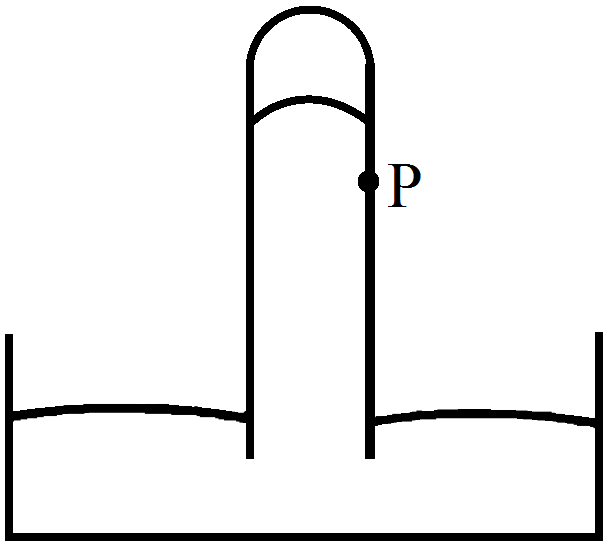
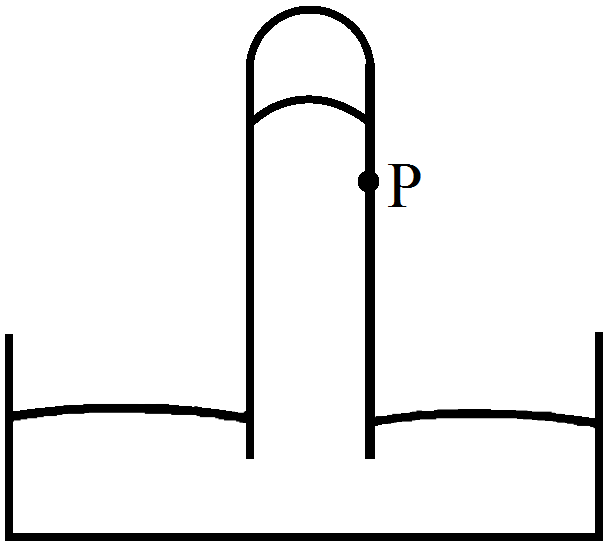
Consider the barometer shown in If a small hole is made at a point P in the barometer tube, will the mercury come out from this hole?

Answer

No, as pressure inside is less than atmospherise.
View full question & answer
Question 41 Mark
If someone presses a pointed needle against your skin, you are hurt. But if someone presses a rod against your skin with the same force, you easily tolerate. Explain?
Answer
$\text{P}=\frac{\text{F}}{\text{A}}\cdot$ Less area more pressure.
View full question & answer
Question 51 Mark
Solve the previous problem if the lead piece is fastened on the top surface of the block and the block is to float with its upper surface just dipping into water.
Answer

Now, the lead piece does not displace the water, as per as our

mathematical calculations in last question. Only the wooden block

displaces.

Thus, the mass = 250cm2 × 1g/cm2

= 250g

$\therefore$ Upthrust = 250 × g.

Now, (200 + a) × g = 250g

where, a is the mass of the metal lead.

a = 250 - 200

a = 50g

View full question & answer
Question 61 Mark
A cubical box is to be constructed with iron sheets 1mm in thickness. What can be the minimum value of the external edge so that the cube does not sink in water? Density of iron = 8000kg/m3 and density of water = 1000kg/m3.
Answer

Let the external Edge of the cubical box be a m.

Total surface area of the cube = 6a?

The volume of the iron in the box = 6a2 × 1 × 10-2

= 6  × 10-2 a2m2

Now, The mass of iron in the box = Volume x density

= 6 × 10⁻² × a2 × 8000

= 48a2kg

Weight = 48 × 10 = 480N.

The volume of the water displaced = a2cm2 [lt will be equal to volume of cube displaced].

$\therefore$ Upthrust = a2 × 1000 × 10

= 104a2

Now, 104a2 = 480

a = 48 × 10-2m.

Therefore, a = 4.8cm.

View full question & answer
Question 71 Mark
A satellite revolves round the earth. Air pressure inside the satellite is maintained at 76cm of mercury. What will be the height of mercury column in a barometer tube 1m long placed in the satellite?
Answer
$\text{F}_\text{net}=0,$ therefore no rise.
View full question & answer
Question 81 Mark
A cubical block of wood weighing 200g has a lead piece fastened underneath. Find the mass of the lead piece which will just allow the block to float in water. Specific gravity of wood is 0.8 and that of lead is 11.3.
Answer

Let the mass of the lead piece be a kg.

Therefore, the total mass of the wood and the lead = 0.2 + akg. Density of lead = Density of water × specific gravity

= 1000 × 11.3 = 11300

Now, The volume of the lead piece $=\frac{\text{a}}{11300}\text{m}^3$

 When the wooden block is just allowed to float in water, it displaces a

volume of water equal to its volume =$\frac{200}{0.8}\text{cm}^3=250\text{cm}^3$

$= 250\text{cm}^2 = 0.25\text{m}^2 $

Now, The Total volume of the water displaced $=0.25+\frac{\text{a}}{11300}​​​​​​\text{cm}^2$

Upthrust $= \text{V}\rho\text{g}$

$=\Big(250+\frac{\text{a}}{11300}\Big)\times 1000 \times 10$

Now:

$(0.2+\text{a})\times 10 = \Big(250+\frac{\text{x}}{11300}\Big)\times 1000\times10$

$\therefore \text{a}=54.8\text{g}$$$

View full question & answer
Question 91 Mark
Find the ratio of the weights, as measured by a spring balance, of a 1kg block of iron and a 1kg block of wood. Density of iro = 7800Kg/m3 density of wood = 800kg/m3 and density of air = 1.293kg/m3.
Answer

The spring balance measures the weight of an object. It will show the same weight

for the given iron and the wood block in the vacuum but in the air, a force of

buoyancy will act on both the blocks which will be equal to the weight of the air displaced.

The volume of iron block $=\frac{1}{7800}\text{m}^3$

The volume of wooden block $=\frac{1}{800}\text{m}^3$

The weight of air displaced by iron block$=\frac{1.293\times1}{7800}\text{Kg}$

$=\frac{1.293}{7800}\text{Kg}$

The weight of air displaced by wooden block $=\frac{1.293\times1}{800}\text{Kg}$

$=\frac{1.293}{800}\text{Kg}$

The apparent weight of the iron block shown in the spring balance $=\frac{1-1.293}{7800}\text{Kg}$

$=\frac{(7800-1.293)}{7800}\text{Kg}$

$=\frac{7798.707}{7800}\text{Kg}$

The apparent weight of the wooden block shown in the spring balance $=\frac{1-1.293}{800}\text{Kg}$

$=\frac{(800-1.293)}{800}\text{Kg}$

$=\frac{798.707}{800}\text{Kg}$

Hence the ratio of the apparent weights$=\frac{\Big(\frac{(7798.707)}{7800}\Big)}{\Big(\frac{798.707}{800}\Big)}$

$=\frac{\big(7898.707\times800\big)}{\big(7800\times798.707\big)}$

$=1.0015$

View full question & answer
Question 101 Mark
A cubical block of ice floating in water has to support a metal piece weighing 0.5kg. What can be the minimum edge of the block so that it does not sink in water? Specific gravity of ice = 0.9.
Answer

Let I be the minimum edge of the block.

Weight of the metal and ice = weight of the water displaced

(0.5 + 0.91%) = 13 × 1 × g

(0.91 + 500) = 13

$\rho=5000$

$\rho = 17.099\text{cm}$

Hence, minimum edge f the block shoud be 17.099cm.

View full question & answer
Question 111 Mark
A ferry boat loaded with rocks has to pass under a bridge. The maximum height of the rocks is slightly more than the height of the bridge so that the boat just fails to pass under the bridge. Should some of the rocks be removed or some more rocks be added?
Answer
Removed.
View full question & answer
Question 121 Mark
Is it always true that the molecules of a dense liquid are heavier than the molecules of a lighter liquid?
Answer
No
View full question & answer
Question 131 Mark
A Gipsy car has a canvass top. When the car runs at high speed, the top bulges out Explain.
Answer
Dynamic lift.
View full question & answer
Question 141 Mark
Find the force exerted by the water on a 2m2 plane surface of a large stone placed at the bottom of a sea 500m deep. Does the force depend on the orientation of the surface?
Answer
Given:
Depth of the stone from the water surface, h = 500m
Area of the plane surface of the large stone, A = 2M2
Density of water, pw = 103kgm-3
Force (F) is given by,
F = P × A = (hpw × g)A (P = Pressure)
⇒ F = (500 × 103 × 10) × 2
= 107N/ m2
The force does not depend on the orintation of the rock when the surface area of the stone remains the same.
View full question & answer
Question 161 Mark
A glass of water has an ice cube floating in water. The water level just touches the rim of the glass. will the water overflow when the ice melts? 
Answer
No
View full question & answer
Question 171 Mark
Water is slowly coming out from a vertical pipe. As the water descends after coming out, its area of cross-section reduces. Explain this on the basis of the equation of continuity.
Answer
Since speed increases, therefore area reduces.
View full question & answer
Question 181 Mark
A barometer tube reads 76cm of mercury. If the tube is gradually inclined keeping the open end immersed in the mercury reservoir, will the length of mercury column be 76cm, more than 76cm or less than 76cm?
Answer
More than 76cm as vertical height is 76cm but length of titled tube will be more then.
View full question & answer
Question 191 Mark
A one meter long glass tube is open at both ends. One end of the tube is dipped into a mercury cup, the tube is kept vertical and the air is pumped out of the tube by connecting the upper end to a suction pump. Can mercury be pulled up into the pump by this process?
Answer
Not necessary. Depends on the length of tube if it less than 76cm then yes.
View full question & answer
Question 201 Mark
Is Archimedes' principle valid in elevator accelerating up? In acar acccelerating on a level road?
Answer
 Yes, Yes,
View full question & answer
Question 211 Mark
Suppose the tube in the previous problem is kept vertical with B upward. Water enters through B at the rate of 1cm3/s . Repeat parts (a), (b) and (c). Note that the speed decreases as the water falls down.
Answer

Since the discharge through the tube remains the same i.e. 1cm/s, the speeds at A and B will be the same.

  1. The speed at A,$\text{v}=\frac{1}{0.04}\text{cm}/\text{s}=\frac{100}{4}\text{cm}/\text{s}=25\text{cm}/\text{s}$ 

  2. The speed at B, $\text{v}'=\frac{1}{0.02}\text{cm}/\text{s}=\frac{100}{2}\text{cm}/\text{s}=50\text{cm}/\text{s}$

  3. Since the end B is upward, we take the end A as a reference level for the height. So the height of end A = 0 and the height of end B = h.

$=\frac{15}{16}\text{cm}$

$=\frac{15}{1600}\text{m}.$

From the Bernoulli's theorem

$\text{p}_\text{a}+\frac{1}{2}\rho\text{v}^2=\text{p}_\beta+\frac{1}{2}\rho\text{v}'^2+\rho\text{gh}$

$\Rightarrow\text{p}_\text{a}-\text{p}_\beta=\frac{1}{2}\text{p}\big(\text{v}^1-\text{v}^2\big)+\rho\text{gh}$

$=\frac{1}{2}\times1000\times\big(0.50^2-0.25^2\big)+1000\times10\times\frac{15}{1600}\text{N}/\text{m}^2$

$=\frac{1}{2}\times1000\times0.75\times0.25+\frac{1500}{16}\text{N}/\text{m}^2$

$=93.75+93.75\text{N}/\text{m}^2$

$=187.5\text{N}/\text{m}^2\approx188\text{N}/\text{m}^2$

View full question & answer
Question 221 Mark
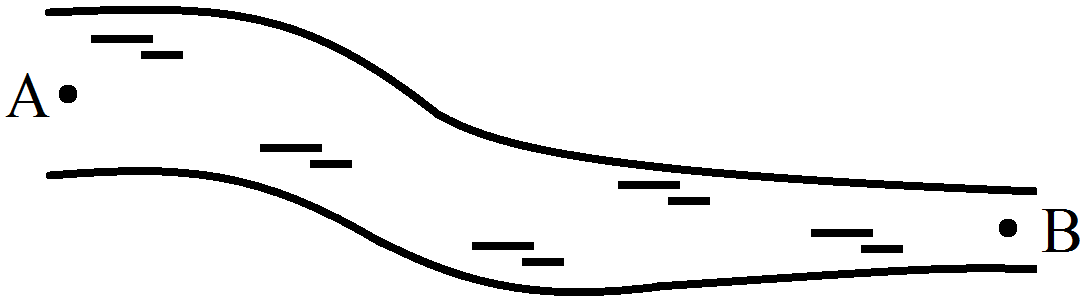
Water flows through a tube shown in The areas of cross-section at A and B are 1cm2 and 0.5cm2 respectively. The height difference between A and B is 5cm. If the speed of water at A is 10cm/s find.
  1. The speed at B.
  2. The difference in pressures at A and B.

Answer
  1. Let the reference for height be the level of B. Height of A.

$=\text{h}=5\text{cm}=0.05\text{m}.\text{v}_\text{a}=10\text{cm}/\text{s}=0.10\text{cm}/\text{s}.$

Area of cross- section at $\text{A}=1\text{cm}^2=\frac{1}{10000}\text{m}^2.$

Hence the discharge $\text{Q}=0.10\times\frac{1}{10000}\text{m}^3=10^{-5}\text{m}^3$

Area of cross- section at $\text{B}=0.5\text{cm}^2=\frac{0.5}{10000}\text{m}^2$

The velocity at $\text{B}=\text{v}_\beta=\frac{10^{-5}}{\Big(\frac{0.5}{10000}\Big)}\text{m}/\text{s}=\frac{1}{5}\text{m}/\text{s}$

$=100\times\frac{1}{5}\text{cm}/\text{s}=20\text{cm}/\text{s}$

  1. Let the pressures at A and B be Pa and PB. From the Bernoulli's theorem,

$\text{p}_\text{a}+\rho\text{gh}+\frac{1}{2}\rho\text{V}\text{a}^2=\text{p}_\beta+\frac{1}{2}\rho\beta^2+\frac{1}{2}\rho\text{v}\beta^2$

$\text{p}_\beta-\text{p}_\text{a}=\rho\text{gh}-\frac{1}{2}\rho\big(\text{V}\beta^2-\text{V}\text{a}^2\big)$

$=1000\times10\times0.05-\frac{1}{2}\times1000\times\big(0.2^2-0.1^2\big)\text{N}/\text{m}^2$

$=500-500\times(0.04-0.01)\text{N}/\text{m}^2$

$500-15\text{N}/\text{m}^2$

$=485\text{N}/\text{m}^2$

View full question & answer
Question 231 Mark
The free surface of a liquid resting in an inertial frame is horizontal. Does the normal to the free surface pass through the centre of the earth? Think separately if the? The free surface of a liquid resting in an inertial frame is horizontal. Does the normal to the free surface pass through the centre of the earth? Think separately if the liquid is.
  1. At the equator.
  2. At a pole.
  3. Somewhere else.
Answer
  1. Yes.
  2. Yes.
  3. No.
View full question & answer