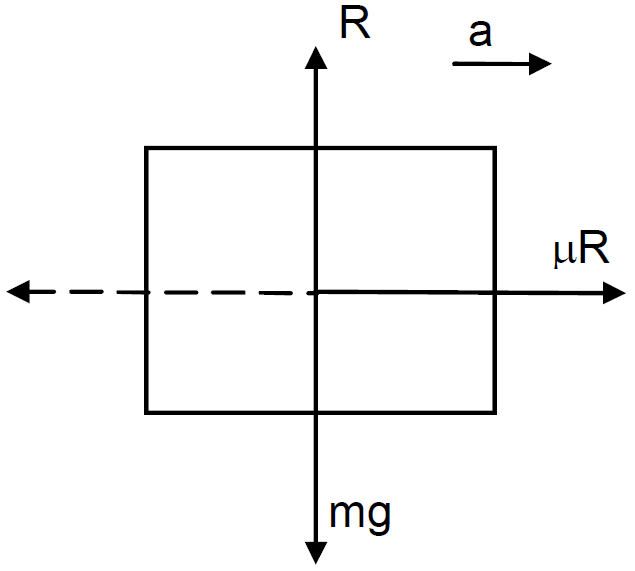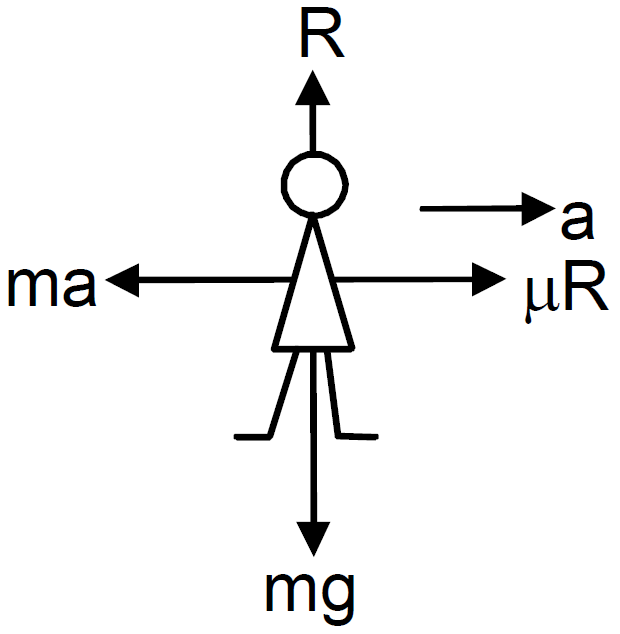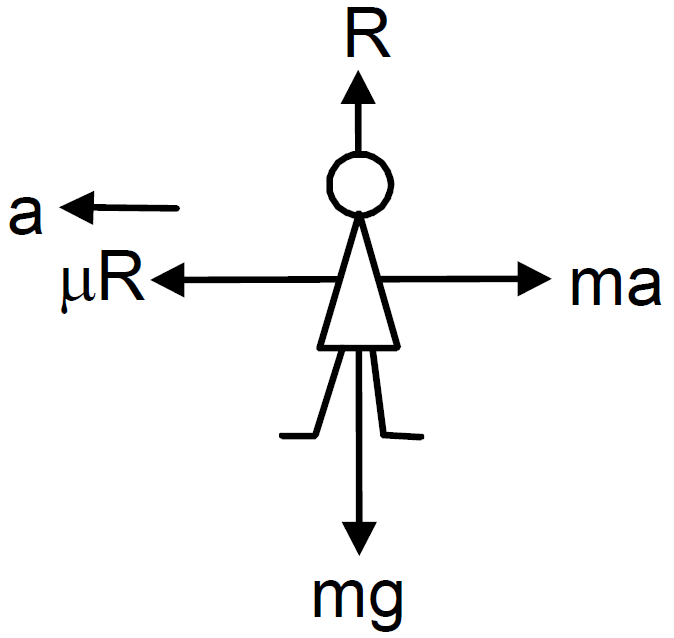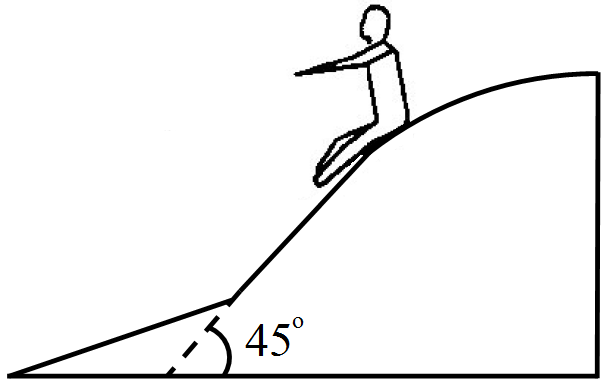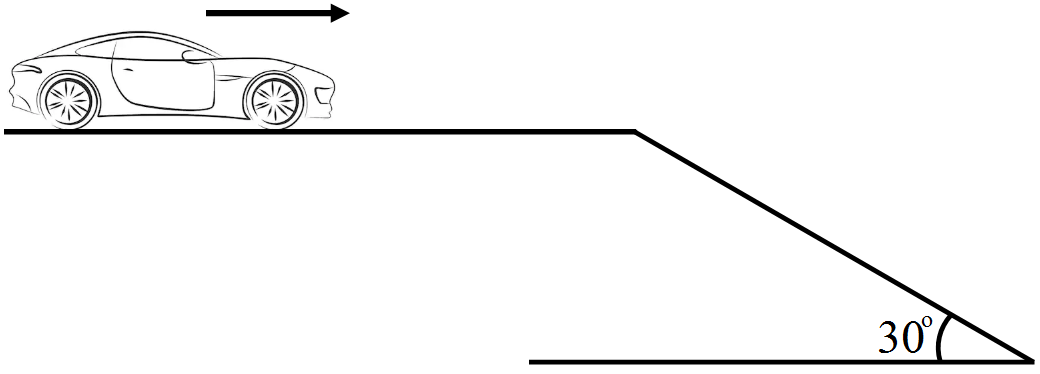
Hardest brake means maximum force of friction is developed between car’s type & road.
Max frictional force $=\mu\text{R}$
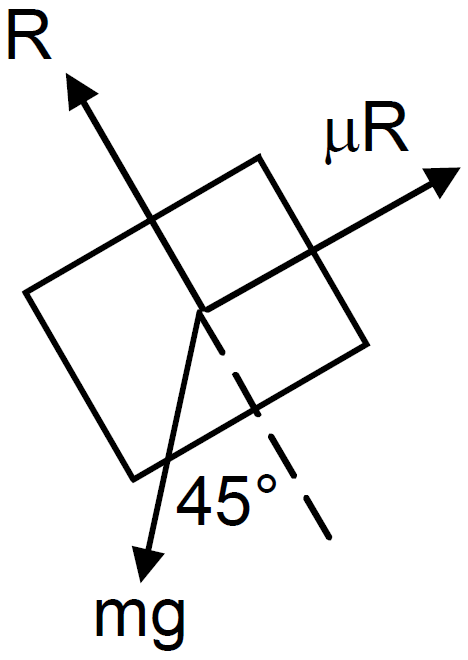
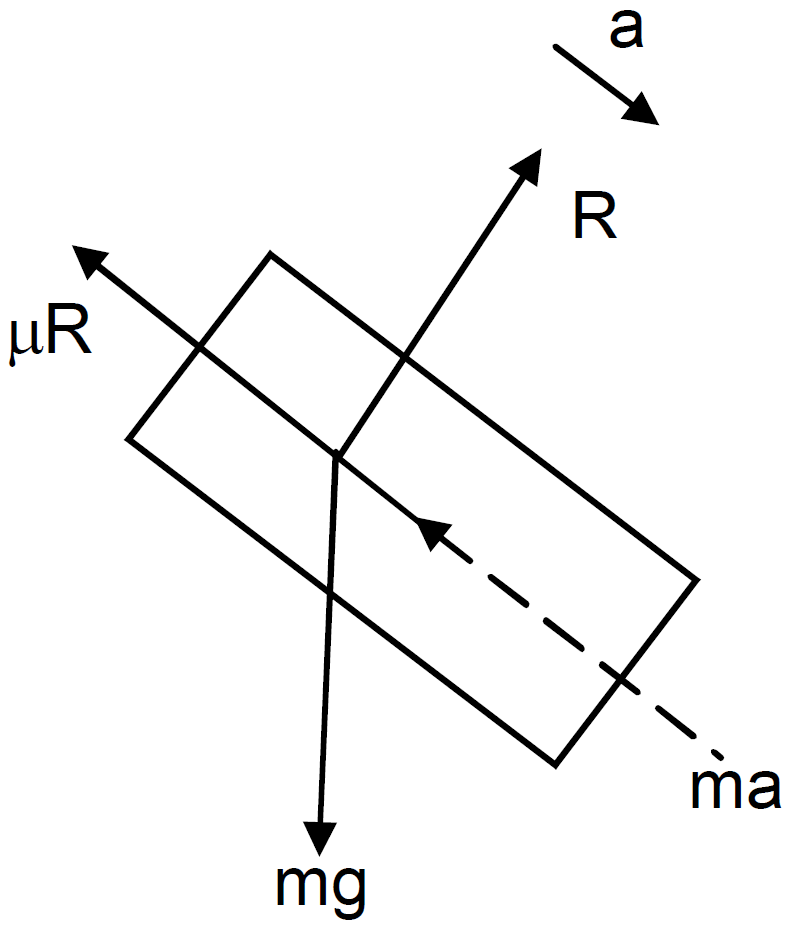
From the free body diagram
$\text{R}-\text{mg}\cos\theta=0$
$\Rightarrow\text{R}=\text{mg}\cos\theta \ ...(\text{i})$
and $(\mu\text{R + ma}-\text{mg}\sin)=0 \ ...(\text{ii})$
$\Rightarrow\mu\text{mg}\cos\theta+\text{ma}-\text{mg}\sin\theta=0$
$\Rightarrow\mu\text{g}\cos\theta+\text{a}-10\times\Big(\frac{1}{2}\Big)=0$
$\Rightarrow\text{a}=5-\{1-(2\sqrt{3})\}\times10\Big(\frac{\sqrt{3}}{2}\Big)=2.5\text{m/s}^2$
When, hardest brake is applied the car move with acceleration 2.5m/s2
$\text{S = 12.8m, u = 6m/s}$
So, velocity at the end of incline
$\text{V}=\sqrt{\text{u}^2+2\text{as}}=\sqrt{6^2+2(2.5)(12.8)}$
$=\sqrt{36+64}=10\text{m/s}=36\text{km/h}$
Hence how hard the driver applies the brakes, that car reaches the bottom with least velocity 36km/h.