Question 11 Mark
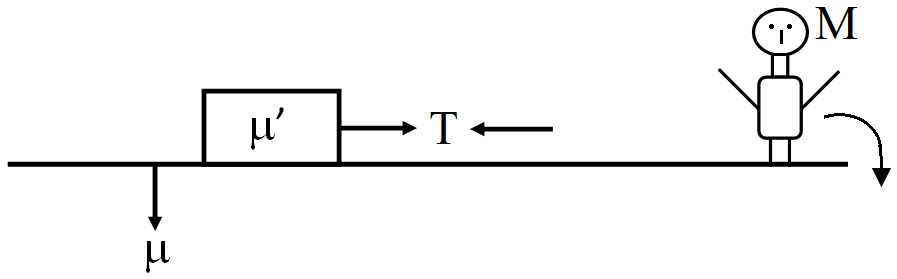
A body of mass M is kept on a rough horizontal surface (friction coefficient = $\mu$). A person is trying to pull the body by applying a horizontal force but the body is not moving. The force by the surface on A is F, where:
-
$\text{F = Mg}$
-
$\text{F}=\mu\text{Mg}$
-
$\text{Mg}\leq\text{F}\leq\text{Mg}\sqrt{1+\mu^2}$
-
$\text{Mg}\geq\text{F}\geq\text{Mg}\sqrt{1-\mu^2}.$
Answer
View full question & answer→- $\text{Mg}\leq\text{F}\leq\text{Mg}\sqrt{1+\mu^2}$
Explanation:
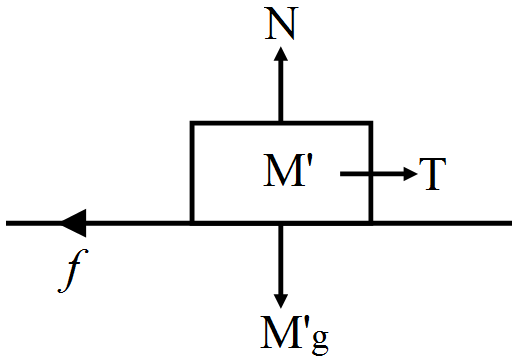
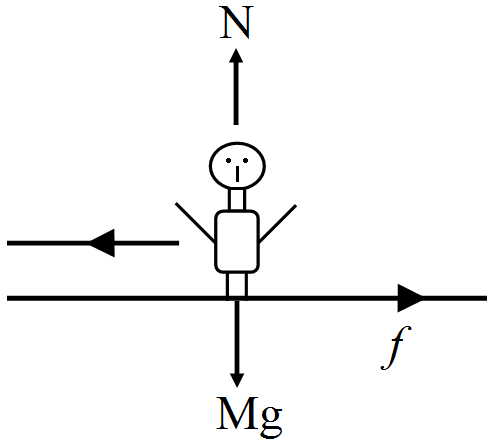
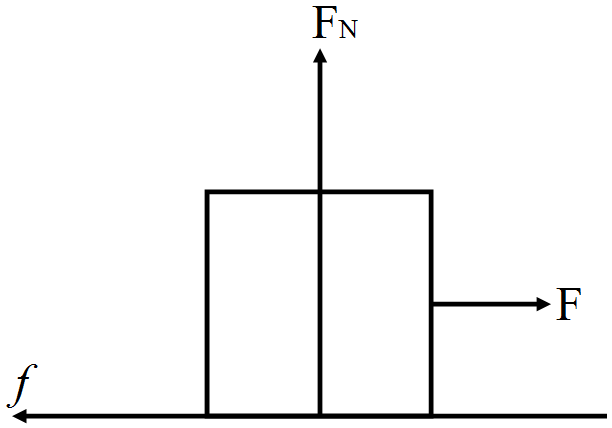
Let T be the force applied on an object of mass M.
If T = 0, Fmin = Mg.
If T is acting in the horizontal direction, then the body is not moving.
$\therefore\text{T}=\mu(\text{mg})$
$\text{F}_{\text{max}}=\sqrt{(\text{Mg})^2+(\text{T})^2}$
$=\sqrt{(\text{Mg})^2+(\mu\text{Mg})^2}$
Thus, we have:
$\text{Mg}\leq\text{F}\leq\text{Mg}\sqrt{1+(\mu)^2}$