Questions · Page 2 of 3

1 Marks Question

Question 521 Mark
If it is safe to jump from a height of 2m on the surface of earth, what is its value on the surface of moon?
Answer
Since g is reduced to $\frac{1}{16^{\text{th}}}$ the height will increase to 12m.
View full question & answer
Question 531 Mark
If the force of gravity acts on all bodies in proportion to their masses, then why doesn't a heavy body fall faster than a light body?
Answer
Acceleration due to gravity is independent of the mass of the body.
View full question & answer
Question 541 Mark
What is the height at which the satellite is to be parked for it to be a geostationary satellite?
Answer
Approximately 36,000Km.
View full question & answer
Question 551 Mark
A mass thrown up returns to the surface of earth. What is the nature of total energy possessed?
Answer
Total energy has to be negative, since P.E. dominates over kinetic energy.
View full question & answer
Question 561 Mark
Where does a body weigh more; at the surface of the earth or in a mine?
Answer
The value of g in mine is less than that on the surface of the earth.
View full question & answer
Question 571 Mark
Should the speed of two artificial satellites of the earth having different masses but the same orbital radius, be the same?
Answer
Yes, since orbital velocity is independent of the mass of the satellite.
View full question & answer
Question 591 Mark
What is the orbital velocity for a satellite orbiting close to the surface of earth?
Answer
$\text{v}_0=\sqrt{\text{gR}}$ for close to earth orbits.
View full question & answer
Question 601 Mark
A satellite revolving around earth loses height. How will its time period be changed?
Answer
Time period of satellite is given by $\text{T}=2\pi\sqrt{\frac{(\text{R}+\text{h})^3}{\text{GM}}}$ Therefore, T will decrease if h decreases.
View full question & answer
Question 611 Mark
Acceleration produced in a freely falling body under the gravitational pull of earth is called __________.
Answer
Acceleration produced in a freely falling body under the gravitational pull of earth is called acceleration due to gravity.
View full question & answer
Question 621 Mark
Can we determine the mass of a satellite by measuring its time period?
Answer
No, We cannot determine the mass of a satellite by measuring its time period.
View full question & answer
Question 631 Mark
When the reaction of the supporting surface is zero then apparent weight of the body become equal to _________.
Answer
When the reaction of the supporting surface is zero then apparent weight of the body become equal to zero.
View full question & answer
Question 641 Mark
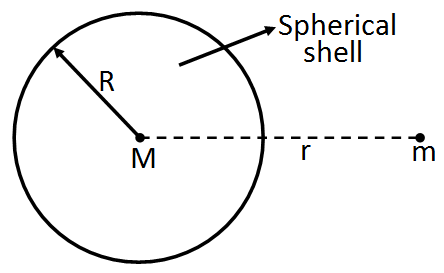
The gravitational force between a hollow spherical shell (of radius R and uniform density) and a point mass is F. Show the nature of F vs r graph where r is the distance of the point from the centre of the hollow spherical shell of uniform density.
Answer
Let us consider the diagram of spherical shell having uniform density (p). $\text{M}=(\text{p})\times\frac{4}{3}\pi\text{R}^3$ Therefore, gravitational force between hollow shell and point mass is $\text{F}=\frac{\text{GMm}}{\text{r}^2}$ where M is the mass of the hollow spherical shell and m is the mass of point mass.Therefore, the mass is distributed on the surface of the sphere only, then F = 0 for $0<\text{r}<\text{R}$ (i.e., force inside the shell is zero)
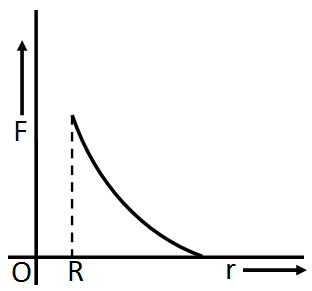
And $\text{F}=\frac{\text{GM}}{\text{r}^2}$ for $\text{r}>\text{R}$
The variation of F versus r is shown in the diagram. Force is maximum at the surface of shell and it is zero if r tends to infinity.
View full question & answer
Question 651 Mark
If the earth's satellite is put into an orbit at a height where resistance due to atmosphere cannot be neglected, how will motion of satellite be affected?
Answer
It will get slowed down in the orbit and so may fall from its orbit.
View full question & answer
Question 661 Mark
Give the S.I. units of 'g' and 'G'.
Answer
$\text{g}\rightarrow\text{ms}^{-2},\text{G}\rightarrow\text{Nm}^2/\text{kg}^2$
View full question & answer
Question 671 Mark
Define the effect of shape of the earth on the value of g.
Answer
At the surface of the earth, g is maximum at the poles and minimum at the equator i.e. the value of g decreases from poles to equator.
View full question & answer
Question 681 Mark
What is the amount of work done in bringing a mass from the surface of the earth on one side to a point diametrically opposite on the other side?
Answer
Since, gravitational potential difference is zero, therefore the work done is zero.
View full question & answer
Question 691 Mark
From Kepler's second law and observations of the sun's motion as seen from the earth, we can conclude that the earth is closer to the sun during winter in the Northern hemisphere than during summer. Explain.
Answer
The earth is closer to the sun during winter. But heating effect is less because the sun's rays fall obliquely.
View full question & answer
Question 701 Mark
Distance between two bodies is increased to three times its original value. What is the effect on the gravitational force between them?
Answer
Since, $\text{F}\propto\frac{1}{\text{r}^2},$ hence the force will remain only $\frac{1}{9}\text{th}$ part of its original value when the distance between two bodies is increased to three times.
View full question & answer
Question 711 Mark
At what factor between the two particles gravitational force does not depend?
Answer
Gravitational force does not depend upon the medium between the two particles.
View full question & answer
Question 721 Mark
What is the apparent weight of a man of 60kg who is standing in a lift which is moving up with a uniform speed?
Answer
Apparent weight = mg = 60 × 10N = 600N
View full question & answer
Question 731 Mark
How the gravitational field at a point inside a solid sphere vary with distance x from its centre, if x R (R-radius)?
Answer
$\text{E}_{\text{g}}\propto\text{x if x}<\text{R and E}_{\text{g}}\propto\frac{1}{\text{x}^2}\text{ if x}>\text{R}$
View full question & answer
Question 741 Mark
If the earth is regarded as a hollow sphere, then what is the weight of an object below surface of the earth?
Answer
The weight of an object below surface of the earth is zero.
View full question & answer
Question 751 Mark
Why is the atmosphere much rarer on the moon than on the earth?
Answer
The value of escape velocity on the moon is small as compared to the value of the earth only $2.5k ~\text{ms}^{-1}$. So, the molecules of air escape easily from the surface of moon, hence there is no atmosphere.
View full question & answer
Question 761 Mark
Work done in moving a particle round a closed path under the action of gravitation force is zero. Why?
Answer
Gravitational force is a conservative force which means that work done by it, is independent of path followed.
View full question & answer
Question 771 Mark
Assume that the law of gravitation changes from inverse square to inverse cube. Does the angular momentum of a planet about the sun will remain constant?
Answer
The torque on a planet is zero so long as the force is a central force. The angular momentum of planet remains constant so long as torque remains zero.
View full question & answer
Question 781 Mark
Gravitational force with which a body is attracted towards the centre of the earth is __________ of the body.
Answer
Gravitational force with which a body is attracted towards the centre of the earth is weight of the body.
View full question & answer
Question 791 Mark
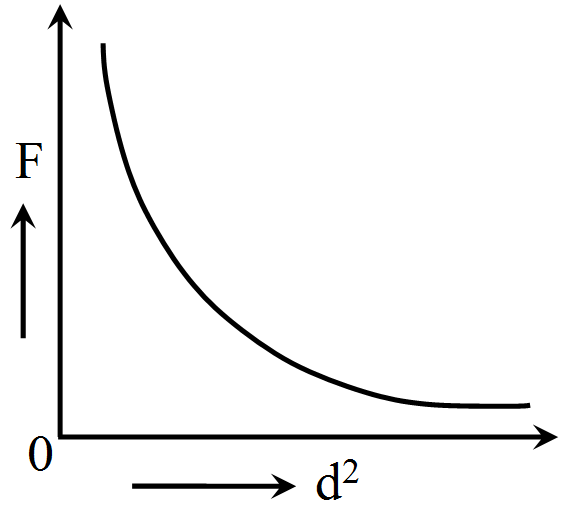
A graph was plotted taking gravitational force (F) along y-axis and the square of the distance ($\text{d}^2$) along x-axis, what is the nature of graph?
Answer
The graph is a rectangular hyperbola.
View full question & answer
Question 801 Mark
Why are space rockets usually launched from west to east in the equatorial plane?
Answer
Space rockets are usually launched from west to east in the equatorial plane, so that linear velocity of Earth's rotation about its own axis is added with the launching velocity of rocket and linear velocity of Earth's rotation is maximum in the equatorial plane.
View full question & answer
Question 811 Mark
What is the angle between the equatorial plane and the orbital plane of Geostationary satel lite?
Answer
Geostationary satel lite revolves in west to east direction along the equatorial plane. So the angle between geostationary and equatorial plane is zero.
View full question & answer
Question 821 Mark
Value of g is largest at the poles due to _________.
Answer
Value of g is largest at the poles due to polar radius is smaller than equatorial radius.
View full question & answer
Question 831 Mark
A satellite is orbiting around the Earth with a speed v. To make the satellite escape, what is the minimum percentage increase in its speed?
Answer
Percentage increase in speed $=\frac{(\text{v}_\text{e}-\text{v}_0)}{\text{v}_0}\times100=\Big(\frac{\text{v}_\text{e}}{\text{v}_0}-1\Big)\times100$ $=(\sqrt{2}-1)\times100=41.4\%$
View full question & answer
Question 841 Mark
Assume that an artificial satellite release a bomb.Would the bomb ever strike the earth if the effect of air resistance is neglected?
Answer
The bomb would merely act as another satellite. It would never hit the earth due to state of weight lessness.
View full question & answer
Question 851 Mark
What is the effect of non-sphericity of the earth on the value of 'g'?
Answer
g is less at equator than at poles, since radius 'h' is more at equator than at poles.
View full question & answer
Question 871 Mark
Draw graph showing the variation of acceleration due to gravity with (a) height above the earth's surface (b) depth below the earth's surface.
View full question & answer
Question 881 Mark
Two artificial satellites, one of mass 400kg and another of mass 2500kg, are set in the same orbit around a planet. What is the ratio of their (i) orbital velocities, (ii) time periods?
Answer
$\frac{\text{v}_1}{\text{v}_2}=\frac{\text{T}_1}{\text{T}_2}=1,$ because both satellites are revolving in same orbit and for a given orbit the orbital velocity as well as time period is independent of the mass of satellite.
View full question & answer
Question 901 Mark
When will the Kepler's law be applicable on the planets?
Answer
Kepler's law will be applicable whenever inverse square law is involved.
View full question & answer
Question 921 Mark
How escape velocity is related to orbital velocity for orbits close to earth?
Answer
$\text{v}_{\text{e}}=\sqrt{2}\text{v}_0$ for near to earth orbits.
View full question & answer
Question 931 Mark
Gravitational force between two bodies at moon surface is _________ gravitational force on earth surface.
Answer
Gravitational force between two bodies at moon surface is equal to gravitational force on earth surface.
View full question & answer
Question 941 Mark
A comet orbits the sun in a highly elliptical orbit. Does the comet have a constant (a) linear speed, (b) angular speed, (c) angular momentum, (d) kinetic energy, (e) potential energy, (f) total energy throughout its orbit? Neglect any mass loss of the comet when it comes very close to the Sun.
Answer
A comet while going on elliptical orbit around the Sun has constant angular momentum and total energy at all locations but other quantities vary with locations.
View full question & answer
Question 951 Mark
The energy required by a satellite to leave its orbit around the earth and escape to infinity is called its _________.
Answer
The energy required by a satellite to leave its orbit around the earth and escape to infinity is called its binding energy.
View full question & answer
Question 961 Mark
What velocity will you give to a donkey and what velocity to a monkey so that both escape the gravitational field of the earth?
Answer
The escape velocity does not depend upon the mass of the body. $\text{v}=\sqrt{\text{gR}}$
View full question & answer
Question 971 Mark
The gravitational potential energy of a body at a distance r from the centre of earth is U. What is the weight of the body at that point?
Answer
$\text{U}=\frac{\text{GMm}}{\text{r}}=\Big(\frac{\text{GM}}{\text{r}^2}\Big)\text{rm}=\text{grm}$$\Rightarrow\ \text{U}=\text{mgr}$
$\text{mg}=\frac{\text{U}}{\text{r}}$ (weight of the body).
View full question & answer
Question 981 Mark
Why a body weighs more at poles and less at equator?
Answer
The value of g is more at poles than at the equator. Therefore, a body weighs more at poles than at equator.
View full question & answer
Question 991 Mark
Two satellites are at different heights. Which would have greater velocity?
Answer
$\text{v}_0\propto\frac{1}{\sqrt{\text{r}}};$ so the satellite at smaller height would possess greater velocity.
View full question & answer
Question 1001 Mark
A mass thrown up returns to the surface of earth. What is the nature of total energy possessed?
Answer
Total energy has to be negative, since potential energy dominates over kinetic energy.
View full question & answer
1 Marks Question - Page 2 - Physics STD 11 Science Questions - Vidyadip