Question types

Mechanical Properties of Fluids question types

449 questions across 7 question groups — pick any mix to generate a Physics paper with step-by-step answer keys.

449
Questions
7
Question groups
5
Question types
Sample Questions

Mechanical Properties of Fluids questions

One sample from each question group in this chapter. Select any group above to see the full set with answer keys.
A hydraulic lift has 2 limbs of areas A and 2A. Force F is applied over limb of area A to lift a heavy car. If distance moved by piston P1 is x, then distance moved by piston P2 is:
  • A
    x
  • B
    2x
  • C
    $\frac{\text{x}}2$
  • D
View full solution
What is the velocity of a metallic ball of radius r falling in a tank of liquid at the instant when its acceleration is one half that of a freely falling body? (The densities of metal and of liquid are $\rho$ and $\sigma$ respectively and of viscosity of liquid is $\eta$)
  • A
    $\frac{\text{r}^2\text{g}}{9\eta}(\rho-2\sigma)$
  • B
    $\frac{\text{r}^2\text{g}}{9\eta}(2\rho-\sigma)$
  • C
    $\frac{\text{r}^2\text{g}}{9\eta}(\rho-\sigma)$
  • D
    $\frac{2\text{r}^2\text{g}}{9\eta}(\rho-\sigma)$
View full solution
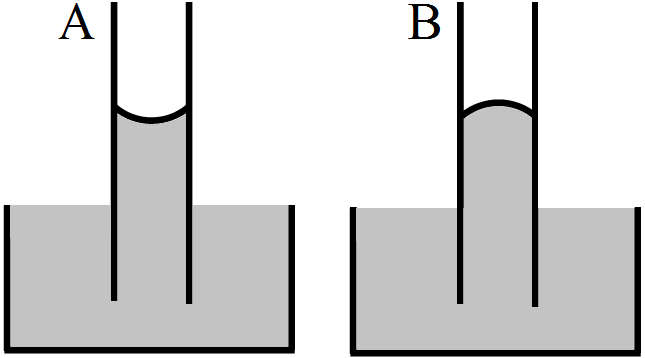
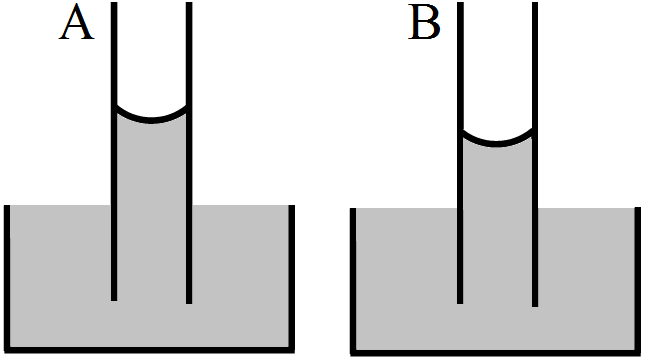
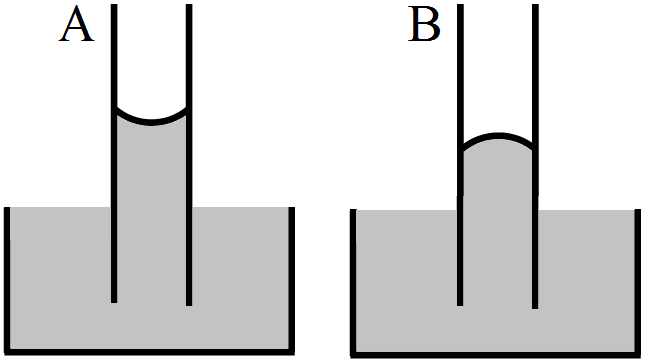
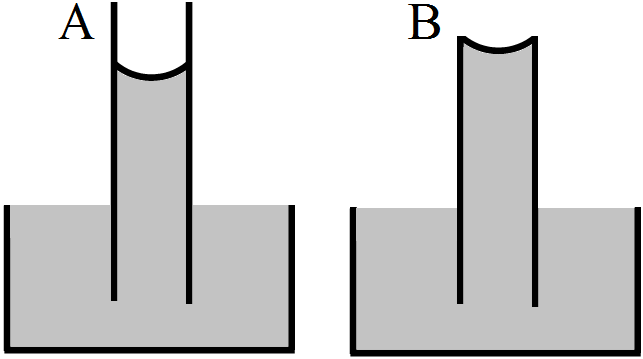
A capillary tube A is dipped in water. Another identical tube B is dipped in soap-water solution. Which of the following shows the relative nature of the liquid columns in the two tubes?
  • A
     

    1. B
       

      1. C
         

        1. D
           

        View full solution
        Spherical balls of radius R are falling in a viscous fluid of viscosity n with a velocity v. The retarding viscous force acting on the spherical ball is:
        1. Directly proportional to radius R but inversely proportional to velocity.
        2. Directly proportional to both radius R and velocity v.
        3. Inversely proportional to both radius R and velocity v.
        4. Inversely proportional to R but directly proportional to v.
        View full solution
        A tank with a square base of area 1.0m2 is divided by a vertical partition in the middle. The bottom of the partition has a small-hinged door of area 20cm2. The tank is filled with water in one compartment, and an acid (of relative density 1.7) in the other, both to a height of 4.0m. compute the force necessary to keep the door close.
        View full solution
        Fill in the blanks using the word (s) from the list appended with statement:
        For solids with elastic modulus of rigidity, the shearing force is proportional to . . . while for fluids it is proportional to . . . (shear strain/ rate of shear strain).
        View full solution
        During blood transfusion the needle is inserted in a vein where the gauge pressure is 2000Pa. At what height must the blood container be placed so that blood may just enter the vein? [Use the density of whole blood from Table 10.1].
        View full solution
        Fill in the blanks using the word (s) from the list appended with statement:
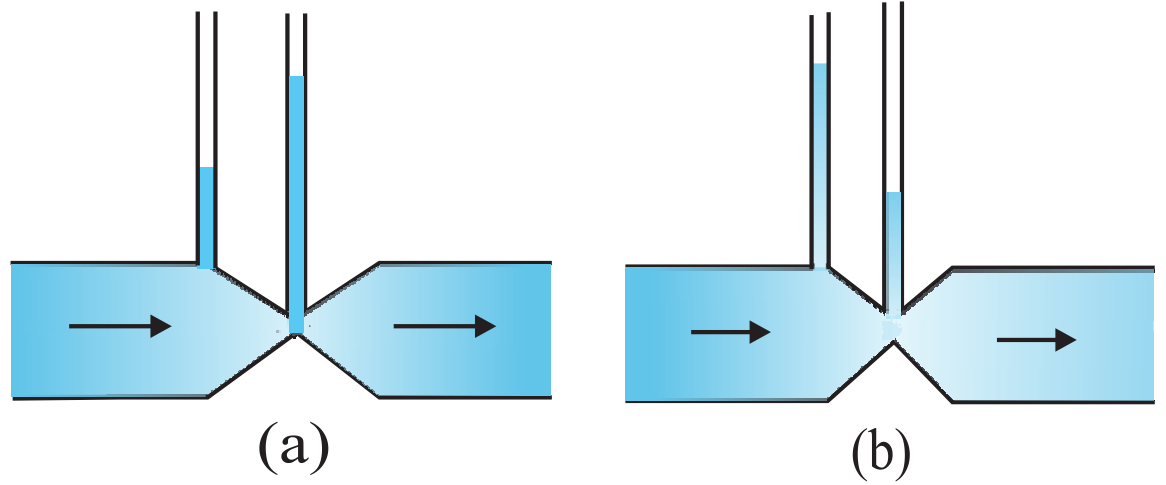
        For a fluid in steady flow, the increases inflow speed at a constriction follows from…… while the decrease of pressure there follows from….....(conservation of mass/ Bernoulli’s principle).
        View full solution
        Fill in the blanks using the word (s) from the list appended with statement:
        For the model of a plane in a wind tunnel, turbulence occurs at a ... speed for turbulence for an actual plane (greater/ smaller).
        View full solution
        Explain why
        The size of the needle of a syringe controls flow rate better than the thumb pressure exerted by a doctor while administering an injection.
        View full solution
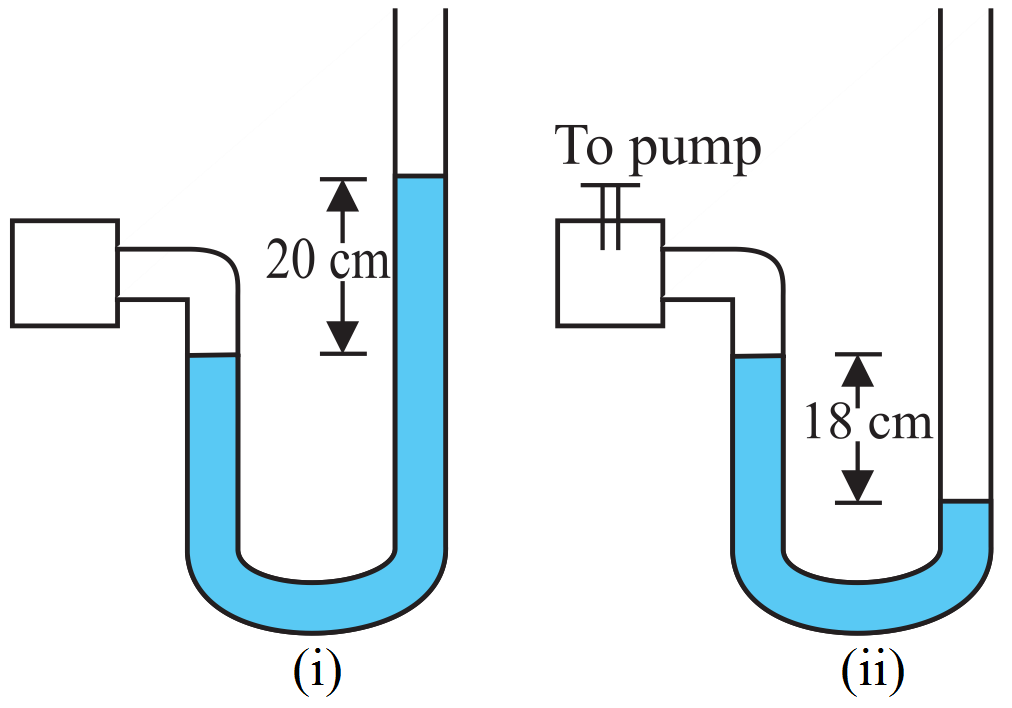
        A manometer reads the pressure of a gas in an enclosure as shown in Fig.(a) When a pump removes some of the gas, the manometer reads as in Fig. (b) The liquid used in the manometers is mercury and the atmospheric pressure is 76cm of mercury.
        Give the absolute and gauge pressure of the gas in the enclosure for cases (i) and (ii) in units of cm of mercury.
        How would the levels change in case (i) if 13.6cm of water (immiscible with mercury) are poured into the right limb of the manometer? (Ignore the small change in volume of the gas.)

        View full solution
        Explain why
        Water on a clean glass surface tends to spread out while mercury on the same surface tends to form drops. (Put differently, water wets glass while mercury does not.)
        View full solution
        Q 213 Marks Question3 Marks
        What is the pressure inside the drop of mercury of radius 3.00mm at room temperature? Surface tension of mercury at that temperature (20°C) is 4.65 × 10⁻¹N m–1. The atmospheric pressure is 1.01 × 10⁵Pa. Also give the excess pressure inside the drop.
        View full solution
        Q 223 Marks Question3 Marks
        In a test experiment on a model aeroplane in a wind tunnel, the flow speeds on the upper and lower surfaces of the wing are 70m s–1and 63m s-1 respectively. What is the lift on the wing if its area is 2.5m2? Take the density of air to be 1.3kg m–3.
        View full solution
        Q 233 Marks Question3 Marks
        A U-tube contains water and methylated spirit separated by mercury. The mercury columns in the two arms are in level with 10.0cm of water in one arm and 12.5cm of spirit in the other. What is the specific gravity of spirit?
        View full solution
        Q 243 Marks Question3 Marks
        A vertical off-shore structure is built to withstand a maximum stress of 109 Pa. Is the structure suitable for putting up on top of an oil well in the ocean? Take the depth of the ocean to be roughly 3km, and ignore ocean currents.
        View full solution
        Q 253 Marks Question3 Marks
        A hydraulic automobile lift is designed to lift cars with a maximum mass of 3000kg. The area of cross-section of the piston carrying the load is 425cm2. What maximum pressure would the smaller piston have to bear?
        View full solution
        Q 264 Marks Question4 Marks
        Read the passage given below and answer the following questions from 1 to 3.

        Bernoulli's Theorem It states that for the streamline flow of an ideal liquid through a tube, the total energy (the sum of pressure energy, the potential energy and kinetic energy) per unit volume remains constant at every cross-section throughout the tube.

        $\text{P}+\text{pgh}+\frac{1}{2}\text{pv}^2$ = constant

        or $\frac{\text{P}}{\text{pg}}+\text{h}+\frac{1}{2}\frac{\text{v}^2}{\text{g}}$ = another constant

        Here, $\frac{\text{P}}{\text{pg}}$ = pressure head;

        h = potential head and $\frac{1}{2}\frac{\text{v}^2}{\text{g}}$ velocity head.

        If the liquid is flowing through a horizontal tube, then h is constant, then according to Bernoulli’s theorem,

        $\frac{\text{P}}{\text{pg}}+\frac{1}{2}\frac{\text{v}^2}{\text{g}}$ constant

        Bernoulli’s theorem is based on law of conser - vation of energy.

        1. Bernoulli’s equation for steady, non-viscous, incompressible flow expresses the:
        1. Conservation of linear momentum
        2. Conservation of angular momentum
        3. Conservation of energy
        4. Conservation of mass
        1. Applications of Bernoulli’s theorem can be seen in:
        1. Dynamic lift of aeroplane
        2. Hydraulic press
        3. Helicopter
        4. None of these
        1. A tank filled with fresh water has a hole in its bottom and water is flowing out of it. If the size of the hole is increased, then:
        1. The volume of water flowing out per second will decrease.
        2. The velocity of outflow of water remains unchanged.
        3. The volume of water flowing out per second remains zero.
        4. Both (b) and (c)
        View full solution
        Q 274 Marks Question4 Marks
        Read the passage given below and answer the following questions from 1 to 5. Surface Tension The property due to which the free surface of liquid tends to have minimum surface area and behaves like a stretched membrane is called surface tension. It is a force per unit length acting in the plane of interface between the liquid and the bounding surface i.e., $\text{S}=\frac{\text{F}}{\text{L}},$ where F = force acting on either side of imaginary line on surface and L = length of imaginary line. Surface tension decreases with rise in temperature. Highly soluble impurities increases surface tension and sparingly soluble impurities decreases surface tension.
        1. The excess pressure inside a soap bubble is three times than excess pressure inside a second soap bubble, then the ratio of their surface area is:
        1. 9 : 1
        2. 1 : 3
        3. 1 : 9
        4. 3 : 1
        1. Which of the following statements is not true about surface tension?
        1. A small liquid drop takes spherical shape due to surface tension.
        2. Surface tension is a vector quantity.
        3. Surface tension of liquid is a molecular phenomenon.
        4. Surface tension of liquid depends on length but not on the area.
        1. Which of the following statement is not true about angle of contact?
        1. The value of angle of contact for pure water and glass is zero.
        2. Angle of contact increases with increase in temperature of liquid.
        3. If the angle of contact of a liquid anda solid surface is less than 90°, then the liquid spreads on the surface of solid.
        4. Angle of contact depend upon the inclination of the solid surface to the liquid surface.
        1. Which of the following statements is correct?
        1. Viscosity is a vector quantity.
        2. Surface tension is a vector quantity.
        3. Reynolds number is a dimensionless quantity.
        4. Angle of contact is a vector quantity. 
        1. A liquid does not wet the solid surface if the angle of contact is:
        1. Equal to 90°
        2. Equal to 45°
        3. Greater than 90° 
        View full solution
        Toricelli’s barometer used mercury. Pascal duplicated it using French wine of density 984kg m–3. Determine the height of the wine column for normal atmospheric pressure.
        View full solution
        In deriving Bernoulli’s equation, we equated the work done on the fluid in the tube to its change in the potential and kinetic energy.
        1. What is the largest average velocity of blood flow in an artery of diameter 2 × 10⁻³m if the flow must remain laminar?
        2. Do the dissipative forces become more important as the fluid velocity increases? Discuss qualitatively.
        View full solution
        1. It is known that density r of air decreases with height y as $\rho_0\text{e}^{-\frac{\text{y}}{\text{y}_0}}$ where $\rho=1.25\text{kg m}^{-3}$ is the density at sea level, and y0 is a constant. This density variation is called the law of atmospheres. Obtain this law assuming that the temperature of atmosphere remains a constant (isothermal conditions). Also assume that the value of g remains constant.
        2. A large He balloon of volume 1425m3 is used to lift a payload of 400kg. Assume that the balloon maintains constant radius as it rises. How high does it rise? [Take y0 = 8000m and rHe = 0.18 kgm–3].
        View full solution
        1. What is the largest average velocity of blood flow in an artery of radius 2×10 – 3m if the flow must remain lanimar?
        2. What is the corresponding flow rate ? (Take viscosity of blood to be 2.084 × 10⁻³ Pa/ s).
        View full solution
        What is the excess pressure inside a bubble of soap solution of radius 5.00mm, given that the surface tension of soap solution at the temperature (20°C) is 2.50 × 10⁻² Nm–1? If an air bubble of the same dimension were formed at depth of 40.0cm inside a container containing the soap solution (of relative density 1.20), what would be the pressure inside the bubble? (1 atmospheric pressure is 1.01 × 10⁵Pa).
        View full solution

        Generate a Mechanical Properties of Fluids paper free

        Pick question groups from the list above, set marks and difficulty, and export a branded PDF with step-by-step answer keys. First 3 chapters free — no signup.

        Download App