Question types

Mechanical Properties of Solids question types

305 questions across 8 question groups — pick any mix to generate a Physics paper with step-by-step answer keys.

305
Questions
8
Question groups
5
Question types
Sample Questions

Mechanical Properties of Solids questions

One sample from each question group in this chapter. Select any group above to see the full set with answer keys.

Two wires A and B of the same material have radii in the ratio 2 : 1 and lengths in the ratio 4 : 1. The ratio of the normal forces required to produce the same change in the lengths of these two wires is:
  • A
    1 : 1
  • B
    2 : 1
  • C
    1 : 2
  • D
    1 : 4
View full solution
Two wires of the same material and length but diameter in the ratio 1 : 2 are stretched by the same load. The ratio of elastic potential energy per unit volume for the two wires is:
  • A
    1 : 1
  • B
    2 : 1
  • C
    4 : 1
  • D
    16 : 1
View full solution
Read the following two statements below carefully and state, with reasons, if it is true or false.
The stretching of a coil is determined by its shear modulus.
View full solution
Read the following two statements below carefully and state, with reasons, if it is true or false.
The Young’s modulus of rubber is greater than that of steel.
View full solution
Read the following two statements below carefully and state, with reasons, if it is true or false.
The stretching of a coil is determined by its shear modulus.
View full solution
Read the following two statements below carefully and state, with reasons, if it is true or false.
The Young’s modulus of rubber is greater than that of steel.
View full solution
The average depth of Indian Ocean is about $3000 m$. Calculate the fractional compression, $\Delta V / V$, of water at the bottom of the ocean, given that the bulk modulus of water is $2.2 \times 10^9 N m ^{-2}$. (Take $g=10 m s ^{-2}$)
View full solution
A wire is replaced by another wire of same length and material but of twice diameter.
  1. What will be the effect on the increase in its length under a given load?
  2. What will be the effect on the maximum load which it can bear?
View full solution
A steel cable with a radius of 1.5cm supports a chairlift at a ski area. If the maximum stress is not to exceed 108N m-2, what is the maximum load the cable can support?
View full solution
A material has poission's ratio 0.5. If a uniform rod of it undergoes a longitudinal strain of 2 × 10⁻³. What is the percentage increases in its volume.
View full solution
Q 233 Marks Question3 Marks
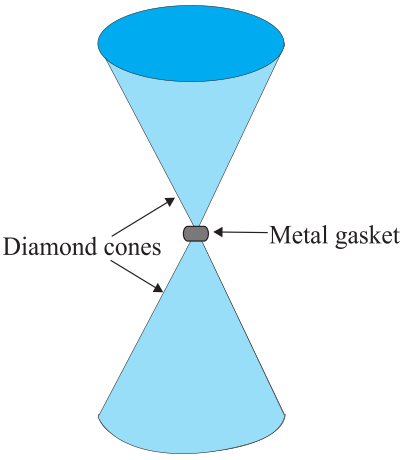
Anvils made of single crystals of diamond, with the shape as shown in Fig., are used to investigate behaviour of materials under very high pressures. Flat faces at the narrow end of the anvil have a diameter of 0.50mm, and the wide ends are subjected to a compressional force of 50,000N. What is the pressure at the tip of the anvil?

View full solution
Q 243 Marks Question3 Marks
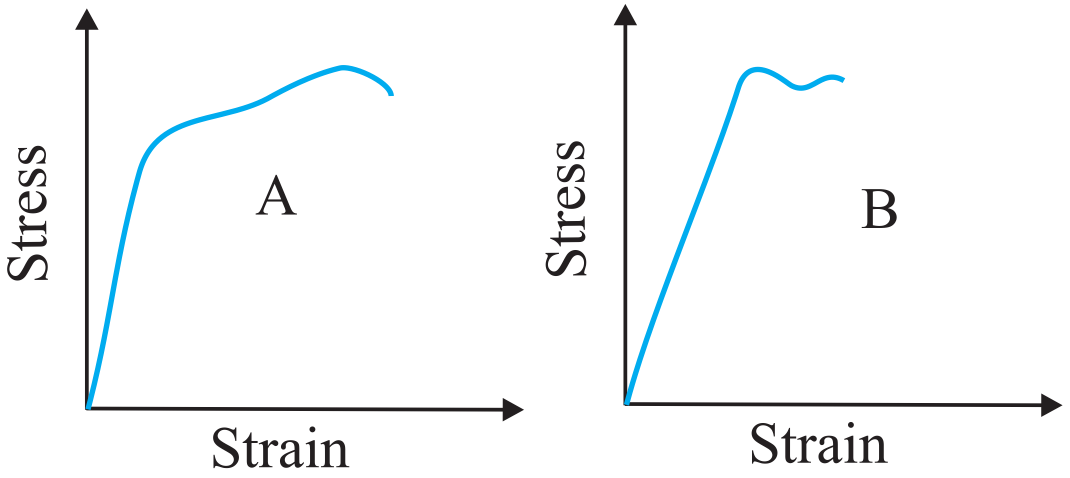
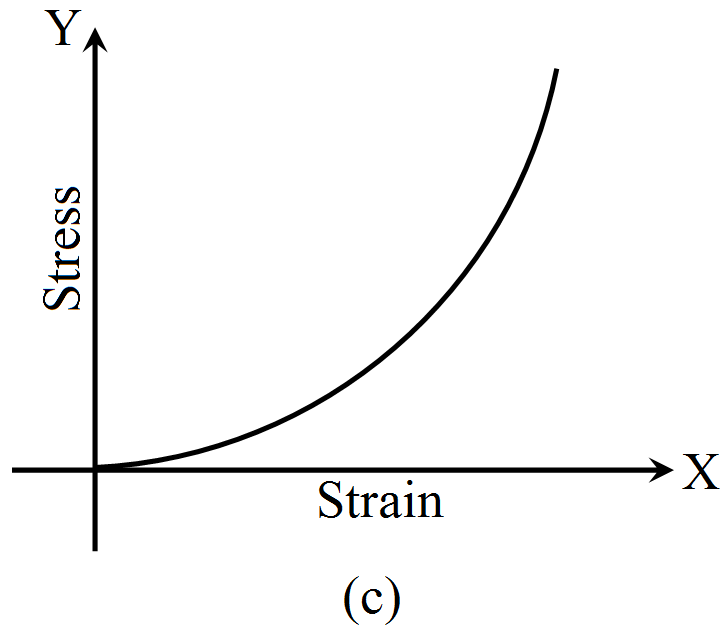
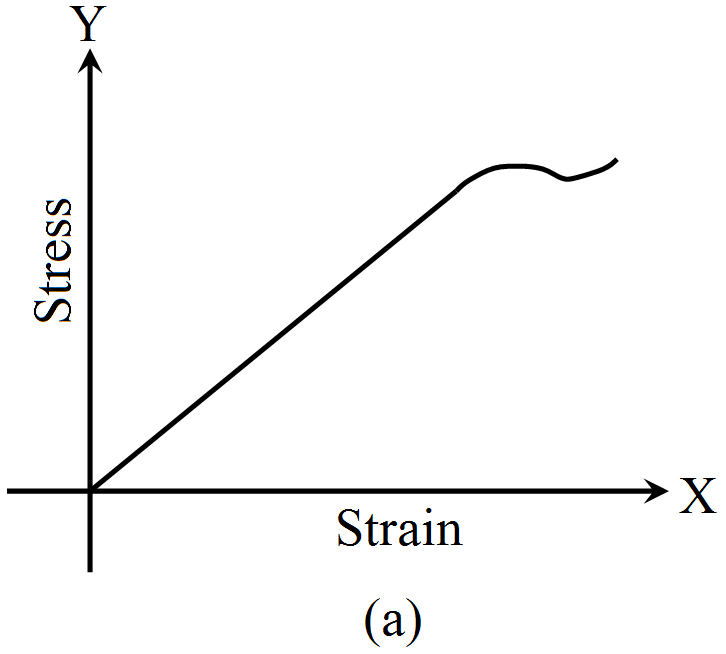
The stress-strain graphs for materials A and B are shown in Fig.

The graphs are drawn to the same scale.
  1. Which of the materials has the greater Young’s modulus?
  2. Which of the two is the stronger material?
View full solution
Q 273 Marks Question3 Marks
Four identical hollow cylindrical columns of mild steel support a big structure of mass 50,000kg. The inner and outer radii of each column are 30 and 60cm respectively. Assuming the load distribution to be uniform, calculate the compressional strain of each column.
View full solution
Q 284 Marks Question4 Marks
Read the passage given below and answer the following questions from 1 to 5.
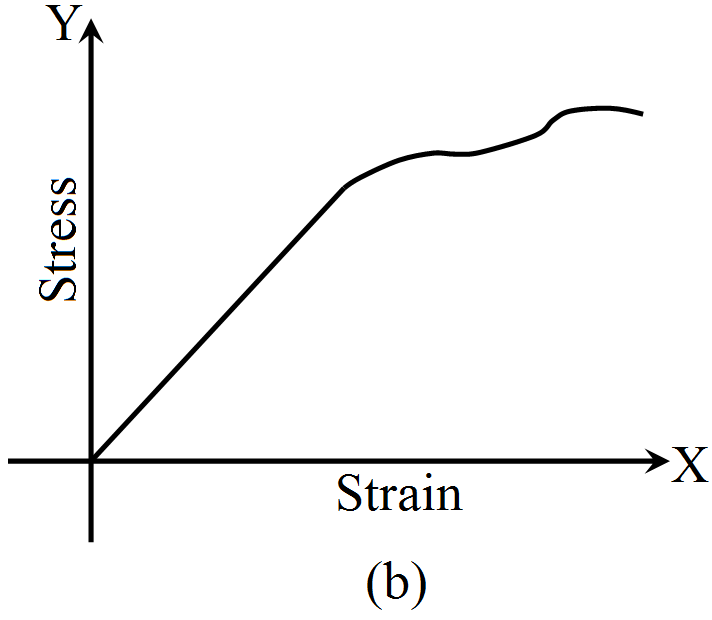
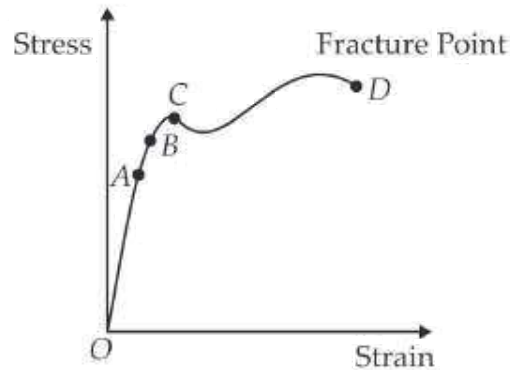
Stress-Strain Curve The graph shown below shows qualitatively the relation between the stress and the strain as the deformation gradually increases. Within Hooke’s limit for a certain region stress and strain relation is linear. Beyond that up to a certain value of strain the body is still elastic and if deforming forces are removed the body recovers its original shape.

  1. If deforming forces are removed up to which point the curve will be retraced?
  1. Upto OA only
  2. Upto OB
  3. Upto C
  4. Never retraced its path
  1. In the above question, during loading and unloading the force exerted by the material are conservative up to:
  1. OA only
  2. OB only
  3. OC only
  4. OD only
  1. During unloading beyond B, say C, the length at zero stress in now equal to:
  1. Less than original length
  2. Greater than original length
  3. Original length
  4. Can’t be predicted
  1. The breaking stress for a wire of unit cross - section is called:
  1. Yield point
  2. Elastic fatigue
  3. Tensile strength
  4. Young’s modulus
  1. Substances which can be stretched to cause large strains are called:
  1. Isomers
  2. Plastomers
  3. Elastomers
  4. Polymers
View full solution
Q 294 Marks Question4 Marks
Read the passage given below and answer the following questions from 1 to 5.
The property of a body, by virtue of which it tends to regain its original size and shape when the applied force is removed, is known as elasticity and the deformation caused is known as elastic deformation. However, if you apply force to a lump of putty or mud, they have no gross tendency to regain their previous shape, and they get permanently deformed. Such substances are called plastic and this property is called plasticity. Putty and mud are close to ideal plastics. We know that in a solid, each atom or molecule is surrounded by neighboring atoms or molecules. These are bonded together by interatomic or intermolecular forces and stay in a stable equilibrium position. When a solid is deformed, the atoms or molecules are displaced from their equilibrium positions causing a change in the interatomic (or intermolecular) distances. When the deforming force is removed, the interatomic forces tend to drive them back to their original positions. Thus the body regains its original shape and size. Answer the following
  1. Putty and mud are example of:
  1. Ideal plastic
  2. Ideal elastic
  3. Pseudo plastic
  4. None of these
  1. The property of a body, by virtue of which it tends to regain its original size and shape when the applied force is removed, is known as:
  1. Elasticity
  2. Plasticity
  3. Both
  4. None of these
  1. Define elasticity.
  1. Define plasticity.
  1. Explain elastic behavior of solid.
View full solution
Q 304 Marks Question4 Marks
Read the passage given below and answer the following questions from 1 to 5.
For small deformations within elastic limit the stress and strain are proportional to each other. This is known as
Hooke’s law. Thus, stress α strain
Stress = k × strain
Where k is the proportionality constant and is known as modulus of elasticity. Hooke’s law is an empirical law and is found to be valid for most materials. However, there are some materials which do not exhibit this linear relationship.
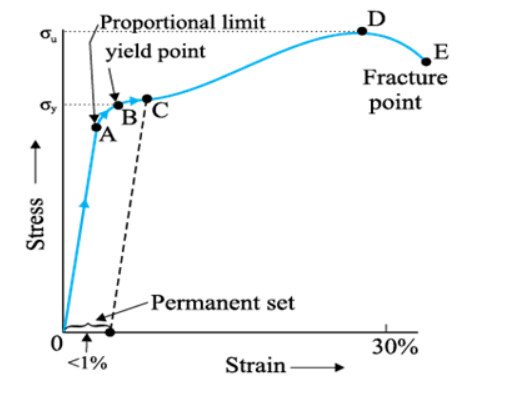
In the region from A to B, stress and strain are not proportional. Nevertheless, the body still returns to its original dimension when the load is removed. The point B in the curve is known as yield point (also known as elastic limit) and the corresponding stress is known as yield strength (σy) of the material.
If the load is increased further, the stress developed exceeds the yield strength and strain increases rapidly even for a small change in the stress. The portion of the curve between B and D shows this. When the load is removed, say at some point C between B and D, the body does not regain its original dimension. In this case, even when the stress is zero, the strain is not zero. The material is said to have a permanent set. The deformation is said to be plastic deformation. The point D on the graph is the ultimate tensile strength (σu) of the material. Beyond this point, additional strain is produced even by a reduced applied force and fracture occurs at point E. If the ultimate strength and fracture points D and E are close, the material is said to be brittle. If they are far apart, the material is said to be ductile.
  1. Stress is directly proportional to strain this is valid:
  1. Above elastic limit
  2. Within elastic limit
  3. Above plastic limit
  4. None of these
  1. SI unit of modulus of elasticity is:
  1. N/m2
  2. N
  3. No unit
  4. None of these
  1. Define modulus of elasticity.
  1. State hooks law.
  1. Write note on stress strain curve for ductile material.
View full solution
Q 314 Marks Question4 Marks
Read the passage given below and answer the following questions from 1 to 5.
The proportional region within the elastic limit of the stress-strain curve is of great importance for structural and manufacturing engineering designs. The ratio of stress and strain, called modulus of elasticity, is found to be a characteristic of the material.
Experimental observation show that for a given material, the magnitude of the strain produced
is same whether the stress is tensile or compressive. The ratio of tensile (or compressive) stress $(\sigma)$ to the longitudinal strain $(\in)$ is defined as Young’s modulus and is denoted by the symbol Y.
$\text{Y}=\frac{\sigma}{\in}$
Since strain is a dimensionless quantity, the unit of Young’s modulus is the same as that of stress i.e., N-m-2 or Pascal (Pa). As steel has more modulus of elasticity than copper brass and aluminum hence steel is preferred in heavy-duty machines and in structural designs. Wood, bone, concrete and glass have rather small Young’s moduli. Answer the following.
  1. If stress strain changes then young’s modulus is:
  1. Also changes.
  2. Remains constant.
  3. Either changes or remains constant depends on amount of stress and strain.
  4. None of these.
  1. SI unit of young’s modulus is:
  1. N-m-2
  2. Pascal (Pa).
  3. N-m-2 or Pascal (Pa).
  4. None of these
  1. Which of the following is more elastic
  1. Aluminum
  2. Steel
  3. Wood
  4. Glass
  1. Defines young’s modulus. Give its SI unit and dimensions.
  1. Why steel is more preferred in heavy industries than copper and brass?
View full solution
Q 324 Marks Question4 Marks
Read the passage given below and answer the following questions from 1 to 5.
When a body is subjected to a deforming force, a restoring force is developed in the body. This restoring force is equal in magnitude but opposite in direction to the applied force. The restoring force per unit area is known as stress. If F is the force applied normal to the cross–section and A is the area of cross section of the body.
Magnitude of the stress $=\frac{\text{F}}{\text{A}}$
The SI unit of stress is N-m-2 or Pascal (Pa) and its dimensional formula is [ML-1 T-2]. The restoring force per unit area in this case is called tensile stress. If the cylinder is compressed under the action of applied forces, the restoring force per unit area is known as compressive stress. Tensile or compressive stress can also be termed as longitudinal stress. In both the cases, there is a change in the length of the cylinder. The change in the length ΔL to the original length L of the body is known as longitudinal strain.
The restoring force per unit area developed due to the applied tangential force is known as tangential or shearing stress.
  1. Restoring force per unit area is called as:
  1. Stress
  2. Strain
  3. Modulus of elasticity
  4. None of these
  1. Ratio of change in dimension to original dimension is called:
  1. Stress
  2. Strain
  3. Modulus of elasticity
  4. None of these
  1. Define shear stress.
  1. Define stress. Give its SI unit and dimension.
  1. Define strain. Give its SI unit and dimension
View full solution
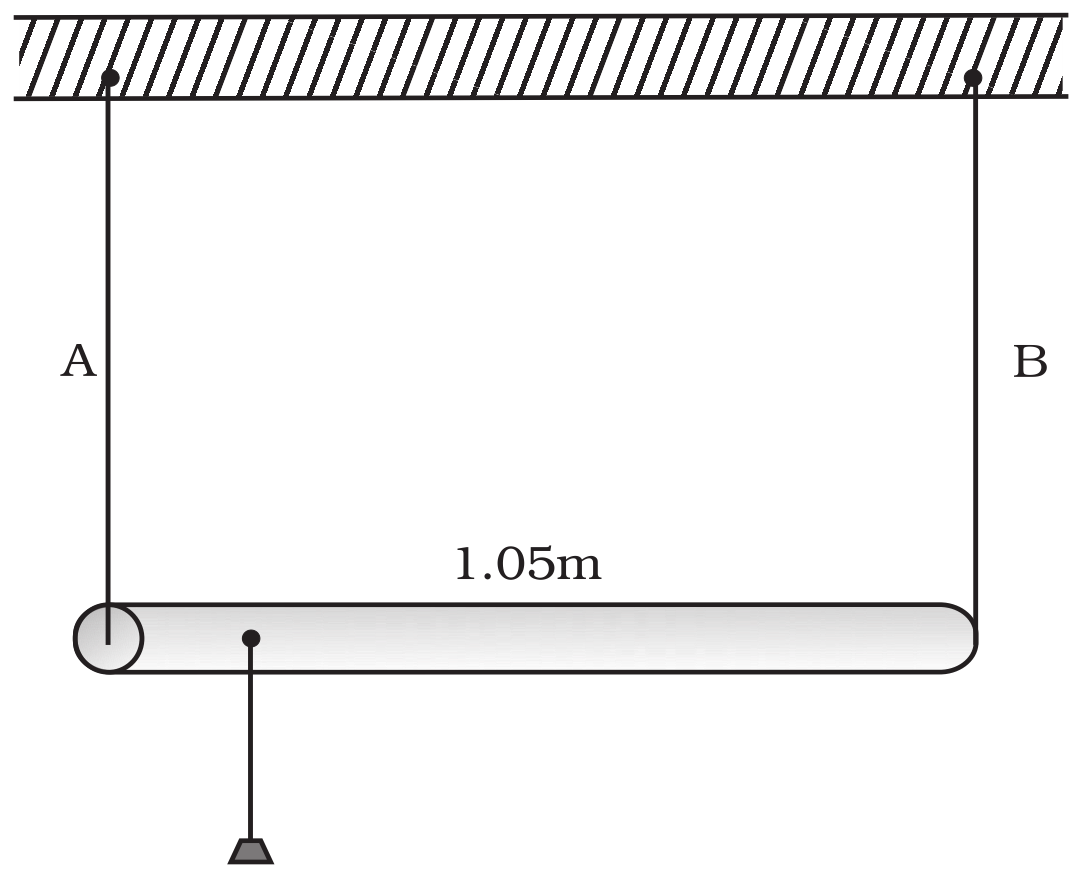
A rod of length 1.05m having negligible mass is supported at its ends by two wires of steel (wire A) and aluminium (wire B) of equal lengths as shown in Fig. The cross-sectional areas of wires A and B are 1.0mm2 and 2.0mm2 , respectively. At what point along the rod should a mass m be suspended in order to produce (a) equal stresses and (b) equal strains in both steel and aluminium wires.

View full solution
The Marina trench is located in the Pacific Ocean, and at one place it is nearly eleven km beneath the surface of water. The water pressure at the bottom of the trench is about 1.1 × 10⁸ Pa. A steel ball of initial volume 0.32m3 is dropped into the ocean and falls to the bottom of the trench. What is the change in the volume of the ball when it reaches to the bottom?
View full solution
A 14.5kg mass, fastened to the end of a steel wire of unstretched length 1.0m, is whirled in a vertical circle with an angular velocity of 2rev/s at the bottom of the circle. The cross-sectional area of the wire is 0.065cm2. Calculate the elongation of the wire when the mass is at the lowest point of its path.
View full solution
Compute the bulk modulus of water from the following data: Initial volume = 100.0 litre, Pressure increase = 100.0 atm (1 atm = 1.013 × 10⁵ Pa), Final volume = 100.5 litre. Compare the bulk modulus of water with that of air (at constant temperature). Explain in simple terms why the ratio is so large.
View full solution
The edge of an aluminium cube is 10cm long. One face of the cube is firmly fixed to a vertical wall. A mass of 100kg is then attached to the opposite face of the cube. The shear modulus of aluminium is 25G Pa. What is the vertical deflection of this face?
View full solution

Generate a Mechanical Properties of Solids paper free

Pick question groups from the list above, set marks and difficulty, and export a branded PDF with step-by-step answer keys. First 3 chapters free — no signup.

Download App