Question types

Mechanical Properties of Solids question types

29 questions across 4 question groups — pick any mix to generate a Physics paper with step-by-step answer keys.

29
Questions
4
Question groups
5
Question types
Sample Questions

Mechanical Properties of Solids questions

One sample from each question group in this chapter. Select any group above to see the full set with answer keys.
The maximum load a wire can withstand without breaking, when its length is reduced to half of its original length, will
  1. Be double.
  2. Be half.
  3. Be four times.
  4. Remain same.
View full solution
Consider two cylindrical rods of identical dimensions, one of rubber and the other of steel. Both the rods are fixed rigidly at one end to the roof. A mass M is attached to each of the free ends at the centre of the rods.
  1. Both the rods will elongate but there shall be no perceptible change in shape.
  2. The steel rod will elongate and change shape but the rubber rod will only elongate.
  3. The steel rod will elongate without any perceptible change in shape, but the rubber rod will elongate and the shape of the bottom edge will change to an ellipse.
  4. The steel rod will elongate, without any perceptible change in shape, but the rubber rod will elongate with the shape of the bottom edge tapered to a tip at the centre.
View full solution
A spring is stretched by applying a load to its free end. The strain produced in the spring is
  1. Volumetric.
  2. Shear.
  3. Longitudinal and shear.
  4. Longitudinal.
View full solution
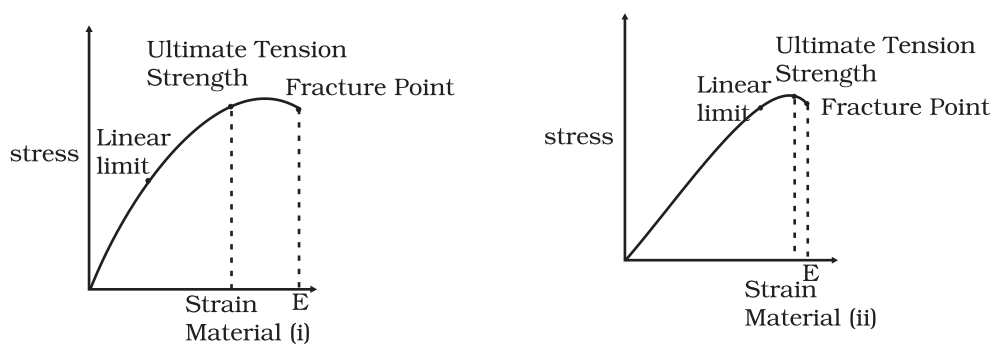
The stress - strain graphs for two materials are shown in (assume same scale).

  1. Material (ii) is more elastic than material (i) and hence material (ii) is more brittle.
  2. Material (i) and (ii) have the same elasticity and the same brittleness.
  3. Material (ii) is elastic over a larger region of strain as compared to (i).
  4. Material (ii) is more brittle than material (i).
View full solution
Q 103 Marks Question3 Marks
Two identical solid balls, one of ivory and the other of wet-clay, are dropped from the same height on the floor. Which one will rise to a greater height after striking the floor and why?
View full solution
Q 113 Marks Question3 Marks
To what depth must a rubber ball be taken in deep sea so that its volume is decreased by 0.1%.
(The bulk modulus of rubber is 9.8 × 10⁸N m-2, and the density of sea water is 103kg m-3.)
View full solution
In nature, the failure of structural members usually result from large torque because of twisting or bending rather than due to tensile or compressive strains. This process of structural breakdown is called buckling and in cases of tall cylindrical structures like trees, the torque is caused by its own weight bending the structure. Thus the vertical through the centre of gravity does not fall within the base. The elastic torque caused because of this bending about the central axis of the tree is given by $\frac{\text{Y}\pi\text{r}^4}{4\text{R}}.$ Y is the Young’s modulus, r is the radius of the trunk and R is the radius of curvature of the bent surface along the height of the tree containing the centre of gravity (the neutral surface). Estimate the critical height of a tree for a given radius of the trunk.
View full solution
A steel rod (Y = 2.0 × 1011N m-2, and $\alpha$ = 10-50 C-1) of length 1m and area of cross-section 1cm 2 is heated from 0°C to 200°C, without being allowed to extend or bend. What is the tension produced in the rod?
View full solution
  1. A steel wire of mass μ per unit length with a circular cross section has a radius of 0.1cm. The wire is of length 10m when measured lying horizontal, and hangs from a hook on the wall. A mass of 25kg is hung from the free end of the wire. Assuming the wire to be uniform and lateral strains << longitudinal strains, find the extension in the length of the wire. The density of steel is 7860kg m–3 (Young’s modules Y = 2 × 10¹¹ Nm–2).

  2. If the yield strength of steel is 2.5 × 10⁸ Nm–2, what is the maximum weight that can be hung at the lower end of the wire?

View full solution
An equilateral triangle ABC is formed by two Cu rods AB and BC and one Al rod. It is heated in such a way that temperature of each rod increases by $\Delta\text{T}$. Find change in the angle ABC. $[$Coeff. of linear expansion for 1 Cu is $\alpha_1$ Coeff. of linear expansion for 2Al is $\alpha_2]$
View full solution
A truck is pulling a car out of a ditch by means of a steel cable that is 9.1m long and has a radius of 5mm. When the car just begins to move, the tension in the cable is 800N. How much has the cable stretched?
(Young’s modulus for steel is 2 × 10¹¹N m–2.)
View full solution

Generate a Mechanical Properties of Solids paper free

Pick question groups from the list above, set marks and difficulty, and export a branded PDF with step-by-step answer keys. First 3 chapters free — no signup.

Download App