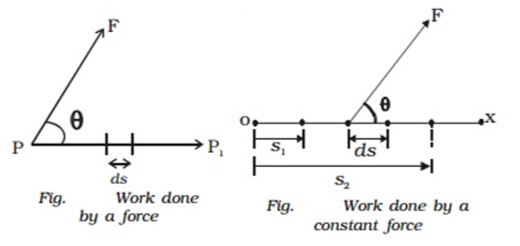
Question 14 MarksIn everyday life, the term work is used to refer to any form of activity that requires the exertion of mental or muscular efforts. In physics, work is said to be done by a force or against the direction of the force, when the point of application of the force moves towards or against the direction of the force. If no displacement takes place, no work is said to be done.1. A box is pushed through 4.0 m across a floor offering 100 N resistance. How much work is done by the applied force?(a) 100 J (b) 300 J (c) 400 J (d) 200 J2. What is work done in holding a 15 kg suitcase while waiting for 15 minutes?(a) 22.5 J (b) zero (c) 225 J (d) 150 J3. Frictional forces are:(a) conservative forces(b) non-conservative forces (c) buoyant force (d) non buoyant forceORForce of 4 N is applied on a body of mass 20 kg . The work done in 3rd second is:(a) 6 J (b) 8 J (c) 4 J (d) 2 J4. When the body moves in a circular motion, net 'work' done is:(a) one (b) positive (c) negative (d) zeroAnswer1. (c) 400 JExplanation: 400 J2. (b) zeroExplanation: zero3. (b) non-conservative forcesExplanation: non-conservative forcesOR(d) 2 JExplanation: 2 J4. (d) zeroExplanation: zeroView full question & answer→
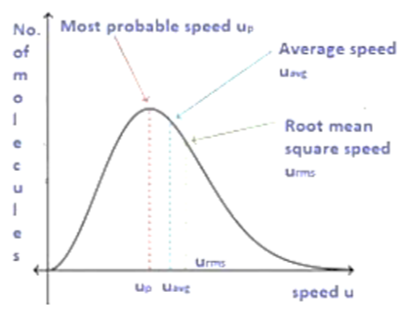
Question 24 MarksRoot mean square velocity (RMS value)is the square root of the mean of squares of the velocity of individual gas molecules and the Average velocity is the arithmetic mean of the velocities of different molecules of a gas at a given temperature.1. Moon has no atmosphere because:(a) the escape velocity of the moon’s surface is more than the r.m.s velocity of all molecules(b) it is far away from the surface of the earth(c) the r.m.s. velocity of all the gas molecules is more than the escape velocity of the moon’s surface(d) its surface temperature is $10^{\circ} C$2. For an ideal gas, $\frac{C_P}{C_V}$ is(a) $\leq 1$ (b) none of these (c) $>1$ (d) $<1$3. The root means square velocity of hydrogen is $\sqrt{5}$ times that of nitrogen. If T is the temperature of the gas then:(a) $T \left( H _2\right)= T \left( N _2\right)$(b) $T \left( H _2\right)< T \left( N _2\right)$(c) $T \left( H _2\right) \neq T \left( N _2\right)$(d) $T\left(H_2\right)>T\left(N_2\right)$4.Suppose the temperature of the gas is tripled and $N _2$ molecules dissociate into an atom. Then what will be the rms speed of atom:(a) $v_0 \sqrt{2}$ (b) $v_0 \sqrt{6}$ (c) $v_0 \sqrt{3}$ (d) $v_0$ORThe velocities of the molecules are $v , 2 v , 3 v , 4 v \& 5 v$. The RMS speed will be:(a) 11 v (b) $v (12)^{11}$ (c) v (d) $v(11)^{12}$Answer1. (c) the r.m.s. velocity of all the gas molecules is more than the escape velocity of the moon's surfaceExplanation: The r.m.s. velocity of all the gas molecules is more than the escape velocity of the moon's surface.2. (c) $>1$Explanation: $>1$3. (b) $T \left( H _2\right)< T \left( N _2\right)$Explanation: $T \left( H _2\right)< T \left( N _2\right)$4. (b) $v_0 \sqrt{6}$Explanation: $v_0 \sqrt{6}$OR(d) $v (11)^{12}$Explanation: $v (11)^{12}$View full question & answer→