Questions

M.C.Q (1 Marks)

Take a timed test

14 questions · auto-graded multiple-choice test.

MCQ 11 Mark
Figure shows the orientation of two vectors $u$ and $v$ in the $XY$ plane.
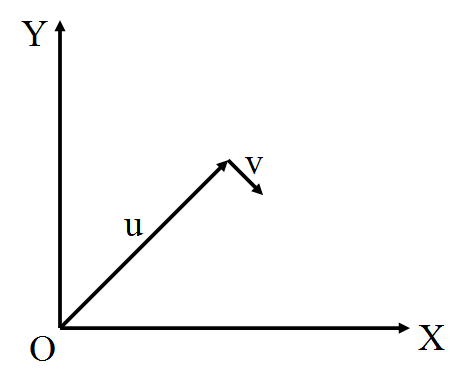
If $\text{u}=\text{a}\hat{\text{i}}+\text{b}\hat{\text{j}}$ and $\text{v}=\text{p}\hat{\text{i}}+\text{q}\hat{\text{j}}$ which of the following is correct?
  • A
    $a$ and $p$ are positive while $b$ and $q$ are negative.
  • $a, p$ and $b$ are positive while $q$ is negative.
  • C
    $a, q$ and $b$ are positive while $p$ is negative.
  • D
    $a, b, p$ and $q$ are all positive.
Answer
Correct option: B.
$a, p$ and $b$ are positive while $q$ is negative.
Main concept used: Sign of $a, b, p$ and $q$ are the sign of their resolving components in the $XY$ direction.
Explanation: Components along $X$ and $Y$ axis of the vector $\vec{\text{u}}$ are both $+X$ and $Y$ direction,
so $a, b$ are positive.
Now if we resolve
View full question & answer
MCQ 21 Mark
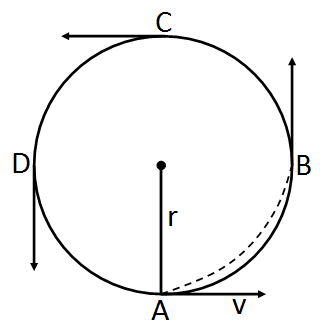
For a particle performing uniform circular motion, choose the correct statement$(s)$ from the following:
  1. Magnitude of particle velocity $($speed$)$ remains constant.
  2. Particle velocity remains directed perpendicular to radius vector.
  3. Direction of acceleration keeps changing as particle moves.
  4. Angular momentum is constant in magnitude but direction keeps changing.
  • $1 , 2$ and $3$
  • B
    $1 , 2$ and $4$
  • C
    $2 , 3$ and $4$
  • D
    $ 2$ and $3$
Answer
Correct option: A.
$1 , 2$ and $3$


While a particle is in uniform circular motion. Then the following statements are true.

  1. Speed will be always constant throughout.
  2. Velocity will be always tangential in the direction of motion at a particular point.
  3. The centripetal acceleration $a = v^2/r$ and its direction will always towards centre of the circular trajectory.
  4. Angular momentum $(mvr)$ is constant in magnitude and direction. And its direction is perpendicular to the plane containing $r$ and $v.$
Important point: In uniform circular motion, magnitude of linear velocity and centripetal acceleration is constant but direction changes continuously.
View full question & answer
MCQ 31 Mark
In a two dimensional motion, instantaneous speed $v_0$ is a positive constant. Then which of the following are necessarily true?
  • A
    The average velocity is not zero at any time.
  • B
    Average acceleration must always vanish.
  • C
    Displacements in equal time intervals are equal.
  • Equal path lengths are traversed in equal intervals.
Answer
Correct option: D.
Equal path lengths are traversed in equal intervals.
Speed (Instantaneous Speed): The magnitude of the velocity at any instant of time is known as Instantaneous Speed or simply speed at that instant of time. It is denoted by $v$.
Quantitatively: Speed $=$ distance/ time
Mathematically, it is the time rate at which distance is being travelled by the particle.
  • Speed is a scalar quantity. It can never be negative $($as shown by speedometer of our vehicle$).$
  • Instantaneous speed is the speed of a particle at a particular instant of time.
Hence, Total distance travelled $=$ Path length $= ($speed$) \times $ time taken
Important point: We should be very carefull with the fact that speed is related with total distance covered not with displacement.
View full question & answer
MCQ 41 Mark
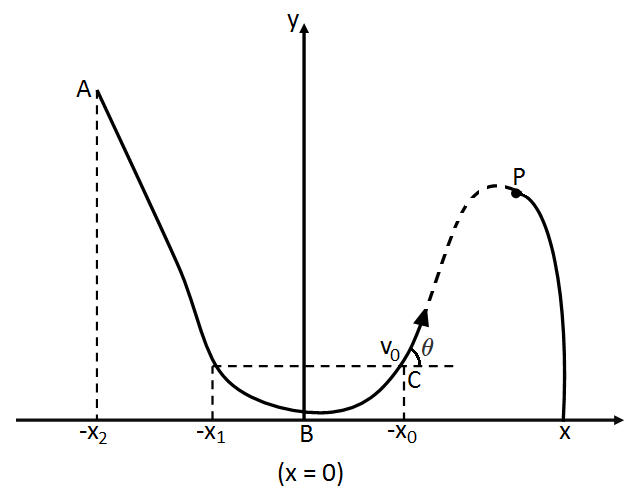
A particle slides down a frictionless parabolic $\left(y=x^2\right)$ track $(A-B-C)$ starting from rest at point $A$. Point $B$ is at the vertex of parabola and point $C$ is at a height less than that of point $A$. After $C$, the particle moves freely in air as a projectile. If the particle reaches highest point at $P$, then
  • A
    KE at $P = KE$ at$ B.$
  • B
    height at $P =$ height at $A$.
  • total energy at $P =$ total energy at $A.$
  • D
    time of travel from $A$ to $B =$ time of travel from $B$ to $P.$
Answer
Correct option: C.
total energy at $P =$ total energy at $A.$

In such type of problems, we have to observe the nature of track that if there is a friction or not, as friction is not present in this track, total energy of the particle will remain constant throughout the journey.
According to the problem, the path traversed by the particle on a frictionless track is parabolic, is given by the equation $y=x^2$, thus total energy $(K E+P E)$ will be same throughout the journey.
Hence, total energy at $A=$ total energy at $P$
At $B$ the particle is having only KE but at $P$ some $K E$ is converted to $P E$.
So, $( KE )_{ B }>( KE )_{ p }$
Total energy at $A = PE =$ Total energy at $B = KE =$ Total energy at $P = PE + KE$
The potential energy at $A$ is converted to $K E$ and $P E$ at $P$, hence (PE) $P<(P E) A$
Hence, (Height) $<$ (Height)A
As, Height of $P<$ Height of $A$
Hence, path length $A B>$ path length $B P$
Hence, time of travel from $A$ to $B \neq$ Time of travel from $B$ to $P$.

View full question & answer
MCQ 51 Mark
The angle between $\vec{\text{A}}=\hat{\text{i}}+\hat{\text{j}}$ and $\vec{\text{B}}=\hat{\text{i}}-\hat{\text{j}}$ is
  • A
    $45^\circ$
  • $90^\circ$
  • C
    $–45^\circ$
  • D
    $180^\circ$
Answer
Correct option: B.
$90^\circ$
Given $\vec{\text{A}}=\hat{\text{i}}+\hat{\text{j}}$
$\vec{\text{B}}=\hat{\text{i}}-\hat{\text{j}}$
$\vec{\text{A}}.\vec{\text{B}}=|\text{A}||\text{B}|\cos\theta$
$\cos\theta=\frac{\vec{\text{A}}.\vec{\text{B}}}{|\text{A}||\text{B}|}$
$=\frac{(\hat{\text{i}}+\hat{\text{j}}).(\hat{\text{i}}-\hat{\text{j}})}{\sqrt{1^2+1^2}\times\sqrt{1^2+(-1)^2}}$
$=\frac{1-1}{2}=0$
$\Rightarrow\cos\theta=\cos90$
$\therefore\theta=90^\circ.$
Hence, verifies the option $(b).$
View full question & answer
MCQ 61 Mark
In a two dimensional motion, instantaneous speed $\text{v}_0$ is a positive constant. Then which of the following are necessarily true?
  • A
    The acceleration of the particle is zero.
  • B
    The acceleration of the particle is bounded.
  • The acceleration of the particle is necessarily in the plane of motion.
  • D
    The particle must be undergoing a uniform circular motion.
Answer
Correct option: C.
The acceleration of the particle is necessarily in the plane of motion.
This motion is two dimensional and given that instantaneous speed $\text{v}_0$ is positive constant. Acceleration is defined as the rate of change of velocity $($instantaneous speed$)$, hence it will also be in the plane of motion.
View full question & answer
MCQ 71 Mark
The component of a vector r along X-axis will have maximum value if
  • A
    r is along positive Y-axis.
  • r is along positive X-axis.
  • C
    r makes an angle of 45° with the X-axis.
  • D
    r is along negative Y-axis.
Answer
Correct option: B.
r is along positive X-axis.
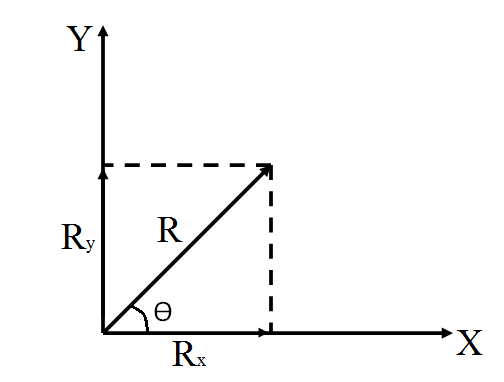
Consider a vector $\vec{\text{R}}$ in X-Y plane as shown in figure. If we draw orthogonal vectors $\vec{\text{R}}_{\text{x}}$ and $\vec{\text{R}}_{\text{y}}$ along x and y axes respectively, by law of vector addition, $\vec{\text{R}}=\vec{\text{R}}_{\text{x}}+\vec{\text{R}}_{\text{y}}$

The magnitude of component of r along X-axis
$\text{r}_\text{x}=|\text{r}|\cos\theta$
$(\text{r}_\text{x})_{\text{maximum}}=|\text{r}|(\cos\theta)_{\text{maximum}}$
$\text{r}_\text{x}=|\text{r}|\cos\theta$
$=|\text{r}|\cos0^\circ=|\text{r}|$ $(\because\cos\theta$ is maximum if $\theta=0^\circ)$
As $\theta=0^\circ,$
r is along positive x-axis.
View full question & answer
MCQ 81 Mark
Two particles are projected in air with speed $v_o$ at angles $\theta_1$ and $\theta_2 ($both acute$)$ to the horizontal, respectively. If the height reached by the first particle is greater than that of the second, then tick the right choices
  1. angle of projection: $q_1 > q_2$
  2. time of flight: $T_1 >T_2$
  3. horizontal range: $R_1 > R_2$
  4. total energy: $U_1 > U_2$
  • A
    $ 2$ and $3$
  • B
    $ 2$ and $4$
  • C
    $ 1$ and $3$
  • $1$ and $2$
Answer
Correct option: D.
$1$ and $2$
  1. According to the problem,
$\Rightarrow\ \text{H}_1>\text{H}_2$
$\Rightarrow\ \frac{\text{v}^2_0\sin^2\theta_1}{2\text{g}}>\frac{\text{v}^2_0\sin^2\theta_2}{2\text{g}}$
$\Rightarrow\ \sin^2\theta_1>\sin^2\theta_2$
$\Rightarrow\ \sin^2\theta_1-\sin^2\theta_2>0$
$\Rightarrow\ (\sin\theta_1-\sin\theta_2)(\sin\theta_1+\sin\theta_2)>0$
Thus, either $\sin\theta_1+\sin\theta_2>0$
$\Rightarrow\ \sin\theta_1-\sin\theta_2>0$
$\Rightarrow\ \sin\theta_1>\sin\theta_2\text{ or }\theta_1>\theta_2$
Hence option $(a)$ is correct.
  1. Time of flight, $\text{T}=\frac{2\text{u}\sin\theta}{\text{g}}=\frac{2\text{v}_0\sin\theta}{\text{g}}$
Thus, $\text{T}_1=\frac{2\text{v}_0\sin\theta_1}{\text{g}}$ and $\text{T}_2=\frac{2\text{v}_0\sin\theta_2}{\text{g}}$
$($Here, $T_1 =$ Time of flight of first particle and $T_2 =$ Time of flight of second particle$).$
As, $\sin\theta_1>\sin\theta_2$
Thus, $\text{T}_1>\text{T}_2$
Hence option $(b)$ is correct.
  1. We know that Range, $\text{R}=\frac{\text{u}^2\sin2\theta}{\text{g}}=\frac{\text{v}^2_0\sin2\theta}{\text{g}}$
Range of first particle $=\text{R}_1=\frac{\text{u}^2_0\sin2\theta_1}{\text{g}}$
Range of second particle $=\text{R}_2=\frac{\text{u}^2_0\sin2\theta_2}{\text{g}}$
Given, $\sin\theta_1>\sin\theta_2$
$\Rightarrow\ \sin2\theta_1>\sin2\theta_2$
$\Rightarrow\ \frac{\text{R}_1}{\text{R}_2}=\frac{\sin2\theta_1}{\sin2\theta_2}>1$
$\Rightarrow\ \text{R}_1>\text{R}_2$
But if $\theta_1+\theta_2=90^\circ,$ then $\text{R}_1=\text{R}_2$
Hence option $(c)$ is incorrect.
Important points about time of flight: For complementary angles of projection $\theta\text{ and }90^\circ-\theta.$
  1. Ratio of time of flight $=\frac{\text{T}_1}{\text{T}_2}=\frac{2\text{u}\sin\frac{\theta}{\text{g}}}{2\text{u}\sin\frac{(90^\circ-\theta)}{\text{g}}}=\tan\theta$
$\Rightarrow\ \frac{\text{T}_1}{\text{T}_2}=\tan\theta$
  1. Multiplication of time of flight $=\text{T}_1\text{T}_2=\frac{2\text{u}\sin\theta}{\text{g}}\frac{2\text{u}\cos\theta}{\text{g}}$
$\Rightarrow\ \text{T}_1\text{T}_2=\frac{2\text{R}}{\text{g}}$
View full question & answer
MCQ 91 Mark
Following are four differrent relations about displacement, velocity and acceleration for the motion of a particle in general. Choose the incorrect one $(s):$
  • A
    $\text{v}_\text{av}=\frac{1}2\big[\text{v}(\text{t}_1)+\text{v}(\text{t}_2)\big]$
  • B
    $\text{v}_\text{av}=\frac{r(\text{t}_2)-\text{r}(\text{t}_1)}{\text{t}_2-\text{t}_1}$
  • C
    $\text{r}=\frac{1}2(\text{v}(\text{t}_2)-\text{v}(\text{t}_1))(\text{t}_2-\text{t}_1)$
  • Both $A$ and $C$
Answer
Correct option: D.
Both $A$ and $C$
When an object covers a displacement $\Delta\text{r}$ in time $\Delta\text{t},$ its average velocity is given by $\vec{\text{v}}_\text{avg}=\frac{\overrightarrow{\Delta\text{r}}}{\Delta\text{t}}=\frac{\text{r}_2-\text{r}_1}{\text{t}_2-\text{t}_1}$ where $r_1$ and $r_2$ are position vectors corresponding to time $t_1$ and $t_2$.
If the velocity of an object changes from $v_1$ to $v_2$ in time $\Delta\text{t},$ average acceleration is given by
$\text{a}_\text{av}=\frac{\Delta\text{v}}{\Delta\text{t}}=\frac{\text{v}_2-\text{v}_1}{\text{t}_2-\text{t}_1}$
But, when acceleration is non$-$uniform,
$\text{v}_\text{av}\neq\frac{\text{v}_1+\text{v}_2}{2}$
Option $(c)$ is similar to the relation $\vec{\text{r}}=\frac{1}2\text{at}^2$ which is not correct if initial velocity is given.
So $(b)$ and $(c)$ are the correct relations for the uniform acceleration.
View full question & answer
MCQ 101 Mark
Three vectors $\vec{\text{A}},\ \vec{\text{B}}$ and $\vec{\text{C}}$ add up to zero. Find which is false.
  • A
    $(\vec{\text{A}}\times\vec{\text{B}})\times\vec{\text{C}}$ is not zero unless $\vec{\text{B}},\ \vec{\text{C}}$ are parallel.
  • B
    $(\vec{\text{A}}\times\vec{\text{B}}).\vec{\text{C}}$ is not zero unless $\vec{\text{B}},\ \vec{\text{C}}$ are parallel.
  • C
    If $A, B, C$ define a plane, $(\vec{\text{A}}\times\vec{\text{B}})\times\vec{\text{C}}$ is in that plane.
  • Both $A$ and $C$
Answer
Correct option: D.
Both $A$ and $C$
$\vec{\text{A}}+\vec{\text{B}}+\vec{\text{C}}=0$
So $\vec{\text{A}},\ \vec{\text{B}}$ and $\vec{\text{C}}$ are in a plane and can be represented bt the three sides of a triangle taken in order.
$a. \vec{\text{B}}\times(\vec{\text{A}}+\vec{\text{B}}+\vec{\text{C}})=\vec{\text{B}}\times0=0$
$\vec{\text{B}}\times\vec{\text{A}}+\vec{\text{B}}\times\vec{\text{B}}+\vec{\text{B}}\times\vec{\text{C}}=0$
$\vec{\text{B}}\times\vec{\text{A}}+0+\vec{\text{B}}\times\vec{\text{C}}=0$
$\vec{\text{B}}\times\vec{\text{A}}=-\vec{\text{B}}\times\vec{\text{C}}$
$\vec{\text{A}}\times\vec{\text{B}}=\vec{\text{B}}\times\vec{\text{C}}\ \dots(\text{i})$
Or $(\vec{\text{A}}\times\vec{\text{B}})\times\vec{\text{C}}=(\vec{\text{B}}\times\vec{\text{C}})\times\vec{\text{C}}$
$\therefore$ It cannot be zero
$\vec{\text{B}}\times\vec{\text{C}}$ will be zero if $\vec{\text{B}}\times\vec{\text{C}}$ are parallel or antiparallel.
i.e, $(\vec{\text{A}}\times\vec{\text{B}})\times\vec{\text{C}}=[\text{BC}\sin0^\circ]\times\vec{\text{C}}$
$(\vec{\text{A}}\times\vec{\text{B}})\times\vec{\text{C}}=0$ only if $\vec{\text{B}}||\vec{\text{C}}$
Hence option $(a)$ is verified.
$b. (\vec{\text{A}}\times\vec{\text{B}})=\vec{\text{B}}\times\vec{\text{C}} [$from $(i)]$
$(\vec{\text{A}}\times\vec{\text{B}}).\vec{\text{C}}=(\vec{\text{B}}\times\vec{\text{C}}).\vec{\text{C}}$
if $\vec{\text{B}}||\vec{\text{C}}$
$\vec{\text{B}}\times\vec{\text{C}}=\text{BC}\sin0^\circ=0$
$\therefore\ (\vec{\text{A}}\times\vec{\text{B}}).\vec{\text{C}}=0\text{ IF }\vec{\text{B}}||\vec{\text{C}}$
So option $(b)$ is not verified.
$c. (\vec{\text{A}}\times\vec{\text{B}})=\vec{\text{X}}$
The direction of $x$ is perpendicular to both planes containing $A$ and $B.$
$(\vec{\text{A}}\times\vec{\text{B}})\times\vec{\text{C}}=\vec{\text{X}}\times\vec{\text{C}}=\vec{\text{Y}}$
The direction of $\vec{\text{Y}}$ is perpendicular to the plane of $\vec{\text{X}}$ and $\vec{\text{C}}$ which again become in the plane of $\vec{\text{A}},\ \vec{\text{B}},\ \vec{\text{C}}$ but perpendicular to the plane of $\vec{\text{X}}$ and $\vec{\text{C}}.$
Hence option $(c)$ is also verified.
$d. |\text{A}|^2+|\text{B}|^2=|\text{C}|^2$ given
It shows that angle between $\vec{\text{A}}$ and $\vec{\text{B}}$ is $90^\circ$
$=|\text{A}||\text{B}||\text{C}|\cos\theta\neq|\text{A}||\text{B}||\text{C}|$
$(\vec{\text{A}}\times\vec{\text{B}}).\vec{\text{C}}=|\text{A}||\text{B}||\text{C}|\cos\theta$
Does not verified option $(c).$
View full question & answer
MCQ 111 Mark
Which one of the following statements is true?
  • A
    A scalar quantity is the one that is conserved in a process.
  • B
    A scalar quantity is the one that can never take negative values.
  • C
    A scalar quantity is the one that does not vary from one point to another in space.
  • A scalar quantity has the same value for observers with different orientations of the axes.
Answer
Correct option: D.
A scalar quantity has the same value for observers with different orientations of the axes.
A scalar quantity does not depend on direction so it does not change for different orientation of axes. So this verifies the option (d).
View full question & answer
MCQ 121 Mark
The horizontal range of a projectile fired at an angle of 15° is 50m. If it is fired with the same speed at an angle of 45°, its range will be
  • A
    60m
  • B
    71m
  • 100m
  • D
    141m
Answer
Correct option: C.
100m
projectile is fired at $\theta=15^\circ,\ \text{R} = 50\text{m}$
$\text{R}=\frac{\text{u}^2\sin2\theta}{\text{g}}$
$50=\frac{\text{u}^2\sin2\times15^\circ}{\text{g}}\Rightarrow\text{u}^2=50\text{g}\times2$
$\text{u}^2=100\text{g}$
Now $\theta = 45^\circ,\ \text{u}^2=100\text{g}$
$\therefore\ \text{R}=\frac{\text{u}^2\sin2\theta}{\text{g}}=\frac{100\text{g}\times\sin2\times45^\circ}{\text{g}}$
$\Rightarrow\ \text{R}=100\text{m}$
So, this verifies option (c).
View full question & answer
MCQ 131 Mark
Consider the quantities, pressure, power, energy, impulse, gravitational potential, electrical charge, temperature, area. Out of these, the only vector quantities are
  • A
    Impulse, pressure and area.
  • Impulse and area.
  • C
    Area and gravitational potential.
  • D
    Impulse and pressure.
Answer
Correct option: B.
Impulse and area.
We know that impulse J = F. $\Delta\text{t}=\Delta\text{p},$ where F is force, At is time duration and Ap is change in momentum. As $\Delta\text{p}$ is a vector quantity, hence impulse is also a vector quantity. Sometimes area can also be treated as vector direction of area vector is perpendicular to its plane.
View full question & answer
MCQ 141 Mark
For two vectors $A$ and $B, |\text{A} + \text{B}| = |\text{A} - \text{B}|$ is always true when
  • A
    $|\text{A}|=|\text{B}|\neq0$
  • B
    $\text{A}\bot\text{B}$
  • C
    when either $|\text{A}|$ or $|\text{B}|$ is zero.
  • Both $B$ and $C$
Answer
Correct option: D.
Both $B$ and $C$

According to the problem, $|\vec{\text{A}}+\vec{\text{B}}|=|\vec{\text{A}}-\vec{\text{B}}|$
$\Rightarrow\ \sqrt{|\vec{\text{A}}|^2+|\vec{\text{B}}|^2+2|\vec{\text{A}}||\vec{\text{B}}|\cos\theta}$
$=\sqrt{|\vec{\text{A}}|^2+|\vec{\text{B}}|^2-2|\vec{\text{A}}||\vec{\text{B}}|\cos\theta}$
$\Rightarrow\ |\vec{\text{A}}|^2+|\vec{\text{B}}|^2+2|\vec{\text{A}}||\vec{\text{B}}|\cos\theta$
$=|\vec{\text{A}}|^2+|\vec{\text{B}}|^2-2|\vec{\text{A}}||\vec{\text{B}}|\cos\theta$
$\Rightarrow\ 4|\vec{\text{A}}||\vec{\text{B}}|\cos\theta=0$
$\Rightarrow\ |\vec{\text{A}}||\vec{\text{B}}|\cos\theta=0$
$|\vec{\text{A}}|=0$ or $|\vec{\text{B}}|=0$ or $\cos\theta=0$
i.e. $\theta=90^\circ$
When $\theta=90^\circ,$ we can say that $\vec{\text{A}}\bot\vec{\text{B}}.$
Hence options $(b)$ and $(c)$ are correct.

View full question & answer