$\text{t}_2=1\text{s}$ Since t1 (time taken by ball 1 to cover distance of 20m) is 2s, time interval between the two throws $=\text{t}_1-\text{t}_2=2\text{s}-1\text{s}=1\text{s}$
Important note: We should be very careful when we are applying the equation of rectilinear motion. These equations are applicable only in case of constant acceleration. Some important observations for motion under gravity: - The motion is independent of the mass of the body, as in any equation of motion, mass is not involved.
That is why a heavy and light body when released from the same height, reach the ground simultaneously and with same velocity, i.e., $\text{t}=\sqrt{\frac{2\text{h}}{\text{g}}}$ and $\text{v}=\sqrt{2\text{gh}}.$
- In case of motion under gravity time taken to go up is equal to the time taken to fall down through the same distance.
Time of descent (t1) = time of ascent $(\text{t}_2)=\frac{\text{u}}{\text{g}}$
Total time of flight $\text{T}=\text{t}_\text{x}+\text{t}_2=\frac{2\text{u}}{\text{g}}$
- In case of motion under gravity, the speed with which a body is projected up is equal to the speed with which it comes back to the point of projection.
As well as the magnitude of velocity at any point on the path is same whether the body is moving in upwards or downward direction.
- A body is thrown vertically upwards. If air resistance is to be taken into account, then the time of ascent is less than the time of descent t2 > t1
Let u be the initial velocity of body, then time of ascent $\text{t}_1=\frac{\text{u}}{\text{g}+\text{a}}$ and $\text{h}=\frac{\text{u}^2}{2(\text{g}+\text{a})}$
where g is acceleration due to gravity and a is retardation by air resistance and for upward motion both will act vertically downward.
For downward ‘motion a and g will act in opposite direction because a always act in direction opposite to motion and g always act vertically downward.
So, $\text{h}=\frac{1}{2}(\text{g}-\text{a})\text{t}^2_2$
$\Rightarrow\frac{\text{u}^2}{2(\text{g}+\text{a})}=\frac{1}{2}(\text{g}-\text{a})\text{t}^2_2$
$\Rightarrow\text{t}_2=\frac{\text{u}}{\sqrt{(\text{g}+\text{a})(\text{g}-\text{a})}}$
Comparing t1 and t2 we can say that $\text{t}_2 > \text{t}_1,$ since $(\text{g}+\text{a})>(\text{g}-\text{a})$
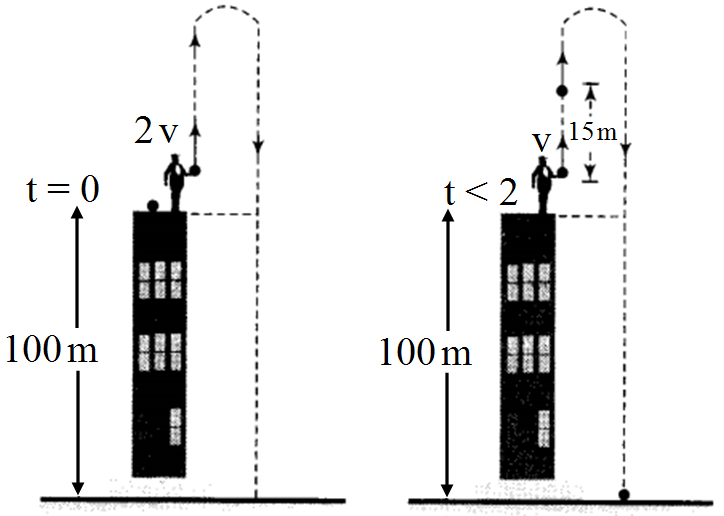 Let the speeds of the two balls (1 and 2) be v1 and v2 where: if