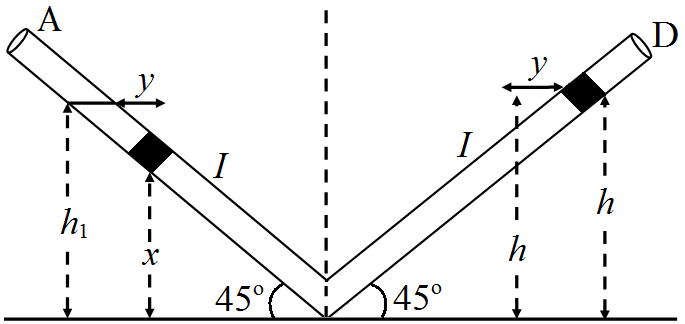
 Then iy's mass $\text{dm}=\text{A}.\text{dx}\rho.$A = area of cross section of tube. P.E. of the left dm element column = (dm)g h P.E. of dm element in left column $\text{A}\rho\text{g x dx}$ Total P.E. in left column $=\int_{0}^{\text{h}}\text{A}\rho\text{gx dx}=\text{A}\rho\text{g}\Big[\frac{\text{x}^2}{2}\Big]^\text{h}_0$
 $=\text{A}\rho\text{g}\frac{\text{h}_1^2}{2}$
from figure $\sin45^\circ=\frac{\text{h}_1}{\text{l}}$$\text{h}_1=\text{h}_2=\text{l}\sin45^\circ=\frac{\text{l}}{\sqrt{2}}$
$\therefore\text{h}_1^2=\text{h}_2^2=\frac{\text{l}^2}{2}$
$\therefore$ P.E. in left column $=\text{A}\rho\text{g}\frac{\text{l}^2}{4}$
Similarly P.E. in right column $=\text{A}\rho\text{g}\frac{\text{l}^2}{4}$$\therefore$ total potential energy $=\text{A}\rho\text{g}\ \frac{\text{l}^2}{4}+\text{A}\rho\text{g}\frac{\text{l}^2}{4}=\frac{\text{A}\rho\text{gl}^2}{2}$
Due to pressure difference, let element moves towards right side y is unit. Then the liquid column is left arm = (l - y) And the liquid column is right arm = (l + y) P.E. of liquid column in left arm $=\text{A}\rho\text{g}(\text{l}-\text{y})^2\sin^245^\circ$ P.E. of liquid column in right arm $=\text{A}\rho\text{g}(\text{l}+\text{y})^2\sin45^\circ$ $\therefore$ Total P.E. due liquid column $=\text{A}\rho\text{g}\Big(\frac{1}{\sqrt{2}}\Big)^2[(\text{l}-\text{y})^2+(\text{l}+\text{y})^2]$ Final P.E. due to different in liquid columns$=\frac{\text{A}\rho\text{g}}{2}[\text{l}^2+\text{y}^2-2\text{ly}+\text{l}^2+\text{y}^2+2\text{ly}]$
Final P.E. $=\frac{\text{A}\rho\text{g}}{2}(2\text{l}^2+2\text{y}^2)$ Change P.E. = final P.E. - Initial P.E.$=\frac{\text{A}\rho\text{g}}{2}(2\text{l}^2+2\text{y}^2)-\frac{\text{A}\rho\text{gl}^2}{2}$
$=\frac{\text{A}\rho\text{g}}{2}\ [2\text{l}^2+2\text{y}^2-\text{l}^2]$
Change in P.E. $=\frac{\text{A}\rho\text{g}}{2}\ (\text{l}^2+2\text{y}^2)$ If change in velocity (v) of total liquid column$\Delta\text{KE}=\frac{1}{2}\text{mv}^2$
$\text{m}=(A.2\text{l})\rho$
$\Delta\text{kE}=\frac{1}{2}\ (\text{A}2\ \text{l}\rho)\text{v}^2=\text{A}\rho\text{lv}^2$
$\therefore$ Change in total energy $=\frac{\text{A}\rho\text{g}}{2}(\text{l}^2+2\text{y}^2)+-\text{A}\rho\text{lv}^2$
Total change in energy $\Delta\text{PE}+\Delta\text{KE}=0$$\therefore\frac{\text{A}\rho\text{g}}{2}\ [\text{l}^2+2\text{y}^2]+\text{A}\rho\text{lv}^2=0$
$\frac{\text{A}\rho}{2}[\text{g}(\text{l}^2+2\text{y}^2)+2\text{lv}^2]=0$
$\frac{\text{A}\rho}{2}\neq0$
$\therefore\text{g}(\text{l}^2+2\text{y}^2)+2\text{lv}^2=0$
Differentiating W.R.T, $\text{g}\Big[0+2\times2\text{y}\ \frac{\text{dy}}{\text{dt}}\Big]+2\text{l}.2\text{v}.\frac{\text{dv}}{\text{dt}}=0$$4\text{gy}\ \frac{\text{dy}}{\text{dt}}+4\text{vl}\ \frac{\text{d}^2\text{y}}{\text{dt}^2}=0$ $\Big[\because\text{A}=\frac{\text{dv}}{\text{dt}}=\frac{\text{d}^2\text{y}}{\text{dt}^2}\Big]$
$4\text{gy}.\text{v}+4\text{vl}\frac{\text{d}^2\text{y}}{\text{dt}^2}=0\Rightarrow4\text{v}\Big[\text{gy}+\text{l}.\frac{\text{d}^2\text{y}}{\text{dt}^2}\Big]=0$
$\frac{\text{d}^2\text{y}}{\text{dt}^2}+\frac{\text{g}}{\text{l}}\ \text{y}=0\ \because4\text{v}\neq0$
It is the equation of SHM oscillator and standard equation of SHM is $\frac{\text{d}^2\text{y}}{\text{dt}^2}+\omega^2\text{y}=0$$\frac{2\pi}{\text{T}}=\sqrt{\frac{\text{g}}{\text{l}}}\Rightarrow\text{T}=2\pi\sqrt{\frac{\text{l}}{\text{g}}}$
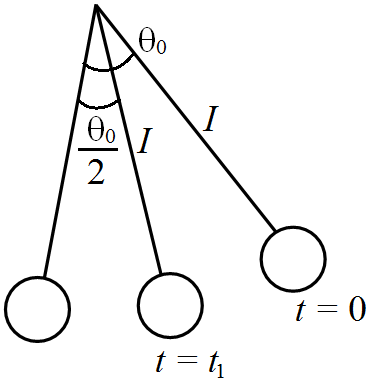
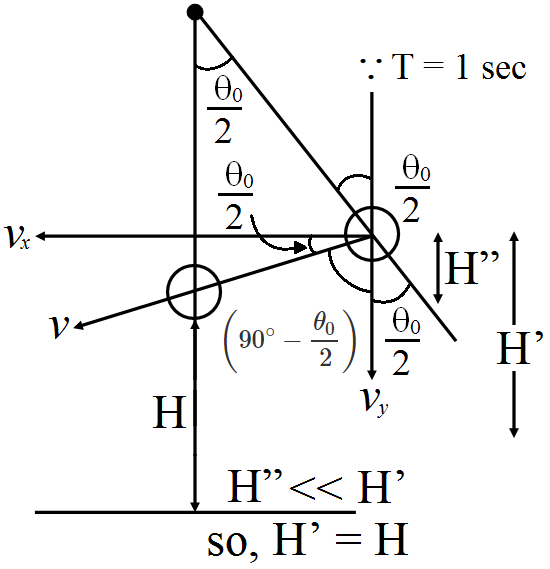
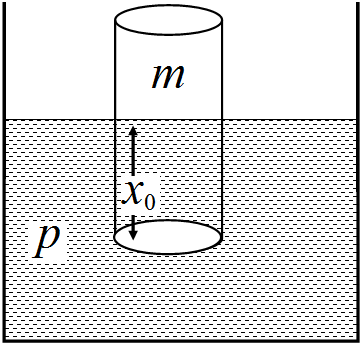 V = volume of liquid displaced by blocks Let when floats then
 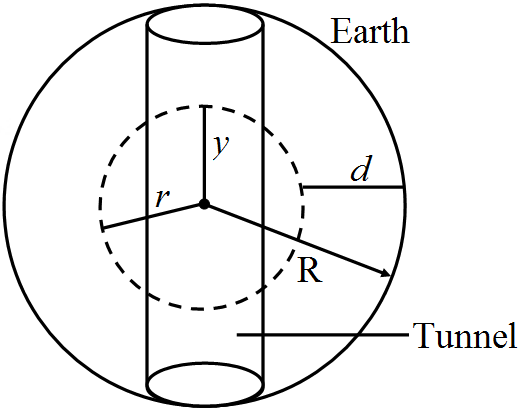 Force on both at depth is
 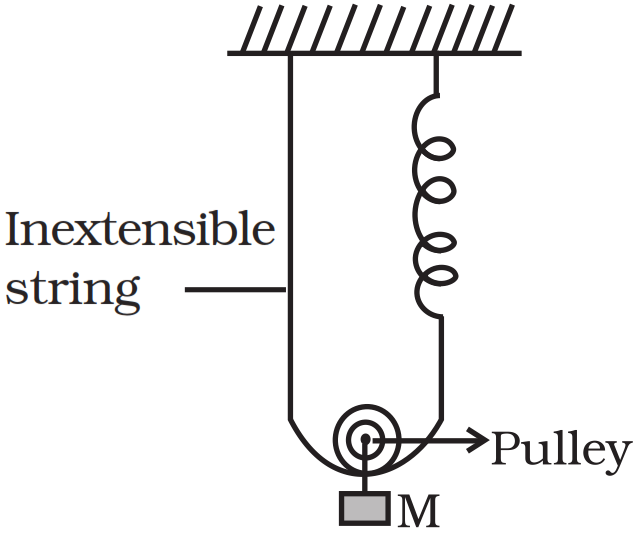 Let the mass be pulled through a distance y and then released. But, string is inextensible, hence the spring alone will contribute the total extension y + y = 2y, to lower the mass down by y from initial equilibrium mean position x0. So, net extension in the spring (x0 + 2y). From F.B.D of the block,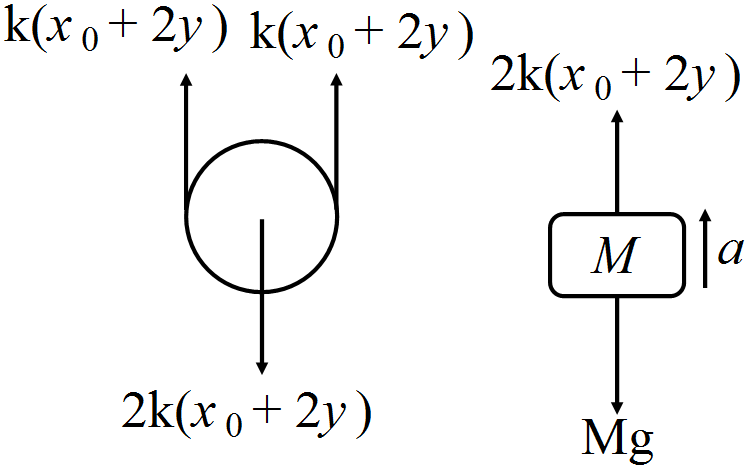
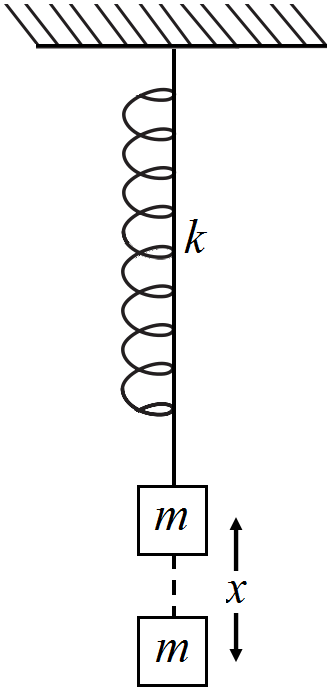 P.E = mg x But P.E. due to spring is
 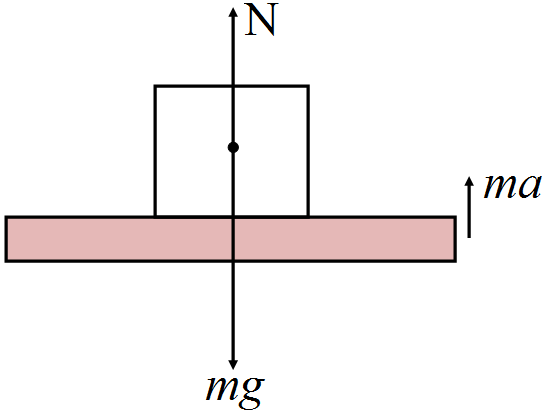 So motion is downward. Let with acceleration a then ma = mg - N ...(i) When platform lifts form its lowest position to upward ma = N - mg ...(ii)