Question types

Rest and Motion: Kinematics question types

89 questions across 6 question groups — pick any mix to generate a Physics paper with step-by-step answer keys.

89
Questions
6
Question groups
5
Question types
Sample Questions

Rest and Motion: Kinematics questions

One sample from each question group in this chapter. Select any group above to see the full set with answer keys.

In a projectile motion the velocity:
  1. Is always perpendicular to the acceleration.
  2. Is never perpendicular to the acceleration.
  3. Is perpendicular to the acceleration for one instant only.
  4. Is perpendicular to the acceleration for two instants.
View full solution
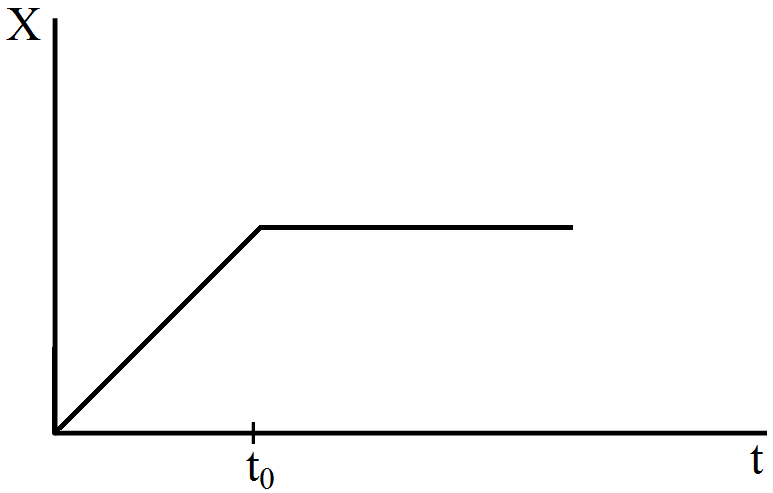
Figure shows the displacement-time graph of a particle moving on the X-axis.

  1. The particle is continuously going in positive x direction.
  2. The particle is at rest.
  3. The velocity increases up to a time to, and then becomes constant.
  4. The particle moves at a constant velocity up to a time to, and then stops.
View full solution
An object may have:
  1. Varying speed without having varying velocity.
  2. Varying velocity without having varying speed.
  3. Nonzero acceleration without having varying velocity.
  4. Nonzero acceleration without having varying speed.
View full solution
A river is flowing from west to east at a speed of 5 metres per minute. A man on the south bank of the river, capable of swimming at 10 metres per minute in still water, wants to swim across the river in the shortest time. He should swim in a direction:
  1. Due north.
  2. 30° east of north.
  3. 30° north of west.
  4. 60° east of north.
View full solution
Two projectiles A and B are projected with angle of projection 15° for the projectile A and 45° for the projectile B. If RA and RB be the horizontal range for the two projectiles, then:
  1. RA < RB
  2. RA = RB
  3. RA > RB
  4. The information is insufficient to decide the relation of RA with RB.
View full solution
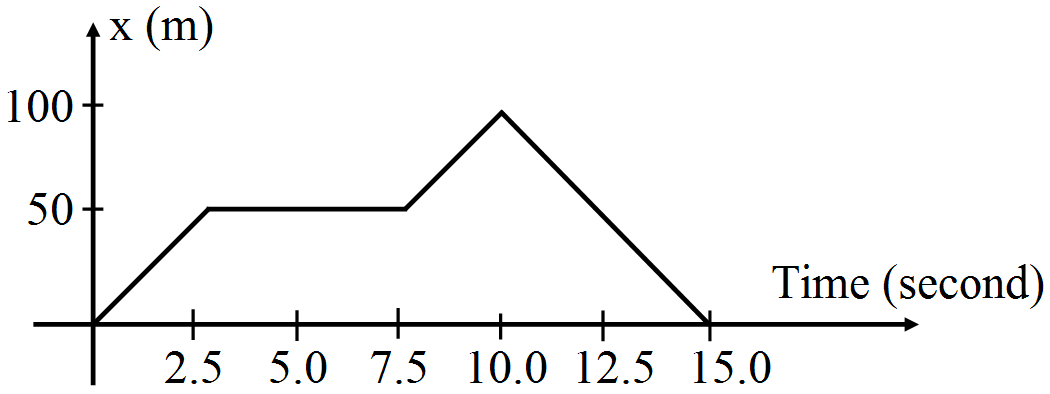
Figure shows the graph of the x-coordinate of a particle going along the X-axis as a function of time. Find:
  1. The average velocity during 0 to 10s.
  2. Instantaneous velocity at 2, 5, 8 and 12s.

View full solution
The increase in the speed of a car is proportional to the additional petrol put into the engine. Is it possible to accelerate a car without putting more petrol or less petrol into the engine?
View full solution
When a particle moves with constant velocity, its average velocity, its instantaneous velocity and its speed are all equal. Comment on this statement.
View full solution
The velocity of a particle is towards west at an instant. Its acceleration is not towards west, not towards east, not towards north and not towards south. Give an example of this type of motion.
View full solution
A ball is thrown vertically upward with a speed of 20m/s. Draw a graph showing the velocity of the ball as a function of time as it goes up and then comes back.
View full solution
When a person leaves his home for sightseeing by his car, the meter reads 12352km. When he returns home after two hours the reading is 12416km.
  1. What is the average speed of the car during this period?
  2. What is the average velocity?
View full solution
Give examples where:
  1. The velocity of a particle is zero but its acceleration is not zero.
  2. The velocity is opposite in direction to the acceleration.
  3. The velocity is perpendicular to the acceleration.
View full solution
Q 163 Marks Question3 Marks
Find the average velocity of a projectile between the instants it crosses half the maximum height. It is projected with a speed u at an angle $\theta$ with the horizontal.
View full solution
Q 183 Marks Question3 Marks
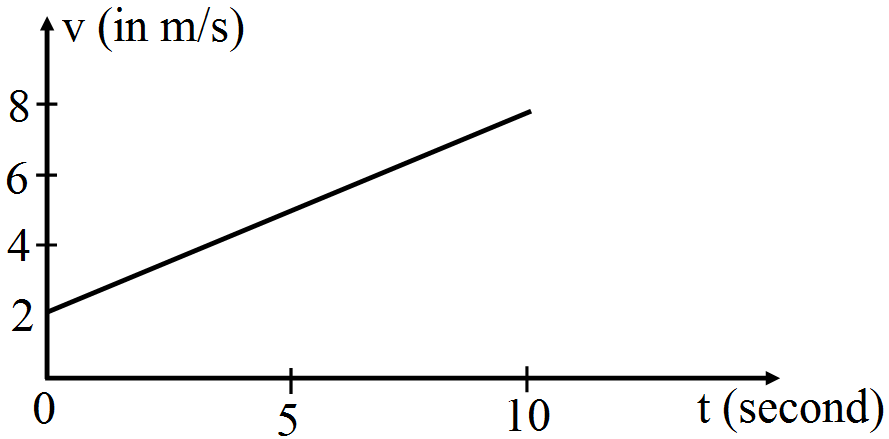
Figure shows the graph of velocity versus time for a particle going along the X-axis. Find:
  1. The acceleration.
  2. The distance travelled in 0 to 10s.
  3. The displacement in 0 to 10s.

View full solution
Q 193 Marks Question3 Marks
A river 400m wide is flowing at a rate of 2.0m/s. A boat is sailing at a velocity of 10m/s with respect to the water, in a direction perpendicular to the river.
  1. Find the time taken by the boat to reach the opposite bank.
  2. How far from the point directly opposite to the starting point does the boat reach the opposite bank?
View full solution
Q 203 Marks Question3 Marks
A person standing on the top of a cliff 171ft high has to throw a packet to his friend standing on the ground 228ft horizontally away. If he throws the packet directly aiming at the friend with a speed of 15.0ft/s, how short will the packet fall?
View full solution
Q 214 Marks Question4 Marks
Complete the following table:
Car Model
Driver X
Reaction time 0.20s
Driver Y
Reaction time 0.30s
A (deceleration on hard braking = 6.0m/s2)
Speed = 54km/h
Braking distance
a = ...
Total stopping distance
b = ...
Speed = 72km/h
Braking distance
c = ...
Total stopping distance
d = ...
B (deceleration on hard braking = 7.5m/s2)
Speed = 54km/h
Breaking distance
e = ...
Total stopping distance
f = ...
Speed 72km/h
Braking distance
g = ...
Total stopping distance
h = ...
View full solution
Q 224 Marks Question4 Marks
A player hits a baseball at some angle. The ball goes high up in space. The player runs and catches the ball before it hits the ground. Which of the two (the player or the ball) has greater displacement?
View full solution
Q 234 Marks Question4 Marks
A police jeep is chasing a culprit going on a motorbike. The motorbike crosses a turning at a speed of 72km/h. The jeep follows it at a speed of 90km/h, crossing the turning ten seconds later than the bike. Assuming that they travel at constant speeds, how far from the turning will the jeep catch up with the bike?
View full solution
Q 244 Marks Question4 Marks
Two friends A and B are standing a distance x apart in an open field and wind is blowing from A to B. A beats a drum and B hears the sound t1 time after he sees the event. A and B interchange their positions and the experiment is repeated. This time B hears the drum t2 time after he sees the event. Calculate the velocity of sound in still air v and the velocity of wind u. Neglect the time light takes in travelling between the friends.
View full solution
Q 254 Marks Question4 Marks
An elevator is descending with uniform acceleration. To measure the acceleration, a person in the elevator drops a coin at the moment the elevator starts. The coin is 6ft above the floor of the elevator at the time it is dropped. The person observes that the coin strikes the floor in 1 second. Calculate from these data the acceleration of the elevator.
View full solution
The benches of a gallery in a cricket stadium are 1m wide and 1m high. A batsman strikes the ball at a level one metre above the ground and hits a mammoth sixer. The ball starts at 35m/s at an angle of 53° with the horizontal. The benches are perpendicular to the plane of motion and the first bench is 110m from the batsman. On which bench will the ball hit?
View full solution
A person is standing on a truck moving with a constant velocity of 14.7m/s on a horizontal road. The man throws a ball in such a way that it returns to the truck after the truck has moved 58.8m. Find the speed and the angle of projection:
  1. As seen from the truck.
  2. As seen from the road.
View full solution
It is 260km from Patna to Ranchi by air and 320km by road. An aeroplane takes 30 minutes to go from Patna to Ranchi whereas a delux bus takes 8 hours.
  1. Find the average speed of the plane.
  2. Find the average speed of the bus.
  3. Find the average velocity of the plane.
  4. Find the average velocity of the bus.
View full solution
A stone is thrown vertically upward with a speed of 28m/s.
  1. Find the maximum height reached by the stone.
  2. Find its velocity one second before it reaches the maximum height.
  3. Does the answer of part.
  4. Change if the initial speed is more than 28m/s suchas 40m/s or 80m/s?
View full solution
An aeroplane has to go from a point A to another point B, 500km away due 30° east of north. A wind is blowing due north at a speed of 20m/s. The air-speed of the
plane is 150m/s.
  1. Find the direction in which the pilot should head the plane to reach the point B.
  2. Find the time taken by the plane to go from A to B.
View full solution

Generate a Rest and Motion: Kinematics paper free

Pick question groups from the list above, set marks and difficulty, and export a branded PDF with step-by-step answer keys. First 3 chapters free — no signup.

Download App