Question types

Systems of Particles and Rotational Motion question types

26 questions across 4 question groups — pick any mix to generate a Physics paper with step-by-step answer keys.

26
Questions
4
Question groups
5
Question types
Sample Questions

Systems of Particles and Rotational Motion questions

One sample from each question group in this chapter. Select any group above to see the full set with answer keys.

The net external torque on a system of particles about an axis is zero. Which of the following are compatible with it?
  1. The forces may be acting radially from a point on the axis.
  2. The forces may be acting on the axis of rotation.
  3. The forces may be acting parallel to the axis of rotation.
  4. The torque caused by some forces may be equal and opposite to that caused by other forces.
View full solution
View full solution
The variation of angular position  of a point on a rotating rigid body, with time t is shown in is the body rotating clock-wise or anti-clockwise?

View full solution
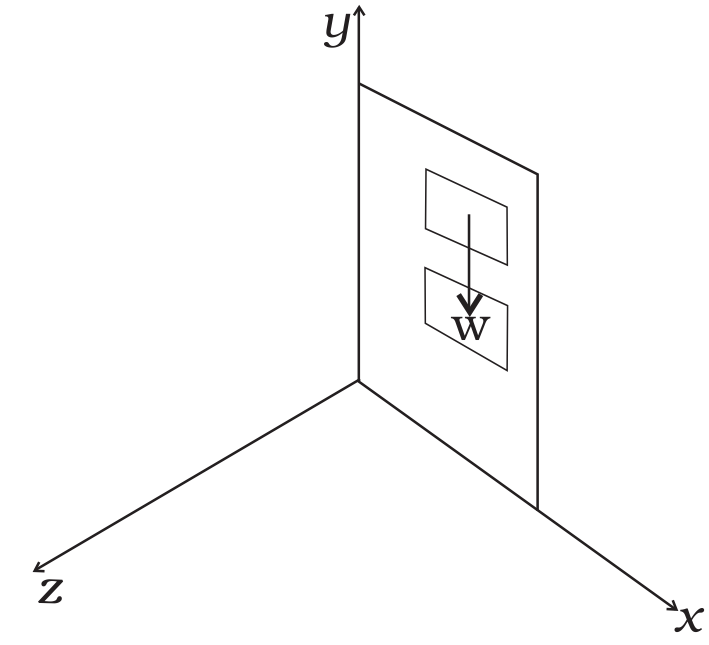
A door is hinged at one end and is free to rotate about a vertical axis. Does its weight cause any torque about this axis? Give reason for your answer.

View full solution
The vector sum of a system of non-collinear forces acting on a rigid body is given to be non-zero. If the vector sum of all the torques due to the system of forces about a certain point is found to be zero, does this mean that it is necessarily zero about any arbitrary point?
View full solution
The centre of gravity of a body on the earth coincides with its centre of mass for a ‘small’ object whereas for an ‘extended’ object it may not. What is the qualitative meaning of ‘small’ and ‘extended’ in this regard?
For which of the following the two coincides? A building, a pond, a lake, a mountain?
View full solution
Q 103 Marks Question3 Marks
Why does a solid sphere have smaller moment of inertia than a hollow cylinder of same mass and radius, about an axis passing through their axes of symmetry?
View full solution
A disc of radius R is rotating with an angular speed $\omega_\text{o}$ about a horizontal axis. It is placed on a horizontal table. The coefficient of kinetic friction is $\mu_\text{k}{:}$
  1. What was the velocity of its centre of mass before being brought in contact with the table?
  2. What happens to the linear velocity of a point on its rim when placed in contact with the table?
  3. What happens to the linear speed of the centre of mass when disc is placed in contact with the table?
  4. Which force is responsible for the effects in (b) and (c).
  5. What condition should be satisfied for rolling to begin?
  6. Calculate the time taken for the rolling to begin.
View full solution
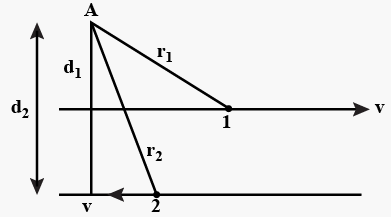
Two cylindrical hollow drums of radii R and 2R, and of a common height h, are rotating with angular velocities $\omega$ (anti-clockwise) and $\omega$ (clockwise), respectively. Their axes, fixed are parallel and in a horizontal plane separated by $(3\text{R}+\delta).$ They are now brought in contact $(\delta\rightarrow0){:}$
  1. Show the frictional forces just after contact.
  2. Identify forces and torques external to the system just after contact.
  3. What would be the ratio of final angular velocities when friction ceases?
View full solution
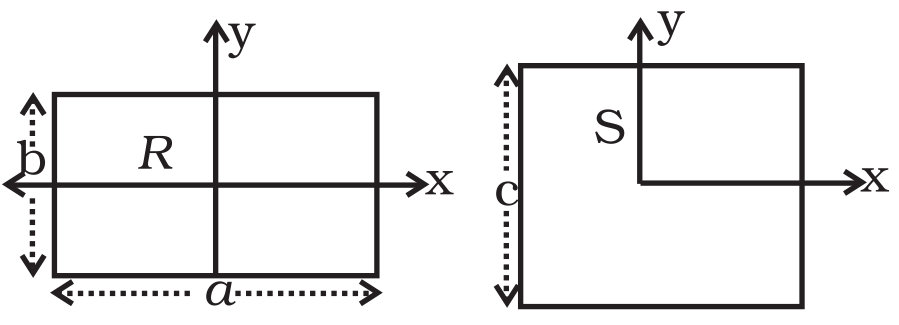
A uniform square plate S(side c) and a uniform rectangular plate R(sides b, a) have identical areas and masses:

Show that:

  1. $\frac{\text{I}_\text{xR}}{\text{I}_\text{xS}}<1$

  2. $\frac{\text{I}_\text{ys}}{\text{I}_\text{ys}}>1$

  3. $\frac{\text{I}_{2\text{R}}}{\text{I}_{2\text{s}}}>1$

View full solution
Two discs of moments of inertia I1 and I2 about their respective axes (normal to the disc and passing through the centre), and rotating with angular speed $\omega_1$ and $\omega_2$ are brought into contact face to face with their axes of rotation coincident.
  1. Does the law of conservation of angular momentum apply to the situation? why?
  2. Find the angular speed of the two-disc system.
  3. Calculate the loss in kinetic energy of the system in the process.
  4. Account for this loss.
View full solution
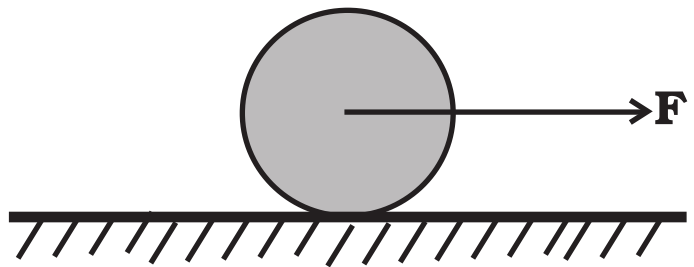
A uniform disc of radius R, is resting on a table on its rim.The coefficient of friction between disc and table is $\mu.$Now the disc is pulled with a force F as shown in the figure. What is the maximum value of F for which the disc rolls without slipping?

View full solution

Generate a Systems of Particles and Rotational Motion paper free

Pick question groups from the list above, set marks and difficulty, and export a branded PDF with step-by-step answer keys. First 3 chapters free — no signup.

Download App