Question 14 Marks
A sample contains a mixture of 108Ag and 110Ag isotopes each having an activity of 8.0 × 10⁸ disintegration per second. 110Ag is known to have larger half-life than 108Ag. The activity A is measured as a function of time and the following data are obtained.
| Time (s) | Activity (A) (108 disinte- grations s-1) | Time (s) | Activity (A) (108 disinte-grations s-1) |
| 20 | 11.799 | 200 | 3.0828 |
| 40 | 9.1680 | 300 | 1.8899 |
| 60 | 7.4492 | 400 | 1.1671 |
| 80 | 6.2684 | 500 | 0.7212 |
| 100 | 5.4115 |
- Plot ln $\Big(\frac{\text{A}}{\text{A}_0}\Big)$ versus time.
- See that for large values of time, the plot is nearly linear. Deduce the half-life of 110Ag from this portion of the plot.
- Use the half-life of 110Ag to calculate the activity corresponding to 108Ag in the first 50s.
- Plot In $\Big(\frac{\text{A}}{\text{A}_0}\Big)$ versus time for 108Ag for the first 50s.
- Find the half-life of 108Ag.
Answer
View full question & answer→Activities of sample containing 108Ag and 110Ag isotopes = 8.0 × 10⁸ disintegration/sec. 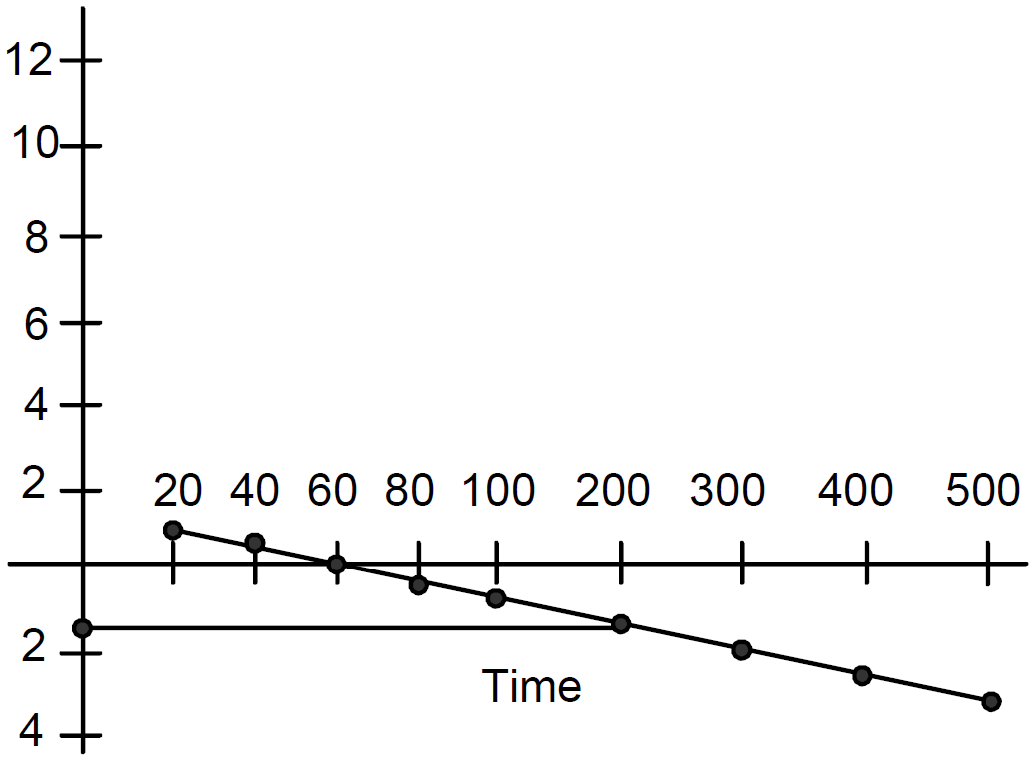
- Here we take A = 8 × 10⁸ dis./sec
- $\text{ln}\Big(\frac{\text{A}_1}{\text{A}_{0_{1}}}\Big)=\text{ln}\Big(\frac{11.79}{8}\Big)=0.389$
-
$\text{ln}\Big(\frac{\text{A}_2}{\text{A}_{0_{2}}}\Big)=\text{ln}\Big(\frac{9.1680}{8}\Big)=0.1362$
-
$\text{ln}\Big(\frac{\text{A}_3}{\text{A}_{0_{3}}}\Big)=\text{ln}\Big(\frac{7.4492}{8}\Big)=-0.072$
-
$\text{ln}\Big(\frac{\text{A}_4}{\text{A}_{0_{4}}}\Big)=\text{ln}\Big(\frac{6.2684}{8}\Big)=-0.244$
-
$\text{ln}\Big(\frac{5.4115}{8}\Big)=-0.391$
-
$\text{ln}\Big(\frac{3.0828}{8}\Big)=-0.954$
-
$\text{ln}\Big(\frac{1.8899}{8}\Big)=-1.443$
-
$\text{ln}\Big(\frac{1.167}{8}\Big)=-1.93$
-
$\text{ln}\Big(\frac{0.7212}{8}\Big)=-2.406$
- The half life of 110Ag from this part of the plot is 24.4s.
- Half life of 110Ag = 24.4s.
$\therefore\text{decay constant}\lambda=\frac{0.693}{24.4}=0.0284\Rightarrow\text{t}=50\text{sec,}$
The activity $\text{A = A}_{0}\text{e}^{-\lambda\text{t}}=8\times10^8\times\text{e}^{-0.0284\times50}=1.93\times10^8$
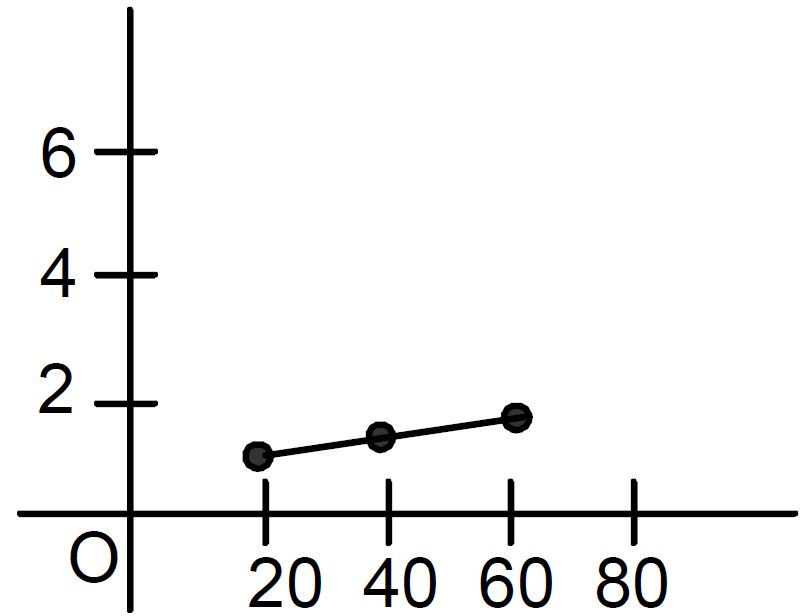
- The half life period of 108Ag from the graph is 144s.