Questions · Page 1 of 2

1 Marks Question

Take a timed test

50 questions · self-marked practice — reveal the answer and mark yourself.
Question 11 Mark
Is it possible to liquefy a gas at any condition?
Answer
No, beyond critical temperature, it is not possible to liquefy however large the pressure may be.
View full question & answer
Question 21 Mark
How much will be the internal energy change in:
  1. Isothermal process.
  2. Adiabatic process?
Answer
  1. Zero.
  2. nCvdT.
View full question & answer
Question 31 Mark
Work depends on path in a thermodynamical process. How?
Answer
Depending on the process carried out, the work done varies. So, it is dependent on path.
View full question & answer
Question 41 Mark
What type of process is a Carnot cycle?
Answer
Carnot cycle is a reversible cyclic process through which heat is converted into mechanical work.
View full question & answer
Question 51 Mark
Put a piece of chalk into water. The chalk will emit bubbles in all directions. Explain.
Answer
The perforations in it will get filled with water and the air is released as bubble.
View full question & answer
Question 61 Mark
Change in internal energy is independent of path followed. Is it true? Why?
Answer
Yes, change in internal energy depends on the change in temperature alone. So, it is independent of path.
View full question & answer
Question 71 Mark
A piece of lead is hammered. Does its internal energy increase? Does the heat enter the lead from outside?
Answer
Yes, internal energy of lead increases. No heat energy from outside enters the lead.
View full question & answer
Question 81 Mark
What is the nature of P-V diagram for isobaric and isochoric processes?
Answer
The P-V diagram for an isobaric process is a straight line parallel to volume axis while that for an isochoric process, it is a straight line parallel to pressure axis.
View full question & answer
Question 91 Mark
If on giving 40J of heat to a system, work done on the system is 10J. What will be the change in internal energy of the system?
Answer
Internal energy of the system will increase by 40 + 10 = 50 joule.
View full question & answer
Question 101 Mark
The coefficient of performance of a refrigerator depends on which factor?
Answer
The coefficient of performance of a refrigerator depends on the temperatures of source and sink.
View full question & answer
Question 111 Mark
Can the temperature of a system be increased without heating it?
Answer
Yes, for example in adiabatic compression.
View full question & answer
Question 121 Mark
Why can a Carnot's engine not get 100% efficiency?
Answer
Due to transmission loss, the energy required to carry the process itself and the inability to build a sink at zero kelvin, one cannot get 100% efficient Carnot's engine.
View full question & answer
Question 131 Mark
Why a gas is cooled when it expand?
Answer
When a gas expands, it does work on the surroundings. This work is done on the expense of internal energy and that is why its internal energy and so its temperature decreases.
View full question & answer
Question 141 Mark
Can two isothermal curves intersect? Why?
Answer
No, since then for two different sets of physical parameters the system may be identified, leading to different states.
View full question & answer
Question 151 Mark
What are the forces which make any process irreversible?
Answer
All sorts of dissipative forces, e.g. force of friction, viscous drag, electrical resistance, non-elasticity, thermal radiation, convection etc., make a real process irreversible.
View full question & answer
Question 161 Mark
What does the flat portion in an isotherm indicate?
Answer
Flat portion refers to the transition from gas to liquid as the gas is compressed. As temperature increases, the flat portion's size reduces.
View full question & answer
Question 171 Mark
What is the value of specific heat of water in S.I. units? Does it vary with temperature?
Answer
Specific heat of water is 4180J kg-1K-1. Yes, it does vary little with temperature.
View full question & answer
Question 181 Mark
Heat is being supplied to a system but the system does not perform any external work. Is it possible? If yes, how?
Answer
Yes, it is possible. If total quantity of heat $\Delta\text{Q}$ supplied to a system is retained by it as its increase in internal energy $\Delta\text{U}$ i.e., $\Delta\text{Q}-\Delta\text{U,}$ then the external work done by the system AW is zero. Isochoric process is an example of this type of process.
View full question & answer
Question 191 Mark
In summer, when the valve of a bicycle tube is removed, the escaping air appears cold. Why?
Answer
This happens due to adiabatic expansion of the air of the tube of the bicycle.
View full question & answer
Question 201 Mark
Find the values of two molar specific heats of nitrogen. Given, $\gamma=1.41$ and R = 8.31J mol-1K-1.
Answer
Given, R = 8.31J mol-1K-1 and $\gamma=1.41$
We know, $\text{C}_\text{V}=\frac{\text{R}}{(\gamma-1)}=\frac{8.31}{(1.41-1)}$
$=20.3\text{J mol}^{-1}\text{K}^{-1}$
$\because\frac{\text{C}_\text{p}}{\text{C}_\text{V}}=\gamma$
$\Rightarrow\text{C}_\text{p}=\text{C}_\text{v}.\gamma$
$=20.3\times1.41=28.263\text{J/mol}-\text{K}$
View full question & answer
Question 211 Mark
Two isothermal curves do not intersect each other, why?
Answer
If two isothermal curves intersect, this implies that the pressure and volume of a gas are the same at two different temperatures, that's impossible.
View full question & answer
Question 221 Mark
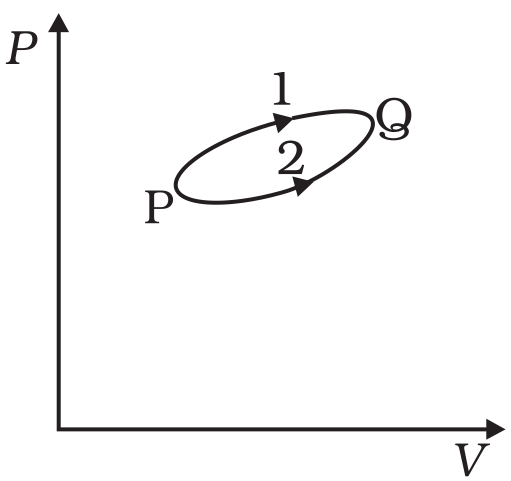
A system goes from P to Q by two different paths in the P-V diagram as shown in Fig. Heat given to the system in path 1 is 1000J. The work done by the system along path 1 is more than path 2 by 100J. What is the heat exchanged by the system in path 2?

Answer
For path (1) Q1 = +1000J
W.D =W1 - W2=100
W= WD through path 1
W2 = WD through path 2
$\therefore$ W= W1 - 100 As change in internal energy by path 1 and 2 are same
$\Delta\text{U}=\text{Q}_{1}-\text{W}_{1}=\text{Q}_{2}-\text{W}_{2}$
1000 - W= Q- (W- 100)
1000 = Q2 + 100
Q= 900J.
View full question & answer
Question 231 Mark
State Carnot's principle.
Answer
No engine working between two temperatures can be more efficient than a Carnot's reversible engine working between the same temperatures.
View full question & answer
Question 241 Mark
Write conditions for an isothermal process.
Answer
The conditions for an isothermal process are:
  1. The walls should be diathermic.
  2. The process should be quasi-static.
View full question & answer
Question 251 Mark
What is the change in internal energy of an ideal gas which is compressed/ expanded isothermally? Why?
Answer
Zero, because for an ideal gas internal energy is wholly kinetic and it is a function of temperature. As temperature remains constant in an isothermal process, hence, internal energy of an ideal gas remains constant.
View full question & answer
Question 261 Mark
What is the temperature at the bottom of a lake when water gets frozen with -ve temperature in the atmosphere?
Answer
It can go down only upto 4°C.
View full question & answer
Question 271 Mark
Is it possible to convert internal energy into work or mechanical energy?
Answer
Yes, for example in an adiabatic expansion and explosion of a bomb (chemical energy is converted into K.E.).
View full question & answer
Question 291 Mark
When a bottle of cold carbonated drink is opened, a slight fog is formed around the opening, why?
Answer
In opening of bottle, adiabatic expansion of gas causes lowering of temperature.
View full question & answer
Question 301 Mark
Three stars A, B, C appear as green, red and blue respectively. Which star has minimum temperature?
Answer
As $\text{T}\propto\frac{1}{\lambda_\text{m}}$ and $\lambda_\text{m}$ for red colour is maximum, therefore temperature T is minimum for star B emitting red colour.
View full question & answer
Question 311 Mark
If a gas is suddenly compressed, its temperature increases, why?
Answer
Because sudden compression of a gas is an adiabatic process. According to the first law of thermodynamics,
$\Delta\text{Q}=\Delta\text{U}+\Delta\text{W}$
$\because\Delta\text{Q}=0$
$\therefore\Delta\text{U}=-\Delta\text{W}$
$\because\Delta\text{W}=$ negative because work done on the gas
Thus, $\Delta\text{U}$ increases and gas temperature rises.
View full question & answer
Question 321 Mark
Find the efficiency of the Carnot engine working between boiling point and freezing point of water.
Answer
Efficiency of Carnot engine, $\eta=1-\frac{\text{T}_2}{\text{T}_1}$
$=1-\frac{273\text{K}}{373\text{K}}=\frac{100}{373}$
$=0.268=26.8\%$
View full question & answer
Question 331 Mark
What is the efficiency of a Carnot engine operating between boiling and freezing points of water?
Answer
$\eta=1-\frac{\text{T}_2}{\text{T}_1}$
$=1-\frac{273}{273}=0.27$
View full question & answer
Question 341 Mark
Apply first law of thermodynamics for isothermal expansion of an ideal gas.
Answer
First law of thermodynamics gives, $\Delta\text{Q}=\Delta\text{U}+\Delta\text{W}$
For an isothermal expansion, $\Delta\text{U}=0$
So, $\Delta\text{Q}=\Delta\text{W}$
For an isothermal expansion of the ideal gas work done by the gas is equal to the heat given to the ideal gas.
View full question & answer
Question 351 Mark
What is the value of $\gamma$ for a gas having 'n' degrees of freedom?
Answer
For n degrees of freedom,
$\text{C}_\text{v}=\frac{\text{n}}{2}\text{R},\text{C}_\text{P}=\Big(\frac{\text{n}}{2}+1\Big)\text{R}$
$\therefore\gamma=\frac{\text{C}_\text{P}}{\text{C}_\text{V}}=\frac{\frac{\text{n}}{2}+1}{\frac{\text{n}}{2}}=\frac{2+\text{n}}{\text{n}}$
View full question & answer
Question 361 Mark
Is first law a conservation law? How?
Answer
Yes, the total heat energy change is the sum of the internal energy change and work done.
$\Delta\text{Q}=\Delta\text{U}+\Delta\text{W}.$
View full question & answer
Question 371 Mark
A piece of lead is hammered. Does its internal energy increase? Does the heat enter the lead from outside?
Answer
Yes, internal energy of lead increases. No heat energy from outside enters the lead.
View full question & answer
Question 391 Mark
On what factors, the efficiency of a Carnot engine depends?
Answer
The efficiency of a carnot engine depends on the temperature of source of heat and the sink.
View full question & answer
Question 401 Mark
At what temperature do the Kelvin and Celsius scales coincide?
Answer
Kelvin and Celsius scales never coincide.
View full question & answer
Question 411 Mark
Can we decide whether change in internal energy of a system is due to heating or performance of work?
Answer
No, as internal energy might change due to both heating and performance of work.
View full question & answer
Question 421 Mark
Is reversible process possible in nature?
Answer
A reversible process is never possible in nature because of dissipative forces and condition for a quasi-static process is not practically possible.
View full question & answer
Question 431 Mark
Why can an engine working under isothermal conditions produce no useful work?
Answer
We know that $\eta=1-\frac{\text{T}_2}{\text{T}_1}$
For isothermal operation of the engine, $\text{T}_1=\text{T}_2$
So, $\eta=0$
Hence an engine working under isothermal condition can do no useful work.
View full question & answer
Question 441 Mark
Cp is greater than Cv why?
Answer
Cp is greater since under constant pressure process, the energy also does work.
View full question & answer
Question 451 Mark
Which one among a solid, liquid and gas of the same mass and at the same temperature has the greatest internal energy and which one has the least?
Answer
A gas has greatest internal energy and a solid has the least internal energy.
View full question & answer
Question 461 Mark
If the temperature of the sink is increased, what will happen to the efficiency of Carnot engine?
Answer
Efficiency, $\eta=1-\frac{\text{T}_1}{\text{T}_2}$
By increasing (T2), the efficiency of the Carnot engine will decrease.
View full question & answer
Question 471 Mark
Which thermodynamic law put restrictions on the complete conversion of heat into work?
Answer
According to second law of thermodynamics, heat energy cannot converted into work completely.
View full question & answer
Question 481 Mark
Is coefficient of performance of a refrigerator constant?
Answer
No, the coefficient of performance of refrigerator decreases with decrease in its inside temperature.
View full question & answer
Question 491 Mark
What is the specific heat of a gas in an isothermal process and in an adiabatic process?
Answer
Since $\text{s}=\frac{\text{Q}}{\text{m}\Delta\text{t}}$
For isothermal process, $\text{s}=\infty(\because\Delta\text{t}=0)$
For adiabatic process, $\text{s}=0.(\because\Delta\text{Q}=0)$
View full question & answer
Question 501 Mark
Why does a gas get heated on compression?
Answer
Because work done in compressing the gas increases the internal energy of the gas.
View full question & answer
1 Marks Question - Physics STD 11 Science Questions - Vidyadip