Question 14 Marks
Read the passage given below and answer the following questions from (i) to (v).
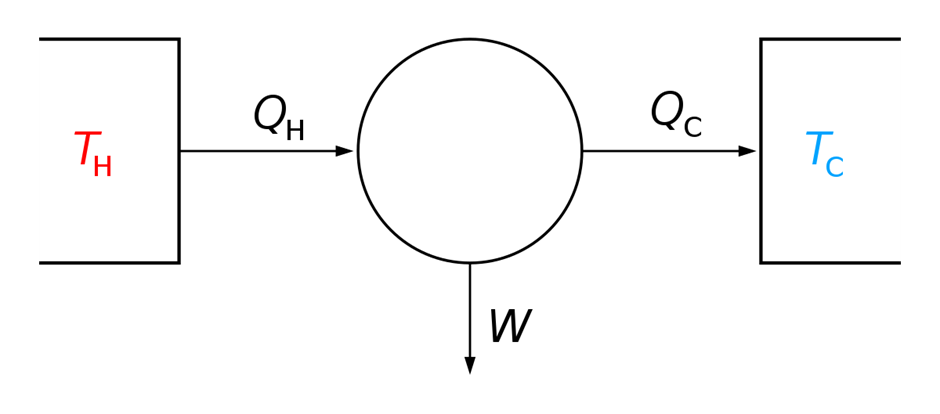
Kelvin-Planck statement: No process is possible whose sole result is the absorption of heat from a reservoir and the complete conversion of the heat into work.
Clausius statement: No process is possible whose sole result is the transfer of heat from a colder object to a hotter object. It can be proved that the two statements above are completely equivalent.
A thermodynamic process is reversible if the process can be turned back such that both the system and the surroundings return to their original states, with no other change anywhere else in the universe. a reversible process is an idealized motion. A process is reversible only if it is quasi-static (system in equilibrium with the surroundings at every stage) and there are no dissipative effects. For example, a quasi-static isothermal expansion of an ideal gas in a cylinder fitted with a frictionless movable piston is a reversible process.
The free expansion of a gas is irreversible. The combustion reaction of a mixture of petrol and air ignited by a spark cannot be reversed. Cooking gas leaking from a gas cylinder in the kitchen diffuses to the entire room. The diffusion process will not spontaneously reverse and bring the gas back to the cylinder. The stirring of a liquid in thermal contact with a reservoir will convert the work done into heat, increasing the internal energy of the reservoir. The process cannot be reversed exactly; otherwise it would amount to conversion of heat entirely into work, violating the Second Law of Thermodynamics. Irreversibility is a rule rather an exception in nature.
Kelvin-Planck statement: No process is possible whose sole result is the absorption of heat from a reservoir and the complete conversion of the heat into work.
Clausius statement: No process is possible whose sole result is the transfer of heat from a colder object to a hotter object. It can be proved that the two statements above are completely equivalent.
A thermodynamic process is reversible if the process can be turned back such that both the system and the surroundings return to their original states, with no other change anywhere else in the universe. a reversible process is an idealized motion. A process is reversible only if it is quasi-static (system in equilibrium with the surroundings at every stage) and there are no dissipative effects. For example, a quasi-static isothermal expansion of an ideal gas in a cylinder fitted with a frictionless movable piston is a reversible process.
The free expansion of a gas is irreversible. The combustion reaction of a mixture of petrol and air ignited by a spark cannot be reversed. Cooking gas leaking from a gas cylinder in the kitchen diffuses to the entire room. The diffusion process will not spontaneously reverse and bring the gas back to the cylinder. The stirring of a liquid in thermal contact with a reservoir will convert the work done into heat, increasing the internal energy of the reservoir. The process cannot be reversed exactly; otherwise it would amount to conversion of heat entirely into work, violating the Second Law of Thermodynamics. Irreversibility is a rule rather an exception in nature.
- The diffusion process is:
- Reversible process
- Irreversible process
- A quasi-static isothermal expansion of an ideal gas in a cylinder fitted with a frictionless movable piston is
- Reversible process
- Irreversible process
- State Kelvin Planck statement.
- State Clausius statement.
- Define reversible processes and irreversible processes of thermodynamics.
Answer
View full question & answer→- (b) Irreversible process
- (a) Reversible process
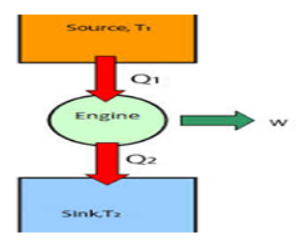
- Kelvin-Planck statement states that We cannot construct any device like the heat engine that operates on a cycle, absorbs the heat energy, and completely transforms this energy into an equal amount of work. Some of the heat gets released into the atmosphere. Practically no device bears 100% thermal efficiency.
- According to clausius It is nearly impossible for heat to move by itself from a temperature that is lower in temperature to a reservoir that is at a higher temperature. That is we can say that the transfer of heat can only occur spontaneously from high temperature to temperature. i.e No process is possible whose sole result is the transfer of heat from a colder object to a hotter object without any external work provided to do it in short we cannot construct a refrigerator that can operate without any input work.
- A thermodynamic process is said to be reversible if both the system and the surroundings return to their original states, with no other change anywhere else in the universe. On the other hand an irreversible process can be defined as a process in which the system and surrounding will not return to their original condition once the process is initiated.