Questions · Page 2 of 3

1 Marks Question

Question 511 Mark
In the given progressive wave $​​​​\text{y}=5\sin(100\pi\text{t+0.4x})$ where y and x are in m, t is in s. What is the:
Amplitude
Answer
Standard form of progressive wave travelling in $+\text{x}$ direction (kx and $\omega\text{}t$ have opposite sign is given)
Eqn. is $\text{y}=\text{a}\sin(\omega\text{t}-\text{kx}+\phi)$
$\text{y}=5\sin(100\pi\text{t}-0.4\pi\text{t}+0)$
Amplitude $\text{a}=5\text{m}$
View full question & answer
Question 521 Mark
What is the phase difference between the waves $\text{y}=\text{a}\cos(\omega\text{t}+\text{kx})$ and $\text{y}=\text{a}\sin (\omega\text{t}+\text{kx})?$
Answer
Phase difference $=\frac{\pi}{2}=90^\circ.$
View full question & answer
Question 531 Mark
State the factors on which the speed of a wave travelling along a stretched ideal string depends.
Answer
The speed of a wave travelling along a streched ideal string,
$\text{v}=\sqrt{\frac{\text{T}}{\text{m}}}$
where, T is the tension in the string and m is mass per unit length of the string.
Hence, it depends on two factors:
  1. Tension in the string.
  2. Mass per unit length.
View full question & answer
Question 541 Mark
What is reverberation?
Answer
The persistence of audible sound after the source has ceased to produce the sound is called reverberation.
View full question & answer
Question 551 Mark
For the travelling harmonic wave
$\text{y}(\text{x, t})=2.0\cos2\pi(10\text{t}-0.0080\text{x}+0.35)$
where x and y are in cm and t in s. Calculate the phase difference between oscillatory motion of two points separated by a distance of
$\frac{\lambda}{2},$
Answer
Equation for a travelling harmonic wave is given as:
$\text{y}(\text{x, t})=2.0\cos2\pi(10\text{t}-0.0080\text{x}+0.35)$
$=2.0\cos(20\pi\text{t}-0.016\pi\text{x}+0.70\pi)$
Where,
Propagation constant, $\text{k}=0.0160\pi$
Amplitude, a = 2cm
Angular frequency, $\omega=20\pi\text{ rad/s}$
Phase difference is given by the relation:
$\phi=\text{kx}=\frac{2\pi}{\lambda}$
For $\text{x}=\frac{\lambda}{2}$
$\phi=\frac{2\pi}{\lambda}\times\frac{\lambda}{2}=\pi\text{ rad}$
View full question & answer
Question 561 Mark
What is the effect on the velocity of waves in a string if only $\frac{1}{4}\text{th}$ of the original length is used with the same tension?
Answer
Since $\frac{\text{m}}{\text{l}}$ is not altered and tension is same, velocity will remain the same.
View full question & answer
Question 571 Mark
Given below are some functions of x and t to represent the displacement (transverse or longitudinal) of an elastic wave. State which of these represent (i) a travelling wave, (ii) a stationary wave or (iii) none at all:
$\text{y}=2\cos(3\text{x})\sin(10\text{t})$
Answer
The given equation represents a stationary wave because the harmonic terms kx and ωt appear separately in the equation.
View full question & answer
Question 581 Mark
Given below are some functions of x and t to represent the displacement (transverse or longitudinal) of an elastic wave. State which of these represent (i) a travelling wave, (ii) a stationary wave or (iii) none at all:
$\text{y}=2\sqrt{\text{x}-\text{vt}}$
Answer
The given equation does not contain any harmonic term. Therefore, it does not represent either a travelling wave or a stationary wave.
View full question & answer
Question 591 Mark
When a source moves at a speed greater than that of sound, will Doppler formula hold? What will happen?
Answer
No, as it is valid only when vs < v. When vs > v, shock waves are produced.
View full question & answer
Question 601 Mark
Why is sound heard more intense in carbon dioxide in comparison to air?
Answer
The intensity of sound increases with increase in density of the medium.
View full question & answer
Question 611 Mark
How is the vibration of the air column in a flute different from that of a string in a sitar?
Answer
The nodes in a sitar are replaced by the antinodes in a flute.
View full question & answer
Question 621 Mark
Given below are some functions of x and t to represent the displacement (transverse or longitudinal) of an elastic wave. State which of these represent (i) a travelling wave, (ii) a stationary wave or (iii) none at all:
$\text{y}=3\sin(5\text{x}-0.5\text{t})+4\cos(5\text{x}-0.5\text{t})$
Answer
The given equation represents a travelling wave as the harmonic terms kx and ωt are in the combination of $\text{kx}-\omega\text{t}.$
View full question & answer
Question 631 Mark
An open pipe makes a good musical instrument, in comparison to a closed pipe. Why?
Answer
In open pipe, all harmonics are possible, while in a closed pipe, only odd harmonics are possible.
View full question & answer
Question 641 Mark
What determines the type of wave motion in a medium?
Answer
Type of wave motion is determined by:
  1. Nature of the medium.
  2. Mode of excitation of wave motion.
View full question & answer
Question 651 Mark
Is Newton's law of motion applicable for material waves? Is this applicable for electromagnetic waves?
Answer
Newton's laws of motion are applicable for material waves but not applicable for electromagnetic waves.
View full question & answer
Question 661 Mark
Is it possible to have interference between the waves produced by two violins? Why?
Answer
No. This is because the sounds produced will not have a constant phase difference.
View full question & answer
Question 671 Mark
Does sound travel faster on a wet hot day or a dry cold day? Why?
Answer
Sound travels faster on a wet hot day due to high temperature and lesser density of wet air.
View full question & answer
Question 691 Mark
In a longitudinal wave, what is the distance between a compression and its nearest rarefraction?
Answer
$\frac{\lambda}{2}.$
View full question & answer
Question 701 Mark
What sort of waves are formed in a sitar wire when it is once plucked in the middle and then released?
Answer
Transverse stationary waves are formed in the sitar wire.
View full question & answer
Question 711 Mark
What is the relation between path difference and phase difference?
Answer
Phase difference $=\frac{2\pi}{\lambda}\times\text{path difference.}$
View full question & answer
Question 721 Mark
Two sounds of very close frequencies, say 256Hz and 260Hz are produced simultaneously. What is the frequency of resultant sound and also write the number of beats heard in one second?
Answer
No. of beats n = n2 - n1
= 260 - 256
= 4
Frequency of resultant sound is the average of the two frequencies 258Hz.
View full question & answer
Question 731 Mark
Explain why (or how):
A violin note and sitar note may have the same frequency, yet we can distinguish between the two notes,
Answer
The overtones produced by a sitar and a violin, and the strengths of these overtones, are different. Hence, one can distinguish between the notes produced by a sitar and a violin even if they have the same frequency of vibration.
View full question & answer
Question 741 Mark
If radius of a stretched wire is reduced to half, how is the wave speed affected?
Answer
As $v\propto\frac{1}{\sqrt{\text{r}}},$ therefore, wave speed becomes twice.
View full question & answer
Question 751 Mark
What is the distance between a compression and its nearest rarefaction in a longitudinal wave?
Answer
Distance between a compression and adjoining rarefaction is $\frac{\lambda}{2}.$
View full question & answer
Question 761 Mark
Explain why (or how):
Solids can support both longitudinal and transverse waves, but only longitudinal waves can propagate in gases,
Answer
This is because solids have both, the elasticity of volume and elasticity of shape, whereas gases have only the volume elasticity.
View full question & answer
Question 771 Mark
If oil of density higher than density of water is used in a resonance tube, how will the frequency change?
Answer
The frequency will not change. Because frequency depends on length of air column above the liquid surface in the tube.
View full question & answer
Question 781 Mark
The ratio of amplitude of two waves is 2 : 3. What is the ratio of intensities of these waves?
Answer
$\frac{\text{I}_1}{\text{I}_2}=\frac{\text{a}^2}{\text{b}^2}=\frac{2^2}{3^2}$
$=\frac{4}{9}$
View full question & answer
Question 801 Mark
If tension of a wire is increased to four times, how is the wave speed changed?
Answer
As $v\propto\sqrt{\text{T}},$ therefore, wave speed becomes twice.
View full question & answer
Question 811 Mark
What will be the speed of sound in a perfectly rigid rod?
Answer
The speed of sound in a perfectly rigid rod will be infinite.
View full question & answer
Question 821 Mark
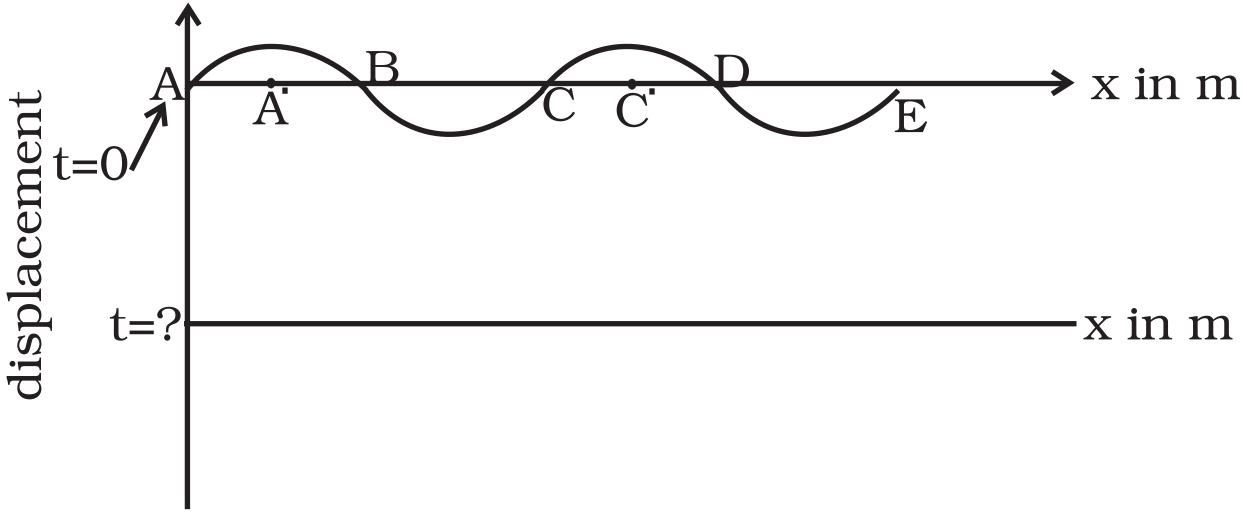
The pattern of standing waves formed on a stretched string at two instants of time are shown in The velocity of two waves superimposing to form stationary waves is 360ms–1 and their frequencies are 256Hz
  1. Calculate the time at which the second curve is plotted.
  2. Mark nodes and antinodes on the curve.
  3. Calculate the distance between A′ and C′.

Answer
Given frequency of the wave v = 256Hz
$\therefore\text{T}=\frac{1}{\text{v}}=\frac{1}{256}$ second = 0.00390
$\text{T}=3.9\times10^{-3}$ seconds.
(a) In stationary wave a particle passes though it's mean position after ever $\frac{\text{T}}{4}$ time
$\therefore$ in II nd curve displacement of all medium particle, are zero so
$\text{t}=\frac{\text{T}}{4}=\frac{3.9\times10^{-3}}{4}=.975\times10^{-3}\sec$
$\text{t}=9.8\times10^{-4}$ secound.
(b) Point does not vibrate i.t., their displacement is zero always so nodes A, B, C, D and E. the point A' and C' are at maximam displacement so there are anti-nodes  at A' and C'.
Between A' and C' $=\lambda=\frac{\text{v}}{\text{V}}=\frac{360}{256}=\frac{90}{64}=1.41\text{m}.$
View full question & answer
Question 831 Mark
When a vibrating tunning fork is moved speedily towards a wall, beats are heard. Why?
Answer
This is due to the difference in the frequency of the incident wave and the apparent frequency of the reflected wave.
View full question & answer
Question 841 Mark
For the travelling harmonic wave
$\text{y}(\text{x, t})=2.0\cos2\pi(10\text{t}-0.0080\text{x}+0.35)$
where x and y are in cm and t in s. Calculate the phase difference between oscillatory motion of two points separated by a distance of
4m.
Answer
Equation for a travelling harmonic wave is given as:
$\text{y}(\text{x, t})=2.0\cos2\pi(10\text{t}-0.0080\text{x}+0.35)$
$=2.0\cos(20\pi\text{t}-0.016\pi\text{x}+0.70\pi)$
Where,
Propagation constant, $\text{k}=0.0160\pi$
Amplitude, a = 2cm
Angular frequency, $\omega=20\pi\text{ rad/s}$
Phase difference is given by the relation:
$\phi=\text{kx}=\frac{2\pi}{\lambda}$
For x = 4 m = 400cm
$\phi=0.016\pi\times400=6.4\pi\text{ rad}$
View full question & answer
Question 861 Mark
Given below are some functions of x and t to represent the displacement (transverse or longitudinal) of an elastic wave. State which of these represent (i) a travelling wave, (ii) a stationary wave or (iii) none at all:
$\text{y}=\cos\text{x}\sin\text{t}+\cos2\text{x}\sin2\text{t}$
Answer
The given equation represents a stationary wave because the harmonic terms kx and $\omega\text{t}$ appear separately in the equation. This equation actually represents the superposition of two stationary waves.
View full question & answer
Question 871 Mark
Periodic rise and fall of intensity of sound when two sound waves moving in same direction, having same amplitude but differ in frequency by less than 10 is known as ________.
Answer
Periodic rise and fall of intensity of sound when two sound waves moving in same direction, having same amplitude but differ in frequency by less than 10 is known as beat.
View full question & answer
Question 881 Mark
What is the phase difference between two successive crests in a transverse wave?
Answer
Phase difference between two successive crests in a transverse wave is $2\pi$ rad.
View full question & answer
Question 891 Mark
A pipe 20cm long is closed at one end. Which harmonic mode of the pipe is resonantly excited by a source of 1237.5Hz?(sound velocity in air = 330ms–1)
Answer
Length of pipe, $\text{l}=20\text{cm}=20\times10^{-2}\text{m}$
Fundamental frequency of closed organ pipe
$\text{f}_0=\frac{\text{v}}{4\text{}L}=\frac{330}{4\times20\times10^{-2}}=412.5\text{Hz}$
$\frac{\text{f given}}{\text{f}_0}=\frac{1237.5}{412.5}=3$

View full question & answer
Question 901 Mark
When will Doppler effect in sound be symmetrical?
Answer
When the velocity of the source or observer is very much less than the velocity of sound.
View full question & answer
Question 911 Mark
For the harmonic travelling wave $\text{y}=2\cos2\pi(10\text{t}-0.0080\text{x}+3.5)$ where x and y are in cm and t is second. What is the phase difference between the oscillatory motion at two points separated by a distance of:
$\frac{3\lambda}{4}$(at a given instant of time)
Answer
$\text{y}=2\cos2\pi(10\text{t}-0.0080\text{x+3.5})$

$\text{y}=2\cos(20\pi\text{t}-0.0016\pi\text{x}+7.0\pi)$

Wave is propagated in $+\text{x}$ direction because $\omega\text{t}$ and kx are in with opposite sign standard equation $\text{y}=\text{a}\cos(\omega\text{t}-\text{kx}+\phi)$

a = 2, $\omega=20\pi,\ \text{k}=0.016\pi$ and $\phi=7\pi$

$\Delta\phi=\frac{2\pi}{\lambda}\text{p}=\frac{2\pi}{\lambda}\times\frac{3\pi}{4}=\frac{3}{2}\pi\ \text{radian}$

View full question & answer
Question 931 Mark
A transverse harmonic wave on a string is described by
$\text{y}(\text{x, t})=3.0\sin\big(36\text{t}+0.018\text{x}+\frac{\pi}{4}\big)$
where x and y are in cm and t in s. The positive direction of x is from left to right.
What is the initial phase at the origin?
Answer
$\frac{\pi}{4}$
Explanation:
Given,
$\text{y}(\text{x, t})=3\sin\big(36\text{t}+0.018\text{x}+\frac{\pi}{4}\big)$
Initial phase at the origi $=\frac{\pi}{4}$
View full question & answer
Question 941 Mark
Why should the difference between the frequencies be less than 10 to produce beats?
Answer
Human ear cannot identify any change in intensity is less than $\Big(\frac{1}{10}\Big)\text{th}$ of a second. So, difference should be less than 10.
View full question & answer
Question 951 Mark
Is the phenomenon of beats observable in case of two light waves of nearly equal frequencies?
Answer
No, this is because phase difference due to two independent light sources changes rapidly and randomly at a given position.
View full question & answer
Question 961 Mark
What causes the rolling sound of thunder?
Answer
The rolling sound of thunder is due to multiple reflection of sound of lightning.
View full question & answer
Question 971 Mark
Velocity of sound in air at N.T.P. is 332m/s. What will be the velocity, when pressure is doubled and temperature is kept constant?
Answer
v = 332m/s, as there is no effect of change in pressure when temperature remains constant.
View full question & answer
Question 991 Mark
At the same temperature and pressure, the densities of two diatomic gases are d, and d. What is the ratio of the speeds of sound in these gases?
Answer
$\frac{v_1}{v_2}=\sqrt{\frac{\text{d}_2}{\text{d}_1}}$
View full question & answer
1 Marks Question - Page 2 - Physics STD 11 Science Questions - Vidyadip