Question 14 Marks
Read the passage given below and answer the following questions from 1 to 5.
Transverse and Longitudinal Waves Transverse waves forms if the particles of the medium vibrate at right angle to the direction of wave motion energy propagation, the wave is called transverse wave. These are propagated as crests and troughs.
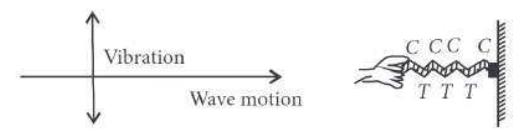
Longitudinal waves forms if the particles of the medium vibrate in the direction of wave motion, the wave is called longitudinal. These are propagated as compressions and rarefactions and wave is also known as pressure or compressional wave. Wave on spring or sound waves in air are examples of longitudinal waves.

Transverse and Longitudinal Waves Transverse waves forms if the particles of the medium vibrate at right angle to the direction of wave motion energy propagation, the wave is called transverse wave. These are propagated as crests and troughs.
Longitudinal waves forms if the particles of the medium vibrate in the direction of wave motion, the wave is called longitudinal. These are propagated as compressions and rarefactions and wave is also known as pressure or compressional wave. Wave on spring or sound waves in air are examples of longitudinal waves.
- In a transverse wave, the particles of the medium:
- Vibrate in a direction perpendicular to the direction of the propagation.
- Vibrate in a direction parallel to the direction of the propagation.
- Move in circle.
- Move in ellipse.
- A transverse wave consists of:
- Only crests
- Only troughs
- Both crests and troughs
- Rarefactions and compressions
- Ultrasonic waves produced by a vibrating quartz crystal are:
- Only longitudinal.
- Only transverse.
- Both longitudinal and transverse.
- Neither longitudinal nor transverse.
- Sound waves travel fastest in:
- Solids
- Liquids
- Gases
- Vacuum
- Sound waves in air cannot be polarized because:
- Their speed is small
- They require medium
- They are longitudinal
- Their speed is temperature dependent
Answer
View full question & answer→- (a) Vibrate in a direction perpendicular to the direction of the propagation.
Explanation:
In a transverse wave, the particles of the medium vibrate in a direction perpendicular to the direction of the propagation.
- (c) Both crests and troughs
Explanation:
A transverse wave travels through a medium in the form of crests and troughs.
- (a) Only longitudinal.
Explanation:
Ultrasonic waves produced by a vibrating quartz crystal are longitudinal.
- (a) Solids
Explanation:
Sound waves travel fastest in solids.
- (c) They are longitudinal
Explanation:
Sound waves are longitudinal waves that is why in air they cannot be polarized.