Questions

1 Marks Question

Take a timed test

9 questions · self-marked practice — reveal the answer and mark yourself.

Question 11 Mark
For the harmonic travelling wave $\text{y}=2\cos2\pi(10\text{t}-0.0080\text{x}+3.5)$ where x and y are in cm and t is second. What is the phase difference between the oscillatory motion at two points separated by a distance of:$\frac{\lambda}{2}$
Answer
$\text{y}=2\cos2\pi(10\text{t}-0.0080\text{x+3.5})$$\text{y}=2\cos(20\pi\text{t}-0.0016\pi\text{x}+7.0\pi)$
Wave is propagated in $+\text{x}$ direction because $\omega\text{t}$ and kx are in with opposite sign standard equation $\text{y}=\text{a}\cos(\omega\text{t}-\text{kx}+\phi)$
a = 2, $\omega=20\pi,\ \text{k}=0.016\pi$ and $\phi=7\pi$
Path difference $\text{p}=\frac{\lambda}{2}$
$\Delta\phi=\frac{2\pi}{\lambda}\text{p}=\frac{2\pi}{\lambda}\times\frac{\lambda}{2}\pi\ \text{radian}$
View full question & answer
Question 21 Mark
In the given progressive wave $​​​​\text{y}=5\sin(100\pi\text{t+0.4x})$ where y and x are in m, t is in s. What is the:Frequency
Answer
Standard form of progressive wave travelling in $+\text{x}$ direction (kx and $\omega\text{}t$ have opposite sign is given) Eqn. is $\text{y}=\text{a}\sin(\omega\text{t}-\text{kx}+\phi)$$\text{y}=5\sin(100\pi\text{t}-0.4\pi\text{t}+0)$
Frequency $\text{v},\omega=2\pi\text{v}\Rightarrow\text{v}=\frac{\omega}{2\pi}\because\omega=100\pi$$\therefore\text{v}=\frac{100\pi}{2\pi}=50\text{Hz}$
View full question & answer
Question 31 Mark
In the given progressive wave $​​​​\text{y}=5\sin(100\pi\text{t+0.4x})$ where y and x are in m, t is in s. What is the:
Wave velocity
Answer
Standard form of progressive wave travelling in $+\text{x}$ direction kx and $\omega\text{}t$ have opposite sign is given) Eqn. is $\text{y}=\text{a}\sin(\omega\text{t}-\text{kx}+\phi)$$\text{y}=5\sin(100\pi\text{t}-0.4\pi\text{t}+0)$
Wave velocity $\text{v}=\text{v}\lambda=50\times5=250\text{m/ s}$
View full question & answer
Question 41 Mark
Given below are some functions of x and t to represent the displacement of an elastic wave.$\text{y}=4\sin(5\text{x}-\text{t/ 2})+3\cos(5\text{x}-\text{t/ 2})$
Answer
A stationary wave of the for $\text{y}=5\cos(4\text{x})\sin20\text{t}$ is a stationary wave so (b) (i).
View full question & answer
Question 51 Mark
For the harmonic travelling wave $\text{y}=2\cos2\pi(10\text{t}-0.0080\text{x}+3.5)$ where x and y are in cm and t is second. What is the phase difference between the oscillatory motion at two points separated by a distance of:0.5m
Answer
$\text{y}=2\cos2\pi(10\text{t}-0.0080\text{x+3.5})$$\text{y}=2\cos(20\pi\text{t}-0.0016\pi\text{x}+7.0\pi)$
Wave is propagated in $+\text{x}$ direction because $\omega\text{t}$ and kx are in with opposite sign standard equation $\text{y}=\text{a}\cos(\omega\text{t}-\text{kx}+\phi)$
a = 2, $\omega=20\pi,\ \text{k}=0.016\pi$ and $\phi=7\pi$
Path differencee p = 0.5m = 50cm
$\Delta\phi=\text{kp}=0.016\pi\times50=0.8\pi$ red.
View full question & answer
Question 61 Mark
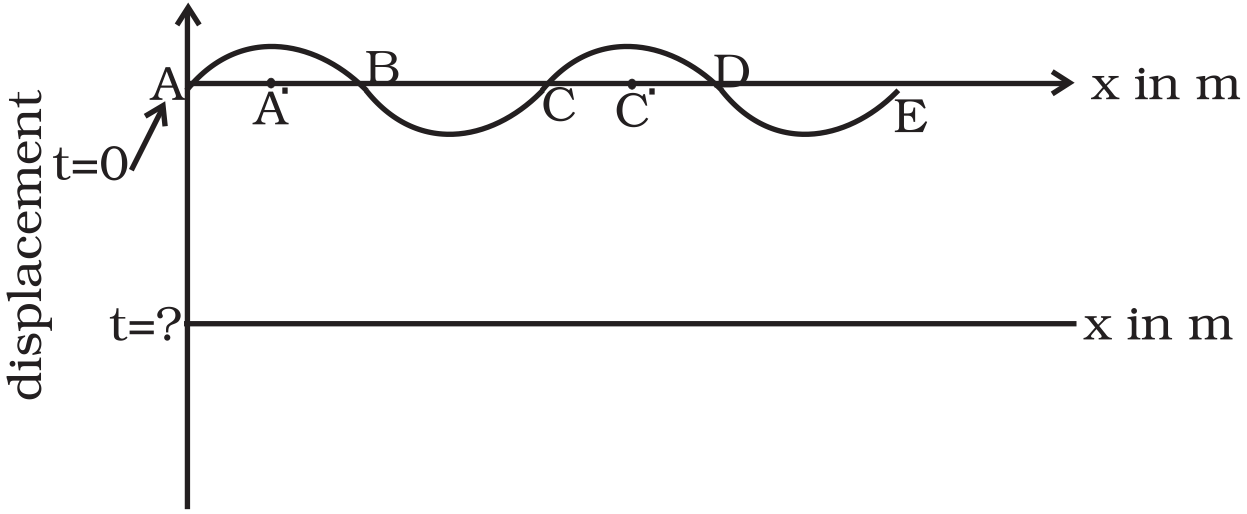
The pattern of standing waves formed on a stretched string at two instants of time are shown in The velocity of two waves superimposing to form stationary waves is $360ms^{–1}$ and their frequencies are $256Hz$
  1. Calculate the time at which the second curve is plotted.
  2. Mark nodes and antinodes on the curve.
  3. Calculate the distance between A′ and C′.
Answer
Given frequency of the wave v = 256Hz$\therefore\text{T}=\frac{1}{\text{v}}=\frac{1}{256}$ second = 0.00390
$\text{T}=3.9\times10^{-3}$ seconds.
(a) In stationary wave a particle passes though it's mean position after ever $\frac{\text{T}}{4}$ time$\therefore$ in II nd curve displacement of all medium particle, are zero so
$\text{t}=\frac{\text{T}}{4}=\frac{3.9\times10^{-3}}{4}=.975\times10^{-3}\sec$
$\text{t}=9.8\times10^{-4}$ secound.
(b) Point does not vibrate i.t., their displacement is zero always so nodes A, B, C, D and E. the point A' and C' are at maximam displacement so there are anti-nodes at A' and C'. Between A' and C' $=\lambda=\frac{\text{v}}{\text{V}}=\frac{360}{256}=\frac{90}{64}=1.41\text{m}.$
View full question & answer
Question 71 Mark
A pipe 20cm long is closed at one end. Which harmonic mode of the pipe is resonantly excited by a source of 1237.5Hz?(sound velocity in air $= 330ms^{–1}$)
Answer
Length of pipe, $\text{l}=20\text{cm}=20\times10^{-2}\text{m}$ Fundamental frequency of closed organ pipe$\text{f}_0=\frac{\text{v}}{4\text{}L}=\frac{330}{4\times20\times10^{-2}}=412.5\text{Hz}$
$\frac{\text{f given}}{\text{f}_0}=\frac{1237.5}{412.5}=3$
View full question & answer
Question 81 Mark
For the harmonic travelling wave $\text{y}=2\cos2\pi(10\text{t}-0.0080\text{x}+3.5)$ where x and y are in cm and t is second. What is the phase difference between the oscillatory motion at two points separated by a distance of:$\frac{3\lambda}{4}$(at a given instant of time)
Answer
$\text{y}=2\cos2\pi(10\text{t}-0.0080\text{x+3.5})$$\text{y}=2\cos(20\pi\text{t}-0.0016\pi\text{x}+7.0\pi)$
Wave is propagated in $+\text{x}$ direction because $\omega\text{t}$ and kx are in with opposite sign standard equation $\text{y}=\text{a}\cos(\omega\text{t}-\text{kx}+\phi)$
a = 2, $\omega=20\pi,\ \text{k}=0.016\pi$ and $\phi=7\pi$
$\Delta\phi=\frac{2\pi}{\lambda}\text{p}=\frac{2\pi}{\lambda}\times\frac{3\pi}{4}=\frac{3}{2}\pi\ \text{radian}$
View full question & answer
Question 91 Mark
In the given progressive wave $​​​​\text{y}=5\sin(100\pi\text{t+0.4x})$ where y and x are in m, t is in s. What is the:
Amplitude
Answer
Standard form of progressive wave travelling in $+\text{x}$ direction (kx and $\omega\text{}t$ have opposite sign is given) Eqn. is $\text{y}=\text{a}\sin(\omega\text{t}-\text{kx}+\phi)$$\text{y}=5\sin(100\pi\text{t}-0.4\pi\text{t}+0)$
Amplitude $\text{a}=5\text{m}$
View full question & answer