Question 14 Marks
The US athlete Florence Griffith-Joyner won the 100m sprint gold medal at Seol Olympic 1988 setting a new Olympic record of 10.54s. Assume that she achieved her maximum speed in a very short-time and then ran the race with that speed till she crossed the line. Take her mass to be 50kg.
- Calculate the kinetic energy of Griffith-Joyner at her full speed.
- Assuming that the track, the wind etc. offered an average resistance of one tenth of her weight, calculate the work done by the resistance during the run.
- What power GriffithJoyner had to exert to maintain uniform speed?
Answer
View full question & answer→S = 100m, t = 10.54sec, m = 50kg
The motion can be assumed to be uniform because the time taken for acceleration is minimum.
Speed $\text{v}=\frac{\text{s}}{\text{t}}=9.487\text{m}/\text{s}$
So, K.E. $=\frac{1}{2}\text{mv}^2=2250\text{J}$
Weight = mg = 490J
given $\text{R}=\frac{\text{mg}}{10}=49\text{J}$
so, work done against resistance WF = -RS = -49 × 100 = -4900J
To maintain her uniform speed, she has to exert 4900J of energy to over come friction,
$\text{P}=\frac{\text{W}}{\text{t}}$
$=\frac{4900}{10.54}=465\text{W}$
The motion can be assumed to be uniform because the time taken for acceleration is minimum.
Speed $\text{v}=\frac{\text{s}}{\text{t}}=9.487\text{m}/\text{s}$
So, K.E. $=\frac{1}{2}\text{mv}^2=2250\text{J}$
Weight = mg = 490J
given $\text{R}=\frac{\text{mg}}{10}=49\text{J}$
so, work done against resistance WF = -RS = -49 × 100 = -4900J
To maintain her uniform speed, she has to exert 4900J of energy to over come friction,
$\text{P}=\frac{\text{W}}{\text{t}}$
$=\frac{4900}{10.54}=465\text{W}$
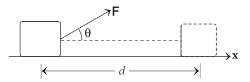 The work done by the force is defined to be the product of component of the force in the direction of the displacement and the magnitude of this displacement, thus
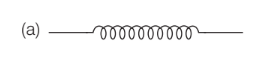
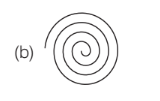 Usually, we assume that the springs are massless. Therefore, work done is stored in the spring in the form of elastic potential energy of the spring. Thus, potential energy of a spring is the energy associated with the state of compression or expansion of an elastic spring.