Questions

3 Marks Question

Take a timed test

49 questions · self-marked practice — reveal the answer and mark yourself.

Question 13 Marks
Among all sources of energy, why do you think nuclear power is the best option?
Answer
Nuclear power is best option for generating electric power. This can be stated from the following points:
  1. Nuclear energy plants produce electricity through the fission of uranium and not through burning of fuels. Consequently, nuclear power plants do not pollute the air with nitrogen oxides, sulfur oxides, dust or greenhouse gases like carbon dioxide.
  2. Although, the radioactive wastes produced by nuclear energy may be dangerous for thousands of years, part of the waste caused by the burning of coal remains dangerous forever.
View full question & answer
Question 23 Marks
Explain primary and secondary sources of energy.
Answer
Primary sources:
They are those sources which do not require any transformation before their use. They are directly used e.g., coal, lignite, petroleum, gas, etc.
Secondary sources:
The sources which involve transformation process before final use are referred to secondary sources e.g. transforming inputs of coal energy into electricity.
View full question & answer
Question 33 Marks
Discuss the role of three services needed in supply of electricity. Should they be in different hands?
Answer
Following are three services needed in supply of electricity:
  1. Generation of electricity.
  2. Transmission of electricity.
  3. Distribution of electricity.
All these services should be in different hands. Transmission of electricity should be in the hands of the government. The government and private sector may operate in the areas of generation of electricity and distribution of electricity. It would bring more and more financial resources in power sector as well as promote competition.
View full question & answer
Question 43 Marks
How are economic growth and infrastructure development related to each other?
Answer
How Infrastructure Promotes Growth: Sufficient availability of the power, water transport, etc may result in optimal utilisation of assets. Infrastructure developments such as transport, power, finance, etc expand the size of markets and improve productivity significantly. Infrastructure brings modern technology in all sectors. There is a close association between infrastructure spending on and GDP growth. Around 6.5% of the total value added is contributed by infrastructure services in UDCs, 9% in developing countries and 11% in developed countries. Infrastructural development is important not only for economic growth, globalisation and technological innovation in manufacturing but also for poverty reduction.
How Growth Promotes Infrastructure: Growth increases demand of infrastructure. Obviously, as income increases, people will demand more of transport, communication, energy, transport etc. Consequently, in UDCs, basic infrastructure such as water, irrigation is most important. In developing economies, demand for transport grows fast. In developed economies, power and telecommunication occupy more importance.
View full question & answer
Question 53 Marks
What is the significance of energy?
Answer
The most important factor which can act as a constraint on economic growth of a country is the availability of energy:
  1. There is a direct correlation between the degree of economic growth, size of per capita income and per capita consumption of energy.
  2. Energy is an essential input for all productive and economic activities like agricultural, industrial and service sectors providing services of banking, telecommunication, communication, etc. Energy is used for non-commercial purposes also for lighting, heating and cooking, etc. More than 60 per cent of Indian households depend upon different sources of energy for their regular needs.
View full question & answer
Question 63 Marks
Why is India's dependence on the imports of crude and petroleum products a negative feature of our energy sector?
Answer
Rising imports of crude and petroleum products have led to a severe balance of payments problem. On the other hand, the costs and prices of a wide range of goods have increased due to global inflation in oil. Inspite of stringent monetary and fiscal controls, the wholesale price index in India has been steadily rising. With heavy reliance on imported energy products like oil, a significant percentage of the export earnings, which otherwise could be channelised into productive domestic investments, is now being diverted to meet expenditure on these imported products.
View full question & answer
Question 73 Marks
Explain the two components of infrastructure.
Answer
The two components of infrastructure are economic infrastructure and social infrastructure.
  1. Economic infrastructure has a direct impact on the working of the system of production and includes such assets as roads, railways, airports, ports, power systems, telephones, water and sewage systems. The social infrastructure includes housing, health and education services and also some other social institutions that facilitate economic and social interaction, which affect the quality of life of the people.
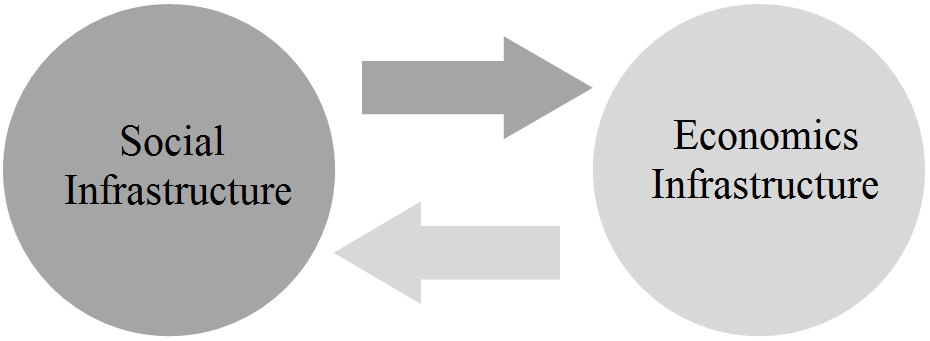
  2. Social infrastructure, on the other hand, needs the workers who will build the social assets. The two are interdependent in the sense that economic infrastructure is essential for increasing production and social infrastructure increases the productivity of workers who help in growth of production.
View full question & answer
Question 83 Marks
Why do we require grid for transmission of electricity?
Answer
Primary sources for electricity power are unevenly distributed and the generation plants are also unevenly located. Thus, bulky transmission of electric power over long distances becomes necessary. We require grid to synchronise power generation with transmission and distribution of electricity. Grid facilitates economising and increasing reliability. Grid avoids overloading of transmission lines, frequent breakdowns and loss of surplus power.
View full question & answer
Question 93 Marks
What do you mean by transmission and distribution losses? How can they be reduced?
Answer
Power transmission and distribution losses refer to the losses that occur in transmission of electricity between the sources of supply and points of distribution. These losses occur due to the inherent resistance and transformation inefficiencies in the electrical conductors (conducting wires, etc) and distribution transformers respectively. In most of the states of our country it is more than 20%. It is due to our backward technology and pilferage involving of official staff these losses can be reduced by using high quality wires of appropriate resistance and proper positioning of transformers.
View full question & answer
Question 103 Marks
Discuss the use pattern of energy consumption in India.
Answer
Consumption pattern of energy shows the percentage use of different sources (solar energy, wind energy, geo thermal energy, bio gas and tidal power). The consumption pattern of energy changes over time.
Commercial sources of energy: Commercial energy makes up about 65% of the total energy consumed in India. It includes coal with the largest share of 55%, followed by oil at 31%, natural gas at 11% and hydro energy at 3%.
Non commercial sources of energy: It consist of fire wood, cow dung and agriculture waste account for more than 30% of total energy consumption. The sectoral pattern of consumption of commercial energy shows that from 1953-54 to 1996-97, share of household sector increased from 1% to 9%; share of industrial sector from 40% to 42% and share of transport sector decreased from 44% to 22% and others increased from 5% to 15%.
View full question & answer
Question 113 Marks
Commercial energy is mostly used for commercial purposes in factories, farms and 'commercial establishments'. In the context of above statement, describe three sources of energy which are mostly used in India for commercial purposes in factories.
Answer
The three sources of energy mostly used in India for commercial purposes in factories are:
  1. Electricity It is the most useful and convenient source of energy in India. There are three main sources of electricity i.e., thermal, hydro and atomic power.
  2. Petroleum It is one of the important source of energy in India. India produces about 3 lakh tonnes of petrol against the demand of 34 lakh tonnes. The country imports 31 lakh tonnes.
  3. Coal It is primary source of energy and accounts for 54% of total energy consumption.
View full question & answer
Question 123 Marks
What is the significance of private sector in health care system in India?
Answer
Private sector is playing a significant role in health care system India. At present, private sector has proved much better than public sector in delivering quality health services. More than 70% of the hospitals in India are run by the private sector. 80% of out-patients and 46% of in-patients are handled by private sector. In 2001-02, there were more than 13 lakh medical enterprises employing 22 lakh people. 80% of them are single person owned and operated by one person occasionally employing a hired worker. Since the 1990s, owing to liberalisation measures, many non-resident Indians and industrial and pharmaceutical companies have set up state-of-the-art super specialty hospitals to attract India's rich and medical tourists.
View full question & answer
Question 133 Marks
A study estimates that medical costs alone push down 2.2% of the population below the poverty line each year. How?
Answer
Public health facilities are highly inadequate in our country. These facilities are also lacking in quality. So even poor and middle class people do not prefer to use these facilities.
So, in case of a medical emergency, they are forced to avail expensive services of private hospitals and health centres. These expenses prove to be a heavy burden on these families and they are forced to sell whatever valuables they have, to fund the treatment. This pushes the families below poverty line.
View full question & answer
Question 143 Marks
What changes are observed in the composition of infrastructure requirements as the economy develops?
Answer
In any country, as the income rises, the composition of infrastructure requirements changes significantly. For low income countries, basic infrastructure services like irrigation, transport and power are most important. As economies develop, most of their basic consumption demands are met. The share of agriculture in the economy shrink and more service-related infrastructure is required. That is why, the share of power, hotel and banking, telecommunication, etc is greater in high income countries.
View full question & answer
Question 153 Marks
Why is it advantageous to use hydel power as a source of energy?
Answer
The hydel power has several advantages:
  1. It is the most economical source of power.
  2. There is no problem of pollution or disposal of waste in generation of hydel power.
  3. Oil, coal, gas resources which can be used for producing electricity are in short supply. Whereas the supply of hydel power is not scarce.
View full question & answer
Question 163 Marks
Can you give some evidence to prove that health infrastructure has improved in India?
Answer
There is no doubt about it that health infrastructure in India has improved.
It can be proved from the statistics given below:
Public Health Infrastructure in India
Item
$1951$ $1981$ $2000$
Hospital
$2694$ $6805$ $15888$
Hospital/ Dispensary Bed
$117000$ $504538$ $719861$
Dispensaries
$6600$ $16745$ $23065$
$PHCs$
$725$ $9115$ $22842$
Subcenters
  $84736$ $137311$
$CHCs^-$
  $761$ $3043$
It is absolutely clear that number of hospitals, dispensaries, $PHCs, CHCs$ all have increased many times during $1951-2000.$
View full question & answer
Question 173 Marks
What is the role played by the infrastructure in the growth process of an economy?
Answer
According to a recent study by the IMF, infrastructure spending yields the best results, though it has the 'longest implementation lags. The upper bound for the impact of infrastructure spending is 1.8 i.e., a rupee spent on infrastructure will lead to a ₹1.8 impact on the economy. The upper bound for tax cuts is a third of this, at 0.6 because in uncertain employment conditions, consumers will not spend the money they save through the tax cuts. Government spending like social security, transfers to local governments and assistance to small enterprises are likely to be more beneficial than tax cuts. Given such linkage, infrastructural development is important economic growth, globalisation and technological innovation in manufacturing and for poverty reduction.
View full question & answer
Question 183 Marks
Review the importance and present position of the energy sector in the Indian economy.
Answer
Importance of energy:
  1. Energy is basic input required to sustain economic growth and to provide basic amenities of life for a country.
  2. Energy is the difference between a subsistence economy and a highly developed economy.
India is the fifth largest producer of electricity in the world, behind USA, China and Russia. Energy in India is produced from commercial and non-commercial sources. The bulk of the commercial energy is consumed in the industrial sector followed by the transport and household sectors whereas a large part of the energy requirement in the rural and domestic sectors is met from noncommercial sources Of the two sets of sources, thermal power accounts for about 81%, hydro power for about 13 percent, and nuclear for about 3%. In next ten years, energy requirements of the economy would multiply by two to six times depending upon the rate of growth of the economy. Even if India achieves only an annual average rate of growth of 5%, the per capita consumption of energy would multiply by about 2.5 times. It, therefore, becomes crucial to identify the sources.
View full question & answer
Question 193 Marks
Elaborate how does the usage of Compact Fluoroscent Lamps (CFL) helps in saving energy.
Answer
As per the Bureau of Energy Efficiency (BEE), CFL's are said to consume 80% less power as compared to ordinary bulbs. So the switch over from ordinary bulbs to CFL's will help in saving power-generation. As said by a CFL manufacture Indo Asian with 20 watt CFL's replacing one million 100 watt bulbs can save 80 megawatt in power generation, which leads to a saving of 400 crores.
Thus such cost-saving and energy saving innovations are always welcomed.
View full question & answer
Question 203 Marks
Explain the critical component of infrastructure determining the economic development of a country?
Answer
Power which is commonly called 'electricity' is considered to be a critical component of infrastructure that determines the economic development of a country. It is held that the rate of growth of power is generally greater than the rate at which GDP grows. In 2011-12, in India thermal energy counted for 68% of the power generation capacity, Hydel and wind power accounted for 18% while nuclear power accounted for only 2% against a global average of 13%.
View full question & answer
Question 213 Marks
Suggest ways to use non-conventional energy in a better way.
Answer
Non-conventional energy is in the form of solar energy, wind energy and tidal energy.
As India has unlimited potential on this front so it should try to make the optimum use of solar and wind energy because both these forms are readily available in India. Innovations based intensive use of these two sources of energy should be encouraged, both for domestic and industrial purposes. The non-conventional sources of energy are cost-efficient. Hydel and wind energy do not rely on fossil fuel and thus avoid carbon emissions. They are cleaner and greener sources of energy, so they are much required today for sustainable development; which is the cry of the day. Thus their rapid usage should be propogated and promoted through the media.
View full question & answer
Question 223 Marks
How does infrastructure impact productivity and induce investment?
Answer
Impact on Productivity:
Infrastructure plays a major role in the raising the productivity of primary, secondary and tertiary sector. Productivity of primary sector has increased due to the provision of better irrigation facilities. Productivity of secondary sector has increased because of development in energy sector and tertiary sector has benefitted by changes in transportation and communication sector.
Induces Investment:
A well-developed infrastructure attracts foreign investors. Thus, infrastructure induces investment and increases profitability.
View full question & answer
Question 233 Marks
How important is natural gas as a new resource?
Answer
Natural gas is a commercial source of energy. Liquefied gas is used as cooking gas. It is also used in thermal plants as fuel. Natural gas is likely to play a major role in bridging the gap between demand and supply of liquid hydrocarbon in future. At present, it is being used as a feed stock for core sector industries like fertilizers.
View full question & answer
Question 243 Marks
What do you mean by morbidity? What are the factors affecting it?
Answer
Morbidity is defined as a proneness to fall ill from water borne diseases and it is generally indicated by the ratio of deaths in an area to the population of that area, expressed per 1000 per year. The factors affecting it are infrastructure of water supply and sanitation, the quality of transport and communication etc. Air pollution and safety hazards connected to transportation also affect morbidity.
View full question & answer
Question 253 Marks
Explain the two categories into which infrastructure is divided. How are both interdependent?
Answer
There are two types of infrastructure:
  1. Economic infrastructure,
  2. Social infrastructure.
Economic infrastructure directly supports the economic system from inside. Examples are energy, transport and communication. Social infrastructure indirectly supports the economic system from outside. Examples are health, education and housing.
Economic and social infrastructure are complementary to each other. Economic infrastructure improves the qualityof economic resources and raises the production, but it cannot be possible until population is literate to use them efficiently. Thus, both of them are needed for the growth and development of the country.
View full question & answer
Question 263 Marks
Highlight the prerequisites for private investment in the infrastructure sector in India.
Answer
Commercialisation in infrastructure will allow private entrepreneurs to enter the market.
  1. The policy of subsidies needs to be replaced by pricing policies based on market forces for private sector.
  2. Paying proper attention on the existing infrastructure and the anticipated demand is required because privatisation will necessitate a demand-oriented approach.
  3. There is a proper need of allocating it amongst different stakeholders.
  4. A transparent framework is needed so that there is neither direct regulation requirement nor pricing becomes inefficient.
View full question & answer
Question 273 Marks
Throw light on the statement that community participation is an important aspect of good healthcare system.
Answer
Indeed the community participation is a vital aspect of good healthcare system. Community participation is based on the idea of involving and training the people in primary healthcare system. Some leading examples of organisations based on this idea are SEWA in Ahmedabad and ACCORD in Nilgiris.
  1. Trade Unions also built alternative healthcare services for their members at low-cost healthcare to people from the villages nearby. For example, Shahid Hospital built in 1983 in Durg, Madhya Pradesh stands a testimony.
  2. Kashtakari Sangathan in Thane, is a tribal's organisation, training women health workers at the village level to handle simple illnesses at least cost.
View full question & answer
Question 283 Marks
Name some premier institutes which give specialized health care in India.
Answer
Some premier institutes which give specialised medical care in India are:
All India Institute of Medical Sciences (AIIMS), New Delhi; Post Graduate Institute, Chandigarh; Jawaharlal Institute of Postgraduate Medical Education and Research, Pondicherry; National Institute of Mental Health and Neuro Sciences, Bangalore and All India Institute of Hygiene and Public Health, Kolkata.
View full question & answer
Question 293 Marks
Mention the facilities which give indirect support to the economy.
Answer
The facilities which build the social sector of the economy by way of education, health, housing etc. are said to be providing indirect support to the economy. This implies that the people who are educated, healthy and have a shelter on their head are bound to be more productive and useful to the society and nation at large.
View full question & answer
Question 303 Marks
Bring out the important elements of the integrated energy policy in India.
Answer
Towards the end of 2008, the Planning Commission approved the Integrated Energy Policy.Two critical elements of the policy are:
  1. Price of all energy from all sources must be determined by markets.
  2. It should be taxed differentially based on their negative externalities, mainly contributions to local and global pollution.
While the policy does not call for a complete end to subsidies, it does favour limiting their scope through better targeting. It will immediately raise the prices of some of the petroleum products, which are currently subsidised, because it demands removal of subsidies to a great extent, including, LPG and kerosene. It will also lower the price of petrol relative to diesel, since the two currently bear differential taxes.
View full question & answer
Question 313 Marks
Why does regional inequality exist in development of infrastructure?
Answer
Though infrastructural facilities were not altogether neglected for rural areas, expansion was confined mainly to urban centres and the more affluent sections of the society.
The climate, location and physical geography controls the development of infrastructure to a large extent. However, the reason for regional inequality in the development of the same can be found in the rural-urban bias and bias towards already rich states which receive the highest plan outlay in government planning. New investment in the private sector has a tendency to concentrate in an already well-developed area to reap more benefit.
View full question & answer
Question 323 Marks
Do you think regional inequality exists even in health infrastructure in India? Give reasons for your answer.
Answer
The development of health infrastructure has shown gender, income and regional biasness in India. Rural areas do not have access to or cannot afford medical care. Even though majority of population lives in rural areas, only one-fifth of India's hospitals are located in rural areas with only half the number of dispensaries. Out of 6.3 lakh beds, roughly 30% of them are available in rural areas. The PHCs in rural areas do not offer basic medical care like X-ray or blood testing devices.
In rural areas, the percentage of people who have no access to proper aid has risen from 15 in 1986 to 24 in 2003. States like Bihar, Madhya Pradesh, Rajasthan and Uttar Pradesh are relatively lagging behind in healthcare facilities.
View full question & answer
Question 333 Marks
Which two sources of energy are encouraged by India's energy policies? Why?
Answer
In the context of acute shortage of conventional sources of energy and the harm caused to the environment, many countries are exploring the possibilities of using nonconventional sources of energy. India's energy policies encourages the two energy sources i.e., hydel and wind, as they do not rely on fossil fuels and hence, avoid carbon emissions. This has resulted in faster growth of electricity produced from these two sources.
View full question & answer
Question 343 Marks
Who regulates the power management in the capital?
Answer
The power management in the capital has changed hands many times. The Delhi State Electricity Board (DSEB) set up in 1951 was succeeded by the Delhi Electric Supply Undertaking (DESU) in 1958. The Delhi Vidyut Board (DVB) took over power management in 1997 which is now in the hands of Reliance Energy Limited (REL) and Delhi Electricity Regulatory Commission (DERC) which regulates the tariff structure and other regulatory issues.
View full question & answer
Question 353 Marks
Expansion of one industry facilitates the expansion of the other. How economic growth can become a dynamic process and a self-propelling activity of change?
Answer
Availability of proper mears of transport and communication, ample sources of energy and a developed system of banking and finance generate an environment of inter-industrial linkages.
In this situation, expansion of one industry facilitates the expansion of the other. Accordingly, growth becomes a dynamic process and a self-propelling activity of change.
View full question & answer
Question 363 Marks
Discuss, in brief, the possibility of development of non-conventional energy.
Answer
In the recent past, the Government of India has accorded high priority to the development of non-conventional energy sources which include biogas, solar energy, wind energy, geo-thermal energy, etc. Efforts are being made to develop technology to use non-conventional energy. There are about 210 sites where wind can be used for generating electricity. Solar energy is also being used through the use of solar cooker. Tidal energy can also be used to generate electricity.
View full question & answer
Question 373 Marks
Do you think India's installed capacity to generate electricity is sufficient?
Answer
India's installed capacity to generate electricity is not sufficient to feed an annual economic growth of 7-8%. In order to meet the growing demand for electricity, between 2000 and 2012, India need to add 100000 MW of new capacity, whereas at present India is able to add only 20000 MW a year.
View full question & answer
Question 383 Marks
How does the need for infrastructural facilities of low income countries differ from those of high income countries?
Answer
For low-income countries, basic infrastructure services like irrigation, transport and power are more important, since agricultural sector is predominant in such countries.
With economic development, the share of agriculture is reduced and more demand for infrastructural facilities comes from industrial sector. Thus, the more developed countries demand infrastructure of power and telecommunication.
View full question & answer
Question 393 Marks
Distinguish between Primary Heath Care Centers, Secondary Health Care Centers and Tertiary Health care Centers.
Answer
S.No.
Basic
Primary Health Care Centre
Secondary Care Centre
Tertiary Health Care Centre
i.
Meaning
In order to provide primary health care, hospitals have been set up in villages and small towns which are generally manned by a single doctor, a nurse and a limited quantity of medicines. They are known as Primary Health Care Centers (PHC).
Three institution are upgraded as compared to PHC and have facilities for Surgery, ECH and X-rays.
These are high-end and fully equipped medical centers, offering specialized medical facilities which are also engaged in education and research in medical.
ii.
Example
Dispensaries
Civil Hospital in Gurgaon, Nursing Homes in urban areas.
All India Institute of Medical Science, New Delhi; Post Graduate Institute, Chandigarh; Jawaharlal Institute of Postgraduate Medical Education and Research, Pondicherry; National Institute of Mental Health and Neuro-Sciences, Bangalore and All India Institute of Hygiene and Public Health, Kolkata.
View full question & answer
Question 403 Marks
Distinguish between conventional and non conventional sources of energy.
Answer
  1. Sources of energy which include both commercial and non-commercial sources are called conventional sources of energy, whereas non-conventional sources of energy include solar energy, wind energy and tidal power.
  2. India, being a tropical country has unlimited potential for producing the non-conventional sources of energy (i.e., solar, wind and tidal energy) if we are able to use the available cost-effective technologies, whereas this is not so in the case of conventional sources of energy.
View full question & answer
Question 413 Marks
It has been estimated that 30-40 million rupees are spent to bring a megawatt of electricity in our homes. Building a new power plant costs millions. In the light of the above statement, discuss the importance of saving electricity.
Answer
It is important to save electricity because of the reasons enumerated below:
  1. Saving electricity helps to save money.
  2. Saving electricity is important for environment conservation.
  3. A large percentage of electricity is generated by using non-renewable sources of energy. If we continue to waste it, without employing proper conservation methods, then we will exhaust these sources in near future.
  4. Reducing electrical usage will result in less carbon dioxide being released in the atmosphere.
View full question & answer
Question 423 Marks
Distinguish between economic and social infrastructure.
Answer
S. No
Economic Infrastructure
Social Infrastructure
1.
It affects production directly.
It affects production indirectly by increasing the productive efficiency.
2.
It works within the system of production.
It works from outside the system of production and affects the well being of workers.
3.
Examples: Power, Transportation, Banking, etc.
Examples: Housing, Health services, Education, etc.
View full question & answer
Question 433 Marks
Both economic and social infrastructure were crucial for development. Substantiate.
Answer
Economic and social infrastructure are interdependent if an economy has strong economic infrastructure. Without social infrastructure, it is not so useful. Similarly, if we have strong economic infrastructure without social, it is of no use and practically, it is not possible to have one form of strong infrastructure without development of other. No economy can have strong health care system without transport and communication which make it accessible. Doctors, nurses, professionals are given by education sector. No educational institution or hospital can be managed without adequate power supply. Communication technology is a gift from educated people. So, we can say that both the forms of infrastructure are interdependent and equally important for the process of development.
View full question & answer
Question 443 Marks
Health care in India is suffering from urban-rural and rich-poor divide. Explain how?
Answer
It is rightly said that health care in India suffers from urban-rural and rich-poor divide. 70% population is living in rural areas while 20% of the hospitals are located in rural areas. It means 80% hospitals are serving 30% population. Of 7 lakh beds only 11% are in rural areas. There are only 0.36 hospitals for one lakh people in rural areas whereas it is 3.6 hospital per one lakh population in urban areas, i.e. number of hospitals in urban areas is 10 times the number of hospitals in rural areas. In villages specialised medical care is completely missing like paediatrics, gyecology, anesthesia and obstetrics. PHCs located in rural areas do not have even X-ray or blood test facility. 20% of doctors passing leave the country for better prospects. Many others are interested in urban areas, rare are the ones interested in rural areas. The poorest one fifth spends 12% of their income on health while rich spend only 2% of their income on health.
View full question & answer
Question 453 Marks
How is energy a critical aspect of the development process of a nation? Explain.
Answer
It is correct to say that energy is a critical aspect of the development process of a nation. This is so because:
  1. it is a must for industries to function properly.
  2. it is also used extensively in the field of agriculture and other related areas like transportation of various inputs like fertilisers, pesticides and farm equipment etc.
  3. it is required on the domestic front for cooking, lighting and heating.
View full question & answer
Question 463 Marks
Inspite of considerable environmental issues, thermal power contributes 70% towards power generation in the country. Why? What values are affected by it?
Answer
Inspite of considerable environmental issues, thermal power's contribution is the highest. It is due to the fact that India has large amounts of coal reserves, setting up cost of a thermal power station is low and also the gestation period is small. The value affected is total disregard towards environment protection and conservation.
View full question & answer
Question 473 Marks
Why is India's import dependence on crude and petroleum products a negative feature of our energy sector?
Answer
Rising imports of crude and petroleum products has led to a severe problem in balance of payments. On the other hand, the costs and prices of a wide range of goods have increased due to global inflation in oil. Inspite of stringent monetary and fiscal controls, the wholesale price index in India has been continuously rising. With such high reliance on imported energy products, a significant proportion of the export earnings, which otherwise could be channelled into productive domestic investments, is used to meet expenditure on these imported products. Therefore, India's dependence on foreign countries for crude and petroleum products is a negative feature of our energy sector.
View full question & answer
Question 483 Marks
What kind of energy is generally used by persons at home? Can you suggest cheaper sources of lighting in homes?
Answer
The consumption of energy for domestic purposes heavily depends upon electricity. A new and advanced lighting technology is Compact Fluorescent Lamp (CFL) which is more efficient alternative to domestic energy consumption. According to the Bureau of Energy Efficiency (BEE), the Compact Fluorescent Lamps (CFLs) consume 80% less power as compared to ordinary bulbs. Solar energy could also be generated for domestic use. Biogas can be used for cooking.
View full question & answer
Question 493 Marks
Why do medical tourists come to India?
Answer
Medical tourists come to India to avail our health services which combine latest medical technologies with qualified professionals and are cheaper for foreigners as compared to costs of similar healthcare services in their own countries. They come for surgeries, liver transplants, dental and even cosmetic care. In the year 2004-05, as many as 1,50,000 foreigners visited India for medical treatment.
View full question & answer