Questions

4 Marks Question

Take a timed test

6 questions · self-marked practice — reveal the answer and mark yourself.

Question 14 Marks
Explain the concept of Inflationary Gap. Explain the role of Repo Rate in reducing this gap.
Answer
The Inflationary Gap: is the amount by which the aggregate demand exceeds aggregate supply at the full employment level. It is called inflationary because it leads to rise in price level.
Repo Rate: is the rate of interest at which central bank lends to commercial banks for a short period. When central bank raises Repo Rate, the borrowings by the commercial banks become costly. This forces the commercial banks to raise their lending rates. People borrow less, and therefore spend less. This helps in reducing inflationary gap.
View full question & answer
Question 24 Marks
Explain the concept of Deflationary Gap and the role of 'Open Market Operations' in reducing this gap.
Answer
Deflationary Gap: Is the amount by which the aggregate demand falls short of aggregate supply at the full employment level. It is called deflationary because it leads to a fall in price level.
Open Market Operations: Refer to buying and selling of government securities by the central bank in the open market. Central bank can reduce deflationary gap by buying securities. Those who sell receive payments by cheques from the central bank. The money flows out from Central bank into the commercial banks. This raises lending capacity of commercial banks. Banks lend more. Spending rises which reduces deflationary gap.
View full question & answer
Question 34 Marks
What is the difference between microeconomics and macroeconomics?
Answer
Serial No.
Points of Difference
Microeconomics
Macroeconomics
1.
Origin
The word micro comes from a Greek word 'Mikros' which means small.
The word macro comes from a Greek word 'Mackros' which means large.
2.
Definition
It is a branch of economics that studies the economic relationships or issues at an individual level like the households, the firms, the consumers etc.
It is a branch of economics that studies the economic relationships or issues of an economy as a whole.
3.
Objective
Its main objective is to analyse the principles, problems and policies for the achievement of the goal of optimum allocation of resources.
e the principles, problems and policies for the achievement of the goal of optimum allocation of resources. it investigates the principles, problems and policies relating to achievement of full employment and expansion of productive capacity.
4.
Deals with
It deals with how consumers or the producers make decisions depending on their given budget and other variables.
It deals with how different economic sectors like households, industries and other government and foreign sectors make their decisions.
5.
Method
The method of partial equilibrium (i.e. equilibrium in one market) is used.
The method of general equilibrium (i.e. equilibrium in all the markets, simultaneously) is used.
6.
Assumptions
It assumes that while studying micro economics, macro variables remains constant.
Study of macro economics assumes that micro variables remains constant.
7.
Variables
The major variables involved are price, consumer's demand, wages, rent, profit, firm's revenue, cost, etc.
The major variables involved are aggregate demand, aggregate supply, inflation, unemployment, poverty, etc.
8.
Significant role
In the context of micro economics 'market mechanism' plays an important role.
In the context of macro economics 'government' plays a significant role.
9.
Theories
Various theories studied are:
1. Theory of Consumer's Behaviour and Demand.
2. Theory of Producer's Behaviour and Supply.
3. Theory of price Determination under different market conditions.
Various theories studied are:
1. Theory of National Income.
2. Theory of Money.
3. Theory of General Price level.
4. Theory of Employment.
5. Theory of International trade.
10.
Popularized by
Alfred Marshal
Keynes
View full question & answer
Question 44 Marks
Explain that Domestic territory is bigger than the political frontiers of a country.
Answer
In layman terms, the domestic territory of a nation is understood to be the territory lying within the political frontiers (or boundaries) of a country. But in national income accounting, the term domestic territory is used in a wider sense. Based on 'freedom' criterion, the scope of economic territory is defined to cover:

  1. Ships and aircrafts owned and operated by normal residents between two or more countries.

For example: Indian Ships moving between China and India regularly are part of domestic territory of India. Similarly, planes operated by Air India between Russia and Japan are part of the domestic territory of India. Similarly, planes operated by Malaysian Airlines between India and Japan are a part of the domestic territory of Malaysia.

  1. Fishing vessels, oil and natural gas rigs and floating platforms operated by the residents of a country in the international waters where they have exclusive rights of operation.

For example: Fishing boats operated by Indian fishermen in international waters of Indian Ocean will be considered a part of domestic territory of India.

  1. Embassies, consulates and military establishments of a country located abroad.

For example: Indian Embassy in Russia is a part of the domestic territory of India. ‘Consulate' is an office or building used by consul (an officer commissioned by the government to reside in a foreign country to promote the interest of the country to which he belongs).

View full question & answer
Question 54 Marks
Describe the Great Depression of 1929.
Answer
The Great Depression was a severe economic crisis that started in the year 1929. It was the longest and deepest and most widespread depression of 20th century. In 21st century, the Great Depression is commonly used as an example of how far an economy can decline. It originated in the United States of America when the stock market crashed which results in the beginning of a decade of high unemployment, poverty, low profit and deflation and it gradually spread to other countries of the world. The worldwide GDP fell by 15% as compared to less than 1% during the Great Recession in 2008-2009. The main cause behind this crisis was the fall in aggregate demand due to under consumption and over investment. Aggregate supply was greater than aggregate demand which resulted into depressing activities. Due to under consumption and over investment the stock of finished goods started piling up, which resulted in low price level and consequently the low profit level. The money in the economy was converted into unsold stock of finished goods that lead to an acute fall in employment and hence income level fell drastically. The demand for goods in the economy was so low that the production was lowered leading to the unemployment. In USA, the rate of unemployment increased from 3% to 25%.
The Great depression has its own implications and importance in economics, as it leads to the failure of the classical approach of economics. Those who believed in the market forces of demand and supply, paved the way for emergence of the Keynesian approach. It was this incident that provided the economists with sufficient evidence to recognize macroeconomics as a separate branch of economics.
The cause and effect relationship of the Great Depression can be summed up in this flow chart.
Low demand → over investment → low level of employment → low level of output → low income → low demand.
View full question & answer
Question 64 Marks
Describe the four major sectors in an economy according to the macroeconomic point of view.
Answer
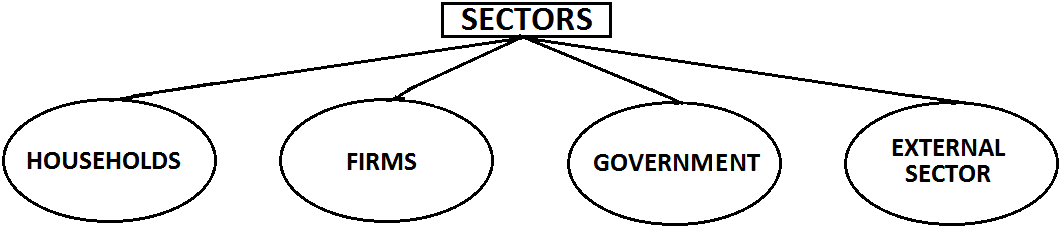
The four major sectors of an economy according to the macroeconomic point of view are:

  1. Households.
  2. Firms.
  3. Government.
  4. External sector.
These can be represented in the following flow chart:

  1. Households:

Households buy goods and services for consumption and also supply factors of production like land, labour, capital, and entrepreneur. Households provide the market for the output of the firms.

  1. Firms:

Firms are economic units that carry out the production. They employ and organise factors of production and undertake production process for the motive of profit making.

  1. Government:

A state/ government provides law and order, maintains growth and stability and provides administrative services. The main motive of a government is to undertake developmental projects such as dams, roads, heavy industries that usually have long gestation periods. The government invests in education, health sector and provides these services at nominal price. The motive of a government is to serve and not to make profits.

  1. External sector:

​​​​​​​This sector is engaged in export and import (external trade) of goods and services. If domestically produced goods and services are sold to the rest of the world, then it is called export. If the goods and services are purchased from the rest of the world, then it is called import.

View full question & answer