Largest amount of fresh water is found in:
- ALakes and streams.
- BUnderground.
- CPolar ice and glaciers.
- DRivers.
534 questions across 7 question groups — pick any mix to generate a BIOLOGY paper with step-by-step answer keys.
M.C.Q (0.5 Marks)
243 Q→021 Marks Question
103 Q→031.5 Marks Questions
72 Q→043 Marks Question
72 Q→054 Marks Questions
19 Q→06Assertion (A) & Reason (B) MCQ
15 Q→07Case study (4 Marks)
10 Q→One sample from each question group in this chapter. Select any group above to see the full set with answer keys.
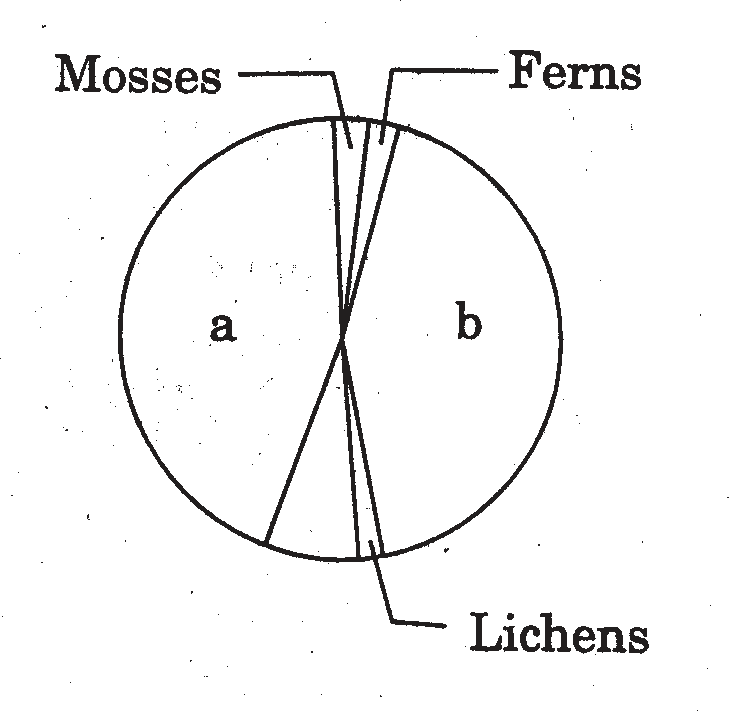
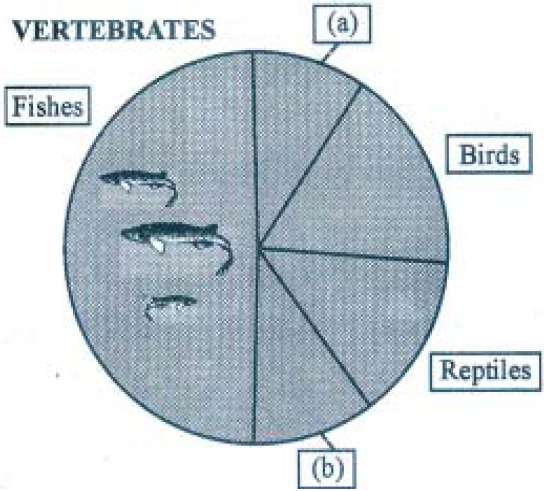
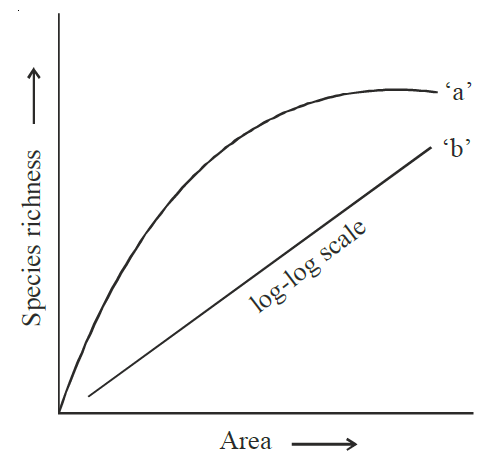
What does 'Z' stand for?
| | Wetland | Location |
| (a) | Harike | Punjab |
| (b) | Chandra Tai | H.P. |
| (c) | Bhoj | M.P. |
| (d) | Ashtamudi | Odisha |
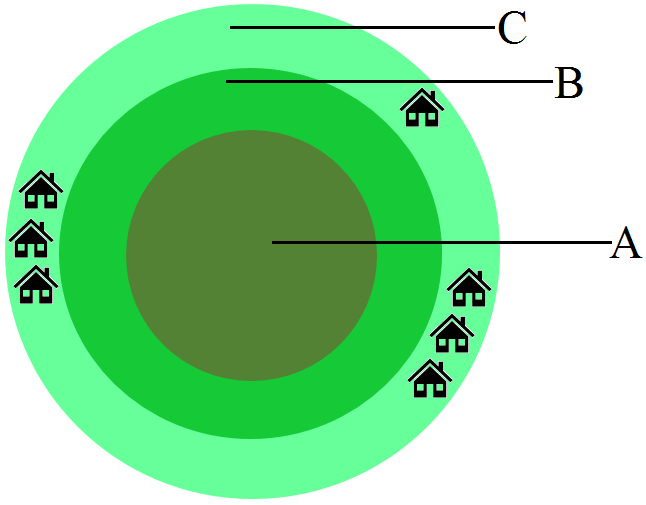
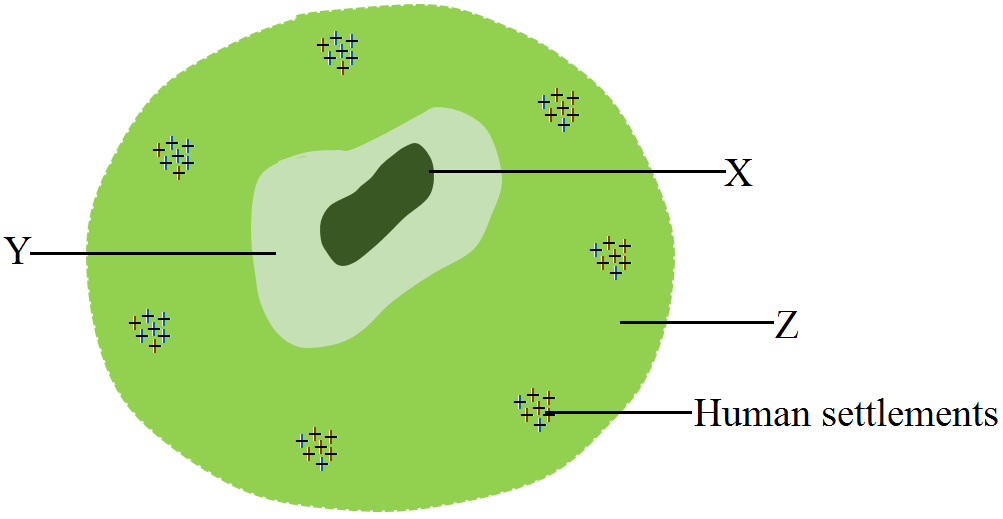
Select the incorrect statement regarding X, Y and Z.
| | (i) | (ii) | (iii) | (iv) |
| (a) | Threatened | Extinct | Endangered | Rare |
| (b) | Endangered | Extinct | Threatened | Rare |
| (c) | Extinct | Rare | Threatened | Endangered |
| (d) | Threatened | Extinct | Rare | Endangered |
Reason: Captive breeding is the conservation of those cases where these is no realistic chance of in-situ survival.
| Area and number of habitats | Species and their population (in thousands) in the area | |||||||||
| A | B | C | D | E | F | G | H | I | J | |
| I(11) | 23 | 12 | 0.52 | 6.0 | - | 3.1 | 1.1 | 9.0 | - | 10.3 |
| II(11) | 10.2 | - | 0.62 | - | 1.5 | 3.0 | - | 8.2 | 1.1 | 11.2 |
| III(13) | 11.3 | 0.9 | 0.48 | 2.4 | 1.4 | 4.2 | 0.8 | 8.4 | 2.2 | 4.1 |
| IV(12) | 3.2 | 10.2 | 1.1 | 4.8 | 0.4 | 3.3 | 0.8 | 7.3 | 1.3 | 2.1 |
| Population | Species | Species | Individuals |
| Population A | I | Mammals | 3 |
| II | Birds | 2 | |
| III | Amphibians | 2 | |
| Population B | I | Mammals | 2 |
| II | Mammals | 2 | |
| III | Amphibians | 1 | |
| Population C | I | Mammals | 3 |
| II | Mammals | 2 | |
| III | Mammals | 4 |
| | Maximum diversity | Minimum diversity |
| (a) | Population B | Population C |
| (b) | Population A | Population C |
| (c) | Population A | Population B |
| (d) | Population B | Population A |
$\text{D}=\displaystyle\sum_{\text{i}=1}(\text{n}_\text{i}/\text{N})^2$
where, n = total number of organisms of particular species
N = total number of organisms of all species
Below are data collected in two terrestrial plant conununities that represent part of a successional chronosequence. ln this case the values were measured as percent cover.
| Early Successional Community | Late Successional Community | ||
| Species | Percent Cover | Species | Percent Cover |
| A | 83 | F | 24 |
| B | 5 | G | 20 |
| C | 9 | H | 18 |
| D | 2 | I | 23 |
| E | 1 | J | 15 |
| | Species Richness | Evenness |
| (a) | Higher | Higher |
| (b) | Higher | Lower |
| (c) | Same | Lower |
| (d) | Same | Higher |
Pick question groups from the list above, set marks and difficulty, and export a branded PDF with step-by-step answer keys. First 3 chapters free — no signup.