Questions

3 Marks Question

Take a timed test

10 questions · self-marked practice — reveal the answer and mark yourself.

Question 13 Marks
What is primary productivity? Give brief description of factors that affect primary productivity.
Answer
The amount of food, energy, biomass or organic matter produced by plants per unit area is called primary production. Productivity is expressed as biomass produced or energy stored per unit area in a unit time.
It is expressed as gm/m2/year or Kcal/m2/year. Primary productivity is two types:
(i) Gross Primary Productivity (GPP): The rate of total assimilation of energy by primary producers or the rate of total production of organic matter or biomass.
(ii) Net Primary Productivity (NPP): The rate of biomass or energy remaining after the respiration by producers is called Net Primary Productivity:
NPP = GPP - R
Primary productivity is most affected by environmental factors affecting photosynthesis and respiration such as radiation, temperature, soil moisture etc. Productivity is aquatic ecosystem is limited due to light. Nutrients like nitrogen, phosphorus etc. limit the productivity in deep oceans.
View full question & answer
Question 23 Marks
Distinguish between :
Primary and secondary productivity
Answer
S.No.Primary ProductivitySecondary Productivity
1.Green plants are primary producers. The rate of production of the amount of organic matter produced per unit area in a given time period is called primary productivity. It is expressed in terms of $gm ^{-2} yr ^{-1}$ or $KCal m ^{-2} yr ^{-1}$. It refers to the productivity at the producer level.1. The rate of the synthesis of new organic matter by consumers is defined as secondary productivity. It refers to the productivity at the consumer level.
2.Primary productivity is of two types: Gross Primary Productivity and Net Primary Productivity.
GPP - R = NPP
( R= Loss in respiration)
2. Secondary productivity is of two types: Gross Secondary Productivity and Net Secondary Productivity
GSP - R = NSP
( R= Loss in respiration)
View full question & answer
Question 33 Marks
Distinguish between :
Food chain and Food web
View full question & answer
Question 43 Marks
Distinguish between :
Upright and inverted pyramid
Answer
S.No.Upright PyramidInverted Pyramid
1.Pyramid of energy are always upright because the amount of energy decreases at each trophic level.1. The pyramid of numbers in tree ecosystem is inverted or downward.
2.In forest ecosystem and grassland ecosystem pyramid of number of organisms and biomass formed straight and upward because the number of organisms and biomass decrease at each trophic level.2. In pond ecosystem and sea ecosystem pyramid of biomass is formed inverted because biomass of carnivores and bigger fishes is more than the biomass of phytoplankton and zooplankton.
View full question & answer
Question 53 Marks
Distinguish between :
Production and decomposition
Answer
S.No.ProductionDecomposition
1.Green plants synthesize organic food substances from water and carbon dioxide by the process of photosynthesis. This process takes place in the presence of sunlight and chlorophyll.1. Decomposers like bacteria, fungi etc. decompose the dead complex organic matter into simpler substances. Energy, water and CO2 are released in this process.
2.Solar energy is transformed into chemical energy and gets stored in organic food material. This process is called production.2. Chemical energy is released in the form of kinetic energy and heat. This process is called decomposition.
View full question & answer
Question 63 Marks
Distinguish between :
Grazing food chain and detritus food chain
Answer
S.No.Grazing Food ChainDetritus Food Chain
1.Grazing food chain begins with plants and moves from smaller animals to larger animals.
Grass $\rightarrow$ Rabbit $\rightarrow$ Peacock
(Plant)$\quad$(Herbivore)$\quad$(Carnivore)
1. Detritus food chain begins with dead decaying organic matter and moves towards microorganisms (detritivores).
Fallen leaves $\quad \rightarrow \quad$ fungi, bacteria
(dead organic matter) (decomposers)
2.It is directly dependent on solar radiation for the source of energy.2. It does not depend on solar radiation.
View full question & answer
Question 73 Marks
What is food chain? Discuss the various types of food chains.
Answer
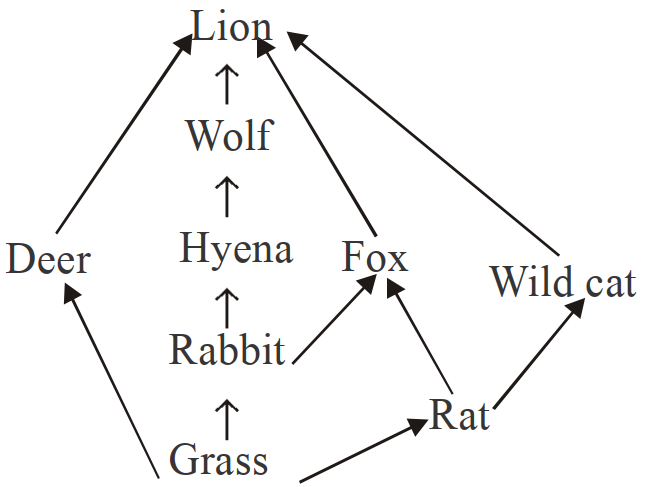
In ecosystem, food energy is transferred from producers to organisms each feeding on the proceeding organism and providing raw materials and energy for the other organisms. Such chain is called food chain. Food chain consists of herbivores, carnivores and decomposers. There are three types of food chains in nature :
(1) Predator or grazing food chain : This type of food chain directly based on solar energy which starts from green plants and moves through carnivores and ends at supreme (top) carnivore. Therefore, it begins with smaller organisms and ends at bigger organisms. e.g. Food chain in grassland.
(2) Parasitic food chain : This chain begins from bigger organisms (herbivorous animals) and ends at smaller organisms (parasite) i.e. it moves from host to parasite. Bigger herbivorous organisms are called host. Example :
Image
(3) Detritus or Saprophytic food chain : This type of food chain begins with dead decaying organic matter and goes through the detritivores present in soil and ends at the organisms that feed on detritivores. Example : 
Dead and decay $\rightarrow$ Earthworm $\rightarrow$ Frog $\rightarrow$ Snake $\rightarrow$ Organic matter.
View full question & answer
Question 83 Marks
Explain the pyramid of energy in ecosystem. ###What is meant by ecological pyramid? Describe an ideal pyramid of energy with diagram.
Answer
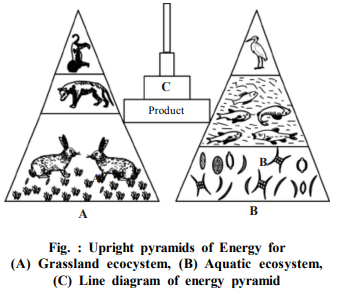
Ecological Pyramid : Ecological pyramids were at first drawn by Charles Elton in 1927. All the trophic levels are arranged in sequence wise one after another in a food chain in each ecosystem. Considering the first trophic level as base and followed by successive trophic levels, are represented in a diagram, then a pyramid is formed, called ecological pyramid. Pyramid of energy : It is a graphic representation of amount of energy trapped per unit time and area in different trophic levels of a food chain.
The pyramid of energy clearly represent the nature of ecosystems as a whole. The energy in the form of food that gets transferred from producers to consumers or from one trophic level to another. It is certain that amount of energy that reaches the next trophic level is lesser than it was present in the earlier trophic level. Therefore, the amount of energy decreases with each higher trophic level.
This is why of the total stored energy at each trophic level only 10% energy is transferred to next trophic level as biomass. Therefore, maximum energy is available at producer level and decreases gradually to primary to secondary to tertiary to top consumers. When the graphical representation is drawn, such pyramids of energy are always formed upright possessing the producer at base and top consumer at the apex of pyramid.
Image
View full question & answer
Question 93 Marks
Name the types of ecosystem.
Answer
There are two types of ecosystem : (1) Natural ecosystem (2) Artificial ecosystem
(1) Natural ecosystem : These are the ecosystems found naturally on the earth. These are of following types :
(i) Terrestrial : Ecosystem existing on land, i.e. forest, grass land, desert ecosystems.
(ii) Aquatic : This ecosystem is of two types :
(a) Fresh water ecosystem : It includes— (i) Lotic e.g. waterfall, river, spring etc. (ii) Lentic e.g. lake, pond, swamp etc.
(b) Marine water ecosystem : e.g. ocean, sea, Estuary, salt lakes etc.
(2) Artificial Ecosystem : These ecosystems are created and maintained by human beings e.g. agriculture garden, orchard tree plantation, aquarium.
View full question & answer
Question 103 Marks
Explain the ecological efficiency.
Answer
In each ecosystem, organisms obtain their food and convert the food into biomass for providing energy to next trophic level.
Ecological efficiencies are the percentage ratios between energy flow at different trophic levels of a food chain.
The unit of measurement of energy is Kcal/m2 /year. At the producer level, photosynthetic efficiency and net production efficiency are important. The efficiency with which a producer uses, incident solar radiation is measured by photosynthetic efficiency.
Photosynthetic efficiency $($ Producer level $)=$$\frac{\text { Gross Primary Productivity }}{\text { Incident Total Solar Radiation }}\times 100$
$\begin{array}{l}\text { Net production efficiency }= \frac{\text { Net Primary Productivity }}{\text { Gross Primary Productivity }} \times 100\end{array}$
Assimilatory efficiency (trophic levels) $=$ $\frac{\text { Net Primary Productivity }}{\text { Food Energy Ingested }} \times 100$

View full question & answer