Questions

1.5 Marks Questions

Take a timed test

14 questions · self-marked practice — reveal the answer and mark yourself.

Question 12 Marks
The flow of energy is unidirectional for sustainable ecosystem. Explain.###Energy flow is an unidirectional in ecosystem- explain.
Answer
→ The efficiency of the producers in absorption and conversion of solar energy.
→ The use of this converted chemical form of energy by the consumers.
→ The total input of energy in form of food and its efficiency of assimilation energy is received in an eco-system.
→ The energy is captured by green plants does not revert back to the sun and the energy which passes to the herbivores does not come back to the autotrophs.
→ Thus the flow of energy in an ecosystem is always unidirectional.
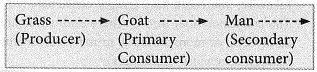
View full question & answer
Question 32 Marks
What is Ecosystem? Describe its types.
Answer
→ Ecosystem term is introduced by A. G. Tansly for the first time.
→ Ecosystem is a result of interaction between all living and non living factors of environment.
→ In an Ecosystem, all biotic and abiotic components are linked by unidirectional energy flow and nutrients cycle.
Biotic components : plants, animals, microbes.
→ Abiotic components : solar energy, water, air and land etc.
→ Types of ecosystem : Different types of ecosystems of nature, constitute the giant ecosystem-the biosphere. The ecosystems are categorised in to two as follows:
(1) Natural ecosystems :
→ They are operated by themselves under natural conditions without any major interference by man.
(2) Man-made ecosystems crop fields and aquarium.
Based upon the particular kind of habitat, these are further divided as :
(1) Terrestrial ecosystems : (a) forest (b) grassland (c) desert.
(ii) Aquatic ecosystems : They may be further divided as fresh water and marine water.
View full question & answer
Question 42 Marks
Certain species occupies more than one trophic levels in a same ecosystem. Explain with example.
Answer
→ Trophic level represents functional level not a specific species.
→ A given species can be a part of more than one tropic level within the same ecosystem at same time.
→ For an instance, sparrow, when eats seed, pea and fruits then it is a primary consumer but when it eats insects and worms, its called a secondary consumer.
→ Human also occupies many trophic levels in a certain food chain.
View full question & answer
Question 52 Marks
Describe: food web
Answer
→ Living organisms depend on each other for their food requirement and form a chain which is termed as food chain.
→ A food chain describes how energy and nutrients move through an ecosystem.
→ However, the trophic inter-relationship between animals in nature cannot be explained as simple food chains only.
→ Among the various ecosystems, each one is having definite food chain.
→ The individuals involved are also linked with. food chains of other ecosystem.
→ In this way, the animals are inter-dependent for food and they form a net which is termed as a food web.
View full question & answer
Question 62 Marks
What is primary productivity? Give brief description of factors that affect primary productivity.
Answer
Primary productivity :
→ Primary production is defined as the amount of biomass or organic matter produced per unit area over a time period by plants. during photosynthesis.
→ Primary productivity depends on the plant species inhabiting a particular area.
→ It also depends on a variety of environmental factors, availability of nutrients and photosynthetic capacity of plants,
→ Therefore, it varies in different types of ecosystems. The annual net primary productivity of the whole biosphere is approximately 170 billion tons (dry weight) of organic matter.
→ Of this, despite occupying about 70 percent of the surface, the productivity of the oceans are only 55 billion tons.
View full question & answer
Question 72 Marks
Explain the interdependence of producers and consumers.
Answer
→ The food chains and webs that exist in nature. Starting from the plants (or producers) food chains or rather webs are formed such that an animal feeds on a plant or on another animal and in turn is food for another.
→ The chain or web is formed because of this interdependency.
→ No energy that is trapped into an organism remains in it for ever.
→ The energy trapped by the producer, hence, is either passed on to a consumer or the organism dies.
→ Death of organism is the beginning of the detritus food chain/web.
View full question & answer
Question 82 Marks
What are the limitations of ecological pyramids?
Answer
→ There are certain limitations of ecological pyramids.
→ Such as it does not take into account the same species belonging to two or more trophic levels.
→ It assumes a simple food chain, something that almost never exists in nature; it does not accommodate a food web.
→ Sparrow, when eats seed, pea and fruits then it is a primary consumer but when it eats insects and worms, its called secondary consumer.
→ Saprophytes are not given any place in ecological pyramids even though they play a vital role in the ecosystem.

View full question & answer
Question 102 Marks
What is stratification?
Answer
→ Vertical distribution of different species occupying different levels is called stratification.
→ For example, trees occupy top vertical strata or layer of a forest, shrubs the second and herbs and grasses occupy the bottom layers.
View full question & answer
Question 112 Marks
Explain grazing food chain.
Answer
Grazing food chain starts from chlorophyll containing producers.
This chain extented up to herbivores, carnivor, and decomposers.
Green plants are directly dependent on solar energy.
In an aquatic ecosystem, GFC is the major conduit for energy flow.
The number of trophic levels in the grazing food chain is restricted as the transfer of energy follows 10 per cent law only 10 per cent of the energy is transferred to each trophic level from the lower trophic level.
In nature, it is possible to have so many levels producer, herbivore, primary carnivore, secondary carnivore in the grazing food chain.
Image
View full question & answer
Question 122 Marks
Sun is the only source of energy for all ecosystems on Earth. Explain.
Answer
→ Sun is the only source of energy for all ecosystems on Earth, except for the deep sea hydro-thermal ecosystem.
→ Of the incident solar radiation less than 50 per cent of it is photosynthetically active radiation (PAR).
→ We know that plants and photosynthetic bacteria (autotrophs), fix sun's radiant energy to make food from simple inorganic materials.
→ Plants capture only 2-10 per cent of the PAR and this small amount of energy sustains the entire living world.
→ So, it is very important to know how the solar energy captured by plants flows through different organisms of an ecosystem.
→ All organisms are dependent for their food on producers, either directly or indirectly.
→ The flow of energy from the sun to producers and then to consumer is unidirectional.
View full question & answer
Question 132 Marks
Explain Structure of ecosystem.
Answer

Structure of Ecosystem :
(1) Abiotic (non-living) components: It includes (i) inorganic substances as macronutrients (C, H, O, P, K, N, S, Mg and Ca) and (ii) micronutrients (Mn, Cu, Mo, B, Zn, Fe, and Cl, Co, Ni, V) etc.
(2) Organic materials - as proteins, carbohydrates, lipids etc.,
(3) Environmental factors as -
(a) The climatic factors-(light, temperature, wind, precipitation, humidity etc.)
(b) The edaphic factors-Soil, Water and Air

View full question & answer
Question 142 Marks
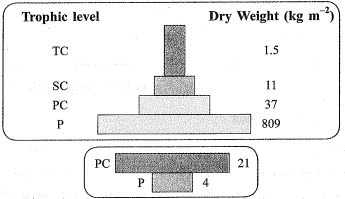
Depending on the nature of food chain, the ecological pyramid of number and biomass can be inverted or upright. Explain with example.
Answer
→ It shows the number of individual organisms at each trophic level. Producers occur in the largest number and top level carnivores are in the smallest number. Normally, the pyramids of numbers is upright.
→ Number pyramid also has exception.
→ For example: if counting of the number of birds and insects live on a banyan tree is done, we will get inverted number pyramid.
→ 50 parrot live on a banyan tree and 50 insects on each parrot.
→ It shows the total dry weight or the average biomass of organisms at a particular trophic level. These pyramids are also upright.
→ The pyramid of biomass in sea is generally inverted because the biomass of fishes far exceeds that of phytoplankton.
→ In a dessert ecosystem, the biomass pyramid can be inverted.
→ In a dessert the number of consumers are more than the number of producers.
View full question & answer