Questions

2 Marks Questions

Take a timed test

111 questions · 1 auto-graded MCQ + 110 self-marked written.

Question 12 Marks
Select two pairs from the following which exhibit divergent evolution. Give reasons for your answer.
  1. Forelimbs of cheetah and mammals.
  2. Flippers of dolphins and penguins.
  3. Wings of butterflies and birds.
  4. Forelimbs of whales and mammals.
Answer
  1. Forelimbs of cheetah and mammals: This is divergent evolution and these structures are homologous.
  2. Flippers of dolphins and penguins: The example of convergent evolution they are not similar in structure but they perform a similar function.
  3. Wings of butterflies and birds: The are look same in structure, they are not atomically similar is structure though they perform similar function they called analogues.
  4. Forelimbs of whales and mammals: This is divergent evolution and these structures are homologous.
View full question & answer
Question 22 Marks
Select the analogous structures from the combinations given below:
  1. Forelimbs of whales and bats
  2. Eyes of octopus and mammals
  3. Tuber of sweet potato and potato
  4. Thorns of Bougainvillea and tendrils of Cucurbita
  1. ​​​​​​​State the kind of evolution they represent.
Answer
  1. Analogous organs or structures are those that are similar in function but different in origin.
From the given options, following are the analogous structures:
  • Eyes of octopus and mammals perform the same basic visual function but they differ in the origin of their retina.
  • Tubers of sweet potato and potato perform the same function of food storage but they are modifications of root and stem, respectively.
  1. The kind of evolution represented by analogous organs or structures is convergent evolution as they have different origins but evolve similar traits with evolution to perform the same function.
View full question & answer
Question 32 Marks
  1. Select the homologous structures from the combinations given below:
  1. Forelimbs of whales and bats.
  2. Tuber of potato and sweet potato.
  3. Eyes of octopus and mammals.
  4. Thorns of Bougainvillea and tendrils of Cucurbita.
  1. ​​​​​​​​​​​​​​​​​​​​​​​​​​​​​​​​​​​​​​​​​​​​​​State the kind of evolution they represent.
Answer
  1.  
  1. Forelimbs of whales and bats.
  1. Thoms of Bougainvillea and tendrils of Cucurbita.
  1. Divergent Evolution.
View full question & answer
Question 42 Marks
List the two main propositions of Oparin and Haldane.
Answer
Oparin Haldane theory was given a chemical evolution.
Oparin and Haldane stated life originated from pre-existing non-living organic molecules e.g. RNA, protein etc. the conditions on earth favouring chemical evolution storms, reducing atmosphere containing $\mathrm{CH}_4, \mathrm{NH}_3$, etc.
View full question & answer
Question 52 Marks
How do Darwin’s finches illustrate adaptive radiation?
Answer
Original stock of seed-eating finches migrated to different habitats (of Galapagos Islands), adapted to different feeding methods, by altered beak structure, evolved into different types of finches.
View full question & answer
Question 62 Marks
What do the forelimbs of whales, bats and cheetah with respect to evolution signify? Provide one such example in plants.
Answer
Homologous organs divergent evolution.
Thorns of Bougainvillea and tendrils of Cucurbita.
View full question & answer
Question 72 Marks
Rearrange the human activities mentioned below as per the order in which they developed after the modern Homo sapiens came into existence during ice age:
  1. Human settlement.
  2. Prehistoric cave art.
  3. Agriculture.
Answer
  1. Pre-historic cave art.
  2. Agriculture/Human Settlement.
View full question & answer
Question 82 Marks
Identify the following pairs as Homologous or Analogous organs:
  1. Sweet potato and potato
  2. Eye of octopus and eye of mammals
  3. Thorns of Bougainvillea and tendrils of Cucurbits.
  4. Fore limbs of Bat and Whale.
Answer
(i) & (ii) Analogous.
(iii) & (iv) Homologous.
View full question & answer
Question 92 Marks
Mention the evolutionary significance of the following organisms:
  1. Shrews.
  2. Lobefins.
  3. Homo habilis.
  4. Homo erectus.
Answer
  1. First mammals.
  2. First amphibians (lived both on land and in water)/fish with stout and strong fins which could move on land and go back to water.
  3. First human-like being/hominid/brain capacity from 650-800 cc/did not eat meat.
  4. Brain around 900 cc/ate meat.
View full question & answer
Question 102 Marks
What is divergent evolution? Explain talking an example of plants.
Answer
The same structure developed along different directions due to adaptations to different needs. This is divergent evolution and these structures are homologous.Eg. Thron of Bougainvillea and Tendrils of Cucurbita represent homology.
View full question & answer
Question 112 Marks
With the help of an algebraic equation, how did Hardy-Weinberg explain that in a given population the frequency of occurrence of alleles of a gene is supposed to remain the same through generations?
Answer
In a given population one can find out the frequency of occurence of alleles of a gene or a locus. This frequency is supposed to remain fixed and even remain the same through generations. Hardy-Weinberg principle stated it using algebraic equations. This principle says that allele frequencies in a population are stable and is constant from generation to generation. The gene pool (total genes and their alleles in a population) remains a constant. this is called genetic equilibrium. Sum total of all the allelic frequencies is 1 . Individual frequencies, for example, can be named p, q, etc. In a diploid, p and q represent the frequency of allele $A$ and allele $a$. The frequency of AA individuals in a population is simply $\mathrm{p}^2$. This is simply stated in another ways, i.e., the probability that an allele A with a frequency of $p$ appear on both the chromosomes of a diploid individual is simply the product of the probabilities, i.e., $p^2$. Similarly of aa is $q^2$, of $A a 2 p q$. Hence, $p^2+2 p q+q^2=1$. This is a binomial expansion of $(p+q)^2$. When frequency measured, differs from expected values, the difference (direction) indicates the extent of evolutionary change. Disturbance in genetic equilibrium, or Hardy-Weinberg equilibrium, i.e., change of frequency of alleles in a population would then be interpreted as resulting in evolution.
View full question & answer
Question 122 Marks
How would the gene flow or genetic drift affect the population in which either of them happen to take place?
Answer
Gene Flow occurs due to emigration or immigration resulting in the change in the frequency of alleles of a gene within the gene pool of a population. A population with active gene flow will not obey the Hardy-Weinberg principle.
Genetic Drift is a sudden change in the frequency of genes and their alleles within a gene pool of a population over a very short duration of time. A population experiencing such a phenomenon will also not obey Hardy-Weinberg principle. Genetic drift can occur due to natural or artificial selection a like.
View full question & answer
Question 132 Marks
Wings of birds and wings of butterflies contribute to locomotion. Explain the type of evolution such organs are a result of.
Answer
Wings of birds and wings of butterflies are example of analogous organs and they exhibit convergent evolution. Organisms developing different structures but have the same function is called convergent evolution.
View full question & answer
Question 142 Marks
What do you understand by differential reproduction and reproductive isolation? In what context are these term used?
Answer
  • Differential reproduction: The phenomenon in which all organisms who reach reproductive stage reproduce with varying degree of success, some reproduce more offsprings and some reproduce only few and other reproduce none depending upon their degree of fitness.
  • Reproductive isolation: The biological phenomenon in which the individual belonging to same species reproduce among themselves, to maintain the species integrity. Both these terms are used in reference to natural selection.
View full question & answer
Question 152 Marks
Define biogeography. How do Darwin’s finches provide the biogeographical evidence in favour of evolution?
Answer
The study of distribution of various organisms in different parts of the earth is called biogeography. All the varieties of Darwin’s finches have evolved on the same island itself from a common seed-eating ancestor due to adaptive radiation.
View full question & answer
Question 162 Marks
In a population which has achieved Hardy-Weinberg equilibrium, which two process will not occur.
Answer
In such a population natural selection and random mating does not occur. This is because both these process promotes evolution which disrupts the Hardy Weinberg equilibrium.
View full question & answer
Question 172 Marks
Fill in the blank (i), (ii), (iii), (iv) with name of the mammals of Australia.
S. No Placental mammal Marsupial mammal
(i) Anteater (i)
(ii) (ii) Spotted cuscus
(iii) Bob cat (iii)
(iv) (iv) Tasmanian wolf
Answer
S. No Placental mammal Marsupial mammal
(i) Anteater Numbat
(ii) Lemur Spotted cuscus
(iii) Bob cat Tasmanian tiger cat
(iv) Wolf Tasmanian wolf
View full question & answer
Question 182 Marks
How can you say the lobefin fish were the ancestors of amphibian?
Answer
Lobefins fish have stout and strong fins, so they can move on land and swim in water to maintain a dual lives like amphibians.
View full question & answer
Question 192 Marks
Name the gases Miller used in his experiment on origin of life.
Answer
Methane, ammonia, hydrogen and water vapour.
View full question & answer
Question 202 Marks
What does the comparison between the eyes of Octopus and those of mammals say about their ancestry and evolution?
Answer
Eyes of Octopus and those of mammals or the wings of butterfly and those of birds are analogous structures, which have resulted from convergent evolution.
  • They have not evolved from common ancestors.
  • It is the similar habitat that has resulted in similar adaptive features in different groups of organisms towards the same function.
View full question & answer
Question 212 Marks
How will you explain artificial selection in terms of evolution?
Answer
Artificial selection refers to the selection of superior traits of plants and animals by man which it wants to perpetuate. It involves selective breeding of organisms and takes a shorter span of time. The different plant and animal breeding programmes are best known examples of artificial selection.
View full question & answer
Question 222 Marks
Evolution is not a direct process, but a stochastic process, based on chance event(s) in nature. Justify.
Answer
  • Evolution is not a direct process in terms of determinism.
  • As the environment changes, due to meteorological, biological and other physical activities, the organisms which are better adapted to the changed environment are selected by nature in a much lesser time scale.
  • It is also true for natural selection and evolution of antibiotic-resistant strains of bacteria in a time scale of months.
  • So, evolution is a stochastic process based on chance events in nature and chance mutation in the organism.
View full question & answer
Question 232 Marks
What is speciation? List any two events leading to speciation.
Answer
The process involving formation of new species from the existing species is called speciation.
Two events leading to speciation are:
  1. Interbreeding among different populations or species.
  2. Migration.
View full question & answer
Question 242 Marks
Mention one significant difference between ontogeny and phylogeny.
Answer
Ontogeny: Ontogeny is embryonic development, i.e. the origin and development of an organism from an embryo to an adult.
Phylogeny: Phylogeny is ancestral history, i.e. the evolutionary development and history of a species or higher taxonomic grouping of organisms.
View full question & answer
MCQ 252 Marks
Choose two pairs of homologous structures from the following and mention why they are so called?
  • Hearts of humans and monkeys.
  • B
    Eyes of Octopus and mammals.
  • C
    Thorns of Bougainvillea and tendrils of Cucurbits.
  • D
    Flippers of penguins and dolphins.
Answer
Correct option: A.
Hearts of humans and monkeys.
View full question & answer
Question 262 Marks
Comment on the statement that "evolution and natural selection are end result or consequence of some other processes but themselves are not processes".
Answer
The world we see, inanimate and animate, is only the success stories of evolution. When we describe the story of this world we describe evolution as a process. On the other hand when we describe the story of life on earth, we treat evolution as a consequence of a process called natural selection. We are still not very clear whether to regard evolution and natural selection as processes or end result of unknown processes.
View full question & answer
Question 272 Marks
Gene flow occurs through generations. Gene flow can occur across language barriers in humans. If we have a technique of measuring specific allele frequencies in different population of the world, can we not predict human migratory patterns in pre-history and history? Do you agree or disagree? Provide explanation to your answer.
Answer
Yes, I agree. Gene flow occurs through generations. By studying specific allele frequencies, we can predict the human migratory patterns in prehistory and history. Studies have used specific genes/ chromosomes/ mitochondrial DNA to trace the evolutionary history and migratory patterns of humans. (The project is known as the Human Genographics Project).
View full question & answer
Question 282 Marks
Name any four mammals that lived in South America before continental drift.
Answer
Mammals like Horse, Hippopotamus, Rabbit and Bear.
View full question & answer
Question 292 Marks
How do we compute the age of a living tree?
Answer
Age of a living tree can be determined by comparing the diameter of the trunk with average growth factor of that species. Average growth factor of a species can be found from records. Diameter can be calculated by measuring the girth of the trunk.
View full question & answer
Question 302 Marks
Define analogous organ. Give one example of an organ analogous to human hand.
Answer
The organs with different structural designs and developmental origin but performing similar functions are called analogous organs. Trunk of an elephant is analogous to human hand.
View full question & answer
Question 312 Marks
Life originated from the earth's inorganic atmosphere in the past, but this no longer happens today. Give two reasons.
Answer
  1. Presence of free oxygen in present day atmosphere.
  2. Existence of living organisms.
View full question & answer
Question 322 Marks
The scientists believe that evolution is gradual. But extinction, part of evolutionary story, are 'sudden' and 'abrupt' and also group-specific. Comment whether a natural disaster can be the cause for extinction of species.
Answer
Natural disaster like earth quake can be the cause for extinction of species. During the long period since the origin and diversification of life on earth there were five episodes of mass extinction of species.
View full question & answer
Question 332 Marks
What is meant by analogous organ? Taking a suitable example, explain how they support the theory of organic evolution.
Answer
The organs which have different developmental origin and structural design but perform similar functions are called analogous organs. The wings of birds and insects are analogous organs indicating that they have different ancestors but show a convergent evolution.
View full question & answer
Question 342 Marks
Give an example for convergent evolution and identify the features towards which they are converging.
Answer
Similar evolution in species of different lineage is called convergent evolution. Convergent evolution happens in an isolated geographical area. Flippers of dolphin and penguin are examples of convergent evolution. In both animals; flippers have different origins but serve similar purpose.
View full question & answer
Question 352 Marks
Give one example of analogy and homology in plants.
Answer
  • Homology: Tendrils of Cucurbita and thorns of Bougainvillea.
  • Analogy: Sweet potato (root modification) and potato (stem modification) to store food.
View full question & answer
Question 362 Marks
Rearrange the following in increasing order of evolution: Gnetales; Ferns; Zosterophyllum; Ginkgo.
Answer
The increasing order of evolution in plants is as on Zosterophyllum-Ferns-Ginkgo-Gnetales.
View full question & answer
Question 372 Marks
Name the ship in which Charles Darwin made his voyage. What was his conclusion about the life forms he observed?
Answer
  1. There are limited natural resources.
  2. Populations are stable in size except for seasonal fluctuations.
  3. Varying characteristics in members of a population, i.e. no two members of a population are identical even though they look superficially similar.
  4. Variations are generally inherited.
  5. Population size has two facts, i.e. theoretically it grows exponentially if everybody reproduced maximally but in reality, population size is limited, due to the competition among the individual for resources. Those, which are better adapted could survive and will reproduce at the cost of others, i.e. who are less adapted in the environment.
View full question & answer
Question 382 Marks
Write about the ancestry and evolution of bat, horse and human on the basis of a comparative study of their forelimbs. What are these limbs categorized as?
OR
What is divergent evolution? Explain taking an example of plants.

OR
Divergent evolution leads to homologous structures. Explain with the help of an example.
Answer
  • The forelimbs of whales, bats and cheetah (or bat, horse and humans) are the result of divergent evolution.
  • Divergent evolution is the evolutionary process, where the same structure develops along different directions in different groups of organisms as adaptations to different needs.
  • The structures evolved are homologous organs; homology indicates common ancestry.
  • Thorns of Bougainvillea and tendrils of Cucurbits are also homologous structures.
View full question & answer
Question 392 Marks
When we say 'survival of the fittest', does it mean that:
  1. Those which are fit only survive.
  2. Those that survive are called fit? Comment.
Answer
  1. The characteristics which enable some population or individuals to survive better in natural conditions (foods, climate, physical factors) would outbreed others (survival of the finest).
  2. Thus, those organisms, which are better fit or adapt well will survive and get selected by nature, which furthers their evolution. This is called natural selection.
View full question & answer
Question 402 Marks
When and where did Australopithecus live? Mention their characteristics.
Answer
Australopithecus lived in the East African grassland:
  1. They were probably not taller than four feet.
  2. They walked upright.
  3. They hunted with stone weapons, but essentially ate fruits.
View full question & answer
Question 412 Marks
Write the names of two dinosaurs that lived early in the history of earth and two others that lived little later.
Answer
  • Brachiosaurus and Stegosaurus lived early in the history.
  • Tyrannosaurus and Triceratops lived later.
View full question & answer
Question 422 Marks
How does 'fitness' of a population help in evolution?
Answer
Fitness, according to Darwin, refers ultimately and only to reproductive fitness. Those who are better fit in an environment would outbreed others, who are less fit in that environment; they leave more progeny (with more fit individuals) than others. They will survive better and are selected by nature (natural selection) to reproduce and increase their population size.
View full question & answer
Question 432 Marks
Discuss, is evolution a process or the end result of a process.
Answer
  • The biodiversity we see today is the story of evolution, i.e. evolution is considered as a process, that has resulted in various life forms.
  • If we talk about the life on earth, evolution is considered as a consequence of the process, called natural selection.
  • It is difficult to decide, whether evolution and natural selection are processes or end results of some unknown processes.
View full question & answer
Question 442 Marks
How does palaeontological evidence support evolution of organisms on Earth?
Answer
Paleontology is the study of fossils. It indicates:
  1. The geological time period in which the organisms existed.
  2. That life forms varied over time and certain life forms are restricted to certain geological time spans.
  3. That new forms of life have appeared at different times in the history of earth.
View full question & answer
Question 452 Marks
Can we call human evolution as adaptive radiation?
Answer
No, human evolution cannot be called adaptive radiation because adaptive radiation is an evolutionary process that produces new species from a single, rapidly diversifying lineage, which is not the case with human evolution.
View full question & answer
Question 462 Marks
Prior to industrialisation, there were far more white winged moths on trees than melanised moths in England. However, after industrialisation, the distribution pattern of these two kinds of moths reversed what does the above observation indicate? Explain giving reasons.
Answer
It indicates that predators will spot a moth against a contrasting background.
  1. After industrialisation, the tree trunks became dark due to deposition of soot and smoke; under such a condition, the white winged moths stood out conspicuously and easily detected by the predators and hence they reduced in number
  2. The dark-winged moths could merge with the black colour and they escaped the predators and hence increased in number.
View full question & answer
Question 472 Marks
Mention any three evolutionary features of mammals.
Answer
Three evolutionary features of mammals:
  • Mammals are endothermic vertebrates.
  • Have hair and fur on the body.
  • Have mammary glands.
View full question & answer
Question 482 Marks
Who proposed the biogenetic law? Who disapproved it? Why?
Answer
  • Ernst Haeckel proposed embryological support for organic evolution.
  • It was disapproved by Ernst Von Baer.
  • He noted that embryos never pass through the adult stage of other animals.
View full question & answer
Question 492 Marks
Birds have evolved from reptiles. How does paleontology provide evidence in support of the above statement?
Answer
The fossil Archaeopteryx is a connecting link between reptiles and birds and provide evidence that birds have evolved from reptiles. Its features are:
  1. It has beak and wings like that of a birds.
  2. It has teeth and scales like that of a reptiles.
View full question & answer
Question 502 Marks
How do new species arise according to de Vries mutation theory of organic evolution?
Answer
The sudden change in appearance or variations in an individual or a population are called mutations. They lead to the new phenotypes. Though mutations are random and occur at very slow rates, they are sufficient to create considerable genetic variations for speciation to occur.
View full question & answer
Question 512 Marks
When we talk of functional macromolecules (e.g. proteins as enzymes, hormones, receptors, antibodies etc), towards what are they evolving?
Answer
Similarities in proteins and genes performing a given function among diverse organisms give clues to common ancestry. These biochemical similarities point to the same shared ancestry as structural similarities among diverse organisms. Trypsin (ancient enzyme) is present from protozoa to mammals.
View full question & answer
Question 522 Marks
Why is nascent oxygen supported to be toxic to aerobic life forms?
Answer
Nascent oxygen is a highly reactive substance. It can react with many molecules; including the DNA. This can result in unwanted mutations which may threaten the life forms. Hence, nascent oxygen is supposed to be toxic to aerobic life forms.
View full question & answer
Question 532 Marks
What is Oparin–Haldane theory? Can life be originated abiotically inside the laboratory today?
Answer
Oparin-Haldane’s theory states that the first life form originated from non-living organic molecules like RNA, protein, etc. Yes, life can be originated abiotically inside the laboratory under controlled conditions.
View full question & answer
Question 542 Marks
Mention the names of three groups of plants for which Psilophyton is the ancestor.
Answer
  1. Rhyniaceae.
  2. Psilophytaceae (in a restricted and revised sense).
  3. Trimerophytaceae.
View full question & answer
Question 552 Marks
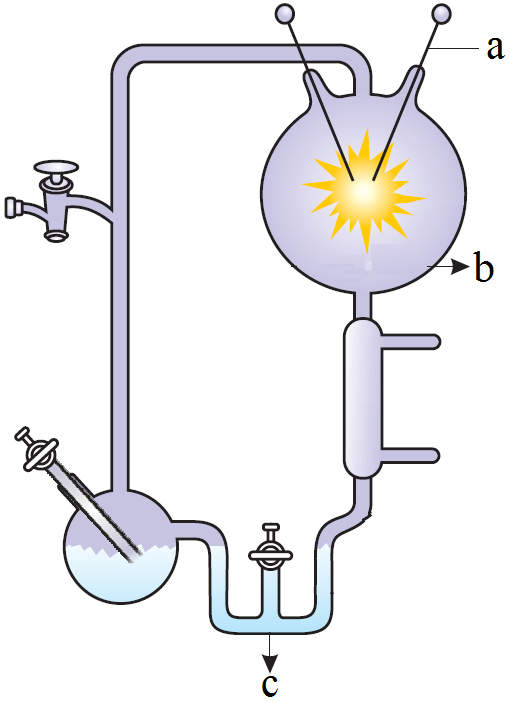
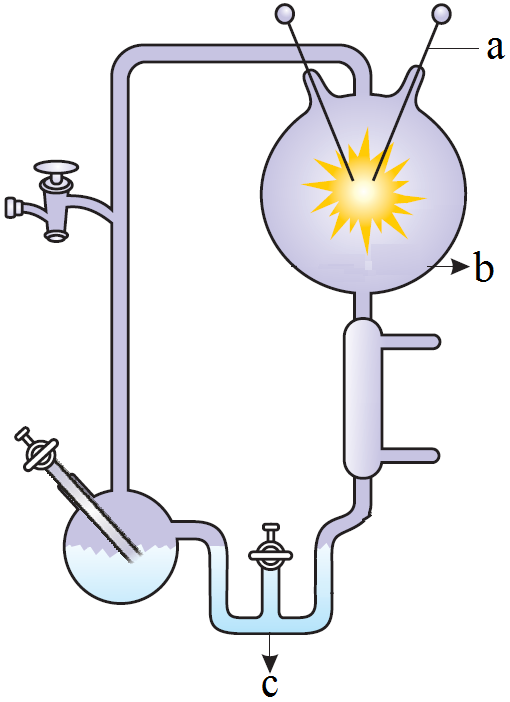
The figure given below represents Miller's apparatus used for his experiment.

Name the chemicals found in the sample drawn from 'e'. How did this experiment support evolution?
Answer
  • Amino acids were found.
  • Miller created in a laboratory scale, the conditions similar to the primitive earth.
  • Electric discharge using electrodes was created in a closed flask containing $\mathrm{CH}_4, \mathrm{NH}_3, \mathrm{H}_2$, and water vapour at $800^{\circ} \mathrm{C}$.
  • The production of organic compounds supported the chemical evolution that preceded the formation of life on earth.
View full question & answer
Question 562 Marks
Name the scientist who had used the set-up shown below:

Write the purpose of 'a' in the set-up and the conclusion, the scientist arrived at.
Answer
  • S.L. Miller used this set-up.
  • The electrodes (a) are used to create an electric discharge, similar to the lightning in the primitive earth; it was to provide energy.
  • The formation of amino acids proved the chemical evolution, which preceded the origin of life.
View full question & answer
Question 572 Marks
Give two examples of biogeographical evidence in favour of evolution.
Answer
  1. Darwin’s finches.
  2. Australian marsupials.
View full question & answer
Question 582 Marks
Give difference between gene frequency and gene pool.
Answer
Gene frequency represent percentage of an allele in relation to total number of alleles of a gene in interbreeding population, while sum total of genes and alleles is called gene pool.
View full question & answer
Question 592 Marks
During an excavation assignment, scientists collected pollen grains of a plant preserved in deeper layers of soil. Analyse the properties of pollen grains which help in the fossilization.
Answer
Pollen has an outer layer called exine which is made of sporopollenin. It is the most resistant organic material known. It can withstand high temperature, strong acids and alkali as well. No enzyme that degrades sporopollenin is so far known.
View full question & answer
Question 602 Marks
Explain briefly how the principle of natural selection can be applied to the development of resistance in mosquitoes for DDT.
Answer
When DDT was used for the first time, maximum mosquitoes died but few survived due to variation in the population. These mosquitoes showed resistance to DDT and survived to reproduce successfully in the presence of DDT and gradually such mosquito population became DDT resistant due to natural selection.
View full question & answer
Question 612 Marks
How do you consider tendrils of Cucurbita and thorns of Bougainvillea as homologous structure?
Answer
Both of them are stem modifications and thus are structurally similar but both have different functions. Thus, they are homologous structures as tendrils and thorns both arise in axillary position and hence are modified branches but tendrils help in climbing and thorns protect the plant.
View full question & answer
Question 622 Marks
Enumerate the conclusions made by A. Wallace from his studies on life forms.
Answer
Alfred Wallace made the following conclusions:
  1. New life forms arise and evolve in due course of time.
  2. All the existing forms of life share certain similarities and common ancestors.
  3. These ancestors lived at different periods in the history of earth.
  4. The geological history closely correlates with the biological history.
View full question & answer
Question 632 Marks
In a certain population, the frequency of three genotypes is an followers.
Genotypes: BB Bb bb
Frequency: 22% 62% 16%
What is the likely frequency of B and b alleles?
Answer
Frequency of B allele = all of BB + ½ of Bb = 22 + 31 = 53%
Frequency of b allele = all of bb + ½ of Bb = 16 + 31 = 47%.
View full question & answer
Question 642 Marks
Who proposed the theory of origin of life? What were the conditions prevailing about 3.6 billion years ago, to create life on primitive earth?
Answer
Oparin and Haldane proposed the theory of origin of life. Initially, on the primitive earth there was no atmosphere. The volcanic eruption and molten mass released water vapour, methane, carbon dioxide, and ammonia which formed earth’s atmosphere. The earth’s atmosphere was reducing one, i.e., no free oxygen was present. Huge amount of energy was liberated from lightning, and UV rays as there was no ozone layer.
View full question & answer
Question 652 Marks
Evolution is not a direct process, but a stochastic process, based on chance events in nature. Justify.
Answer
Evolution is not a direct process. As environment changes the organisms are better adapted to changed environment are selected by nature. Therefore, it is termed as stochastic process.
View full question & answer
Question 662 Marks
Protein synthesis machinery revolves around RNA but in the course of evolution it was replaced by DNA. Justify.
Answer
Since RNA was unstable and prone to mutations, DNA evolved from RNA with chemical modifications that makes it more stable.
DNA has double stranded nature and has complementary strands. These further resist changes by evolving a process of repair.
View full question & answer
Question 672 Marks
While creation and presence of variation is directionless, natural selection is directional as it is in the context of adaptation. Comment.
Answer
Creation and variation occur in a sexually reproducing population as a result of crossing over during meiosis and random fusion of gametes. It is however the organisms that are selected over a period of time which are determined by the environmental conditions. In other words, the environment provides the direction with respect to adaptations so that the organisms are more and more fit in terms of survival.
View full question & answer
Question 682 Marks
Describe Lamarck's theory of evolution.
Answer
Lamarck's Theory:
  • Lamarck's theory is known as theory of Inheritance of acquired characters.
  • According to this theory, organisms undergo certain changes to adapt themselves to the environment.
  • These characters acquired by an organism during its life time, are passed on to the progeny, e.g. the long neck of giraffe was explained by Lamarck, as an outcome of these animals having to stretch their necks constantly to eat the leaves on the upper branches of the trees.
View full question & answer
Question 692 Marks
Why Hardy-Weinberg equilibrium is not applicable for large population size.
Answer
Hardy-Weinberg equilibrium is not applicable for large population because as migration of a part of population takes place gene frequency also changes and may lead to founder effect.
View full question & answer
Question 702 Marks
Name the species in the blanks a and b given below-
Ramapithecus → a → b → Homo erectus Homo sapiens.
Answer
  1. Australopithecus.
  2. Homo habilis.
View full question & answer
Question 712 Marks
If abiotic origin of life is in progress on a planet other than earth, what should be the condition there? Explain.
Answer
The atmosphere will be reducing, i.e., no free oxygen will be present. There must be continuous supply of energy like that from lightning, thunder, volcanic eruption and stellar radiation. The presence of autocatalyst or self-replicating molecules is essential.
View full question & answer
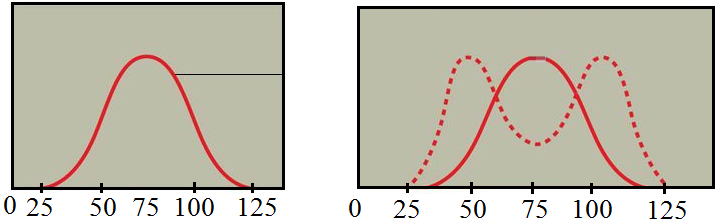
Question 722 Marks
Refer the graph and answer the questions that follow.
  1. The graph depicts which type of natural selection?
  2. Explain the other two effects/ types of natural selection.
​​​​​​​
Answer
  1. The graph depicts disruptive natural selection. This type of selection tends to eliminate intermediate types.
  2. The other two types of natural selection are,
  1. Directional selection Large number of individuals acquire value other than mean character value.
  2. Stabilising selection Large number of individuals acquire mean character value.
View full question & answer
Question 732 Marks
What is the significance of Archaeopteryx in the study of organic evolution?
Answer
Archaeopteryx is a connecting link between reptiles and birds. It shows features of both birds and reptiles giving an evidence that birds have evolved from reptiles.
View full question & answer
Question 742 Marks
What is the study of fossils called? Mention any three points how the fossils throw light on past life.
Answer
Study of fossils is called paleontology: The fossils throw light on past life in following ways,
  1. Distribution of fossil gives information about habitat of an organism.
  2. Establishes phylogenetic links.
  3. Some fossils provide evidence of connecting link.
  4. Age of the organisms can be determined by fossils.
  5. Fossils also throw light on morphology and anatomy of past life.
View full question & answer
Question 752 Marks
Gene flow occurs through generations and can occur across language barriers in humans. If we have a technique of measuring specific allele frequencies in different population of the world, can we not predict human migratory patterns in pre-history and history? Do you agree or disagree? Provide explanation to your answer.
Answer
Yes, I agree. Gene flow occurs through generations. By studying specific allele frequencies, we can predict the human migratory patterns in pre-history and history. Studies have used specific genes/ chromosomes/ mitochondrial DNA to trace the evolutionary history and migratory patterns of humans. (The project is known as the Human Genographics Project).
View full question & answer
Question 762 Marks
How is Darwin's concept of evolution different from that of de Vries?
OR
How is mutation explained by Hugo de Vries different from the Darwinian variations?

OR
How do Darwin and de Vries differ in their views on the mechanism of evolution of life on earth?
Answer
Darwinian Concept
de Vries Concept
According to Darwin, speciation occurs with the accumulation of minor heritable variations.
According to de Vries, mutations arising suddenly in a population, are responsible for speciation.
Evolution was gradual and occurs through a number of generations.
Evolution occurs in a large single-step mutation (saltation).
Variations are small and directional.
Mutations are random and directionless.
View full question & answer
Question 772 Marks
Describe convergent evolution, taking an example from plants.
OR
Convergent evolution leads to analogous structures. Explain with the help of an example.
Answer
Convergent evolution is the evolutionary process, where anatomically different structures in different groups of organisms evolve towards the same function, in similar habitats.
  • Such structures in different groups of organisms which perform similar function, but are anatomically different, are called analogous organs.
  • The tuber of potato (stem modification) and the tuber of sweet potato (root modification) are analogous as they perform the function of storage of food.
View full question & answer
Question 782 Marks
Explain how did von Helmont supported the theory of spontaneous generation?
Answer
The theory of spontaneous generation held that living creatures could arise from nonliving matter and that such processes were commonplace and regular. For instance, it was hypothesized that certain forms such as fleas could arise from inanimate matter such as dust, or that maggots could arise from dead flesh.
View full question & answer
Question 792 Marks
Find out through internet and popular science articles whether animals other than man has self-consciousness.
Answer
Recent studies on self consciousness says gibbons are the nearest to human in this respect. Apes and orangutans came next. Among domestic animals, dog and other members of canidae family show subtle self consciousness.
View full question & answer
Question 812 Marks
Explain the origin of universe.
Answer
The universe is about 15-20 billion years old. It comprises of huge clusters of galaxies, which contains stars, clouds of gas and dust. According to the Big Bang theory given by Abbe Lemaitre (1931), our universe arose as cataclysmic eruption. The temperature lowered and the gases like hydrogen and helium were formed sometimes later. By the force of gravitation, the gases condensed and galaxies were formed.
View full question & answer
Question 822 Marks
What was the composition of the primitive atmosphere that favoured abiotic origin of life on earth?
Answer
The primitive earth or primordial earth contained large amounts of hydrogen, nitrogen, water vapour, ammonia and gases evolved from molten lava but no free oxygen was found. The primitive atmosphere was reducing which favoured abiotic origin of life.
View full question & answer
Question 832 Marks
Did aquatic life forms get fossilised? If, yes where do we come across such fossils?
Answer
Yes, aquatic life forms get fossilised in the sediments of the water bodies. Later, sediments forms the part of sedimentary rocks in which fossils, are deposited.
View full question & answer
Question 842 Marks
How does Darwin’s theory of Natural Selection explain the appearance of new forms of life on earth?
Answer
Darwinian theory of evolution:
  • Charles Darwin, based on his observations during a sea voyage around the world in the ship H.M.S. Beagle, concluded the following:
  • Varying degrees of similarities can be observed between existing life forms and those that existed millions of years ago.
  • There has been gradual evolution of life forms with new forms arising at different periods of history.
  • Any population has built-in variations in characteristics which adapt it better to environment.
  • The characteristics which enable some populations or individuals to survive better in natural conditions (climate, food, physical factors) would out-breed others (Survival of the fittest).
  • Those populations which are better fit (reproductively fit) in an environment will be selected by nature and will survive more (Natural selection).
  • Adaptability is inherited and fitness is the end result of ability to adapt and get selected by nature.
View full question & answer
Question 852 Marks
Have you heard of modern synthetic theory of evolution. What are the drawbacks of mutation theory that could lead to formation of a new theory?
Answer
Mutations are not as commonly occurring, most of them are negative. Mutations mostly are recessive however traits responsible for evolution are dominant.
View full question & answer
Question 862 Marks
When we say "survival of the fittest", does it mean that,
  1. Those which are fit only survive, or
  2. Those that survive are called fit?
Comment.
Answer
Survival of fittest means that those that survive are called fit. Organisms with useful adaptations survive in the long run and are considered to be fit.
View full question & answer
Question 872 Marks
Define homologous organ. Give one example of an organ homologous to hand of man.
Answer
The organs with same structural design and developmental origin but differing in their functions are called homologous organs. Forelimbs of human being are homologous to forelimbs of whales and bats.
View full question & answer
Question 882 Marks
Arrange the following primates in correct sequence of evolution to man-
  1. Dryopithecus.
  2. Australopithecus.
  3. Homo erectus.
  4. Homo habilis.
  5. Homo sapiens.
  6. Cro-Magnon man.
  7. Ramapithecus.
Answer
  1. Dryopithecus.
  2. Ramapithecus.
  3. Australopithecus.
  4. Homo habilis.
  5. Homo erectus.
  6. Cro-Magnon man.
  7. Homo sapiens.
View full question & answer
Question 892 Marks
"Migration may enhance or blurr the effects of selection". Comment.
Answer
Migration may cause enrichment of the gene pool of such alleles that are being selected for, or annul the effects of selection through replenishment of alleles that were selected against by nature.
View full question & answer
Question 902 Marks
Explain the concept of differential reproduction as a major component of theory of natural selection.
Answer
The rate of reproduction among the different individuals in a population varies. Some produce more offsprings and some produce only few offsprings. This biological phenomenon is called differential reproduction. So, the reproductively fit individual produces more offsprings than other. They are thus selected by nature to survive and evolve into new species.
View full question & answer
Question 912 Marks
How was the earth's atmosphere formed?
Answer
Earth's atmosphere:
  • Water vapour, methane, carbon dioxide and ammonia that were released from the molten mass covered the surface.
  • The UV rays from the sun broke up water into hydrogen and oxygen.
  • The lighter hydrogen escaped into the atmosphere.
  • Oxygen combined with ammonia and methane to form carbon dioxide and other gases.
  • Later ozone was formed from the oxygen.
View full question & answer
Question 922 Marks
What is meant by abiotic synthesis? Who proposed the idea and who supported it experimentally?
Answer
Abiotic synthesis means origin of life from non-living constituents, i.e., chemical evolution of life states that diverse organic molecules were synthesised from inorganic constituents. These complex organic molecules adapt to autocatalyst property, i.e., self-duplication or self-replication. This idea was proposed by Oparin and Haldane. It was experimentally proved by Urey and Miller.
View full question & answer
Question 932 Marks
Differentiate between the Homo habilis and Homo sapiens.
Answer
S. No.
Homo habilis
Homo sapiens
(i)
The brain capacities were between 650-800cc.
During ice age between 75,000-10,000 years ago modern Homo sapiens arose.
(ii)
They probably did not eat meat.
Pre-historic cave art developed about 18,000 years ago.
(iii)
They were the makers of stone tools.
Agriculture came around 10,000 years back and human settlements started.
View full question & answer
Question 942 Marks
What are we referring to when we say 'simple organisms' or 'complex organisms'?
Answer
These are the terms to classify organisms according to their evolutionary history. Simple organisms have simple structural and functional organisation and are considered primitive, whereas complex organisms have complex structural and functional organisation and are said to have arise from simple organisms.
View full question & answer
Question 952 Marks
Discovery of lobefins is considered very significant by evolutionary biologists. Explain.
Answer
  1. Lobefins are the fish with stout and strong fins, that could move on land and go back to water, they must have lived about 350 mya and were thought to be extinct.
  2. In 1938, a Coelacanth (lobefin) was caught in South Africa.
  3. Though no specimens of these are left with us, they evolved into the first amphibians.
  4. These were the ancestors of modern day frogs and salamanders.
View full question & answer
Question 962 Marks
In a certain population, the frequency of three genotypes is as follows:
Genotypes: BB Bb bb
Frequency: 22% 62% 16%
What is the likely frequency of B and b alleles?
Answer
Frequency of B allele = all of BB + of Bb
= 22 + 31 = 53%
Frequency of b allele = all of bb + of Bb
= 16 + 31 = 47%.
View full question & answer
Question 972 Marks
What must have provided energy for the warmth for life to originate on primitive earth? Name the first organism to release oxygen into the atmosphere.
Answer
Energy for life to originate must have been provided by heat, cosmic rays and lightning. Cyanobacteria was the first organism to release oxygen into the atmosphere.
View full question & answer
Question 992 Marks
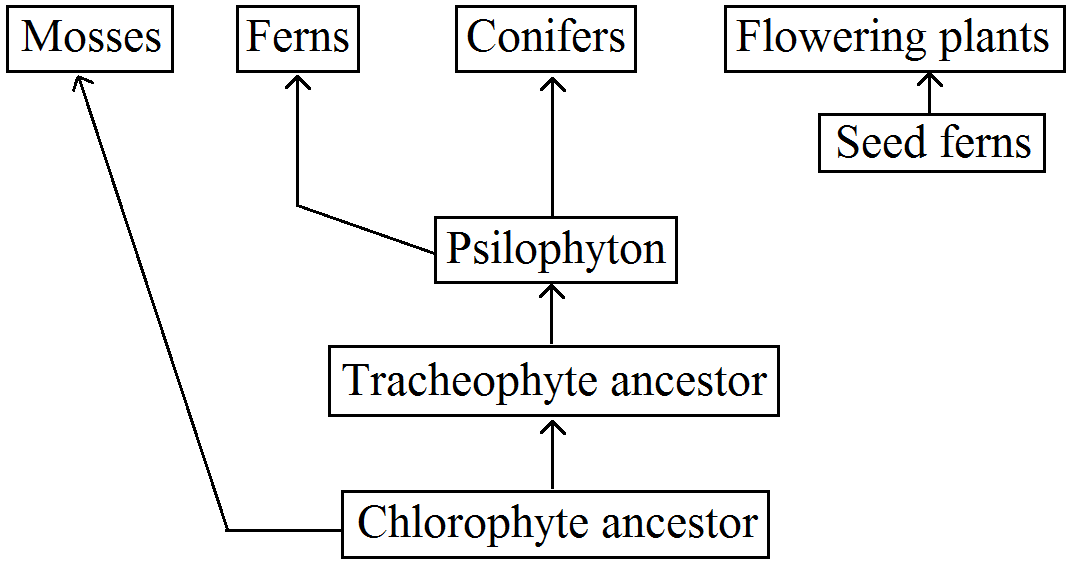
Study the schematic representation of evolutionary history of plant forms given below and mention
  1. The plant forms ferns and conifers are most related to.
  2. The nearest ancestors of flowering plants.
  3. The most primitive group of plants.
  4. Common ancestry of Psilophyton provides to.
  5. The common ancestor of Psilophyton and seed ferns.
  6. The common ancestors of mosses and tracheophytes.
Answer
  1. Psilophyton.
  2. Seeds and ferns.
  3. Chlorophyte ancestor.
  4. Ferns, conifers and seed ferns.
  5. Tracheophyte ancestor.
  6. Chlorophyte ancestor.
View full question & answer
Question 1002 Marks
The evolutionary story of moths in England during industrialisation reveals, that 'evolution is apparently reversible'. Clarify this statement.
Answer
In the story of moths in England; white winged moths survived because whitish lichens proliferated on tree trunks during pre-industrialisation days. White-winged moths had better chances of survival against a whitish background. But when the tree trunks become dark due to pollution, the white-winged moths perished; and dark-winged moths reappeared and survived. Thus, evolution of white wings was reversed because of pollution. This shows that evolution is apparently reversible.
View full question & answer
Question 1012 Marks
What is meant by homologous organ? Taking suitable example, explain how they support the theory of organic evolution.
Answer
The organs which have same basic structural design and development origin but differ in their uses and functions are called homologous organs. The forelimbs of some animals have similar anatomical structure. They possess humerus, radius, ulna, carpals, metacarpals and phalanges in their forelimbs, e.g., forelimbs of man, whales, bats, cheetah, indicates that they have common ancestors, thus supporting organic evolution.
View full question & answer
Question 1022 Marks
Evidences that evolution of life forms has indeed taken place come from many quarters. Name any four branches of biology that support or provide evidence for organic evolution.
Answer
Embryology, anatomy, palaeontology and biogeography provided evidences for organic evolution.
View full question & answer
Question 1032 Marks
What was Lamarck’s theory of evolution? Explain the theory by quoting an example.
Answer
Lamarck’s theory of evolution states that use and disuse of an organ can bring about a change in that organ which is then acquired and passed on to the next generation, e.g., the long neck of giraffe was explained by Lamarck, as an outcome of these animal to stretch their neck constantly to eat the leaves from the upper branches of the trees.
View full question & answer
Question 1042 Marks
Give the sum total of all the allelic frequencies in a stable population. List any two factors which disturb the stability of a population. How does this disturbance affect the population?
Answer
The sum total of all the allelic frequencies of a stable population is one.
The factors which affect Hardy-Weinberg's equilibrium are as follows:
  1. Gene migration/ gene flow.
  2. Genetic drift.
  3. Mutation.
  4. Genetic recombination.
  5. Natural selection.
The disturbance in genetic equilibrium in a population, would result in evolution.
View full question & answer
Question 1052 Marks
Categorise the following pairs of examples as convergent or divergent evolutions:
  1. Eyes of Octopus and mammals.
  2. Wings of butterfly and birds.
  3. Tuber of sweet potatoes and potato.
  4. Thorns in Bougainvillea and tendrils in Cucurbits.
Answer
  1. Convergent evolution.
  2. Convergent evolution.
  3. Convergent evolution.
  4. Divergent evolution.
View full question & answer
Question 1062 Marks
Put these statements in the proper order, by rearranging the letters, to describe Darwin's theory of natural selection-
  1. The end result of organic evolution is many different species, each adapted to specific environments.
  2. Many more individuals are produced each generation that can survive and reproduce.
  3. Gradually, over long periods of time, a population can become well adapted to a particular environment.
  4. There are inheritable variation among the members of a population.
  5. Individuals with adaptive characteristics are more likely to be selected to reproduce by the environment.
Answer
  1. There are inheritable variation among the members of a population.
  2. Many more individuals are produced each generation that can survive and reproduce.
  3. Individuals with adaptive characteristics are more likely to be selected to reproduce by the environment.
  4. Gradually, over long periods of time, a population can become well adapted to a particular environment.
  5. The end result of organic evolution is many different species, each adapted to specific environments.
View full question & answer
Question 1072 Marks
Name the gases that covered the early/ primitive earth surface.
Answer
Methane, carbon dioxide, ammonia and water vapour.
View full question & answer
Question 1082 Marks
Name the ancestors of man based on the features given below:
  1. Human-like meat eater with 900cc brain, lived in Java.
  2. More human with brain size 1400cc, lived in Central Asia, used hides and buried their dead.
  3. Human-like, vegetarian, with brain capacity between 650cc and 800cc.
  4. Man-like primate, that existed about 15 mya. Fossils found in Tanzania.
Answer
  1. Homo erectus.
  2. Neanderthal man.
  3. Homo habilis.
  4. Dryopithecus and Ramapithecus.
View full question & answer
Question 1092 Marks
When was earth formed? What was its conditions at that time?
Answer
Earth was supposed to have been formed about 4.5 billion years back in the solar system of our milky way galaxy. Its surface was covered with water vapour, methane, carbon dioxide and ammonia released from molten mass.
Subsequently, the ozone layer was formed. fu it cooled, the water vapour fell as rain and filled all depressions to form oceans and other water bodies.
View full question & answer
Question 1112 Marks
All vertebrate embryos show some similarities at an early stage. Mention two such similarities. What do they indicate? Explain.
Answer
  1. All vertebrate embryos develop a row of gill slits, which are functional only in fish and tadpole larva and not in other vertebrates.
  2. Notochord is present in all vertebrate embryos.
Such similarities indicate that they have descended/ evolved from a common ancestor.
View full question & answer