Questions

3 Marks Question

Take a timed test

22 questions · self-marked practice — reveal the answer and mark yourself.

Question 13 Marks
Describe the structure of a seminiferous tubule.
Answer
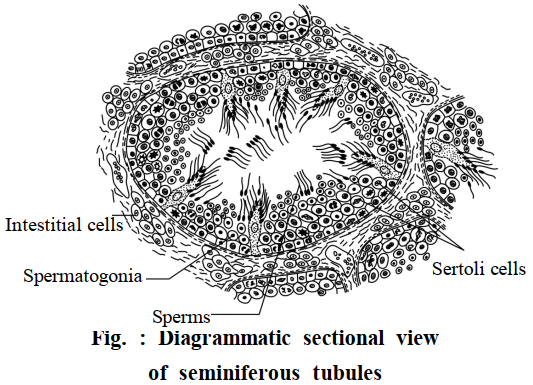
Seminiferous tubules are known as structural and functional unit of testis. In testis, these are present 1-3 highly coiled seminiferous tubules in each testicular lobule.
Image
Each seminiferous tubule is surrounded by a membraneous covering called Tunica propid and is lined on inside by germinal epithelium which has two types of cells:
(i) Primary Germ Cells: These cells divide both mitotically and meiotically to form spermatogonia, primary spermatocytes, secondary spermatocyte spermatids and sperms (as shown in diagram).
(ii) Sertoli Cells: These are column shaped cells providing nutrition to developing sperms in testis.
The region outside the seminiferous tubules called interstitial spaces contain small interstitial cells or leydig cells which synthesize and secrete testosterone harmone to regulate secondary sexual character.
View full question & answer
Question 23 Marks
In our society the women are often blamed for giving birth to daughters. Can you explain why this is not correct?
Answer
The chromosome pattern in human female is XX and that in the male is XY. Therefore the female produces haploid eggs during oogenesis, each contains only the X as sex chromosome whereas male produces haploid sperms of two types during spermatogenesis, 50% of the sperms have X chromosome and other 50% of sperms with Y as sex chromosome. After fertilization the zygote so produced contains XX or XY depending on the either X or Y sperm fertilises the ovum. The zygote with XX pattern develops into a female baby (girl) and with XY patterns into a male baby (boy). It proves that sex of the baby is determined by the father and not by the mother.
View full question & answer
Question 33 Marks
What is parturition? Which hormones are involved in induction of parturition?
Answer
Parturition: When the gestation period of about 9 month becomes over in human, vigorous contraction of the uterus causes delivery of the foetus from womb of mother. This process of delivery of foetus from womb of mother is called parturition. It is induced by a complex neuroendocrine mechanism. The signals for parturition originate from fully developed foetus and the placenta and cause foetal ejection reflex. It triggers release of oxytocin from mother's pituitary gland. Oxytocin stimulates uterine muscles so that uterus undergoes contraction strongly called labour pain. The stimulatory reflex between oxytocin secretion and uterine contraction continuously results into expulsion of the foetus as fully developed baby out of the uterus through birth canal, so called parturition completes.
Hormones involved in parturition induction are cortisol, estrogen and oxytocin.
View full question & answer
Question 43 Marks
What are the major functions of male accessory ducts and glands?
Answer
The major functions of male accessory ducts and glands are as follows:
1. Rete testis: To conduct the sperms from seminiferous tubules to vas efferentia.
2. Vas efferentia: To conduct the sperms upto epididymis.
3. Epididymis: Temporary storage of sperms for maturation.
4. Vas deferens: To conduct the sperm upto urethra.
5. Prostate glands: Secretion of this glands activate the sperms and prevent coagulation.
6. Bulbouretheral glands: Its secretion lubricates the vagina and makes sexual act easier.
7. Seminal Vesicles: The secretum of these glands, removes acidity of vaginal passage and provide protection to developing sperms.
View full question & answer
Question 53 Marks
Write the important functions of various reproductive organs of human female.
Answer
Various reproductive organs of human female and their important functions :
1. OvaryProduces ova through oogenesis.
2. OviductsFertilization occurs and also transfers the fertilized ovum or embryo in uterus.
3. Uterus Implantation of embryo to endometrial wall of uterus and provides nutrition. The muscular contraction assists foetus to deliver during parturition.
4. CervixProduces watery mucus lubricate penis and sperms swim in it after ejaculation.
5. VaginaReceives sperms through penis during coitus and acts as birth canal for delivery of baby during parturition.
6. ClitorisHomologous to penis.
View full question & answer
Question 63 Marks
Write any four differences between Vasa efferentia and Vasa deferentia.
Answer
Differences between Vasa Efferentia and Vasa Deferentia :
S.No.Vasa EfferentiaVasa Deferentia
1It arises from rete testis.It arises from cauda epididymis.
2Their number vary from 15-20.There are 2 vas deferens one on either side.
3It is highly folded.It is highly coiled in scrotal sac and straight in abdominal cavity.
4It carries sperms from rete testis to epididymis.It carries sperms from epididymis to ejaculatory duct.
View full question & answer
Question 73 Marks
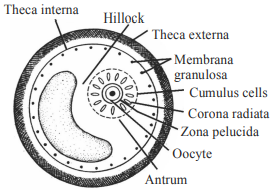
Draw a well labelled diagram of mature graafian follicle.
Answer

Image
Fig. : A diagrammatic view of graafian follicle
View full question & answer
Question 103 Marks
Describe the mammary gland by drawing well labelled diagram of sectional view and explain the mechanism of lactation.
View full question & answer
Question 113 Marks
Write the name of 4 reproductive events of sexual reproduct that occur after attaining puberty in human.
Answer
Four reproductive events of sexual reproduction :
1. Gametogenesis
2. Gamete transfer
3. Fertilization
4. Embryogeny
View full question & answer
Question 133 Marks
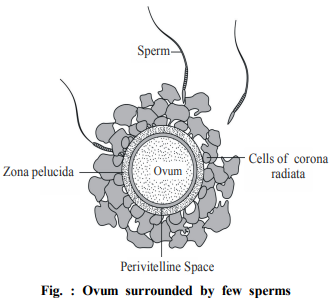
Explain the process of fertilization by defining the insemination.
Answer
Insemination : During copulation (coitus), semen is released by penis of man into vagina of women is called insemination.
Process of Fertilization : The motile sperms swim rapidly, pass through the cervix, enter into uterus and finally reach the ampullary region of the fallopian tube. Meanwhile ovum released by ovary during ovulation also reach the ampullary region where fertilization takes place. The process of fusion of a sperm with an ovum is called fertilization. During fertilization a sperm comes in contact with the zona pellucida layer of the ovum and induces changes in the membrane that block the entry of additional sperms. Thus, it ensures that only one sperm can fertilize an ovum. The secretion of acrosome help the sperm enter into the cytoplasm of the ovum through the zona pellucida and the plasma membrane. This induces the completion of the meiotic division of the secondary oocyte and it results into formation of second polar body and a haploid ovum. Soon the haploid nucleus of sperm and that of ovum fuse together forming diploid zygote.
Image
View full question & answer
Question 143 Marks
What do you understand by sertoli cells? What is their functions?
Answer
Sertoli Cells : These cells are also called supporting or nurse cells. These cells are columnar shaped, elongated less in number and bigger in size. These cells have many spermatids to be clumped at their free end.
Functions :
1. These cells provide protection, support and nutrition to developing spermatids.
2. These cells degenerate the useless cytoplasm of spermatids.
3. These cells also secrete inhibin hormone to regulate the activities of FSH for spermatogenesis
View full question & answer
Question 163 Marks
What is pregnancy? Write the name of pregnancy maintaining hormone.
Answer
Pregnancy : The process of attachment of the embryo as blastocyst in the endometrium of the uterus is called implantation and it leads to pregnancy. It is also indicated by stoppage of menstrual cycle.
Hormone maintaining the pregnancy are human chorionic genadotropin (hCG), human placental lactogen (hPL), estrogens, progestons. In the later phase of pregnancy, a hormone called relaxin is also secreted by the ovary. hCG, hPL and relaxin are produced in the women during pregnancy. In addition, during pregnancy the levels of other hormones like—estrogens, progestogens, cortisoles, prolactin, thyroxine etc. are increased several folds in maternal blood and increased level of these hormones is essential for supporting the foetal growth, metabolic changes in the mother and maintenance of pregnancy
View full question & answer
Question 173 Marks
Write any four similarities in spermatogenesis and oogenesis.
Answer
1. Both spermatogenesis and oogenesis take place in gonads and begin by primary germ cells of germinal epithelicum.
2. Both the processes have three phases named multiplication phase, growth phase and maturation phase.
3. In multiplication phase, there occurs quantitative increase in germ cells by repeated mitotic division in both spermatogenesis and oogenesis.
4. Maturation phase involves two meiotic division both in spermatogenesis and oogenesis.
View full question & answer
Question 183 Marks
How is corpus luteum formed and what is its important function?
Answer
After ovulation, the follicle which ruptures is finally converted into a blood filled cavity called corpus haemorrhagicum. The follicle cells proliferate and the clotted blood is replaced by yellow lipid rich luteal cells thereby forming the corpus luteum. The formation and maintenance of corpus luteum is under the influence of LH. The corpus luteum is a temporary endocrine gland which secretes progestrone and relaxin.
If fertilization occurs, corpus luteum persists, but if not, it degenerates and is replaced by scar tissue called corpus albicans.
Functions :
1. Corpus luteum secretes progestrone which prepares the uterus for implantation of foetus to the womb’s wall and also maintains the pregnancy till birth.
2. It also secretes relaxin on completion of gestation period so that delivery of foetus can occur easily.
View full question & answer
Question 193 Marks
How do accessory glands in man help in semen formation and reproduction process?
Answer
Man has three types of accessory glands. The secretion of these glands take part in semen formation :
(1) Prostate Glands : It is large lobulated, gland situated at the base of urethra. This gland secrets slightly white alkaline fluid which forms 25-30% of total semen and contains phosphates, citrates, lysozyme, fibrinolysin, spermin etc. It activates the sperms, provides nutrition and prevents coagulation of semen.
(2) Seminal Vesicle : These are one pair situated between the bladder and rectum. It is muscular and sacculated glands. These glands secrete alkaline fluid forming 60% of total semen. It contains prostaglandins and fructose. Fructose provides energy to sperms whereas prostaglandin stimulates vaginal contractions to help in fusion of gametes.
(3) Cowper Glands or Bulbourethral Gland : These glands secrete a viscous, sticky alkaline fluid during copulation which lubricates the penis and removes the acidity
of vaginal passage to protect the sperms. In this way we can conclude that secretum of accessory glands help in semen formation and reproductive process. 
View full question & answer
Question 203 Marks
What changes are seen in human male and females by onsetting of puberty.
Answer
Changes seen in male and female by onsetting of puberty :
In MalesIn Females
1. Growth in size of penis, scrotal sacs, prostate and seminal vesicles.1. Growth in size of uterus, vagina, oviduct and vulva.
2. Enlargement in testis size and beginning of spermatogenesis.2. Enlargement of breast and beginning of menstrual cycle.
3. Growth of hair on face as beard and moustache and on chest.3. Pubic and axillary hair grow
4. Voice becomes coarse.4. The broading of hip region due to widening of pelvis.
5. Pubic and axillary hair grow.5. Voice becomes thin, melodious.
6. Secretion of FSH, cowper gland, prostate gland and testosterone actively.6. Secretion of FSH, estrogen, LH, oxytocin actively.
7. Psychological attraction towards female.7. Psychological attraction towards male.
View full question & answer
Question 213 Marks
What is oestrous cycle? Differentiate between oestrous and menstrual cycle.
Answer
Oestrous Cycle : The cyclic changes occuring in the female reproductive tracts of non-primates mammal are known as oestrous cycle. During this cycle, female is in heat period and is ready for coitus.
Differences between Oestrous and Menstrual Cycle :
S.No.Oestrous CycleMenstrual Cycle
1It occurs in non-primates mammals.It occurs in primates mammals.
2Menstruation does not occur.Menstruation occurs.
3Endometrium is not de-generated but reabsorbed.Endometrium is degenerated and goes out with menstrual.
4Copulation only when female in oestrous or heat period.It occurs at any time of year.
View full question & answer
Question 223 Marks
Describe the major features of embryonic development at various months of pregnancy.
Answer
The human pregnancy lasts 9 months. The major features of embryonic development at various months of pregnancy are as follows :
1. In human being, after one month of pregnancy, the embryo heart is formed and heart sound can be carefully listened through the stethoscope.
2. By the end of 2nd month of pregnancy, the foetus develops limbs and digits.
3. By the end of 12 weeks/first trimester, most of the major organ systems are formed. For example : The limbs and external genital organs are well developed.
4. During the fifth month, the first movements of the foetus and appearance of hair on the head are usually observed.
5. By the end of 24 weeks, the body is covered with fine hair, eyelids separate and eyelashes are formed.
6. By the end of nine month of pregnancy, the foetus is fully developed and ready for delivery.
View full question & answer