Questions

3 Marks Question

Take a timed test

3 questions · self-marked practice — reveal the answer and mark yourself.

Question 13 Marks
Write a short note on female external genitalia.
Answer
→ It include mons pubis, labia majora, labia minora, hymen, clitoris
(a) Mons Pubis: It is a cushion of fatty tissue covered by skin and pubic hair.
(b) Labia majora: These are fleshy folds of tissue, which extend down from the mons pubis and surround the vaginal opening.
(c) Labia minora: These are paired folds of tissue under the labia majora.
(d) Hymen: The opening of the vagina is often covered partially by a membrane called "hymen".
(e) Clitoris: It is a tiny finger-like structure which lies at the upper junction of the two labia minora above the urethral opening.
→ The hymen is often torn during the first coitus (Intercourse). However, it can also be broken by a sudden fall or jolt, insertion of a vaginal tampon, active participation in some sports like horseback riding, cycling, etc.
→ In some women the hymen persists even after coitus.
→ In fact, the presence or absence of hymen is not a reliable indicator of virginity or sexual experience.
View full question & answer
Question 23 Marks
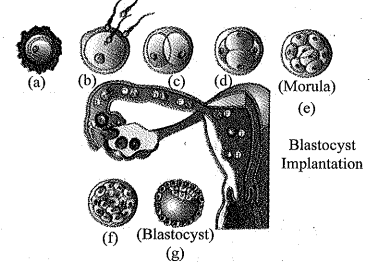
The zygote passes through several developmental stages till implantation, describe each stage briefly with suitable diagrams.
Answer

Image
→ The zygote is formed at the ampulla-isthmus junction of the fallopian tube when the union of secondary oocyte and spermatozoa occurs. The zygote undergoes various divisions and changes before it reaches the uterus for implantation.
→ The figure shows the various stages of development of a zygote as it passes through the oviduct and uterus:
(a) The zygote divides into a two-celled stage wide via division or 1st cleavage while the ozygote is still in the isthmus of the oviduct.
(b) Several more mitotic divisions or cleavages occur in the 2 celled stage to form a 2, 4, 8 and finally a 16-celled stage of the zygote.The 16 celled stage is called the morula and various cells formed after cleavage are called blastomeres.
(c) Morula then changes into a blastocyst after a few more divisions and this stage contains a fluid filled cavity in the embryo. The blastomeres become arranged and line up into an outer layer of cells called the trophoblast and an inner mass of cells. The fluid filled cavity is called blastocoel.
(d) Implantation of the embryo occurs at this blastocyst stage by the help of trophoblast layer which embeds itself into the uterine endometrium.
View full question & answer
Question 33 Marks
Write a short note on female accessory ducts.
Answer
→ The oviducts (fallopian tubes), uterus and vagina constitute the female accessory ducts.
→Structure of Oviducts:
→ Each fallopian tube is about 10-12 cm long.
→ It extends from the periphery of each ovary to the uterus.
→ The part closer to the ovary is the funnel-shaped infundibulum.
→ The edges of the infundibulum possess finger- like projections called fimbriae, which help in collection of the ovum after ovulation.
→ The infundibulum leads to a wider part of the oviduct called ampulla.
→ The last part of the oviduct, isthmus has a narrow lumen and it joins the uterus.
→ Structure of Uterus :
→ The uterus is single and it is also called womb.
→ The shape of the uterus is like an inverted pear.
→ It is supported by ligaments attached to the
pelvic wall.
→ The wall of the uterus has three layers of tissue.
(i) The external thin membranous perimetrium.
(ii) middle thick layer of smooth muscle, myometrium.
(iii) inner glandular layer called endometrium that line the uterine cavity.
→ The endometrium undergoes cyclical changes during menstrual cycle while the myometrium exhibits strong contraction during delivery of the baby..
→ The uterus opens into vagina through a narrow cervix.
→ The cavity of the cervix is called cervical canal which along with vagina forms the birth canal.
View full question & answer